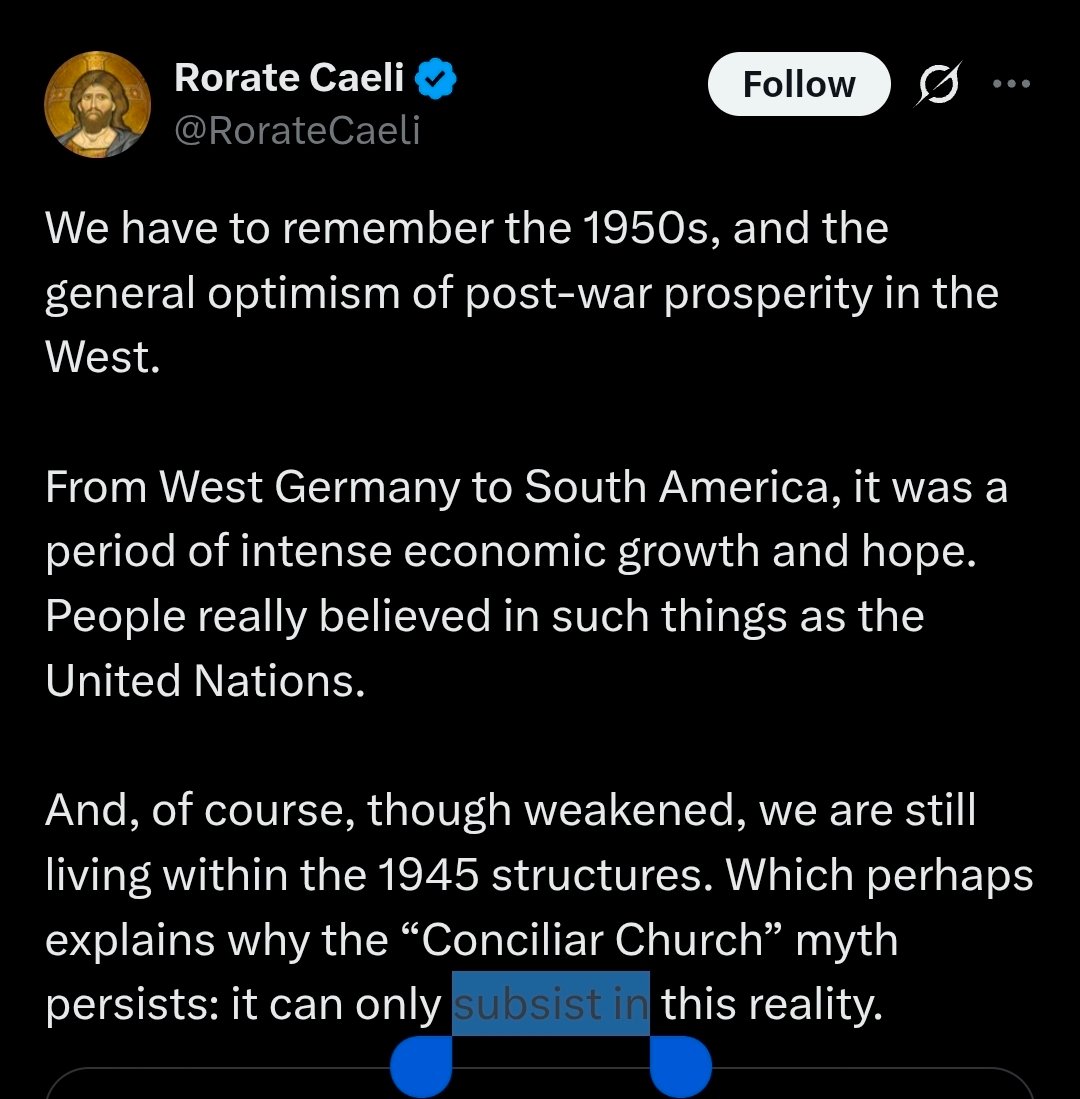
What Luther Was ACTUALLY Excommunicated For...
Watch the full episode here: youtu.be/IlYoZU74NYA
YouTube
English
Shameless Popery
1.8K posts

@ShamelessPopery
Shameless Popery is a witty podcast that equips you to explain Catholicism, hosted by Catholic Answers apologist Joe Heschmeyer

@xwanyex It’s a nice mid-sized city with affordable prices, a walkable downtown, and great BBQ

I was not an adult in 1962 (not quite born yet), but I still find it hard to believe that real adults who slogged through the first half of the 20th Century actually thought these sorts of things.
How ‘Christ is King’ got politicized Watch the full episode here: bit.ly/4dyf4zQ


I think people are unaware of how mutable the Church's grant of jurisdiction for valid confessions has been in the history of the Church. Before Trent, it was required that one have permission to be validly absolved from one who wasn't their own priest: "If anyone from a just cause shall wish to confess his sins to another priest, let him first ask and obtain permission from his own priest, since otherwise that one cannot absolve or bind him." (Lateran IV) This is why the mendicant orders were so important due to the special permissions from the Pope to be the 'proper priest' to absolve wherever. St. Thomas (and other authors on IV Sent) make this quite clear: "it is essential to this sacrament not only for the minister to be in orders, as in the case of the other sacraments, but also for him to have jurisdiction: wherefore he that has no jurisdiction cannot administer this sacrament any more than one who is not a priest. Therefore, confession should be made not only to a priest, but to one’s own priest..." (ST.IIISup.Q8.A4) The Church didn't always give supplied jurisdiction to heretical or schismatic priests (outside of danger of death, ST.IIISup.Q8.A6): "the power of jurisdiction is that which is conferred by a mere human appointment. Such a power as this does not adhere to the recipient immovably: so that it does not remain in heretics and schismatics; and consequently they neither absolve nor excommunicate, nor grant indulgence, nor do anything of the kind, and if they do, it is invalid." (ST.II-II.Q39.A3)

I’ve read many of Scott Hahn’s books and find them interesting. But my own testimony is the exact opposite. After four years studying Protestant theology in seminary—including biblical Hebrew, New Testament Greek, Latin, church history, and historical theology—the more I studied, the more problems I found with Roman Catholicism, and the more convinced I became of the truth of Protestantism. So why is Scott Hahn’s testimony persuasive to @MrCasey62, but mine isn’t? Is it because Hahn’s evidence is stronger, or simply because his testimony supports the Roman Catholic narrative whereas mine counters it?

Taken this morning in the sacristy of the SSPX chapel in Naples. The top photo shows a simple notice for the celebrant: the name of the pope (Leo) and of the local ordinary, Archbishop Domenico Battaglia. These are the names he must insert into the Roman canon — ‘una cum famulo tuo Papa nostro N. et Antistite nostro N.’ as pictured below in my missal — every time he offers mass. You don’t commemorate a pope and a local ordinary ‘una cum’ in the canon if you think you’re a separate church. Better than what @holysmoke regards as ‘pointless poring over canon law’—though that in fact also works—this photograph is concrete proof in action that the SSPX isn’t in schism, never was, and never will be.