

Shane
2.3K posts
Shane
@ShaneTJacobs
Professional Twitter Lurker, Former Investment Banker, Currently in Data Analytics and calling out the crypto / web3 grift.
New York, USA Katılım Mart 2015
185 Takip Edilen82 Takipçiler
With an endorsement from President Trump, let me say it once again. The Bush era in Texas has ended!!!
Share it far and wide. God bless Texas!!!
English
@KrissBergTweets @porterstansb In a few billion years when the sun does destroy earth, Porter, from his grave, will be proudly boasting that he was right about the end of America. 😂
English

@porterstansb Funny you pegged 2011 as the year you started your bullshit doomerism because that’s the exact year America restarted it’s global domination. How’s it feel to be completely wrong for a decade and a half??
English
I have been writing about the End of America since 2011, but I have never been more certain of its fatal outcome than I am now. There is now no constituency for tax payers. There is no constituency for anti-war voters. There is no constituency for honest government.
America is lost.
Acyn@Acyn
Massie: I would have come out sooner but I had to call my opponent to concede and it took a while to find him in Tel Aviv
English
@ReneSellmann Most of Alex Bosserts names have fallen 60%. $BOC is no different. He is the new inverse Cramer.
English

Boston Omaha is definitely an underfollowed stock and a fascinating business to unpack! $BOC
It’s the longest deep dive I ever published as you basically have to cover three different businesses.
Reading all the shareholder letters is a good starting point too!
Galician Investor Quality Research@GaliciaInvestor
$BOC Boston Omaha cotiza cerca de mínimos. Algunos ven una estafa y la usan para ridiculizarme. Yo veo monopolios locales de vallas, fibra enterrada que nadie va a replicar, hangares de lujo sin competencia posible y un CEO recomprando acciones sin parar. He dejado el análisis en abierto para que entendáis como veo yo el negocio. Saca tus propias conclusiones.
English
@TonyBuzbee2 @jakegonz73 Just talking shit for the fun of it, counselor. Keep kicking ass.
English
@ShaneTJacobs @jakegonz73 Yeah. Tell that to the Buzbee cabal in northeast Texas big boy. I’ll show you where they all are. It ain’t on the map.
English
@jakegonz73 @TonyBuzbee2 W is more Texan than Buzbee will ever be. If you wear pastel linen blazers and hang out in Palm Beach, you ain’t Texan.
English

The point is that Buzbee is Texas born, while George HW Bush and Babs were born New Englanders (Mass & NYC).
Jeb has been a Floridian for most of his life (even if he was born in West Texas), as was George P for his early years (after being born in the armpit of Texas)...
Dubya is the closest in spirit, but he was born in Connecticut.
Seeing as you don't understand how this sits w us, especially nowadays...
...it aint a surprise you keep swallowing up your "missing the point." You have our pity.
A Texan on vacation is still... a TEXAN.
English
@LoewyLawFirm Buzbee spends more time at his home in Maine than the Bushes do
English

BACK TO MAINE!
#txlege
Tony Buzbee@TonyBuzbee2
I was AG Paxton’s lawyer during the failed attempt to impeach him. I studied every piece of evidence. I cross examined the key witnesses. It quickly became apparent to me that the entire effort was sloppily thrown together by those he opposed—the old guard, the establishment. Their hope was that with unsupported, salacious allegations, along with a compliant and willing media, Paxton would quit. He would not quit. He will not quit. He will never quit. The totality of the impeachment evidence was nothing more than junk. And it didn’t take much effort to expose it. In the process I came to know Ken Paxton. He is thoughtful, strategic, and brilliant. He will be a damn fine senator for our state. Most of the attacks you see now are being made by the same people he soundly defeated in the impeachment. They lost then, and they will lose again. Go vote.
English
@jakegonz73 @TonyBuzbee2 You missed the point. The Bush family was in Texas long before Tony was born. Tony and the bushes have a vacation home in Maine. Hilarious for Tony to say “go back to Maine”. Bet Tony spends more time in Maine than they do 😂😂
English
@ShaneTJacobs @TonyBuzbee2 ...a vacation home.
You kinda missed the whole point.
Does he fucking sound like he's a carpetbagger?!?!?
English

If you are running a consulting business and you are deploying Anthropic or OpenAI directly into your organization (I’m looking at you PwC and Accenture) you are letting the fox into the hen house.
OpenAI and Anthropic are openly funding and starting competitors to you while also using your usage to drive more success for them.
This is not a failure on their part but a failure on your part.
Consulting businesses that understand this are adopting a control plane that allows them to arbitrate where tokens go and who generates tokens for them.
Controlling the tokens is controlling the spice (Dune).
This was a key pillar of 8090’s global partnership with EY and they key feature of our Software Factory. We control token generation and can direct them to any model provider.
We are close to another global partnership and will announce it soon.
These organizations refuse to accept the disruption standing still or, even worse, by adopting and accelerating the companies who want to disrupt them.
Milk Road AI@MilkRoadAI
Chamath just delivered the clearest diagnosis of what is happening to enterprise software and the OpenAI Deployment Company is the most damning piece of evidence he could have picked. "The low end of the market is basically finished. There is no safe space." 90% of public SaaS stocks are down 30-80% from their 52 week highs, the median software stock is now negative over the last 3-6 months. Goldman Sachs reported that software forward P/E multiples fell from 35x to 20x, the lowest absolute level since 2014 and the smallest premium to the S&P 500 since 2010. The low end died first and fastest, because AI replaced it most directly. The small business tools, the lightweight project managers, the single function SaaS products that charged $49 a month per seat, those are being replaced by AI agents that do the same work as a workflow, not a product. You do not buy an AI powered tool, you describe what you need and it builds it and the seat based model that created the SaaS industry simply does not apply to that transaction. But Chamath's more interesting argument is about the high end and the tell he points to is perfect. OpenAI just raised $4 billion from 19 investors including TPG, Brookfield, Bain, and McKinsey to launch a consulting company and guaranteed those investors a 17.5% annual return to do it. On $4 billion in committed capital, that is roughly $700 million per year in guaranteed payouts, owed by a company that is projected to lose $14 billion in 2026. The goal of this venture is to compete directly with Deloitte, PwC, Ernst & Young, Andersen, and Cognizant. Think about what that structure reveals. OpenAI lost half of its enterprise LLM API market share from 50% to 25% between late 2023 and mid-2025, with Anthropic now leading at 32%. Its response was not to build a better model but rather to raise $4 billion, offer guaranteed PE-tier returns and hire embedded engineers to physically sit inside client organizations and make AI actually work in production. The reason, as Chamath identified, is that the high end of the market is not easy. "It's not like boop boop boop, put in a prompt and beep bap boop, it all works," he said and the data confirms exactly that. 88% of organizations running AI agents reported a security incident in the past year, 42% of C-suite executives say AI adoption is creating internal organizational conflict. The average enterprise AI consulting implementation costs $228,000 in year one versus $77,000 for platform-based approaches and most still stall before reaching production. Anthropic immediately matched OpenAI with a competing $1.5 billion consulting venture backed by Blackstone, Goldman Sachs, and Hellman & Friedman bringing the combined spend by the two leading AI labs on human powered enterprise deployment to $5.5 billion in a single month Chamath's read is that the high end, the large enterprise platforms like Salesforce with proprietary data flywheels, Palantir with its FDE model already proven at scale, Oracle with vertical specific data moats will survive and consolidate. The mid-market point solutions, the single function tools, the lightweight enterprise apps without defensible data assets, those are on the conveyor belt. The AI industry is not just disrupting the companies that use software but rather disrupting the companies that sell it.
English


@Austen And this is his second one, Gotham, his first, also outperformed significantly
English
@alexbossert @GaliciaInvestor Buffett wannabes learning that buying garbage companies at low multiples isn’t usually a winning strategy. Names you guys tout like $BOC and $BUR have been absolute disasters. Buffett wouldn’t have touched this stuff, even in his early days.
English


$BOC Boston Omaha cotiza cerca de mínimos.
Algunos ven una estafa y la usan para ridiculizarme. Yo veo monopolios locales de vallas, fibra enterrada que nadie va a replicar, hangares de lujo sin competencia posible y un CEO recomprando acciones sin parar.
He dejado el análisis en abierto para que entendáis como veo yo el negocio.
Saca tus propias conclusiones.
Español
Last year, nearly 600,000 Americans paid $100 deposits to get a Trump Mobile phone.
Not a single person received one.
Where’d their money go?
This looks like another Trump scam.
English
@DonaldJTrumpJr @JDVance Looking forward for when they come after you and your brother for all your fraudulent crypto schemes? When Trump phone?
English

The War on Fraud is one of the most important parts of my father's America First agenda. For decades, politicians in both parties talked about stopping fraud, but didn't do a damn thing to end it. So it's good to see @JDVance and the rest of the Fraud Task Force hitting it hard!!
Andrew Surabian@Surabees
The beauty of Vice President @JDVance's Fraud Task Force is that it's a team effort across the entire Administration, and they're not just talking a good game about ending fraud, they're actually delivering immediate ACTION to protect taxpayers. Cue the leftwing media meltdown.
English
@Restructuring__ Chris Bloomstran is similar. He has significantly underperformed the market for decades and gets paid tens of millions in management fees to do so. He frequently criticizes Cathie but they play the same game, just a different style.
English

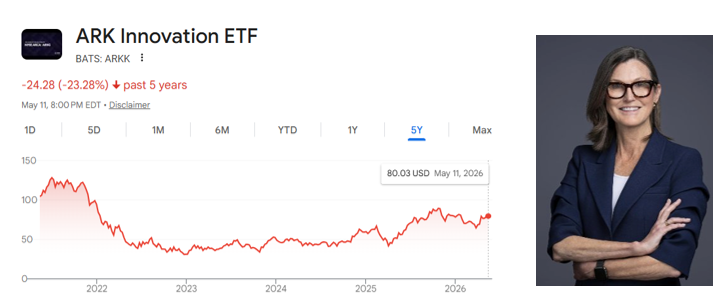
Cathie Wood’s ability to collect management fees will be studied for decades.
Truly one of the worst investors of all time, while making tens of millions in fees.
Some of the worst trades include:
- TDOC: made it ARKK’s largest position at ~$80/sh.; today: ~$7/sh.
- Zoom: loaded up around ~$300/sh.; today: ~$110/sh.
- Nvidia: sold almost all of it in January 2023 at ~$20/sh.; today: ~$220/sh.
Amazing track record.
English
@porterstansb What does “served millions of investors” mean? Served them straight to the slaughterhouse by selling them horrible advice? You also left out the part where you were found liabile for securities fraud by falsifying stuff if the newsletters you peddle…
English
In 2011, I wrote a best-selling documentary called The End of America. It was viewed, online, by over 40 million people. As a book it sold millions of copies.
I warned every American:
Without a reliable currency, there is no way for human beings to cooperate at scale.
Cooperation runs on trust.
Trust, across a complex economy, requires a unit of exchange that's reliable. Corrupt the unit of exchange and you break cooperation. And once you break cooperation, the entire architecture of a free society — the voluntary exchanges, the long-term commitments, the marriages and mortgages and business partnerships — starts to come apart.
That's happening now in America:
* The labor force participation rate for prime-age American men — men between the ages of twenty-five and fifty-four, the exact demographic that is supposed to be working, marrying, and fathering children — was roughly 97 percent in the early 1970s. In 2026 it is around 89 percent. That is a one-in-twelve collapse.
* The median age at first marriage for American men in 1970 was 23.2 years old. Today it is over 30. Young men cannot afford to start a family because their wages have been destroyed by inflation.
* In 1960, more than half of all thirty-year-olds in this country were both married and owned a home. In 1990, that number was 43 percent. In 2026, it is about 12 percent.
Again, that isn't because they haven't earned a home; it's because the paper they collected as payment was destroyed by our central bank. Destroyed to bail out the banks in 2009. Destroyed to fight the "pandemic" in 2020. And, soon, it will be destroyed yet again to bail out the next man-made disaster that D.C. and Wall Street create.
In today's America, the single largest cause of death for American men between eighteen and forty-five is now fentanyl. That's a collapsing society.
America is no longer the land of opportunity and our best and brightest are leaving: Americans renouncing their U.S. citizenship were a few hundred people a year before 2009. Now they are 5,000 to 7,000 people a year, every year.
In 2011, I warned that all of these things would happen:
1. That the dollar’s run as the world’s reserve currency was ending;
2. That the American middle class was being quietly strip-mined by a monetary system rigged in favor of Washington and Wall Street;
3. That the country’s social fabric was coming apart in ways the political class could not see and refused to measure; and
4. That our society was heading for a crisis unlike anything America had faced since the 1930s.
That crisis is no longer coming. It’s here.
The U.S. dollar regime is now openly breaking, which central banks around the world dumping Treasuries and buying gold. The federal government is running peacetime deficits above 6 percent of GDP, and our government's debt is spiraling out of control, past $40 trillion. These debts will never be repaid honestly. There's a vast inflation yet to come.
What's coming isn't merely another crisis, it is The Fourth Turning. A complete cultural and monetary collapse.
And, in my new book, 2029: The End of America I lay out exactly why the climax to this crisis will occur in 2029.
But, this book is not a book about despair. It is a book about how to come out the other side of this global monetary reset with your family’s wealth, dignity, and freedom intact.
amazon.com/dp/B0GX2XFX4V
English
@porterstansb Lol. You claimed that was going to happen 15 years ago. What actually happened was one of the most prosperous 15 years in American history, now you are back 15 years later selling the same bullshit. Folks: avoid slimy gloom and soon newsletter salesmen!
English
@ShaneTJacobs Wrong. You’ve never read my research. What I said was that our currency was being destroyed and our society would fall apart as a result. We are living in that quiet depression. And if you own gold you know why.
English