Mr PitBull@MrPitbull07
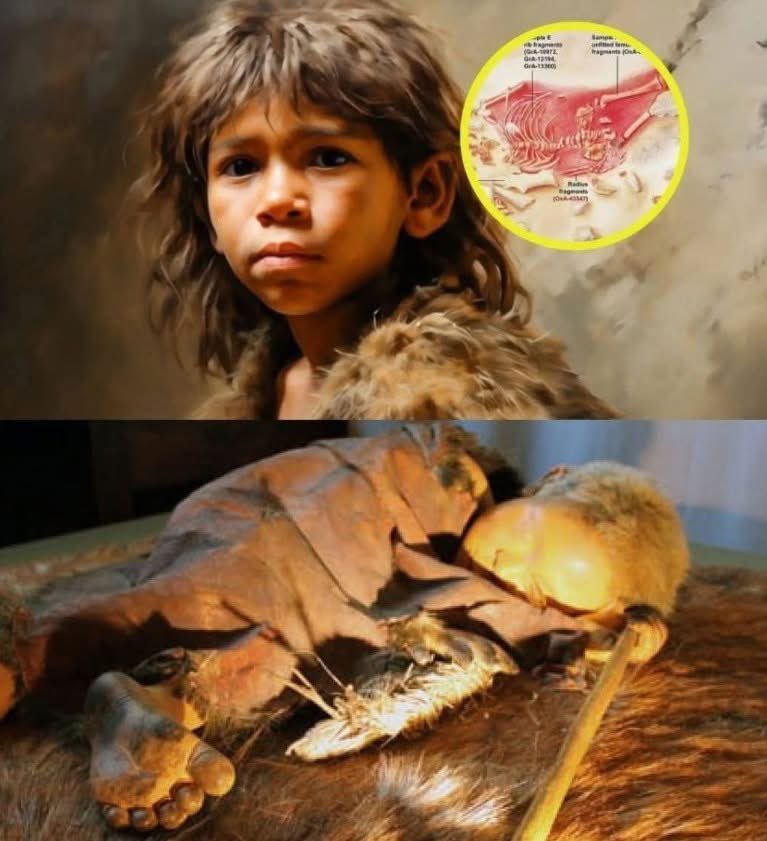
A groundbreaking new study confirmed what had long been an unsettling suspicion among archaeologists: the Lapedo Child, whose remains were discovered in a Portuguese cave in 1998, is far more than just an ancient child's fossil. Using cutting-edge molecular dating techniques, scientists have determined that the child lived between 27,800 and 28,500 years ago. But the most astonishing revelation is that this child was not a pure Homo sapiens, nor a full Neanderthal—he was a hybrid. The offspring of two distinct human species. And that changes everything.
Until recently, it was widely believed that Neanderthals had gone extinct around 40,000 years ago without leaving direct descendants. However, this new analysis not only reveals that Neanderthals were still around thousands of years later, but that they were also interbreeding with modern Homo sapiens. The Lapedo Child had a robust jaw and short limbs, traits typical of Neanderthals, along with a rounded skull and defined chin like those of modern humans. These features aren’t random; they are the unmistakable markers of interspecies hybridization—physical proof that human evolution is not a straight line, but a braided stream of shared blood and heritage.
Even more intriguing is the context of the burial itself. The child had been carefully laid to rest, covered in red ochre, surrounded by animal bones and feathers—elements that suggest a symbolic funeral ritual. Such practices were rare among southern European Homo sapiens of that era but were common among Neanderthals. Could it be that we also inherited their beliefs, their rituals, their view of life and death? This discovery, confirmed in March 2025 by multiple European research teams, strongly implies that modern humans are not the product of a single lineage, but of a deep, ancient fusion. The legacy of the Neanderthals lives on—not only in our DNA but perhaps in our emotions, our fears, our memories, and our ways of honoring the dead. The Lapedo Child is not just a fossil—he is a reminder that our humanity is, and always has been, shared.