

Caerbannog
83 posts

@_Fe2O3_ @archeohistories Just cause of this comment I'm going to start promoting all Japanese cultural assets to ALL the foreigners ;)
English

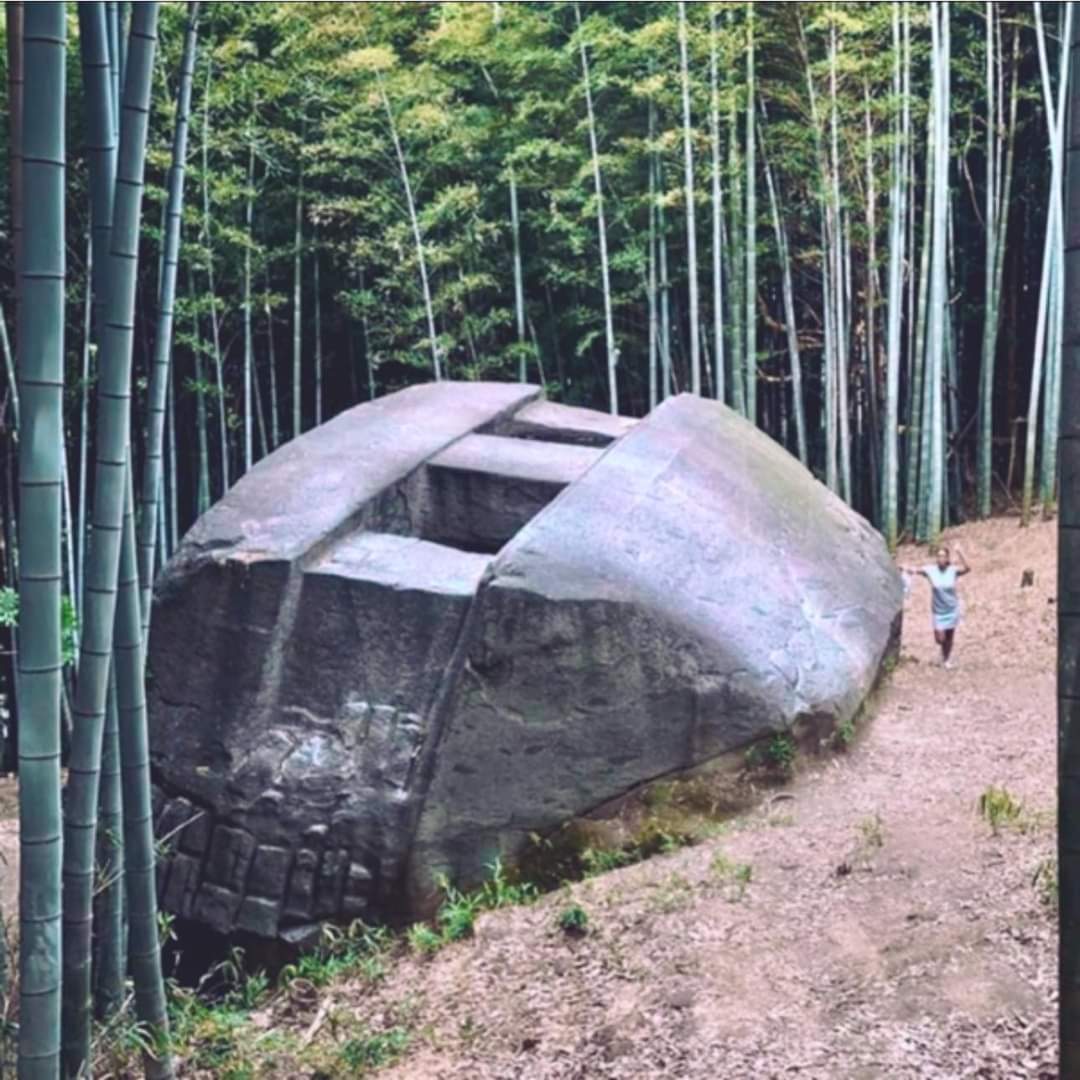
In the quiet hills of Japan 🇯🇵, the “Rock Ship of Masuda” can be found hidden among the bamboo looking as if it’s just crash-landed from another planet. Despite its strangely smooth surfaces and angular indents, the structure has been around for centuries, although its original purpose has been long-forgotten.
Bar the odd tourist blog, very little information about the strange stone is published in English. It’s located just a 15-minute walk from Okadera Station on a forested hill near an elementary school in Kashihara, Nara Prefecture.
The area is known for its carved granite stones, many of which are fashioned into the shape of human-like figures and animals. It’s uncertain when they were made, but some have argued they were built around the 7th Century CE towards the end of the Kofun period. Collectively, the artworks are known as the Stoneworks of Asuka. They’re particularly interesting as they stand in contrast to the dominant style of Buddhist art that swept through Japan at the time.
The Rock Ship of Masuda, aka Masuda-no-iwafune, is the most unusual and large of them all. The carved stone measures 11m in length, 8m in width, and 4.7m in height – roughly comparable to the size of a luxury tour bus. Its unusual shape and size are especially impressive when you realize it was made out of granite, a notoriously tough rock that’s extremely difficult to cut and carve. Along with the square cut indents on top of the rock, it also features a square scale-like pattern on the side that’s also been intentionally carved.
People have dreamt up a few theories about why the rock was carved. As is often the case with unexplained archeological finds, some have speculated it was used for star gazing and astronomy. A more likely explanation is that it played some kind of spiritual function, perhaps relating to the burial or celebration of the death.
Truth be told, however, the story of the Rock Ship of Masuda is still largely a mystery.
© Tom Hale / IFL Science
#archaeohistories
English
@t2y3DtbOYQPUEZL @9dsNq1Gedf9064 @archeohistories Outsiders often lack respect for the cultural grounds of others.
In fact, they often deface their own without even knowing what it stood for.
It's just people without respect. Foreign or not. Respect.
English

@9dsNq1Gedf9064 @archeohistories 別に変な事している訳じゃないだろ? 外国人だと変な事をするに決まっていると言う偏見しか無いバカだなwww😆
日本語
@eshanbuilds @Rainmaker1973 Many animals can likely portray those traits. If they are allowed to live in peace.
Imagine we never meet anyone over 30, because they're all killed. We'd still be living in caves. Sharing knowledge is how we survive the insatiable hunger.
English

"not driven by genetic changes but by social transmission of learned behavior" is the line that makes orcas the only other species running culture as an operating system. genes update on generational timescales. culture updates in real time. the boat-disabling behavior spread across pods in the strait of gibraltar in months, not generations. that's not evolution. that's deployment. orcas are patching their behavioral software through peer-to-peer knowledge transfer at a speed that genetic evolution can't match. the same reason human civilization outpaced biological evolution is now showing up in a second species.
English
Scientists say orcas aren’t just getting smarter: they’re becoming increasingly sophisticated and formidable.
Orcas are proving that their remarkable social intelligence is a key advantage in today’s human-altered oceans.
Far beyond being apex predators, orcas are strategic problem-solvers capable of rapid cultural evolution. Recent observations show pods working together to hunt blue whales, cleverly evading or raiding commercial fishing gear, and even teaching each other how to disable boats. These advanced behaviors aren’t driven by genetic changes, but by an exceptional ability to learn from one another. Through social transmission, pods build and share specialized knowledge, allowing them to quickly adapt to new challenges and pass successful strategies across generations.
This cognitive flexibility is being tested as human activities, from overfishing to climate change, dramatically reshape the marine environment. Researchers believe the rise in innovative behaviors, from scavenging to navigating changing ice patterns in Antarctica, represents a direct response to these pressures.
While there’s no indication that orcas are deliberately targeting humans, their growing ability to innovate and transmit survival tactics demonstrates a level of cultural intelligence that closely parallels our own. As we continue transforming their world, we’re witnessing the rise of a highly adaptable apex mind that is rewriting the rules of the ocean.
[Whitehead, H., & Rendell, L. The Cultural Lives of Whales and Dolphins. University of Chicago Press]

English
@gladney83398 @Rainmaker1973 All religions aside, it is still the truth.
We learn everything we know from birth. We are just slaughtering other animals before they learn how to fight back.
English
@Rainmaker1973 ALLAH (GOD) created the creatures of the ocean's like He created the human beings and provide them both with the ability to nourish their bodies.
Intelligence is not exclusive to mankind.
English
@auskdav2 @Rainmaker1973 Unfortunately, we've been at war forever. Except, we don't give them a fighting chance.
It's a slaughter, not a war.
Remember, we ARE the things that go bump in the night. A tyrant species.
English

@Rainmaker1973 I had realized very recently that we are about to be at war with nature itself. Most specifically the creatures of the ocean
English
@Rainmaker1973 Orcas are more organized than most human groups. We are good exactly where we are for now, if only we could unite.
English
@dogeyes413 @gamestop The fact that they hired an adult "actress?" is fitting for a dying company.
All exotic flash, no authentic sustenance.
English

@gamestop Support your local game stores and don’t support these crooks.
English

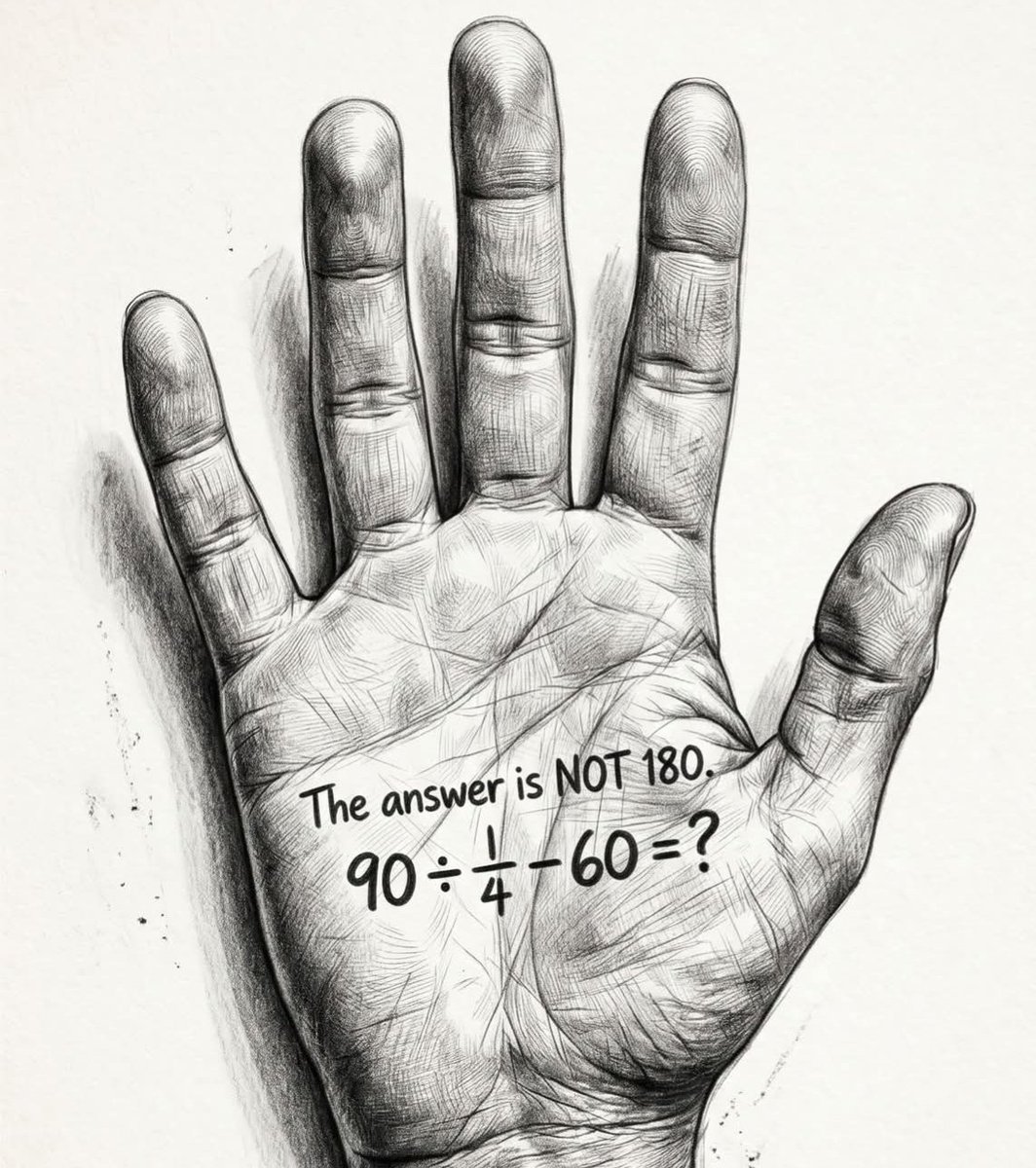
@SqSehrish 90 ÷ 1/4 = 90 x 4/1
90 x 4/1 = 90 x 4 = 360
90 x 4 = 360
360 - 60 = 300
300. 🤓
English

@zooganopolos @histories_arch @archeohistories Many times they are simply resurfaced. Used as a new solid foundation.
Some ancient cities weren't even buried, just had their culture resurfaced. This is why museums need to stay open. We don't realize how much was buried, not all at once at least.
English

@histories_arch @archeohistories Is it not fascinating that in all of these old cities, someone seems to have decided to use backfill vs destroying what was underneath or otherwise digging it up? The UK, Japan, China, India, Italy, Greece, Israel, Egypt... all have many sites where things are buried but in...
English

Italy is that country where, when you dig to replace the gas pipes, you find a mosaic from the 4th Century AD.... This happened in Montorio, Verona 🇮🇹 in 2022.
Italy’s layered past has a way of resurfacing, sometimes quite literally. In Montorio, near Verona, routine utility work revealed a Roman-era mosaic dating to the 4th Century AD, a period when the region was still firmly within the Western Roman Empire. Such finds are not unusual across Italy, where modern infrastructure often sits directly atop ancient settlements, villas, and roads.
Roman mosaics were typically crafted from tesserae, small pieces of stone, marble, or glass, and used to decorate floors in private homes and public buildings. By the 4th Century AD, designs often featured geometric patterns, marine motifs, and symbolic imagery reflecting both classical traditions and emerging Christian influences. Discoveries like this are usually reported to Italy’s cultural heritage authorities, and work may pause to allow archaeological assessment before construction continues.
Italy contains an estimated 2.5 million cataloged archaeological sites, though many more remain undiscovered beneath towns, farmland, and roadways. This density is a direct result of continuous habitation stretching back over two millennia.
Italian law requires that any significant archaeological discovery during construction be documented and, if necessary, preserved, often altering or delaying modern building projects.
#archaeohistories

English
@TheDDfiles @histories_arch Annihilation of people's history, building a "new world" on top.
It's beautifully macabre. RIP to many ancient cities and their cultures.
English

It never ceases to amaze me how Italy is essentially a modern country functioning directly on top of an ancient one. What's especially fascinating about finding these Late Empire residential mosaics is what usually lies just beneath them. These intricate floors were often built directly over a hypocaust an ancient underfloor heating system where hot air from a furnace circulated through empty spaces under the tiles. So, the modern utility crew digging for gas lines was likely just inches away from the Roman equivalent of luxury central heating!
English
@archeohistories It is known as "Buffa di Perrero".
For those who wish to find more images/info. ❤️
English
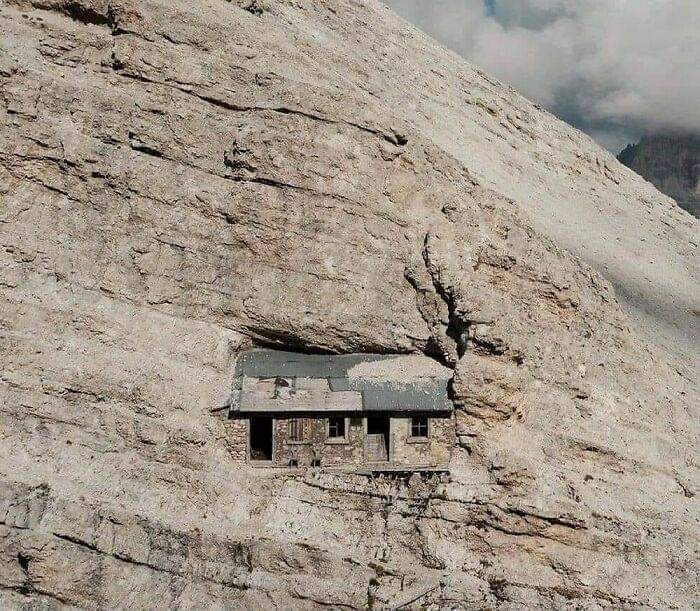
Alpine refuge from WWI, embedded in sheer rockface of a mountain in Italian Dolomites ...
A little alpine refuge that was built more than 2700m above sea level in Italy’s Dolomite mountains (Mount Cristallo) is among most dramatic reminders of WWI. This incredible refuge has been built inside one of the peaks of the massif, with brick walls, a slanted roof, two doorways and four windows framed in wood. Some of the windows are shuttered.
At a glance, it looks as though to step out of the shelter's doorway is to plummet into the valley below. It’s believed that the refuge was constructed by Italian soldiers during WWI, in what was known as 'The White War’, due to the freezing conditions soldiers were faced with.
On May 23, 1915, Italy declared war on Austria-Hungary. A merciless battle ensued between Italy and the Austro-Hungarian forces in the Dolomites.
Soldiers and pack animals carried artillery and munitions across the wild and unforgiving terrain, with supply routes and tunnels built into the rock and ice. Both sides triggered avalanches to take out the enemy. Refuges were constructed by these soldiers, who used rope ladders and cableways to access hard-to-reach spots, for shelter from the raging battles.
#archaeohistories
English
@panzervor051 @histories_arch Until there is nothing left but one person and their delusional perfect world?
English

In early 1900s, many physicians believed premature babies were weak and not worth saving. But a sideshow entertainer named Martin Couney thought otherwise. Using incubators that he called child hatcheries, Couney displayed premature babies at his Cone.
At a time when many hospitals lacked both the equipment and the will to treat premature babies, Couney operated “infant incubator exhibits” at venues like Coney Island and the 1939 New York World’s Fair. Visitors paid admission, and the proceeds funded round-the-clock medical care, trained nurses, sterilized equipment, and temperature-controlled incubators based on European designs.
Medical consensus in the early 20th century often viewed premature infants as unlikely to survive. Couney challenged that assumption. Over several decades, his exhibits reportedly cared for thousands of infants, with survival rates far exceeding typical hospital outcomes of the era.
His work, while unconventional, helped normalize neonatal care and demonstrated the effectiveness of incubators long before hospitals widely adopted them.
By 1940s, advances in neonatal medicine, many validated by outcomes from Couney’s programs, led hospitals to establish dedicated premature infant units, effectively ending the need for public incubator exhibits.
© Reddit
#archaeohistories

English
@nithgenga @histories_arch Genuine question, was this sarcasm?
Doctors are just humans with a piece of paper. Some are a blessing. Some are nightmares incarnate.
English
@histories_arch Thank God doctors are always correct
Insert rainbow stuff here
English
@fasc1nate He once heard a fly fart on the far side of the moon.
No one believed him. Not even the fly.
English


@ABailey6351 @histories_arch @archeohistories Some people are amazed at being able to sew. One day, their ancestors will be amazed at how people tie their shoes.
Learning history is vital for a better world. We repeat it over and over. While those who know history, beg for others to pay attention. It's a cycle. 🙈🙈🕵️🙈🙈
English

@histories_arch @archeohistories Good grief, why do modern day people think that ancient people had no culture? Burial mounds have been found all around the world.
English
Beneath a quiet West Virginia mound, archaeologists found eleven people laid around one central burial, a pattern so deliberate it still unsettles the imagination.
What makes Criel Mound linger in the mind is not simply its age, but the care buried inside it. Deep beneath the earth, eleven people were found together at the base, arranged around one central burial in a layout that looked intentional, ceremonial, and impossible to dismiss as random.
That arrangement is the detail people remember, because it suggests a community making a statement in earth and ritual. Ten individuals surrounded the central figure, and the finds around that middle burial made excavators believe this person held unusual importance.
Today the mound stands in South Charleston, but long before streets and businesses surrounded it, this was part of a much larger ceremonial landscape in the Kanawha Valley. The mound was once among extensive earthworks that stretched for miles on both sides of the river, evidence that this was not an isolated monument but part of a broader sacred geography.
Archaeologists generally connect the mound to the Adena world, with the West Virginia Encyclopedia placing such builders in the Ohio and Kanawha drainages between roughly 1000 and 200 B.C. The commonly repeated estimate for Criel Mound itself is around 250 to 150 B.C., though some older nomination language also noted a mingling of Adena and Hopewell traits in the material recovered there.
Even in altered form, the mound still conveys scale. Sources describe it as about 33 feet high after historic damage, making it one of the largest surviving burial mounds in West Virginia and second only to Grave Creek Mound in the state.
But Criel Mound was not left untouched by the modern world. Before the Smithsonian excavations, its summit had already been leveled for a bandstand or judges’ stand, tied to a racetrack that once circled the mound, so by the time investigators arrived part of the original form had already been lost.
That loss matters, because every change to a mound like this erases context that can never be fully restored. What survives is precious not because it is complete, but because it endured despite being treated for years as scenery, usable land, and public space rather than as an irreplaceable archive of Native history.
In late 1883, Smithsonian investigators began cutting a shaft from the top down toward the original ground surface. Near the upper levels they found burials at shallow depths, and the associated artifacts led later interpreters to believe those upper interments were intrusive and from a later period rather than part of the mound’s first use.
Then came a long stretch of earth with no major discovery. Only when excavators neared the base, roughly 31 feet down, did the original burial deposit appear and reveal the moment for which the mound had first been raised.
The dead at the bottom were found on a prepared setting of bark and ash, then covered with another layer of bark. Postmolds and structural traces suggested some form of tomb or vault, which helps explain why this was understood as a formal, deliberate burial event rather than a casual accumulation of graves.
The central burial drew the most attention, and not only because of position. Copper near the head, shell beads, and weapon points were associated with that individual, while some of the surrounding burials had fewer or no objects, creating a pattern of difference that likely reflected status, role, or ceremony.
Older retellings often fixate on the size of the person in the center. Some sources and later retellings describe a skeleton around 6 feet or even 6 feet 8 3/4 inches long, but the West Virginia Encyclopedia stresses that Norris reported the individuals as adults of medium size, and the National Register form itself warns that the extreme height may have been exaggerated by pressure from the earth.
#archaeohistories

English
@mounabhargava50 @PhysInHistory After a little digging, I believe Fred Lawrence Whipple is the second from the right.
J. Allen Hynek is also said to be in here. Perhaps the second from the left? Or perhaps very right?
Didn't find anyone else's name easily. Good luck! 😁
English

@PhysInHistory Can anyone please share the names of these scientists
English

NASA scientists in 1961 posing in front of a chalkboard with mathematical calculations.

English
@PatDunn64 @PhysInHistory No, this is not. Several more images exist of them. Math parties required a large board.
Taken at the "Systems labs" in California.
English
@PhysInHistory No way. There is no reason for them to be on ladders. This is stupid AI nonsense.
English
@DavidPiper46005 @PhysInHistory At least, that's my guess. Maybe they had better reasons. Or no reason at all. 🤷♂️
English

@PhysInHistory Why in the world would they build the chalkboard up instead of sideways? lol
English
@DavidPiper46005 @PhysInHistory One ladder, one person, they can go up and down, reaching most of the board.
Sideways, one person, one ladder, they'd have to get all the way down and move it left/rIght.
More energy, time, and mental distractions. Even if it's just a quick recalculation or syntax error.
English
@AfizaNoori @AChinnow @PhysInHistory Teamwork makes the dream work! ☮️
Dichotomy breeds hate and segregation. 🤮
English

@AChinnow @PhysInHistory You're being petty and making us look bad. Stop it please.
English