Van Slooten 🇳🇱🇮🇱🇺🇦

10.9K posts

Van Slooten 🇳🇱🇮🇱🇺🇦 banner
Van Slooten 🇳🇱🇮🇱🇺🇦

Van Slooten 🇳🇱🇮🇱🇺🇦

@SlootenSv

Vice is a monster of so frightful mien/As, to be hated, needs but to be seen/Yet seen too oft, familiar with her face/We first endure, then pity, then embrace.

Nederland Katılım Haziran 2012
259 Takip Edilen268 Takipçiler
Van Slooten 🇳🇱🇮🇱🇺🇦
@umlaut @ZInterloper @313formation True, but to some degree *every* promotion path is stupid. Excellent employees get promotion after promotion after promotion untill they end up in a job where they don't function properly anymore (and then often remain stuck, unhappy, yet bound by golden cuffs)
English
0
0
10
1.4K
Van Slooten 🇳🇱🇮🇱🇺🇦 retweetledi
Dr. Maalouf ‏
Dr. Maalouf ‏@realMaalouf·
The Syrian Islamist rebels have kidnapped a large group of Kurdish women in Tell Rifaat, Aleppo. This is no different than what ISIS did to Yazidi women and Hamas did to Israeli women.
English
279
1.4K
3.2K
353.7K
gon
gon@chinesegon·
no one: guys getting paid 3x your salary:
gon tweet media
English
720
2K
52.1K
3.5M
Van Slooten 🇳🇱🇮🇱🇺🇦
@DieuwsNieuws Herkenbaar, dat continue gejij en gejou. Ik ben ooit van energieleverancier gewisseld omdat ze het niet laten konden om voordurend in straattaal te communiceren. Maar ook overheidsorganisaties kunnen er wat van. Ik noem het de infantilisering van de samenleving.
Nederlands
0
0
2
114
Dieuwertje Kuijpers
Dieuwertje Kuijpers@DieuwsNieuws·
Wat mij altijd opvalt na een paar dagen NL is hoe mensen continu als een kwijlende baby/bejaarde worden benaderd: niet alleen nieuws wordt op kleuterjuftoon “uitgelegd”, maar ook restaurants hebben “gerechtjes” zoals “soepjes”. Wtf.
Nederlands
66
21
242
22.3K
Olliert
Olliert@Olliert1·
@chinesegon probably because he has curiosity to understand things on a deeper level and isn't embarrassed to ask stupid questions. So many people go through the whole of school math without even questioning why anything is anything. Once they learn the formula that's it job done.
English
42
16
1K
48.1K
More Births
More Births@MoreBirths·
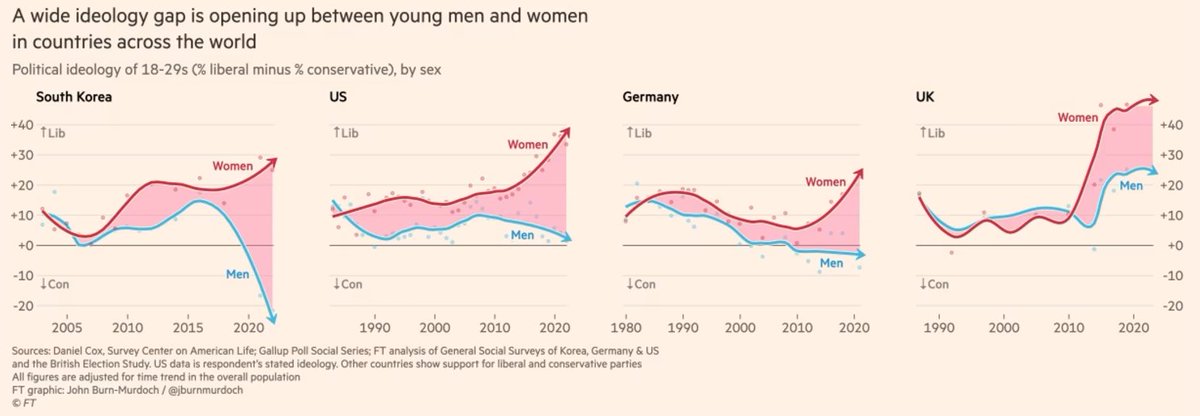
It will take big families to fix the birthrate crisis A lot of people will never have children for reasons that run deep. To make up for that, family sizes will have to get a lot bigger! The rise of singles As most people know, declining marriage has been a major cause of falling birthrates. Marriage rates of have been plummeting for more than 50 years in the US. In particular, those without a college education are marrying a lot less. But it is not simply a matter of people living together without marriage. As this chart by the excellent Financial Times data reporter John Burn-Murdoch shows, the share of young people ages 18-34 who are single has gone above 50%. If you are not living with a partner and not in any relationship, you are not very likely to have children. Even though having children outside of marriage is now commonplace, most people having kids are at least in some kind of relationship. For women born before 1975 in US, childlessness hovered around 15%, while around 85% of women became mothers. But for women born in 1990, only 70% are projected to become mothers, mostly because more women are choosing to remain single. But why? A lack of educated men, and women not needing men to support them It used to be that more men than women went to college. These days far more women go than men. Meanwhile, the income gap between young men and young women in the US has almost completely closed. In the US, young women earn almost as much as men while in the UK, young women earn more than young men on average. Most women want to marry a man they regard as at least their equal, and there are a lot of highly educated women who won’t be able to find a similarly educated man. Meanwhile, the role of a man as a financial provider is greatly diminished when women are earning as much as or more than men. Although many celebrate the disappearance of the wage gap, this means that one of the main motivators for women to marry has disappeared. Making matters worse a growing share of young men have neither a job nor are enrolled in school. Women and men are at opposite poles politically Today just 4% of all marriages are between Democrats and Republicans. Many countries including the United States are more polarized than ever, with women tending toward the left and men tending toward the right. Liberal women mostly aren't eager to marry conservative men and vice versa. Singlehood is a hard trend to reverse While many men have become less desirable to women in terms of education, money, and politics, the social pressure on women to get married, both from religion and culture, is less than ever. Do we expect that Democrat women will suddenly start pairing off with MAGA Trump supporters? Is a woman who went to graduate school clamoring to marry a man with only a high school degree who stocks shelves at night or change tires for a living? Young, professional women stand to lose a lot of status (and money) if they commit to the wrong man and a lot of women just won’t do it. We haven’t even gotten into the realm of attraction yet. Dating apps let women swipe right on a lot of attractive men, but there aren’t enough of those men to go around. I wrote about this recently. x.com/MoreBirths/sta… So, there is a severe matching problem these days. On top of that, a lot of young men and women have substance abuse problems or mental health issues that are unresolved. Should we push these people to become parents? As well, there are lot of people who just don’t believe in marriage, from women who think marriage means patriarchal oppression to men who think they will lose everything in a divorce. All this is to say that trying to increase the birthrate by getting more people to partner up is a tall order. Most people are single for a reason, or a lot of reasons. Rolling back women's education or turning mediocre men into great catches? Really? Larger family sizes may be the only way For a whole bunch of reasons we’ve just discussed, we are probably stuck with a high rate of singlehood for the foreseeable future. We haven’t even mentioned those who have a partner but don’t want children or can't have them. There are a lot of boxes to check before most people are willing and able to bring a child into the world: · Complete education · Become independent · Find a suitable partner who will commit to you · Find a place of one’s own appropriate for a family · Become financially ready · Structure your life for kids (find time in your schedule) · Want children · Be able to have children physically So, getting existing families to have more kids seems easier than getting childless singles to change their whole lives. People with kids have already found a partner, probably have a place, and have rejiggered their lives around children. And they probably like kids if they have some! What’s more, large families represent a return to the norm we had for most of history. Below is a chart of Children Ever Born (CEB) to women in the United States, by birth cohort. Source: An Economic History of Fertility in the U.S.: 1826-1960 by Larry E. Jones & Michele Tertilt Childlessness has always been a thing. Throughout the 1800s, between 10 and 20 percent of women were childless. But birthrates were high, and the America grew because those who did have children tended to have a lot. When the Baby Boom generation started having children, the two-child norm was established and that has been the most typical family size ever since. But there no reason why the norm has to be two. Fertility Turnarounds Usually Came from Big Families Examples of fertility turnarounds, where birthrates went from below replacement to above replacement are rare. But they seem to happen through existing family sizes getting bigger, not through eliminating childlessness. In the Republic of Georgia, Patriarch Ilya II promised to personally baptize a third (or higher) child in every family. This led to a surge in larger families that lifted the nations’ birthrate by a lot. x.com/MoreBirths/sta… In Mongolia, the celebration of mothers who have many children produced a big surge in fertility on the national level. x.com/MoreBirths/sta… Ultimately people have large families because they believe in the cause of having children. The Math Requires Larger Families If 1/3 of women are childless and 1/3 average two kids each, then the final third needs to average four kids each just to achieve a TFR of 2! Alternatively, a three-child-norm instead of a two-child norm leads to replacement fertility. x.com/MoreBirths/sta… Previous posts about large family norms: x.com/MoreBirths/sta… x.com/MoreBirths/sta… Please share and follow @MoreBirths!
More Births tweet mediaMore Births tweet mediaMore Births tweet mediaMore Births tweet media
More Births@MoreBirths

It Will Take a 3-Child Norm Just To Reach Replacement Fertility (Please share!) The brilliant demographic data scientist @BirthGauge has created a new chart that shows the distribution of births by birth order across various countries. It is great for understanding typical family sizes. Since almost nobody has seen a chart like this before, @BirthGauge offers some helpful advice for how to interpret it. And what this chart shows is that there is a strong family size 'norm' of two children in almost every developed country. If the family size norm is 2 kids and a large share of women are childless, then TFR will be well below replacement As @Empty_America and @ludditeautist astutely observe, if there is a two-child ideal, actual fertility will be well-below replacement. This is especially true since unintended pregnancies are way down due to the widespread availability of very effective birth control. For example, in the United States, if the fertility rate among women who have children is about 2.15 (close to a two-child ideal) and one quarter of women end up childless, then the total fertility rate will be ~1.61. And that is almost exactly what we see! Indeed, in virtually every developed country where modern birth control is widely available, fertility rates are far below replacement. For example, almost every European country bunches in a tight group at between about 1.3 and 1.7 births per woman. What explains this remarkable result? Simply put, there is a 2-child ideal combined with quite a bit of childlessness. But what about countries like Korea, Taiwan and China? A lot of people in those countries have a one-child ideal, which is directly due to one-child propaganda and policies. If you combine lower family size ideals with a lot of childlessness, these incredibly low fertility rates are the result. We should do all we can to address unplanned childlessness Data analyst and filmmaker @StephenJShaw in his Birthgap documentary shares the heartbreaking stories of many people who had hoped to have children but could not. There are a number of ways to reduce unplanned childlessness. As Shaw explains in numerous interviews, education of young people is key, especially regarding the very high risk that people will run out of time to start a family if they are not intentional about and focused on partnering and starting a family before fecundity wanes. High rates of childlessness are here to stay Still, it is likely that very high rates of childlessness are here to stay. We can't go back to the world of the 1950s. During the Baby Boom, very high rates of marriage at quite young ages ensured that almost everyone had children. My thread on what caused the Baby Boom explains this. It is said that the past is a foreign country. Can anyone imagine women these days getting married at an average age of 20 as they did then? Now there is a vast education gap as far more women obtain college degrees than men and highly educated women struggle to find suitable partners. Meanwhile a significant portion of men and women have adopted explicitly anti-natal views as I detailed in two recent posts on fertility and culture. These people are not having children any time soon. The only way the numbers work is if there is a higher norm among those who do have children These days, "accidental" pregnancy is getting less and less common. In the past, people did what came naturally and children were the result. Since there is little appetite to roll back the availability of birth control and return to the world of very high unplanned pregnancies (many of which were teen pregnancies) the only way forward is through much higher fertility intentions. In short, intentional pro-natalism in culture will be essential for advanced societies like ours to thrive. In a future world where 1/3 of women wind up childless (a fairly middle-of-the-road figure) the remainder will need to have three children each just for society to be at replacement. But that is not such a strange concept. As the below-linked post shows, there was always a significant rate of childlessness in the past -- combined with families that had a lot of children. If we are to solve the low fertility crisis, bigger families will have to become the norm again. Follow @MoreBirths for more.

English
26
69
347
38.9K
OnlMaps
OnlMaps@onlmaps·
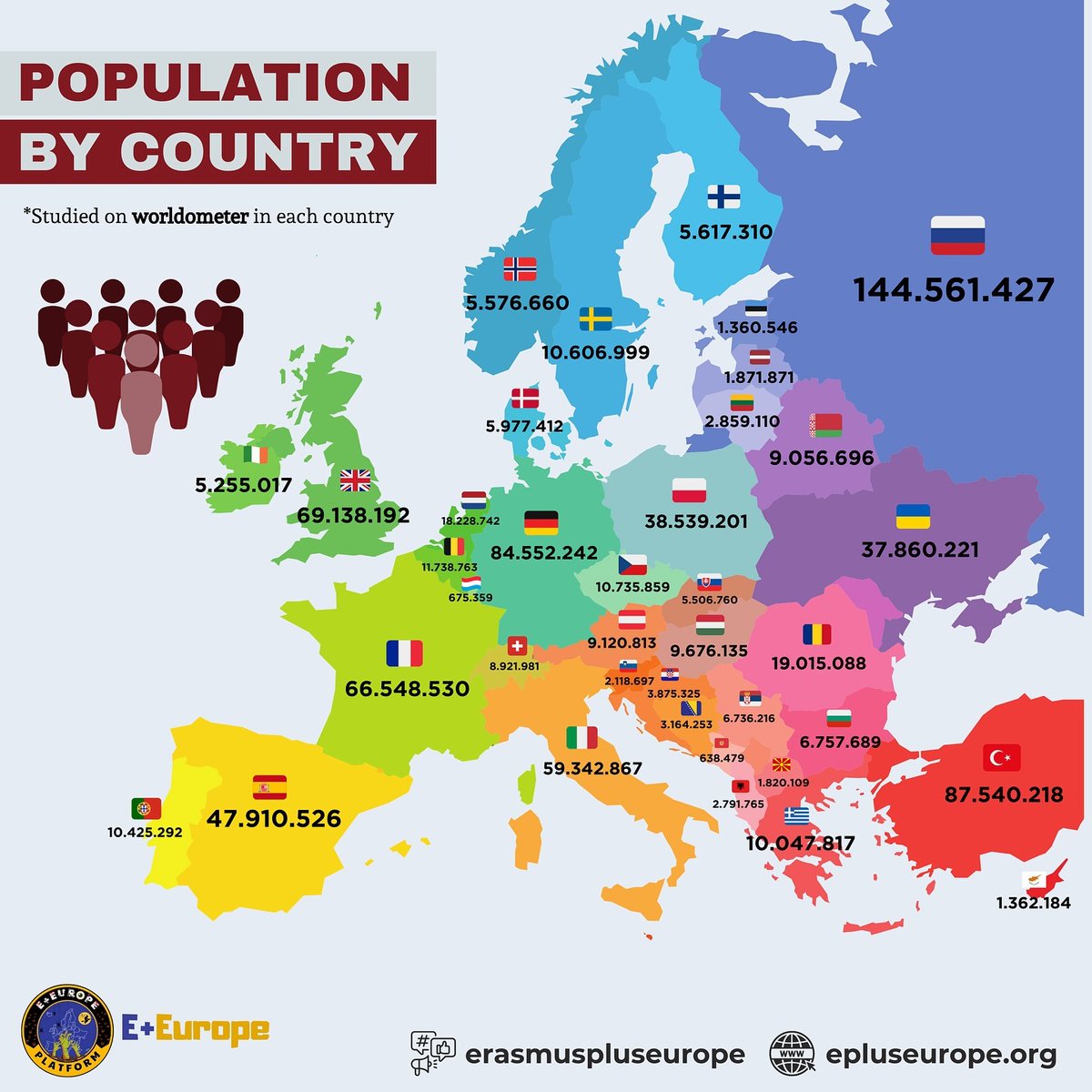
Population of each European country. 2024 (map by epluseurope/instagram)
OnlMaps tweet media
English
8
52
177
15.3K
zi
zi@ZInterloper·
@313formation > Engineer isn't cut for technical work > Moves to a managerial position Seen it way too many times.
English
35
36
2.9K
318.3K
Van Slooten 🇳🇱🇮🇱🇺🇦
@TheAnalytic @Mercian_Man A lot, and yet it should. It's such a shallow concept. Certainly not a fit framework for a PhD level analysis. The fact that you can writhe a thesis trough an intersectional lense and get zero remarks says it all.
English
0
0
0
18
C_M001X
C_M001X@TheAnalytic·
@Mercian_Man how many academic works would be struck out if the word "intersectional" was banned?
English
1
1
11
405
Tetra
Tetra@greenTetra_·
I am currently losing my mind that "voor de lol" is a real phrase in Dutch that means "for fun" that is somehow completely and utterly unrelated to the English neologism "for the lolz".
English
39
707
10.8K
192.8K
Van Slooten 🇳🇱🇮🇱🇺🇦
@janchenoweth @MoreBirths Working mothers are not a new phenomenon either. Ofcourse a large family and a 9-5 job at the office don't combine well, but with todays possibilities to work from home at flexible times, it's just as "easy" as in the past –when mothers spun, sewed, braided and weaved at home.
English
1
0
0
30
Van Slooten 🇳🇱🇮🇱🇺🇦
@MoreBirths Good point. Bigger families foster efficiency and economies of scale, and will help to build strong and stable communities. which makes them preferable from a social and economic perspective. Bigger families should be celebrated instead of frowned up on.
English
1
0
5
381
Red Headed Steppeson
Red Headed Steppeson@RdHdSteppeson·
@SlootenSv @wizardofux @nosilverv I’ve seen this argument before, and its no less retarded. The premise does not include it for a reason. The premise assume universal participation, else the entire premise changes. If you ‘scroll past,’ you simply don’t exist in the world of the poll.
English
1
0
1
16
Ole Lehmann
Ole Lehmann@itsolelehmann·
Throwing money at the problem. Hungary launched the continent's most aggressive incentives: • Lifetime tax exemption for mothers with 4+ children • Free IVF treatments • Housing grants • Loan forgiveness per child
Ole Lehmann tweet media
English
14
68
1.3K
137.7K
Ole Lehmann
Ole Lehmann@itsolelehmann·
I'm German. Europe is dying out. Birthrates are rapidly collapsing. Government incentives aren't working. By 2100, Europe will have lost 117 million people. Here's why Europe's population is imploding (and what it means for the world) 🧵:
Ole Lehmann tweet mediaOle Lehmann tweet media
English
1.4K
2.6K
22.4K
6M