Online Registration for @WSOP tournaments is now available in the WSOP LIVE app
Payment methods through the app:
Debit card (no fee)
ACH (no fee)
LuxonPay (no fee)
Credit card (American Express, MasterCard, Visa) (2% fee)
PayPal (2% fee)
Paris Tournament Account
In-person registration scheduled next week at the Paris Main Cage - date and hours TBA
Accepted methods:
Cash
Horseshoe/Paris Casino chips
Paris Tournament Account
Using the WSOP LIVE app is strongly encouraged.
What actually makes a poker strategy exploitable?
How do you categorize and prioritize different kinds of imbalances in a human-readable way?
This question is the foundation of every strategic framework, be it GTO or exploitative. Yet, I've never seen any serious work on it.
18) The biggest win rates come from combinin strong technical foundations with the ability to stay present, identify what’s actually happening in front of you, and execute exploitative adjustments in real time
You spend more time in flow and time flies
Poker becomes fun again
16) The ability to solve difficult spots in real time and force opponents into parts of the game tree they don’t know
That’s where your opponents biggest blunders happen and where the highest exploit EV exists
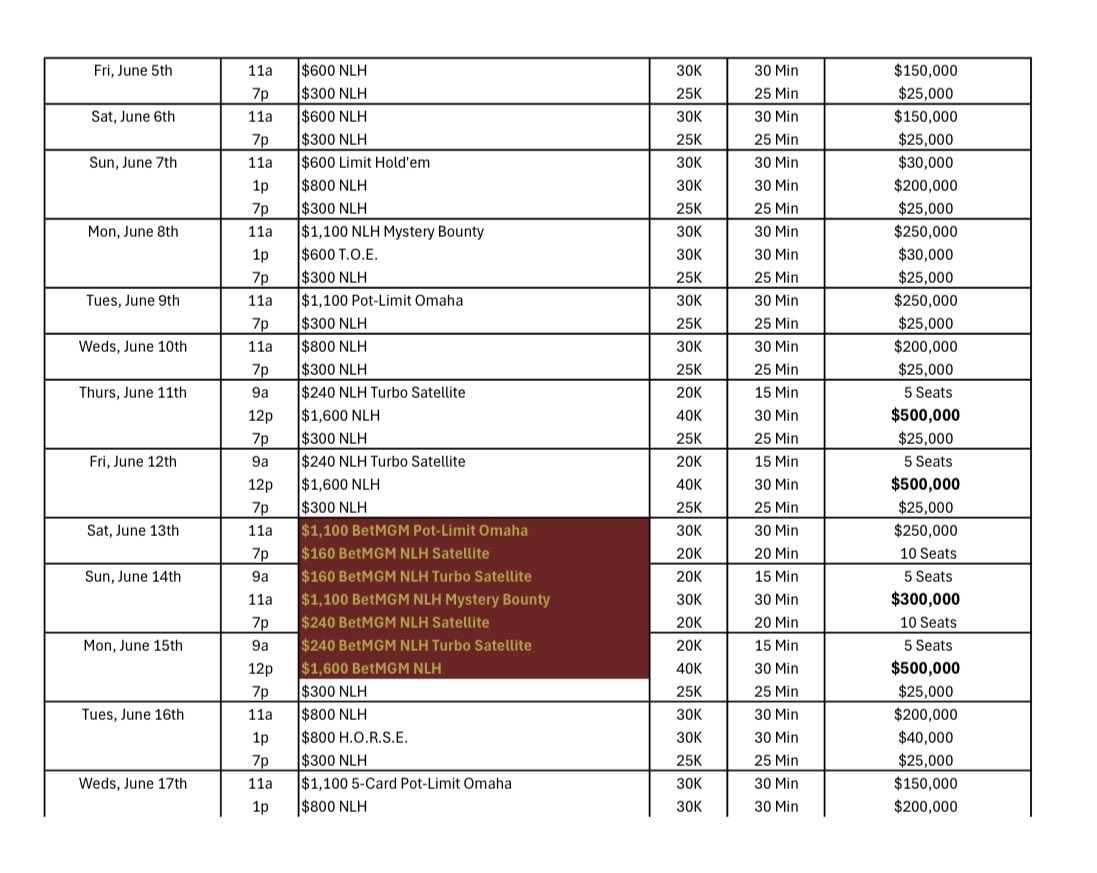
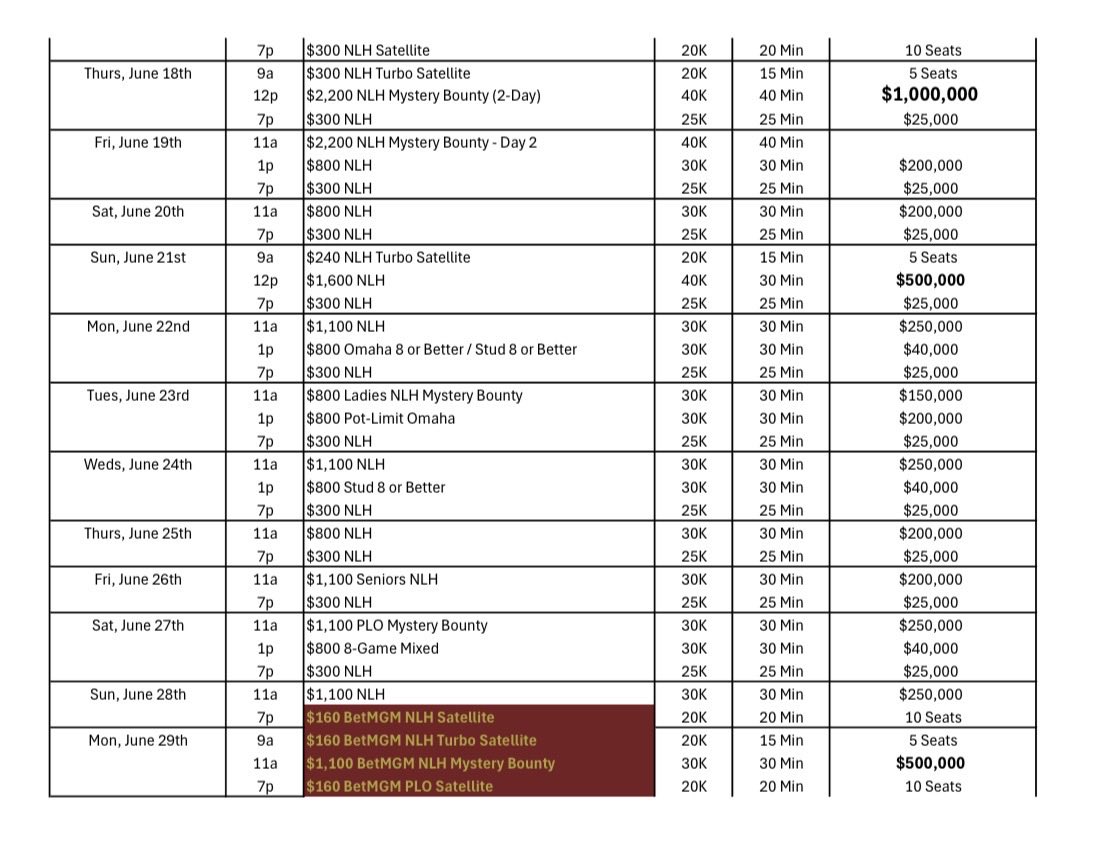
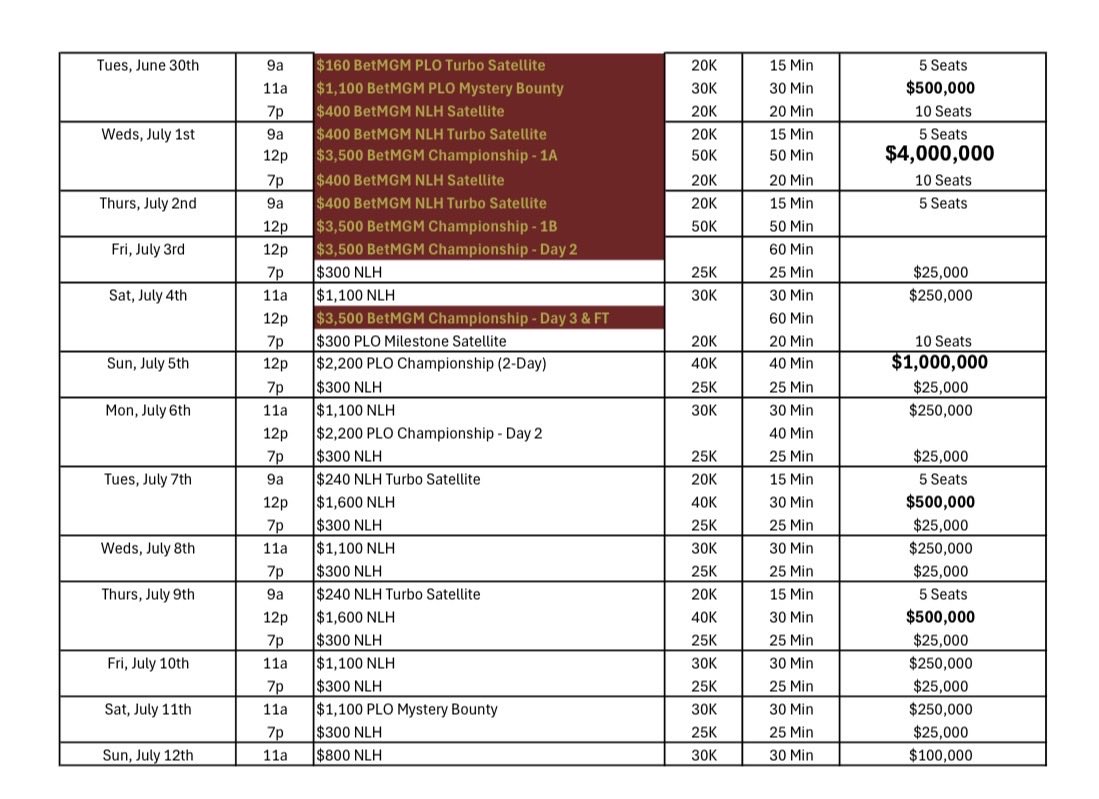
ARIA 2026 Poker Classic runs from May 27th through July 12th
More Mixed Games, More PLO and now a $4,000,000 GTE on the @BetMGMPoker Championship Event!
Today, we announced a new forward-flow commitment with Fortress Investment Group. This follows our initial forward-flow transaction with Fortress last year, and we're excited to expand our partnership even further.
Had a @hungryhorsepokr interview in 2015 that still bothers me.
It was my 6th round. Final interview. The guy walks in—no laptop, no notes—just a coffee and a rack of chips.
He writes on the whiteboard:
bankroll: $20,000
rent: $2,000
life expenses: $1,000
poker buy-ins: $15,000
EV: negative
Then he turns around and says, “Optimize.”
I laughed because I thought it was a bit. He did not laugh.
So I said, “Well, obviously you cut down the buy-ins.”
He says, “Assume volume is non-discretionary.”
Okay.
I start building something. Bankroll management. Risk-of-ruin constraints. Maybe there’s an angle where you move down stakes, smooth variance, treat EV as a long-term drift while minimizing drawdowns.
He stops me.
“You’re thinking like a nit.”
That’s when I knew I was in trouble.
He says, “Give me a range on punting.”
I say, “What?”
He says, “You’re overrolled for your ego, underrolled for your game. Where do you start blasting?”
I try to recover. I say the real issue is variance: rent and expenses are fixed, bankroll is elastic, but emotional tilt is convex. Therefore the optimal strategy is to reallocate buy-ins toward higher ROI spots and hedge mental game exposure.
He nods for the first time.
Then he asks, “What time do you punt?”
I say, “Whenever the game is good?”
He says, “Be more specific.”
I say, “Uh… 2 a.m.?”
For the first time, he smiles.
He goes, “Every day?”
I say, “Every day.”
He says, “In size?”
I say, “In size.”
He says, “And what do we call that?”
I say, “Spewing?”
The room gets very quiet.
He looks disappointed and writes something down.
“No. We call it applying maximum pressure to capped ranges in late-session pools.”
I try to save it. “Right. Of course. The bankroll isn’t shrinking—we’re just accelerating variance realization.”
He nods again.
Then he points back at the board.
I had missed it. Life expenses were $1,000—but poker includes comps, meals, and drinks. You can zero out expenses.
I update the model:
bankroll: $20,000
rent: $2,000
life expenses: $0
poker buy-ins: $16,000
EV: still negative, but now more aggressively so
He says, “How confident are you?”
I say, “0.95.”
He smiles and circles EV.
“0.95, huh?”
Then he asks me to estimate how many regs go broke if we 3-bet jam every marginal spot at 2:00:01 a.m. for 90 consecutive sessions.
Needless to say I did not get the offer
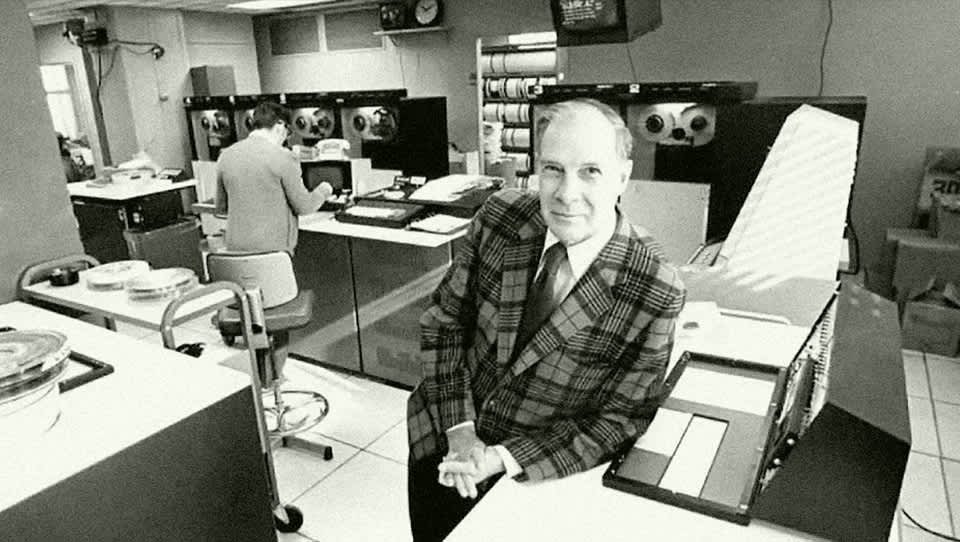
A mathematician who shared an office with Claude Shannon at Bell Labs gave one lecture in 1986 that explains why some people win Nobel Prizes and other equally smart people spend their whole lives doing forgettable work.
His name was Richard Hamming. He won the Turing Award. He invented error-correcting codes that made modern computing possible. And he spent 30 years at Bell Labs sitting in a cafeteria at lunch watching which scientists became legendary and which ones faded into nothing.
In March 1986, he walked into a Bellcore auditorium in front of 200 researchers and told them exactly what he had seen.
Here's the framework that has been quoted by every serious scientist for the last 40 years.
His opening line landed like a punch. He said most scientists he worked with at Bell Labs were just as smart as the Nobel Prize winners. Just as hardworking. Just as credentialed. And yet at the end of a 40-year career, one group had changed entire fields and the other group was forgotten by the time they retired.
He wanted to know what the difference actually was. And he said it wasn't luck. It wasn't IQ. It was a specific set of habits that almost nobody is willing to follow.
The first habit was the one that hurts the most to hear. He said most scientists deliberately avoid the most important problem in their field because the odds of failure are too high. They pick a safe adjacent problem, solve it cleanly, publish it, and move on. And because they never swing at the hard problem, they never hit it. He said if you do not work on an important problem, it is unlikely you will do important work. That is not a motivational line. That is a logical one.
The second habit was about doors. Literal doors. He noticed that the scientists at Bell Labs who kept their office doors closed got more done in the short term because they had no interruptions. But the scientists who kept their doors open got more done over a career. The open-door scientists were interrupted constantly. They also absorbed every new idea passing through the hallway. Ten years in, they were working on problems the closed-door scientists did not even know existed.
The third habit was inversion. When Bell Labs refused to give him the team of programmers he wanted, Hamming sat with the rejection for weeks. Then he flipped the question. Instead of asking for programmers to write the programs, he asked why machines could not write the programs themselves. That single inversion pushed him into the frontier of computer science. He said the pattern repeats everywhere. What looks like a defect, if you flip it correctly, becomes the exact thing that pushes you ahead of everyone else.
The fourth habit was the one that hit me the hardest. He said knowledge and productivity compound like interest. Someone who works 10 percent harder than you does not produce 10 percent more over a career. They produce twice as much. The gap doesn't add. It multiplies. And it compounds silently for years before anyone notices.
He finished the lecture with a line I have never been able to shake.
He said Pasteur's famous quote is right. Luck favors the prepared mind. But he meant it literally. You don't hope for luck. You engineer the conditions where luck can land on you. Open doors. Important problems. Inverted questions. Compounded hours. Those are not traits. Those are choices you make every single day.
The transcript has been sitting on the University of Virginia's computer science website for almost 30 years. The video is free on YouTube. Stripe Press reprinted the full lectures as a book in 2020 and Bret Victor wrote the foreword.
Hamming died in 1998. He gave his final lecture a few weeks before. He was 82.
The lecture that explains why some careers become legendary and others disappear is still free. Most people who could benefit from it will never open it.
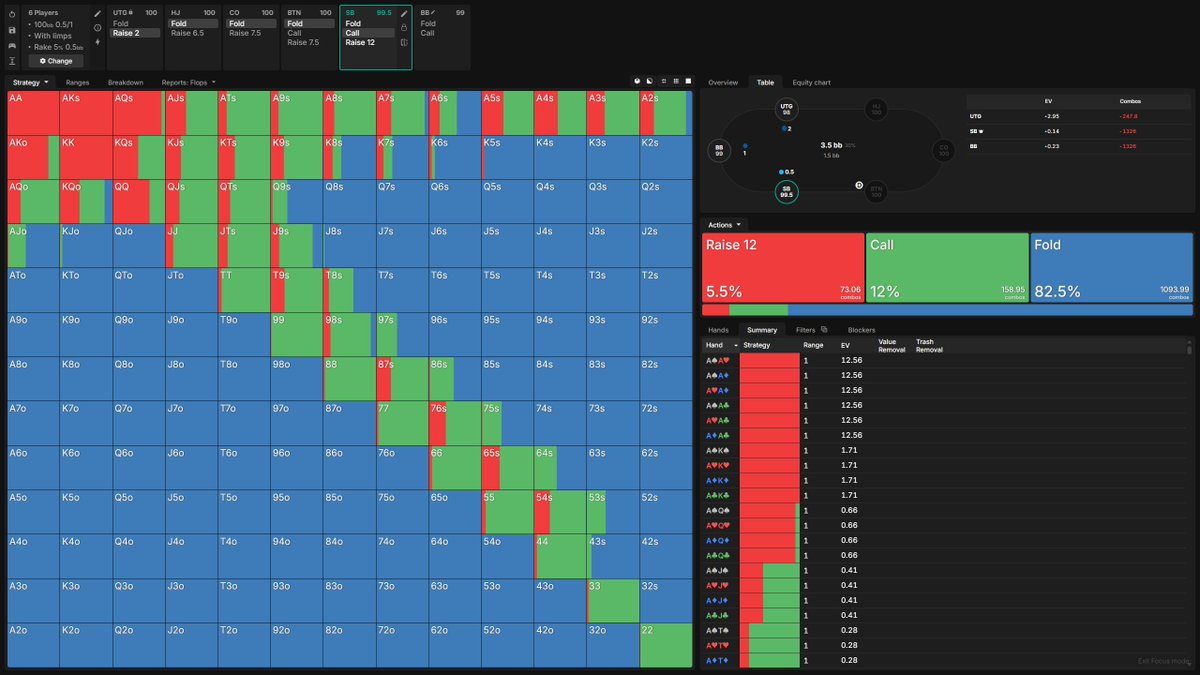
Yesterday I asked how much wider SB should cold-call if BB can’t squeeze. Most of you thought the increase would be significant.
Surprisingly, SB only cold-calls 2% wider with the threat of a squeeze removed!
3-bet% didnt' change, and EV only increased by ~1 bb/100.
Today, we're excited to announce a new, multi-year forward-flow commitment with Centerbridge Partners, L.P.
From Upstart's Sanjay Datta: “This partnership broadens our funding capabilities and enables Upstart to sustainably and resiliently deliver smarter, faster credit solutions across the lending ecosystem.”
🔗 Get the full press release here: bit.ly/3OFbxXY
Poker PSA.
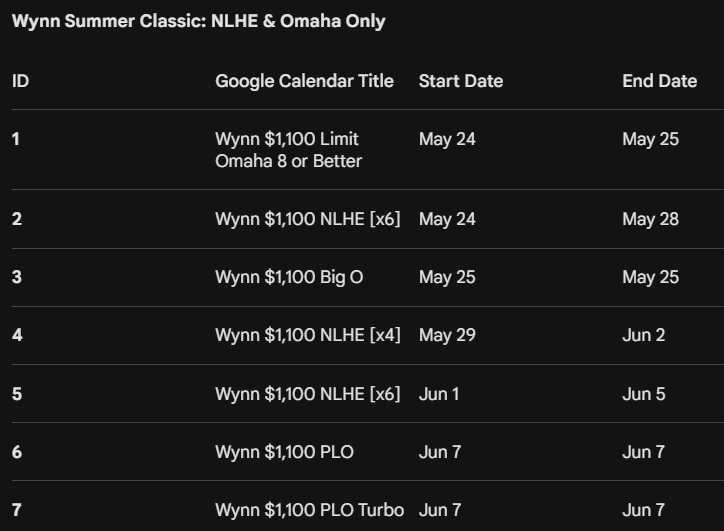
Here is a 2-step process to load the summer schedule into your Google Calendar via Gemini.
1) Upload the pdf (e.g., Wynn)
2) Prompt: "help me fill out my google calendar with uplodated summer poker schedules. Start with the Wynn. Extract all events (any game) >= $1k, and all all omaha variants and satellites >= $500. Show it on a table. Number each event so I could reference easily. The google calendar convention should be as follows, as an example: Wynn $10k NLHE [x3], where x3 means 3 flights, and the calendar entry incldues the first flight all way to the final day. Include start time, for end time just use 10pm. Skip $1100 NLHE dailies"
cdn.wynnresorts.com/image/upload/v…
@UriPelegPoker Replace car insurance with overpriced warranties then I'm aligned!
Car insurance is a weird one because it isn't about protecting your car, it's about making whole the person / car that you hit.
@SnakeJazz5 i'm talking specifically about car insurance though, not insurance in general.
Car insurance has been normalized in society as someone everyone gets.
For everyone telling me car insurance stop risk of ruin -
I think of it as though there are broadly speaking 3 categories of people.
1. Too rich for car insurance - there is no ruin, so you're just doing it for nothing (anything beyond the legal minimum of course).
2. Too poor for car insurance - this might actually be weighing you down financially. Even if you can't afford a new car, this is probably worth the risk - worse case just use public transporation for most people.
3. Comfortable life but depend on the car in your current situation and low liquidity - might make sense to have on a temporary basis until your situation changes (either car becomes less necessary or you save enough money where you can afford the car getting stolen/etc)
I think most people for most of their lives shouldn't get more car insurance than they are legally obligated to.
@UriPelegPoker Uri, I get what you're trying to say, but this is simply not correct.
Insurance lets you hedge.your risks, so you can take higher ev spots without blowing up.
EV maximization is not the only goal.
Car insurance is just a lottery ticket in reverse.
You pay a premium for a low-frequency, high-payout outcome.
The only difference?
Lottery runs on hope.
Car insurance runs on fear.
Nitty poker players buy insurance, skip the lottery.
Degenerates buy lottery tickets, skip the insurance.
True pros buy neither.
3 years of pro tournament poker was the best structured finance training I never knew I was getting.
On break at the $10k @PokerGOTour@VenetianPoker PLO final table. 4 left.
Epiphany: ICM is structured finance. Chips aren't face value - they're worth more or less depending on stack sizes and payout structure.
Cash flows in a deal waterfall work the same way. The equity tranche is the short stack. The senior tranche is the chip leader. Same nonlinear math, different table.