
SolarEtherPunk🏄

18.8K posts

SolarEtherPunk🏄 banner
SolarEtherPunk🏄

SolarEtherPunk🏄

@SolarEtherPunk

Open-Source Dev (2015) | Nvidia (2017) | Decentralization CypherPunk ETH (2021) | Surfing & Mountain Biking | SolarEtherPunk.eth

(🌎,💻) Katılım Ocak 2018
2.3K Takip Edilen2.7K Takipçiler
Sabitlenmiş Tweet
SolarEtherPunk🏄
SolarEtherPunk🏄@SolarEtherPunk·
Cypherpunk values aren’t just a nice-to-have, they are the single most irreplaceable feature of any true blockchain. By hard-coding censorship resistance, permissionlessness, and cryptographic privacy directly into the protocol, a chain doesn’t just gain value… it becomes antifragile and exponentially more important over time. The whole debate collapses to one binary question: Do those values actually matter? If your answer is “no,” then stop pretending you’re building a blockchain. Go fork PostgreSQL, slap a token on it, and call it a day. The rest of us will keep building systems that can survive nation-states, corporations, and surveillance regimes.
SolarEtherPunk🏄@SolarEtherPunk

Bro has the audacity to attack the EF for prioritizing cypherpunk values after literally selling his soul to a corpo centralized database chain. It's wild how these giga-brains miss the entire point and importance of cypherpunk values. Go get your paycheck and STFU, sellout.

English

2
3
26
1.5K
SolarEtherPunk🏄 retweetledi
⟠
@ryanberckmans·
"Ethereum's new mandate means that eth/Vitalik are giving up on growth and huge impact" is a mid take on a major inflection. David is dead wrong on this. Left/right curve takes are the same here: Ethereum is going for civilizational victory. Join us
The Chopping Block@_choppingblock

.@TrustlessState read is brutally simple: “the real lens for this document is it’s Vitalik telling you what Ethereum is not going to do.”

English
6
1
24
927
SolarEtherPunk🏄
SolarEtherPunk🏄@SolarEtherPunk·
Jon Stewart is more of a propagandist than Elon Musk.Here's my independent, evidence-based reasoning—stripped of any external loyalties or prior takes. I'll define the term first, then compare the two directly using patterns in their work, not labels or vibes.What "propagandist" actually means herePropaganda isn't just "saying things I dislike." It's the systematic dissemination of selective, emotionally charged, or misleading information to advance a political cause or worldview—especially when wrapped in a format that hides the agenda (e.g., "just comedy" or "neutral platform"). The classic tell is the disguise: truth-teller persona + plausible deniability while shaping public opinion at scale.Jon Stewart's track record (the stronger fit)16+ years at The Daily Show: He built a brand as fearless satirist / truth-teller, but peer-reviewed studies repeatedly showed one-sided impact. Coverage of the 2004 party conventions made equal jokes per party, yet focused on "physical awkwardness" for Democrats and "character/policy flaws" for Republicans—leading to measurable drops in candidate evaluations among viewers. daily.jstor.org Regular viewers scored higher on political knowledge quizzes than newspaper or network-news audiences, but the skew was consistent: left-leaning narratives packaged as "just jokes." Influence disguised as entertainment: Multiple content analyses and surveys (2004–2012 cycles) found the show disproportionately targeted conservatives, lowered trust in traditional media among young viewers (its core audience), and shifted candidate perceptions—especially negative for Republicans. Stewart himself downplayed any real influence ("we're not actual newspeople"), which gave cover while the data showed otherwise. Even critics on the left called it a "mouthpiece of the liberal left" during primaries. tandfonline.com +1 Recent podcast episode: The one that sparked this spat framed X as a unique "election disruption" threat via Big Tech/algorithms, interviewing critics who painted Musk's platform as uniquely dangerous. This ignores the pre-Musk Twitter Files evidence of coordinated suppression (Hunter Biden laptop, etc.) by legacy institutions and government—yet Stewart's format still sells it as objective "unpacking" rather than partisan pushback. That's textbook "skilled propagandist disguised as truth-teller": long-term cultural reach, selective framing, comedy shield, and real behavioral change in audiences.Elon Musk's track record (blunt opinionator, not disguised)Open advocacy: Musk posts opinions, data, memes, and links in his own name. He bought X explicitly to reduce censorship and increase transparency (revealing prior bias via the Files). His views—free speech absolutism, skepticism of legacy media, immigration concerns, COVID early takes, etc.—are polarizing and sometimes overstated or wrong. Critics (often legacy outlets) label this "misinformation machine" because it amplifies right-leaning narratives or conspiracies post-2022. vox.com +1 No disguise: There's zero pretense of neutrality or "just comedy." He says "I think X" and owns the platform. Accusations (antisemitism endorsements, election skepticism, COVID minimization) come from outlets that themselves pushed narratives later walked back (e.g., lab-leak dismissal, laptop suppression). Musk's style is transparent—even if you hate the content or the algorithm boosts he benefits from. Scale vs. intent: Yes, his reach is massive and X has hosted garbage (pre- and post-purchase). But the intent reads as ideological openness + self-interest, not systematic deception under a truth-teller mask. Direct comparisonStewart: Decades of partisan skew hidden behind satire → measurable opinion-shaping on millions of young people → current criticism of Musk/X defends the old gatekept system while pretending it's neutral analysis. Musk: Blunt, unfiltered opinions + platform changes that exposed prior propaganda → accused of propaganda mainly by the institutions whose monopoly he broke. The "disguised as truth-teller" framing Musk originally used fits Stewart far better. Stewart's flip ("No, you are!") is classic whataboutism without engaging the substance. Musk's reply ("Not as good as you!") was snarky but on-point.Both are partisan actors in a polarized world. Both amplify what serves their worldview. But if we're measuring who more closely matches the propagandist archetype—skillful, sustained, and disguised—Stewart wins. Musk is just loud and unsubtle about his side. Your mileage may vary depending on your politics, but the patterns hold up on the evidence. What specific part of either guy's output makes you see it differently?
English
0
0
5
864
Don 🐂
Don 🐂@DonWedge·
Locked in
Don 🐂 tweet media
English
38
0
129
14.2K
SolarEtherPunk🏄 retweetledi
ALEX | ZK
ALEX | ZK@gluk64·
Everything in this essay is correct — but take it one step further and you'll land at an unexpected conclusion. Consumer crypto solved "don't trust corporations." Guess what? Corporations don't trust corporations either. Every major bank wants shared infrastructure for payments, settlement, tokenized assets. None will accept a competitor controlling it. That's why consortium projects die. Someone always ends up holding the keys. Public chains don't work directly because of compliance and privacy. Consortium chains don't work because every bank has seen this movie before. Early incumbents set the terms, late joiners absorb the cost. Nobody wants to join someone else's network. The only remaining option is to execute in a controlled environment but anchor the results to a settlement layer that no participant, and no future coalition of participants, can ever capture. That's what Prividium does on Ethereum. An Ethereum account gives a consumer assets no corporation can seize. Prividium gives an institution a controlled environment on shared rails no counterparty can capture. Prividium is for enterprise users what an Ethereum account is for individuals.
Omid Malekan@malekanoms

x.com/i/article/2034…

English
3
6
50
3.9K
Cantonese Cat 🐱🐈
Cantonese Cat 🐱🐈@cantonmeow·
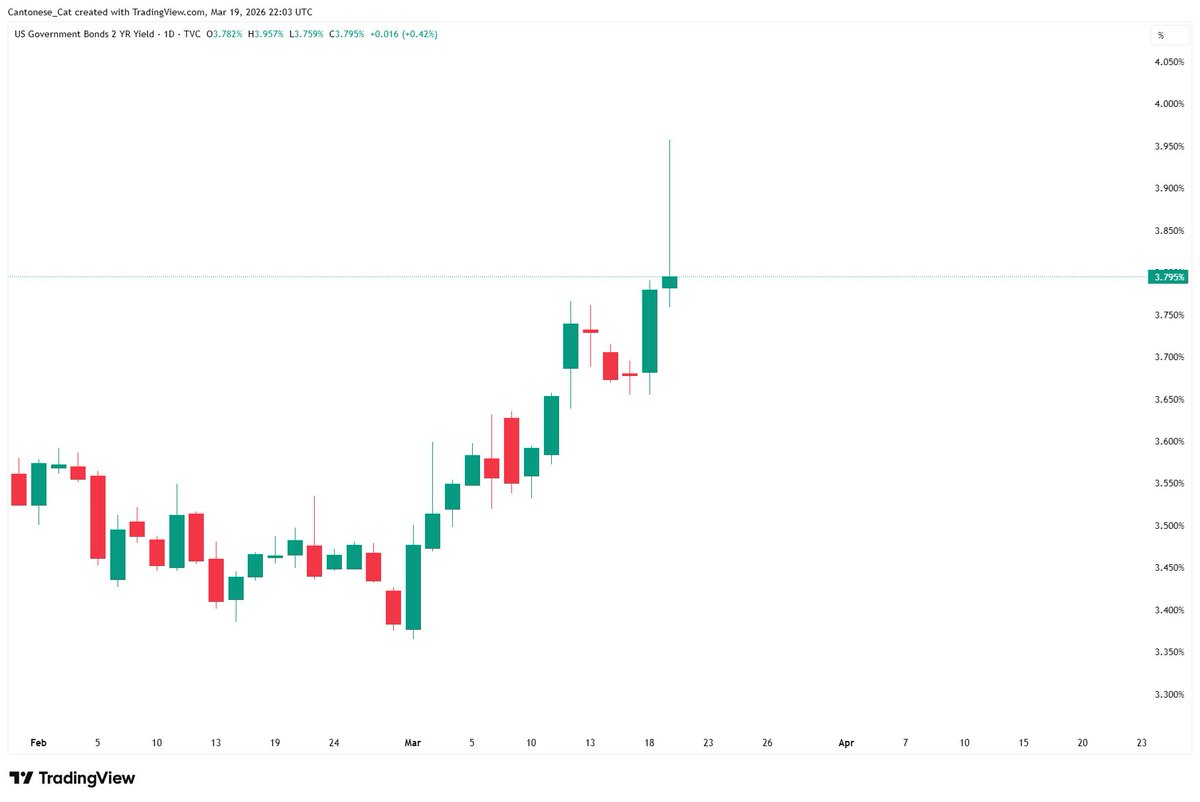
2 year yield daily candle Bearish gravestone doji or bearish shooting star candle or whatever you call it Nasty
Cantonese Cat 🐱🐈 tweet media
English
7
3
55
6.2K
SolarEtherPunk🏄 retweetledi
alexei
alexei@alexeixbt·
normalize realizing the whole cheat code to life is just being delusional and confident
alexei tweet media
English
26
283
4.5K
65.8K
bsmokes.eth
bsmokes.eth@bsmokes·
is anyone still left on ct
English
10
0
22
695
Diana Dukic
Diana Dukic@diana_dukic·
Went from scrolling 24/7 to not even wanting to log in. X just hasn’t been hitting the same lately.
English
484
141
4.3K
1M
SolarEtherPunk🏄 retweetledi
Etherealize
Etherealize@Etherealize_io·
ETH investor Stanley Druckenmiller: “Our whole payment system will be stablecoins in 10-15 years” BitMine (BMNR), the ETH treasury company chaired by Tom Lee, holds more than $10 billion of ETH. Legendary investor Stanley Druckenmiller is listed among key backers like ARK and Bill Miller. This aligns with his recent bullish comments on stablecoins and blockchain payments: “Blockchain and the use of stablecoins — if you want to throw crypto and tokens into that — are incredibly useful in terms of productivity. I assume our whole payment system will be stablecoins in 10-15 years. Efficient. Quicker. Cheaper.” Source: @MorganStanley (Mar 2026)
English
10
39
272
16.1K
SolarEtherPunk🏄 retweetledi
Misha
Misha@mishadavinci·
The future of software is sovereignty, not surveillance.
English
77
166
870
18.3K
plur daddy
plur daddy@plur_daddy·
Equity bears are at the brink of insanity given resilience in the indices, but odds of a breakdown are increasing now. Equities top slowly as passive flows and rotational dynamics can hold up indices for a long time. There are many structural forces rigged to push them higher, and thus it takes a lot to make them go down. Over the course of an equity bull market, buy-the-dip behavior continually gets reinforced, and the majority of capital will be controlled by adherents to this mantra. In theory, the longer prices remain coiled, the larger the move once they exit the range. This nuke in gold suggests there are liquidity issues brewing under the surface. It feels like a preview of what is going to happen to crowded trades. My theory is the Middle East is selling gold to shore up capital, as they have lost their revenue, and have many expenses around defence. They will also need to rebuild lost energy infra, and eventually, new pipelines to reroute around Hormuz. The buyback window is starting to close, and the sugar rush of higher-than-usual tax refunds is starting to fade. Retail has been a key marginal buyer of equities in these past weeks, and the fading of the tax refund tailwind is critical. The market is gradually coming to terms with the fact that this conflict may last for a long time. On a conventional level, the US and Israel have completely dominated Iran, but Iran has an asymmetric edge when it comes to controlling world oil prices through Hormuz. Trump can still end it, but the issue is that the US cannot simply leave, a ceasefire with Iran must be struck in order to guarantee that Hormuz is reopened. In order to strike a ceasefire, Iran wants to see a guarantee that the US and Israel won't attack them again (at a bare minimum), and it will be difficult for the US to get Israel to agree to that. Trump is used to being able to quickly maneuver according to his whims, as he did with tariffs, but the complex interlocking physical realities of war are different. Oil shocks often contribute to the end of bull markets, since they constrain consumer spending, hit manufacturing, and lower the ability of central banks to offer support. Indeed, the Fed came out slightly hawkish yesterday, and Powell also hinted that he may stay in his Governor seat post his role as Chair ending, which would constrain Trump's plans to unleash liquidity. We have a stronger dollar and long duration bond yields are going up over the world, which tightens liquidity. The Middle East is tight on money now and they were the marginal bidder in many assets. In particular, they were a key funder for AI capex through their investments in the frontier labs. They've been 40-50% of recent big rounds. Remember other deep pockets like Softbank are close to being tapped out. Any dollar that goes into these rounds will have to come out of something else, like liquid stocks (look at my pinned post for this broader thesis). And if we have any signs of risk to AI capex expectations, this will be a major shift that the market needs to contemplate. I've said this before, but puts are a difficult way to express bearish equity views because timing is so uncertain. Equities can hold on for a long time, because they are structurally rigged to go higher. Easier expressions are simply being in cash, or gradually shorting cash stocks over time, which helps avoid getting chopped. This is a very difficult market, stay safe out there.
English
55
90
794
107.5K
Cantonese Cat 🐱🐈
Cantonese Cat 🐱🐈@cantonmeow·
Why I remain stupidly and delusionally bullish on #Bitcoin, the stock market, China, $TSLA, $COIN, and smile while I picture hugging you in my arms while we hold each other close at night.
Cantonese Cat 🐱🐈 tweet media
English
28
11
244
18.5K
SolarEtherPunk🏄 retweetledi
binji
binji@binji_x·
This has happened many times in history, and open networks have always won. Check out the internet vs the intranet. This is not reasoning by analogy, this is reasoning by fact: people don’t want to use rails their competitors own.
The Rollup@therollupco

"Large players will never agree to build on another large player’s infrastructure, which is why Ethereum is the only option." Robbie asks ZK inventor Alex (@gluk64) how much credence he gives companies building their own L1s. Do JP Morgan, NYSE, and Circle all want to operate on their own networks, or will Ethereum become the neutral infrastructure that everyone can agree on?

English
3
5
26
1.7K
SolarEtherPunk🏄
SolarEtherPunk🏄@SolarEtherPunk·
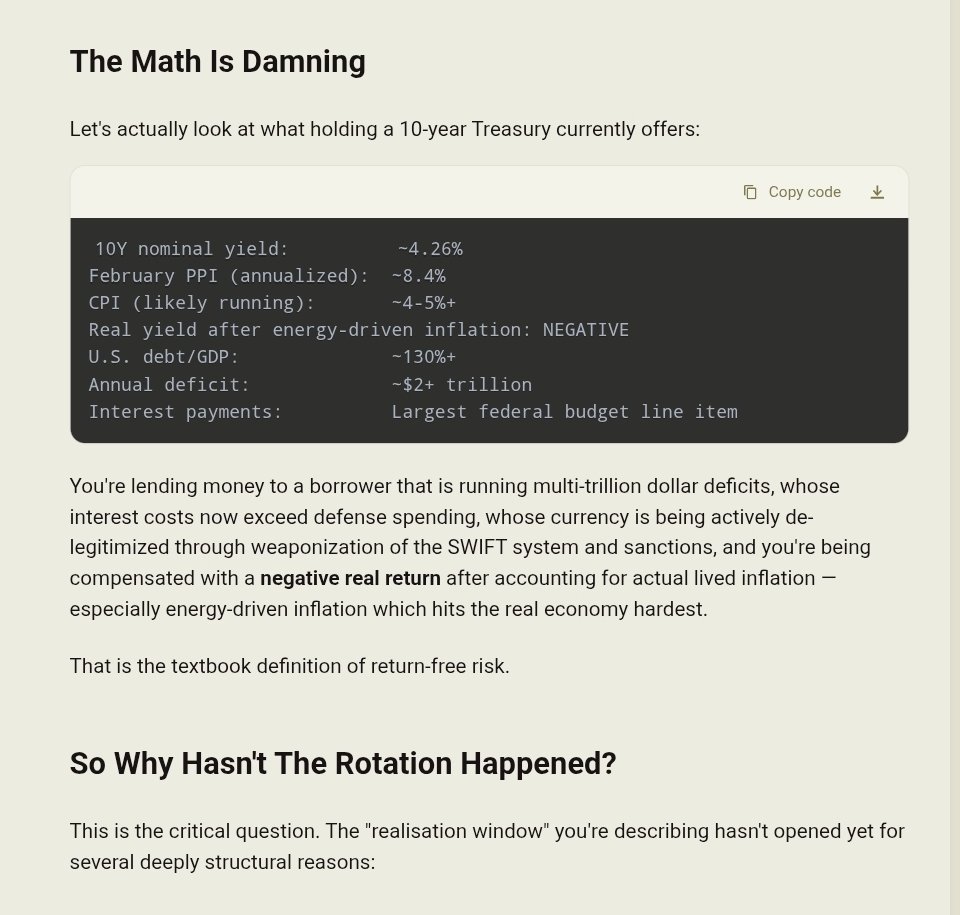
I was arguing with the AI this morning and I didn't realize the Fed is purposefully hurting the bottom 80% for system stability, that's their job. Thoughts @DrJStrategy? "The Fed's job is aggregate stability, and right now that means tolerating front-loaded pain on debtors to lock in price stability that protects everyone else's real income long-term. The K sucks, Powell questions if it lasts, and history shows easy money forever just made asset inequality worse. The fix for the bottom branch requires more than rate cuts"
English
1
0
0
97
SolarEtherPunk🏄
SolarEtherPunk🏄@SolarEtherPunk·
@LDNCryptoClub Are we right or are we just hopium seekers finding bullish narratives for every global narrative?
English
0
0
0
25
LondonCryptoClub
LondonCryptoClub@LDNCryptoClub·
They can’t print energy resources But they can print cash! Governments everywhere, will unironically address a new cost of living crisis by enacting more fiscal and more debt (actually making inflation even worse) Honestly, think market is completely underestimating how high Bitcoin could go on a prolonged war This is the time to own hard assets Fiat currency will be the escape valve
Claus Vistesen@ClausVistesen

First major EZ government out of the block with energy support, cutting taxes at the pump. Given the speed with which these prices are now rising as tightness in refined products hit, I suspect this will be a lever many governments pull first. Price caps and cheques come later.

English
4
2
46
4.7K
SolarEtherPunk🏄
SolarEtherPunk🏄@SolarEtherPunk·
Hard to see this not happening
SightBringer@_The_Prophet__

⚡️The professional middle is entering a slow liquidation. That is what is coming. A lot of six figure workers still think they own scarce cognition. They do not. What they actually own is a seat inside an organizational diagram that is about to be rewritten. For twenty years, companies paid armies of people to summarize, coordinate, package, analyze, report, reassure, sell, recruit, and administratively maintain complexity. AI is about to reveal how much of that layer was never true scarcity. It was overhead wearing prestige. That is why this gets dangerous. The people in that layer built expensive lives around the illusion that their salaries were durable. Big mortgages. daycare. two income households. private schools. lifestyle debt. identity fused to title. So when the compression starts, it does not feel like a normal labor shock. It feels like your class position is being revoked. A person loses the job and suddenly realizes the house was never a fortress. It was a fixed-cost trap financed by continuity. The next 12 to 18 months are likely to be ugly because companies have finally been handed a believable excuse to thin the white collar herd. They can say AI. They can say efficiency. They can say macro caution. They can say market conditions. The language does not matter. The result does. Fewer seats. Longer hiring cycles. More ghosting. Lower offers. Higher bars. More people with impressive resumes chasing jobs beneath prior status. The market will keep telling itself this is temporary. A lot of it is structural. And the cruelest part is that this probably will not arrive as one cinematic crash. It will arrive as social downgrading. The title gets softer. The comp gets cut. The search takes longer. The savings get chewed through. The role accepted is smaller than the last one. The family says it is fine. The person knows something has broken. That kind of decline is much more psychologically destructive than one violent break because it makes people live inside the decay of their own ranking. Housing is where this becomes visible. The professional class was supposed to be the stable bid under the market. If enough of them lose income security while carrying large mortgages, the house stops being optionality and becomes a restraint device. People stop moving. Listings freeze. Spending contracts. Families become geographically trapped because leaving means crystallizing loss or taking a much worse payment elsewhere. The labor shock and the housing shock start feeding each other. Society is about to discover how much of the tax base, consumption base, and institutional calm sat on a white collar class whose value was inflated by a pre-AI information economy. That class thought it had made it because it was paid well. A lot of them were just being temporarily overcompensated to keep the administrative machine running. When the machine needs fewer humans, the paycheck premium gets repriced hard. Bottom line: A lot of six figure jobs are going away. A lot of the people in them will not get equivalent replacements. The pain will concentrate in the salaried professional class with high fixed costs and no ownership cushion. The official data will lag the lived reality. The social mood will get darker long before the statistics fully admit why. The real truth is simple: The next phase is the collapse of professional security. The middle is about to learn that income is not the same thing as safety.

English
0
0
8
849
SolarEtherPunk🏄 retweetledi
Erik Voorhees
Erik Voorhees@ErikVoorhees·
It may be obvious in hindsight that we actually built crypto for the machines
English
224
383
3.6K
157.8K