Sreejith Santhosh
150 posts

@SreejithS_
PhD (physics) @UCSanDiego , @Mattia__Serra group. Undergrad @iitmadras.


The most powerful scientific instrument of the 21st century isn't the electron microscope or the particle collider. It's the algorithm. Today, a scientist in biology, physics, chemistry etc. is more likely to be debugging a Python script than to be running a wet lab. Going forward, the biggest breakthroughs will be mostly software achievements, like AlphaFold.

📣New preprint: Mechanochemical feedback, tissue geometry & rigid-body dynamics initiate rotational migration in Drosophila via spontaneous chiral symmetry breaking. A mechanism generalizable to closed epithelia. @SreejithS_ biorxiv.org/content/10.110…

🧬🔬🧪 🎉 Our team at @czbiohub is thrilled to share TWO companion papers out today in @NatureMethods! 📦 Ultrack — robust, scalable nD cell tracking 🌐 inTRACKtive — a beautiful, open-source web viewer for lineage exploration Let’s dive in! 👇 (LINKS BELOW)

🥳Congratulations to our @gbventur, postdoc in the lab of @diana__pinheiro, who received an EMBO fellowship! The funding will support his research on how the timing of embryonic development is controlled. ➡️Read more: imp.ac.at/news/article/e…


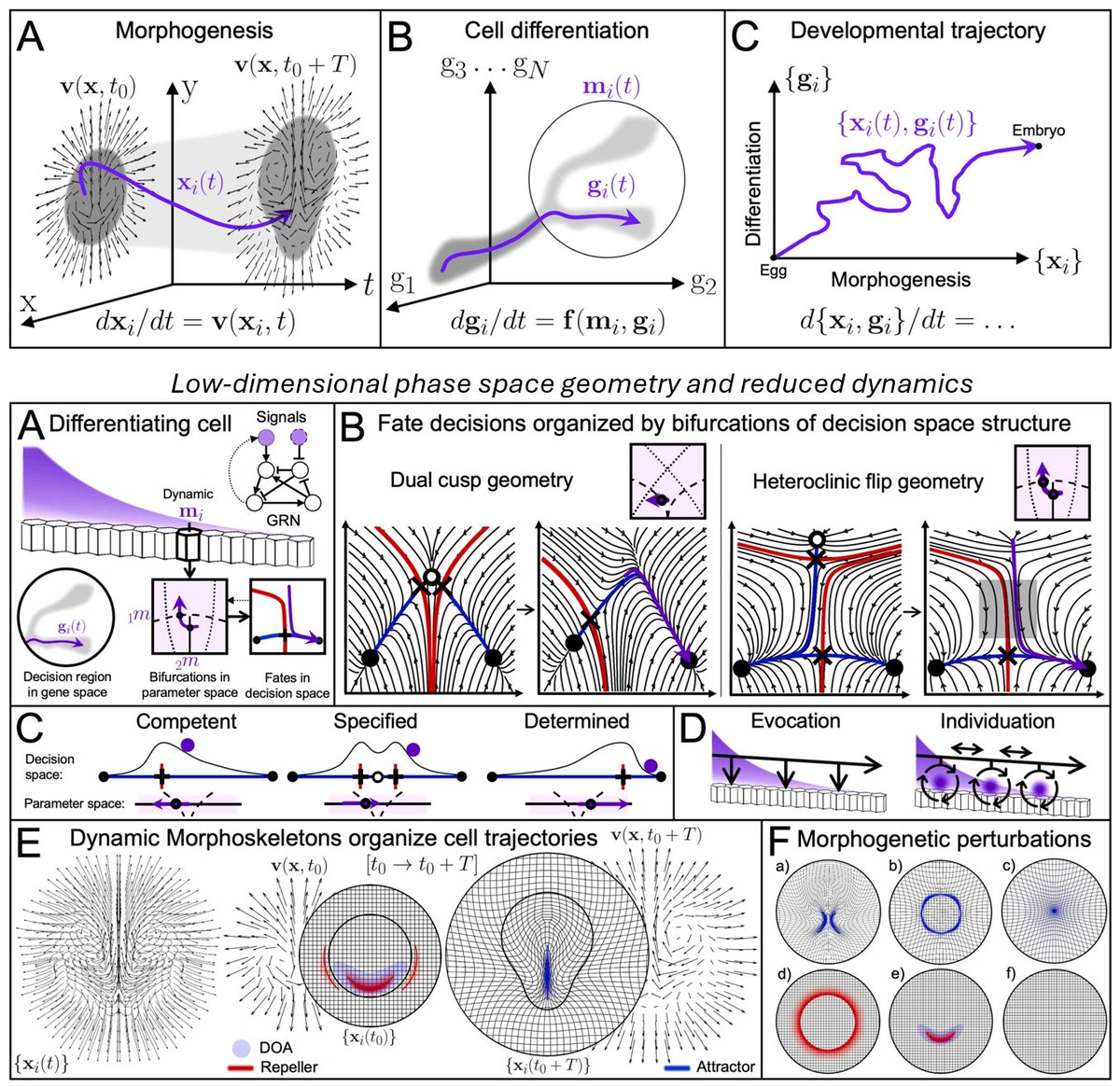
📣 New preprint alert! We developed a framework to uncover Coherent Structures in flows on dynamic surfaces—revealing dynamic attractors, repellers and deformation directions in active nematic vesicles, pancreatic spheroids, and beating zebrafish hearts. biorxiv.org/content/10.110…


Self-organized dynamics of a viscous drop with interfacial nematic activity, Mohammadhossein Firouznia and David Saintillan @MHFirouzniaa @FlatironCCB @ucsd_mae @UCSDJacobs #SoftMatter #Fluids go.aps.org/4iviy6Q

🎉Congratulations to our @gbventur, postdoc in the lab of @diana__pinheiro who secured a prestigious Marie Skłodowska-Curie fellowship! 🔬The funding will support his research on the mechanisms that control how the embryonic development clock is set: imp.ac.at/news/article/m…

How to "program" living cells.🧫 In 2000, physicists ( @ElowitzLab) made bacteria blink on-and-off every 150 minutes. Their experiment, which blended mathematics and wet-lab methods, launched the field of synthetic biology. Learn how they did it in my first interactive story.


Tissue-Like Multicellular Development Triggered by Mechanical Compression in Archaea biorxiv.org/cgi/content/sh… #biorxiv_cellbio


And the 2024 Nobel Prize in Physics does not go to physics...