ElowitzLab

435 posts

ElowitzLab banner
ElowitzLab

ElowitzLab

@ElowitzLab

Lab of Michael Elowitz at Caltech. Synthetic biology and systems biology

Los Angeles Katılım Aralık 2013
1.1K Takip Edilen12.1K Takipçiler
Niko McCarty.
Niko McCarty.@NikoMcCarty·
I've started writing my book: "Biology is a Burrito & Other Essays." It is an interactive and highly visual look into the beauty, speed, and complexity of a living cell. I'm planning to print hardcover books while serializing the essays online. The first essay is now available at burrito.bio. This was inspired by Stewart Brand's latest book, "Maintenance of Everything," which he developed in serialized form with @WorksInProgMag. One cool thing about that book was that he improved each chapter with reader comments before printing the physical copies! I'll be doing the same with this book. If you send me feedback that improves the text, I'll credit you online and in the final print version. You can also sign up to get email updates when a new essay launches. Hope you enjoy!
English
26
95
683
33.6K
MayoClinicBMB
MayoClinicBMB@mayoclinicbmb·
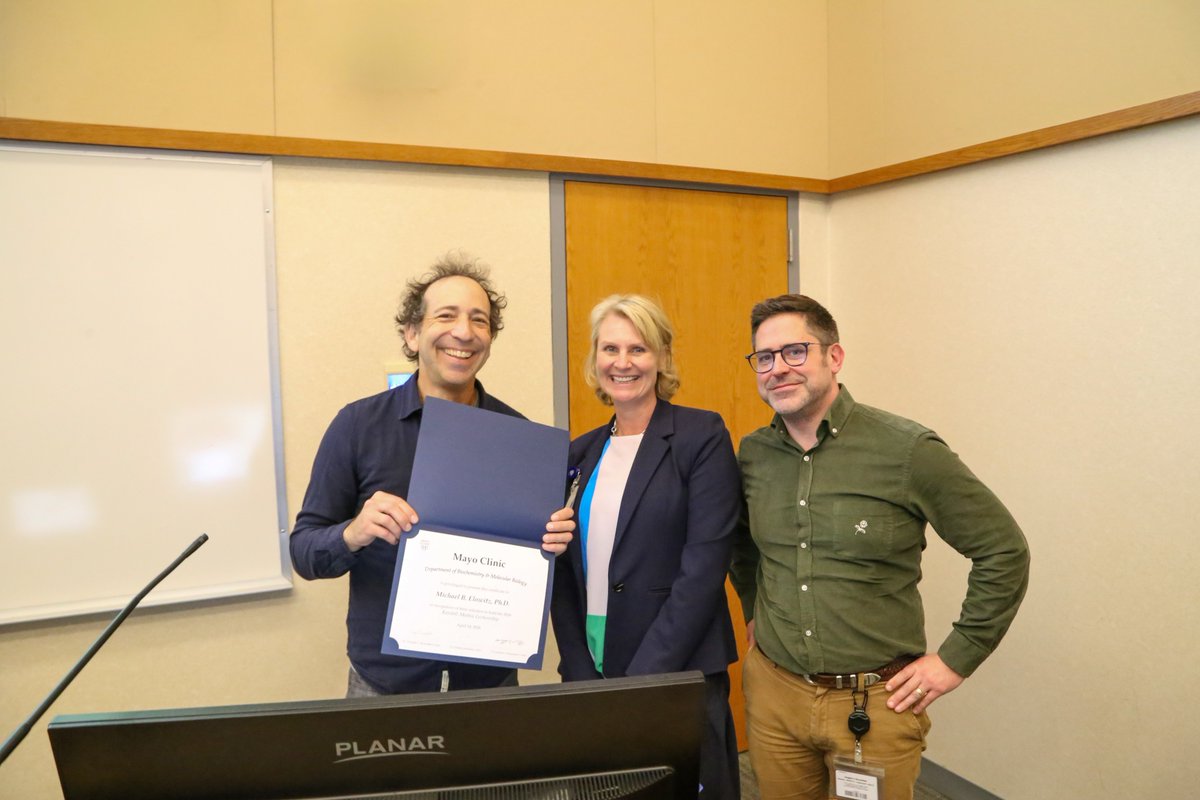
Thank you to Michael B. Elowitz for an outstanding Kendall-Mattox Lecture in our Biochemistry and Molecular Biology (BMB) Named Lecture Series. His talk, "Engineering protein circuits for cancer therapy," highlighted the promise of programmable approaches to cancer treatment.
MayoClinicBMB tweet media
English
1
1
3
110
ElowitzLab
ElowitzLab@ElowitzLab·
(Whoops - I meant to credit Victoria Tobin @victoriartobin above but misspelled her username)
English
0
0
1
449
ElowitzLab retweetledi
Niko McCarty.
Niko McCarty.@NikoMcCarty·
There is a tiny device (first invented almost two decades ago) that lets you watch a single cell divide hundreds of times, under tightly-controlled conditions, and yet I almost never meet people who actually use it. This is a shame because there’s many interesting ideas that I think could be uniquely tested in such a device. Most experiments in biology are instead done in “bulk,” which is not a good way to deeply understand an organism. RNA-seq experiments, for example, are often done by growing lots of cells in a flask, exposing them to some chemical, and then killing all the cells, extracting their RNAs, and sequencing all of them together. The end result of this is just an average, and it completely obscures the messier (and more truthful) stochastic nature of life. But a Mother Machine, and other microfluidics tools like it, helps to solve this problem. It’s just a tiny device with a long trench through which nutrients flow. Cells travel down this trench and fall into little wells, etched perpendicularly to the main trench. Each of these wells is barely wide enough for a bacterium to fall inside. When a cell falls into a well, it keeps dividing and also has access to fresh nutrients, which are constantly pumped through. Waste molecules are continuously flushed out. As one cell divides into two, then four, then eight, and so on, some cells eventually extend out of the well entirely and get swept away with the current. The cell at the bottom, though, stays put and will keep dividing. Like many other “great” inventions, the Mother Machine was designed to answer a specific question. In a 2005 paper, some scientists claimed that, when a cell divides, whichever offspring inherits the “old pole” from the mother divides about 2 percent slower with each passing generation. (Said another way: When an E. coli cell divides, it builds a wall down the middle and cuts itself in two at that point. Each “daughter” cell has two ends; one end is made from the wall, and the other end is “old.” This old end gets passed down through the generations, again and again. The authors of the 2005 paper claimed that this constitutes a form of cellular aging, and that cells which inherit the old end are basically less fit than the other daughter cell. Provocative claim!) The Mother Machine was invented by a small team at Harvard to disprove this hypothesis. In the 2010 paper describing the device, they basically just strapped a camera to the microfluidics chip and recorded the growth rate for tens of thousands of cells, under constant nutrient conditions, for “hundreds of generations.” After tallying all the data, they concluded that “E. coli, unlike all other aging model systems studied to date, has a robust mechanism of growth that is decoupled from cell death.” In other words, growth does not slow down with age, and the 2005 claims were wrong. Other groups have since made modifications to the original device, using it to revisit classic experiments in molecular biology. In 2018, for example, a Swiss team modified the microfluidic chip to have two input channels, rather than just the one. With two ports, they could expose cells to different growth media at the same time. Or they could switch back-and-forth between the two conditions, or even expose cells to gradients of those conditions. Now, it has been known since the 1960s that E. coli cells prefer to eat glucose over lactose. When glucose runs out and only lactose is around, the cells activate their lac operon and begin making enzymes to digest it. Jacques Monod and François Jacob shared a Nobel Prize, in 1965, for figuring this out. But nobody had ever actually watched this “switch” at the level of single cells, under tightly-controlled conditions. But then the Swiss team made their modified Mother Machine. They flooded E. coli cells into the device, trapped them in wells, and switched the inputs between glucose and lactose every four hours. And what they found is that, when lactose comes in to replace glucose, every cell stops growing within three minutes. This outcome is extremely uniform! But the reverse — or the time it takes each cell to switch on its lac operon — is extremely variable. About one-fourth of cells start growing within 25-45 minutes, two-thirds start growing in one-to-three hours, and five percent of cells never grow again at all. By accounting for cells individually, in other words, the Mother Machine enabled these researchers to make observations which could never be made at the population-scale. And yet, Mother Machines still seem relatively rare! The blueprints are freely available online, but making these devices still requires an understanding of photolithography. The wells are only a micron wide, so they can’t be 3D-printed; one has to make a master mold using photomasks, cast PDMS in that mold, and then cure the polymer into that shape. The original specs only work for E. coli, too. If you wanted to study Bacillus or Caulobacter or yeast, you’d have to redesign the channels with different dimensions. A few companies sell Mother Machines, but they seem to be quite small. If Mother Machines did become widespread, though (maybe even cheap enough to ship in, say, a $100 kit for students) they could be used to run all kinds of interesting experiments. One idea is to combine a Mother Machine with a hypermutation tool, such that we can watch cells evolve in real-time. In a recent study, British scientists reported a way to do “highly mutagenic continuous evolution” in E. coli. The beauty of their tool is that it only requires two components: an error-prone DNA polymerase, and a replicon carrying a gene of interest. The error-prone polymerase, which introduces about one mutation per 1,000 bases every ten generations, only copies the DNA on the replicon; it doesn’t touch the host genome. One could take a gene encoding antibiotic resistance (against molecule X) and clone it onto the replicon, transform the whole thing into E. coli, and trap the cells inside a Mother Machine. Then, by exposing the cells to increasing levels of antibiotic Y, one could watch in real time as cells mutate their resistance gene and, perhaps, hit upon a solution that confers resistance against both molecules. This would be a way to study how cells evolve resistance autonomously, at the single-cell level. Another idea is to use Mother Machines to study how perturbations change a cells’ transcriptome in real-time. Felix Horns (previously in Michael Elowitz’s group at Caltech, now at Arc Institute) created an RNA Exporter tool. The gist is that genes encoding virus-like particles are placed into cells and, when these particles get made, they latch onto RNA molecules and physically carry them out of the cell. Cells are effectively engineered to export their own RNA. My understanding is that RNA Exporters are relatively unbiased, meaning they have a roughly equal chance of grabbing onto any RNA molecule. The molecules that get carried from the cell, then, are representative of the transcriptome as a whole. If cells carrying RNA Exporters were studied in a Mother Machine, it might be possible to perturb them and measure their transcriptional responses in real time — rather than the classical approach of perturbing millions of cells at once in a flask and doing RNA-seq on the entire population to collect average results. A third idea is to collect single-cell observations to train a predictive model for molecular burden. Any time we engineer an organism to carry new genes, we are forcing it to execute a function it wouldn’t normally do, thus draining resources that would otherwise go toward growth, DNA repair, and so on. Perhaps we could take 100+ plasmids, each carrying a fluorescent protein, and clone all of them into the same strain of E. coli. Then we could study each strain inside a Mother Machine, carefully quantifying growth rates and fluorescence levels, to map out the full distribution of outcomes for a given plasmid. If we did this enough times (hopefully with some kind of automated data pipeline) we could collect a huge dataset. The resulting model could also help bioengineers design constructs that impose less of a burden on living cells. I’m not entirely sure why we’re not seeing more of these ideas implemented, or why bioengineers still haven’t fully embraced single-cell experiments. Every university should have a microfluidics facility making custom devices, but I’ve only visited a few of them. Most experiments are still done in bulk, using orders-of-magnitude more cells and reagents than microfluidics would require; and usually the results are less representative of ground truth, too! It’s a shame, because one of the beautiful things about biology is that each cell is unique and lots of molecular phenomena are highly stochastic, following a distribution of outcomes. Biology is fun because it is not deterministic; and that makes it both richer as a field of study but also more complicated as an engineering medium. A Mother Machine, and other tools like it, help us to actually see these distributions.
GIF
English
20
36
299
20.5K
ElowitzLab retweetledi
plasmidsaurus
plasmidsaurus@plasmidsaurus·
Big news 🧬 Plasmidsaurus is partnering with @Addgene in a 4-year strategic collaboration to strengthen genetic tool verification for researchers worldwide. By combining Addgene’s plasmid repository with Plasmidsaurus long-read whole plasmid sequencing, we’re helping make reliable science the baseline. Open science runs on verified materials. Learn more: plasmidsaurus.com/news/a-new-cha…
plasmidsaurus tweet media
English
6
38
320
15.2K
Seth Bannon
Seth Bannon@sethbannon·
Goodies for 5050 gift boxes going out to labs. If you want one for your lab, let us know below!
Seth Bannon tweet media
English
23
7
122
8.4K
ElowitzLab retweetledi
Mikhail Shapiro (same on bsky)
Mikhail Shapiro (same on bsky)@mikhailshapiro·
Excited to co-found @Merge Labs! TLDR: We’re developing a new paradigm for BCI using molecules instead of electrodes. If you’re excited about this and want to contribute in protein engineering, synbio, delivery, immunology, ultrasound, devices, neuroscience, or data/ML/AI, we’d love to hear from you. merge.io/blog merge.io/careers 🧵
English
40
63
660
54.9K
ElowitzLab retweetledi
Niko McCarty.
Niko McCarty.@NikoMcCarty·
Some things I believe about writing: > It is the best, most efficient way to transmit ideas. (Brain-to-brain BCIs may surpass it someday.) Even the best YouTube videos or podcasts usually only convey a fraction of the ideas contained in an excellent essay. > It is faster to write than to make a video or record a podcast. Therefore, you should usually default to writing when exploring an idea. (And videos and podcasts usually involve a fair amount of writing anyway.) > Using AI to write for you (not research, or explaining a paper to you, but actually **writing**) will make you dumb. > Writing is a form of telepathy across space and time. Here's a passage from Stephen King that I love, about a table on which there is "a cage the size of a small fish aquarium. In the cage is a white rabbit with a pink nose and pink-rimmed eyes. In its front paws is a carrot-stub upon which it is contendedly munching. On its back, clearly marked in blue ink, is the numeral 8.... Do we see the same thing? We'd have to get together and compare notes to make absolutely sure, but I think we do." (King wrote this in 1999, and his thought of this rabbit, and what it looks like, shall remain firmly established for all time. Similarly, I can still read Pliny today and know exactly what he was thinking 2,000 years ago.) > It is the best way to make sure you, yourself, understand something. > If you can write something using simpler words, without distorting your meaning, then you should do so. > Adverbs are almost always your enemy; akin to a gentle lullaby that will strangle you into the passive tense. (And readers do not enjoy the passive tense.) This list will expand over time. Brief bibliography: - The Elements of Style by Strunk and White is the only book on writing worth reading. But Stephen King's "On Writing" is also nice. - "Always Bet on Text" by graydon2: graydon2.dreamwidth.org/193447.html
Niko McCarty. tweet media
English
3
13
95
17.9K
ElowitzLab
ElowitzLab@ElowitzLab·
This experiment came to life when I realized the negative control (two genes, same regulation) was intrinsically more interesting—and easier!—than the "real" experiment I had been planning... Thanks @NikoMcCarty!
Niko McCarty.@NikoMcCarty

Take two cells and place them side by side. Both cells have the same genome. And yet, oddly enough, they behave in different ways. They divide at different times and their RNA levels are distinct. Now let’s go one step further. Take those same two cells. But this time, imagine that they have not only the same genome, but completely identical molecules at identical concentrations. Will these two cells behave in the same way? The answer is no. This is because there are two types of "noise" inside of living cells; intrinsic and extrinsic. In the first example, the two cells act differently because of subtle differences in their gene levels. Not all genes are expressed at the same time or in the same amount, and this leads to slight differences. This is extrinsic noise, because it is “global to a single cell” but varies “from one cell to another.” In the second example, which is so statistically unlikely as to be basically impossible, the two cells would still have different gene expression patterns “because of the random microscopic events that govern which reactions occur and in what order.” This is intrinsic noise or stochasticity; it is an inalienable part of biology. I’m pulling these quotes from one of my all-time favorite papers, called “Stochastic Gene Expression in a Single Cell.” The first author is @ElowitzLab (of synthetic biology fame) and it was published in August 2022. It’s worth reading. For this paper, Elowitz & co. designed a simple experiment to separate intrinsic and extrinsic noise in a cell. Their goal was measure each source of noise to figure out which one dominates in different scenarios, like exposure to IPTG or the addition of a plasmid. So here’s what they did: First, they took E. coli cells and inserted two genes into the genome; one encoding a fluorescent cyan protein, and another encoding a fluorescent yellow protein. Each gene had the same promoter, and was placed equidistant from the genome’s origin of replication (but on opposite sides.) Next, they grew these cells in LB broth and photographed them using a microscope with color filters. The brightness of each color, in each cell, was quantified. If the variability between different E. coli cells stems from shared cellular conditions (like ribosome levels or extrinsic noise), then both colors in a single cell would fluctuate together. If the variability instead arises from random molecular events (intrinsic noise), then even within the same cell, the cyan and yellow levels would differ. If you plot these changes out on a scatterplot, then you can literally decode which “signals” or “triggers” are dominated by intrinsic or extrinsic noise, and by how much. This is a “beautiful experiment” because the experiment is so simple, yet it retrieves a huge amount of information. All they did was put two genes into an E. coli cell at symmetrical locations in the genome! And from that alone, they deconvoluted noise and its origins.

English
4
16
210
31.1K
ElowitzLab retweetledi
Katie Galloway
Katie Galloway@GallowayLabMIT·
Wellcome Connecting Science Learning and Training@eventsWCS

Our #SynBioFH23 team have brought together an exciting programme to showcase how #bioscience technologies are impacting global healthcare approaches. #GlobalHealth Submit an abstract by 17 Jan 2023 for an opportunity to share your work.📅 Full details➡️bit.ly/3Dj2HHp

English
0
11
29
10.3K
ElowitzLab
ElowitzLab@ElowitzLab·
“What’s past is prologue” — excited about chromatin recording by synthetically engineering recruitment of adenine methyltransferases in living cells. Will enable one to correlate past states with subsequent fate decisions. New work from the virtuosic @yodai_takei See thread.
Yodai Takei@yodai_takei

I'm excited to share our new preprint on LagTag, a method that recovers both past and present chromatin states from the same mammalian cells. biorxiv.org/content/10.110…

English
2
23
135
20.9K
ElowitzLab retweetledi
Asimov Press
Asimov Press@AsimovPress·
In 2000, a physicist named Michael Elowitz published one of the first synthetic gene circuits, called the "repressilator." By stitching three genes together, he endowed living cells with an artificial rhythm, coaxing them to flash green. Learn how he built it, and even play around with its parameters, in our interactive article from the archives: "The Making of a Gene Circuit." press.asimov.com/articles/gene-…
English
9
44
235
15.1K