

Stephen Milne
12.8K posts
Stephen Milne
@StephenMilne8
Accountant in Aberdeen,love sport, esp cricket, comments on economics,politics and some science things that I don't understand!
Aberdeen Katılım Haziran 2014
709 Takip Edilen583 Takipçiler

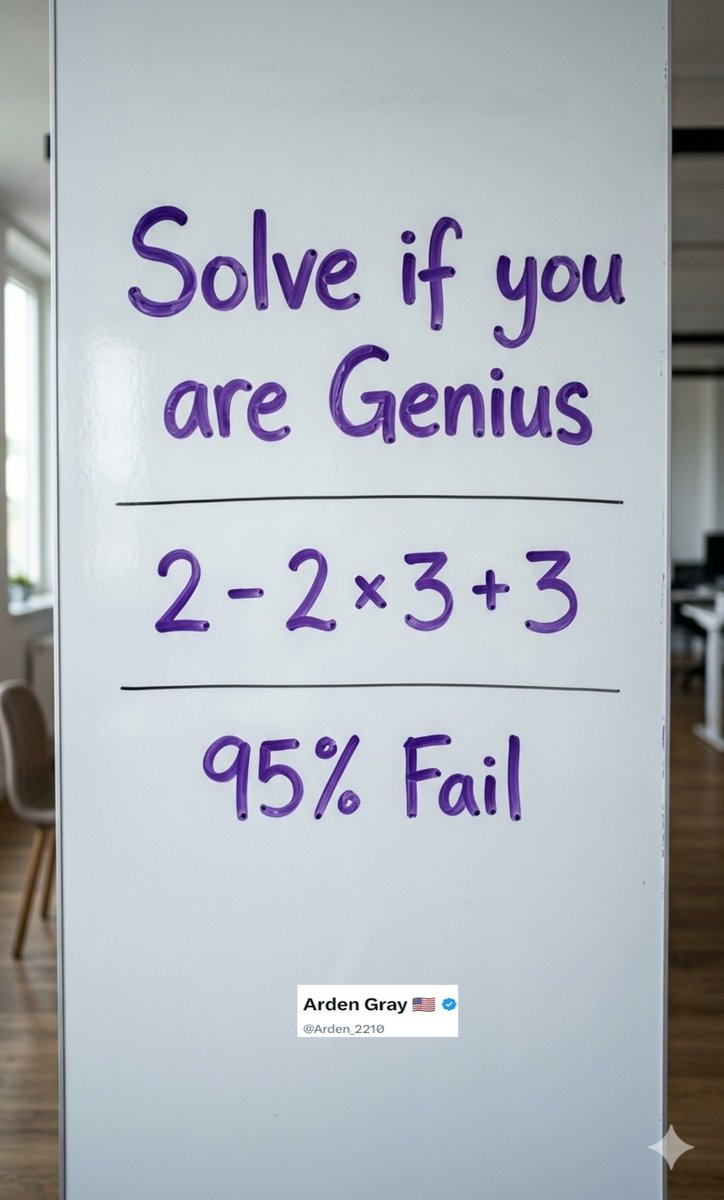
Answer is not "6" Then what is the answer??
Difficulty, "Hard"
English

Someone called me a leftie on here today. I’ve had to sit quietly in a dark room for a few hours. Feeling better now.
English
@afneil The oil profits levy is doing more damage than the ban on new licences
English

If that’s the case oil companies won’t apply for licenses. Leave it to the market not the politicians.
Angry Duck@histpics2025
@afneil What is your response to the claim that getting new oil out of the British part of the North Sea is no longer cost effective, all the easy to get stuff has already been drilled and extracted?
English
Stephen Milne retweetledi

BREAKING: Strait of Hormuz now observing New York Stock Exchange hours. Lunch break sponsored by Goldman Sachs.
English
There has been a lot of instances ovr the past few weeks!
Aaron Astor@AstorAaron
My general tendency is to reject conspiracy theories. And yet, this keeps happening - massive trades just minutes before Trump announces something. And that something (Iran handing over uranium and opening Hormuz) often turns out not to be true at all.
English
Stephen Milne retweetledi

Our 🇬🇧 last few governments punished oil companies for drilling in the North Sea, while 😨 falling for green scare stories about earthquakes and misleading footage of near-surface shale gas extraction in the USA to stop fracking here.😱
English
I come from Peterhead, a fishing town on North East Scotland, the RNLI has saved so many lives and lost some of their own, nothong but admiration for them!
Andy@CybermanAndy
@SimonHarrisMBD I only have admiration for RNLI teams. They put out to sea in pretty any weather to save lives. Hundreds of RNLI crew have lost their lives saving others. How many of us can say we do something so selfless?
English
Stephen Milne retweetledi

Just 20 minutes before Trump announced the Strait of Hormuz was open—Someone dumped 7,990 lots of Brent crude futures.
A $760 million bet that oil prices would drop.
Orders far larger than anything else in the market at that moment.
They made a fortune.
But somebody knew the announcement was coming.
This is insider trading at the highest level of government.
English
It has certaonly looked that way for a few weeks now!
Turnbull@cturnbull1968
This may turn out to be the biggest stock market manipulation in American history.
English
Stephen Milne retweetledi
A few days ago we talked about the university racket: the thirty-year experiment in charging every eighteen-year-old nine grand a year for credentials of diminishing value.
Here is the other half of the story: while the universities were expanding, the alternative - the life-shaping, geopolitically vital, nation-building alternative - was being destroyed.
Apprenticeship starts among under-twenty-fives have fallen 40% since 2015. In a country that cannot find enough plumbers, electricians, welders, or bricklayers to build the houses it desperately needs, and with skill deficits in almost every major line of work, we have somehow managed to spend a decade making it harder for young people to learn how to do, build, and craft things.
There are now 106 applicants for every apprenticeship opening in the trades. Plumbing starts have fallen 37% since 2021. Electrician training is down 16% year on year, with completion rates so low that the pipeline is essentially decorative.
The country needs 140,000 extra construction workers a year to meet its own housebuilding targets, and the system that is supposed to produce them is running at roughly half the capacity it had a decade ago.
How did this happen? The Apprenticeship Levy happened. Introduced in 2017, it was supposed to fund training. Instead, large employers discovered they could use it to put their existing middle managers through degree-level qualifications — £400 million a year spent on people who already have degrees, while the number of apprenticeship starts at small and medium businesses, where the trades are actually taught, collapsed by 48%. The levy did not fund a training revolution. It funded a credential-laundering operation for corporate HR departments, and the bricklayer and the spark and the plumber paid for it with places that no longer exist.
Meanwhile, a generation of young people who are good with their hands — who do not want a lecture hall, who want a workshop and a trade and the self-respect that comes from mastering something real — are being told, by the structure of the system if not in so many words, that there is no room for them. The universities had unlimited space and unlimited fees and unlimited encouragement. The trades had a levy that was captured by consultants before it reached a single apprentice.
Britain was built by people who could do things. The economy we need — the houses, the reactors, the infrastructure, the physical rebuilding of a country that has been falling apart for thirty years — will be built by people who can do things. Every year we let the training pipeline shrink is a year we are choosing, actively, to remain a country that talks about renewal while making it structurally impossible.
English
Stephen Milne retweetledi

@crit_gen You and your facts. You will be claiming next humans can’t change their sex 🤦🏼♀️
English
Stephen Milne retweetledi
The University of Leicester has pulled nearly three hundred UCAS offers for students who were expecting to start Modern Languages and Film Studies this September. The departments are being shut down. The students, many of whom will have turned down other universities and planned their year around going to Leicester, have been told to naff off and find somewhere else.
Leicester's UCU co-chair called it a "language-learning desert in the East Midlands." Nottingham has already suspended intake for over forty courses. Essex is closing its entire Southend campus this summer; eight hundred students told to commute to Colchester, four hundred staff let go, international enrolments down fifty-two per cent since 2021. Thirty thousand university jobs have gone across the sector in three years.
And the instinct, naturally, is to call this a crisis. I think it's something different.
There is no more transformative force for good in all of civilisation than education; and nothing better explains the straits we find ourselves in in 2026 than to consider how much better we were educating people in 1926 than we are now.
Nevertheless, an education industry is not the same as a culture of education. And I think what's happening across the tertiary education sector might be something closer to a long-overdue correction of a model that was, at bottom, a racket.
The British university sector spent thirty years expanding on the following proposition: charge every eighteen-year-old nine thousand two hundred and fifty pounds a year, regardless of aptitude, regardless of whether the degree has any labour-market value whatsoever.
It's great business. You are nominally giving the appearance of investing in your young by building a credential pipeline whose main output, as Rachel Reeves all but admitted earlier this year, is the never-ending interest payments on student loans that allow government to continue spending money on black-hole entitlement schemes, while keeping your brand new confected middle class in debt slavery forever after.
Once you've got the domestic student body enlarging at a sufficient clip, you start to really bolster the institutional funds with a parallel stream of international students paying three times what the locals pay for the privilege of a British institutional stamp on their CV.
You take the money, build a vanity campus in a satellite town, pay the vice-chancellor £666,000 a year (Oxford, since you ask, though perhaps they've earned the right), and then act stunned when the international pipeline dries up and the sums stop working.
These institutions were not, in the main, parsing the frontiers of human knowledge. They were running a fee-collection operation with a graduation ceremony bolted on. The students were the revenue line; the degree was the packaging; and now that the customers are thinning out, the factories are closing, and the people who ran them would like the taxpayer to treat this as a tragedy rather than a consequence.
If they cannot serve to demand, if they do not have a service worth providing, if they are in excess to the demand that would sustain them, then we must them close.
Let the ones that are genuinely excellent survive on merit, and for those that do not, let something be built in their place that fills in the gaping craters in our economic firmament by teaching people to do things the country actually needs done.
Britain managed to produce Newton, Darwin, and the entire Industrial Revolution - managed to establish a system that spread more intelligence throughout the world than any other nation before or since - before anyone decided that fifty per cent of school leavers needed a three-year residential degree whose value as a credential has been utterly annihilated by academic inflation, and economically voided by a lack of graduate jobs.
English
Stephen Milne retweetledi

@Matt_Pinner Grok: What's the difference between a Swede and a turnip?
A Swede is a person from Sweden. A Turnip is the Prime Minister of the UK.
English

My son passed his driving test today finally after 5 years or so, interrupted by COVID and Uni. The other is off travelling in the far east on his own and my worry as a mother has just hit the highest peak since they were young and I had to cut grapes into 4 bits!
English