Steven Kelly

4.5K posts

Steven Kelly banner
Steven Kelly

Steven Kelly

@StevenKelly49

Senior Advisor, @FDICgov. Former director at the Yale Program on Financial Stability. Still an academic at parties.

[email protected] Katılım Mart 2019
369 Takip Edilen9.5K Takipçiler
Sabitlenmiş Tweet
Steven Kelly
Steven Kelly@StevenKelly49·
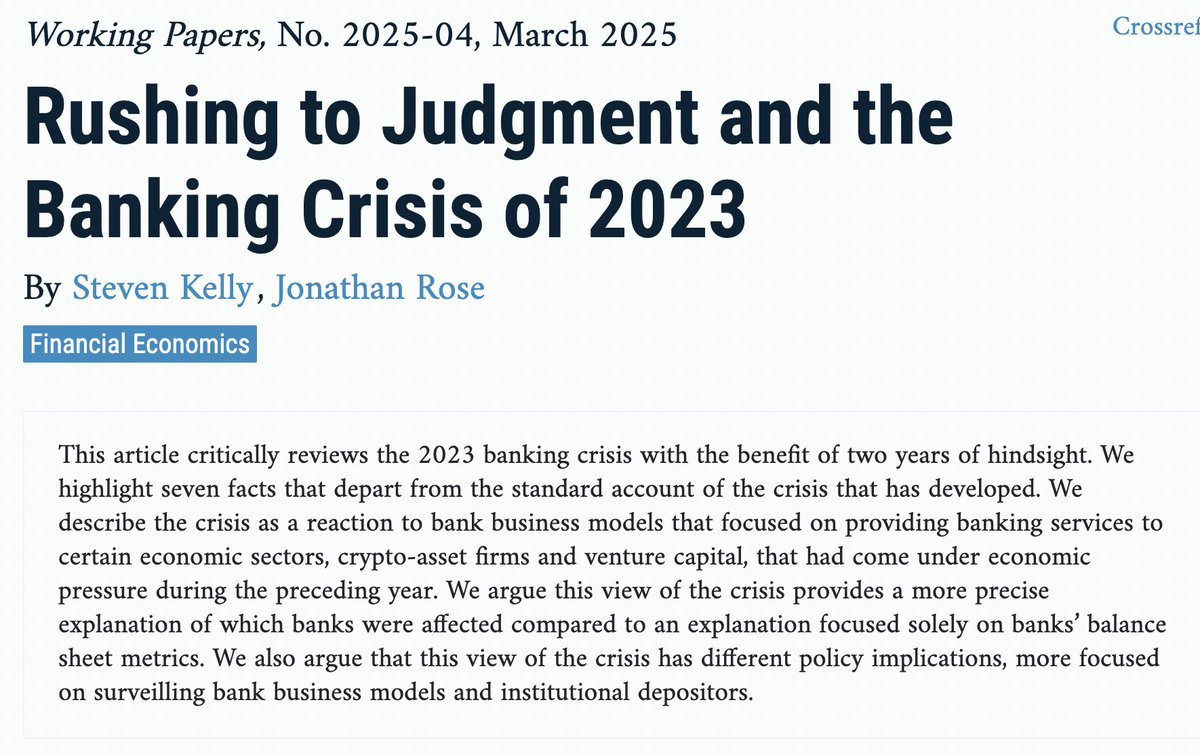
New paper: "Rushing to Judgement and the Banking Crisis of 2023" At the two-year anniversary of the crisis, @thejonrose and I present 7 facts that are overlooked in the standard account of the crisis: chicagofed.org/publications/w…
Steven Kelly tweet media
English
5
22
112
84.4K
Steven Kelly retweetledi
Emil Verner
Emil Verner@EmilVerner·
New paper on bank runs with Correia and Luck: "Bank Runs With and Without Bank Failure" Questions: - What are the determinants of runs? - When do bank runs result in bank failure? - Can runs trigger the failure of healthy banks and amplify small shocks into large crises? - Are runs themselves the initial cause of financial distress or are they a symptom of deeper fundamental solvency problems in the financial system? What we do: - Apply LLMs to historical newspapers to uncover over 4,000 runs on individual banks in the pre-FDIC US banking system from 1863 to 1934. Capture the most famous runs (Bank of the US - Merge data on runs and other bank-level events discussed in newspapers (suspensions, failures) to bank-level fundamentals (harder than it sounds!) What we find: (1) Runs are considerably more likely in weak banks, but can also occur in strong banks, especially in response to negative news about the real economy or the broader banking system. (2) However, runs typically only result in failure for banks with weak fundamentals [see figure below]. Strong banks survive runs through various mechanisms, including interbank cooperation, equity injections, public signals of strength, and suspension of convertibility (3) At the local level, poor fundamentals necessary for runs to translate into large declines in lending. Moreover, bank failures (with and without runs) translate into substantially larger declines in deposits and lending than runs without failures. Overall takeaways: - Poor fundamentals are key for whether runs pass through into failure and have severe consequences for the broader economy. - The findings temper the view that small shocks can result in large jumps to bad equilibria via runs on demandable debt. Full paper here. Comments welcome. Given the methodology and evolving AI tools, we expect to make refinements to the runs database over time. Any input is welcome. static1.squarespace.com/static/58f6b1c…
Emil Verner tweet media
English
3
54
185
51.6K
Steven Kelly
Steven Kelly@StevenKelly49·
@khaslett “pays for itself”? My scam sensors are going off 😂
English
1
0
0
44
Steven Kelly
Steven Kelly@StevenKelly49·
@khaslett nothing a quick squeegee at the gas station can't fix. Certainly not every 20 days??
English
1
0
0
27
Steven Kelly
Steven Kelly@StevenKelly49·
Me trying to explain the Industry season finale:
GIF
English
0
0
2
656
Steven Kelly
Steven Kelly@StevenKelly49·
Chair Hill on stablecoin flows: "It is worth noting, however, that this likely would not have a material impact on the aggregate deposits in the banking system [... ] but this would have impacts on the nature and distribution of deposits across the system" fdic.gov/news/speeches/…
English
2
4
20
5.2K
Steven Kelly
Steven Kelly@StevenKelly49·
The Board seemed to invoke the authority through gritted teeth: "It was reiterated that the Board would prefer that this authority not be used, and that this action did not set a precedent for other institutions that were not similarly affected by the pending legislation."
English
0
0
3
370
Steven Kelly
Steven Kelly@StevenKelly49·
The invocation of Section 13(3) is (rightfully) associated with widespread banking stresses and a pandemic. But also, in 1980, the Fed invoked it to lend up to $5 million to a $100-million bank in Kansas.
English
1
0
3
848
Eric Wallerstein
Eric Wallerstein@ericwallerstein·
i’m tired of hearing about euribor grandpa! well that’s too damn bad!
Eric Wallerstein tweet media
English
2
0
18
1.6K
Steven Kelly
Steven Kelly@StevenKelly49·
"Weekly aggregate disclosure makes [discount window] borrowing potentially detectable by markets. Above-market interest rates make borrowing costly, even for testing. Markets interpret any usage as a sign of fragility."
Federal Reserve@federalreserve

Speech by Vice Chair for Supervision Bowman on liquidity resiliency, financial stability, and the role of the Federal Reserve: federalreserve.gov/newsevents/spe… Learn more about Vice Chair for Supervision Bowman: federalreserve.gov/aboutthefed/bi…

English
1
1
7
3.9K