The Business of Sports

572 posts

The Business of Sports banner
The Business of Sports

The Business of Sports

@StickySportsBiz

The business of sports, explained. 📈💰

Katılım Şubat 2025
8 Takip Edilen81 Takipçiler
The Business of Sports
The Business of Sports@StickySportsBiz·
When Egon Durban bought 3.5% of the @Raiders last month, he paid Mark Davis $388 million. Then he paid another $39 million to thirty-one people he wasn't buying anything from. The clause that explains why is the most important one in @NFL economics. Almost no one knows it exists. x.com/StickySportsBi…
English
0
0
0
45
The Business of Sports
The Business of Sports@StickySportsBiz·
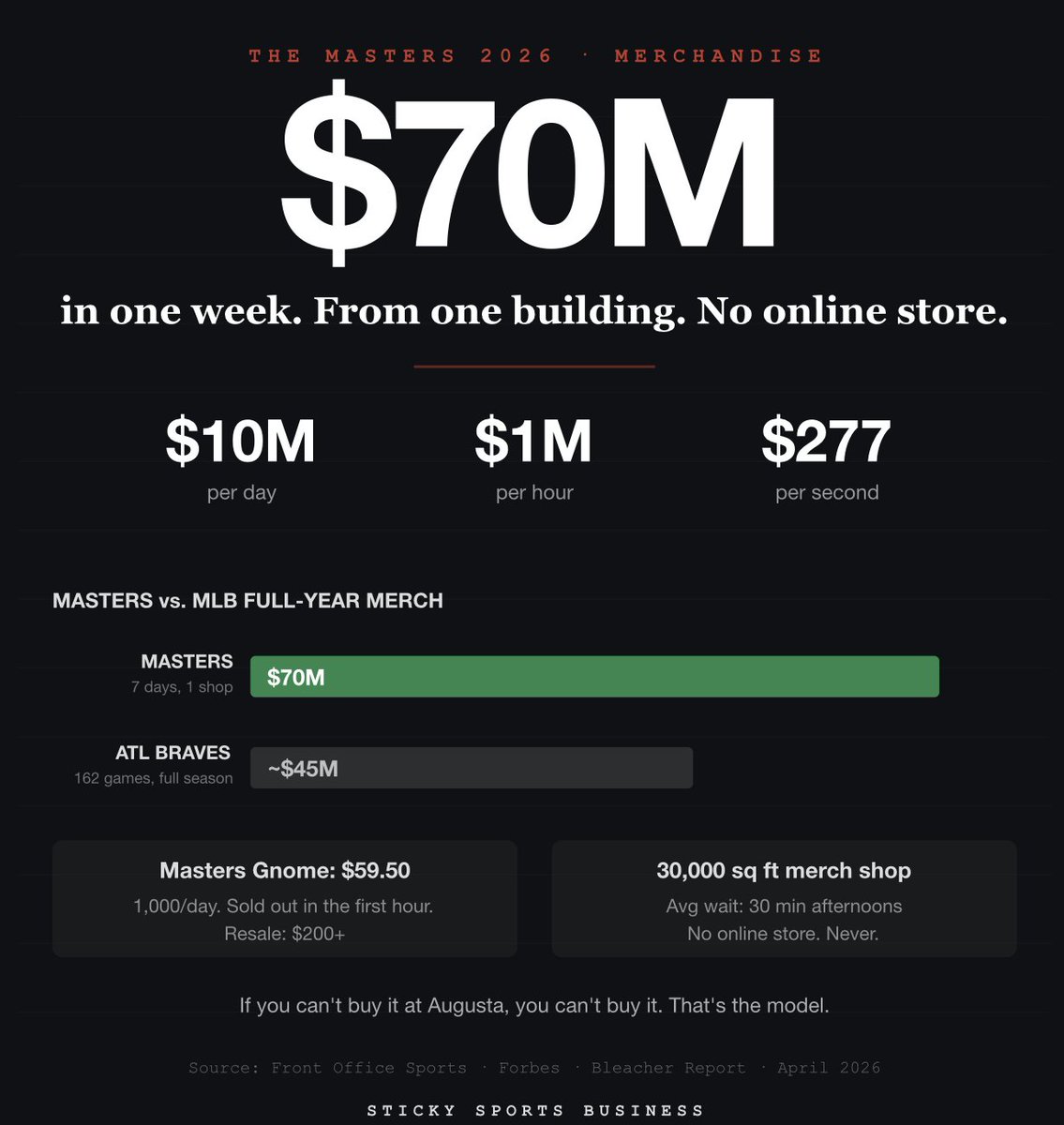
The Masters just sold $70 million in merchandise. In seven days. From one building. With no online store. That's $10 million per day. $1 million per hour. $277 per second. For context, that's $25 million more than the @Braves generate in merchandise across an entire 162-game @MLB season. Yesterday I broke down how Augusta National leaves $300 million in annual revenue on the table by charging CBS nothing for broadcast rights, limiting ads to 4 minutes per hour, and allowing only 6 sponsors. The obvious follow-up: if Augusta turns down that much revenue, where does the money actually come from? This is a large part of the answer. Merchandise. Everything about Augusta's merch operation is designed around scarcity: → 30,000-square-foot on-site shop. No online store. Not in 2026. Not ever. → If you want it, you have to be there. If you can't be there, you can't buy it. → The Masters Gnome: $59.50 retail. 1,000 available per day. Sells out within the first hour every morning. Resale value: $200+. → $88 sweatshirts. $178 woven bags. All exclusive to that building on that week. → Average afternoon wait time to enter the shop: 30 minutes. → Patrons walk in knowing they're buying something they can't get anywhere else on the planet. This is the same scarcity playbook Augusta runs on everything. Fewer ads make each ad worth more. Fewer sponsors make each partnership worth more. No online merch makes every in-person purchase feel like a collectors item. The $1.50 pimento cheese sandwich isn't where Augusta makes its money. The $70 million merch shop is. Augusta figured out something most sports properties haven't: you don't need to sell everywhere to sell a lot. You need to sell nowhere else. The constraint IS the demand driver. Removing access doesn't reduce revenue. It concentrates it. 40,000 patrons per day funneled into one shop with exclusive product and zero alternative. That's not retail. That's a conversion machine. The Masters' merch revenue alone likely covers the $22.5 million tournament purse three times over. And they still have $60 million in sponsorship, $150 million+ in tournament week gate receipts, and whatever they choose not to collect from CBS. Every other sports property is chasing e-commerce scale. Augusta is running a pop-up shop that does more in a week than most franchises do in a year. What would happen if other leagues tried this model? #TheMasters #Business #SportsBusiness #Golf #Merchandise #NBA #MLB #Retail #NFL #Finance #PGATour #SportsMerch
The Business of Sports tweet media
English
0
0
0
48
The Business of Sports
The Business of Sports@StickySportsBiz·
Augusta National charges @CBS $0 for the right to broadcast the Masters. Not a discount. Not a below-market deal. Zero dollars. The network sends Augusta National Golf Club an invoice for production costs, Augusta collects from its six sponsors to cover it, and that's the transaction. No rights fee. No negotiation. No leverage given. @Forbes estimates Augusta deliberately leaves $300 million in annual revenue unrealized. They treat that number as a badge of honor. @McIlroyRory just won his second consecutive Masters, joining only Nicklaus, Faldo, and Woods as back-to-back champions. He took home $4.5 million from a record $22.5 million purse. But the business story at Augusta has nothing to do with the purse. It has everything to do with what the club refuses to sell. The numbers that define Augusta's model: → TV rights fee charged to CBS/@espn : $0 → Advertising per broadcast hour: 4 minutes (industry average: 18-20 minutes) → Total sponsors: 6 (@ATT, @IBM, @MercedesBenz, @ROLEX, @BankofAmerica, @UPS) → Estimated sponsorship revenue: ~$60 million per year → @usopengolf sponsorship revenue from 30+ partners: ~$15 million → Pimento cheese sandwich: $1.50. Average stadium sandwich: $12-18. → Tournament week economic impact on Augusta, GA: $110 million+ Augusta generates 4x the sponsorship revenue of the US Open from one-fifth the number of sponsors. That's not a pricing anomaly. That's pricing power built on scarcity. Every other major sports property is maximizing. More sponsors. More ads. More rights fees. More content. More platforms. Augusta is doing the opposite. Fewer sponsors. Fewer ads. No rights fees. Total editorial control over the broadcast. And it works better than every property trying to extract every dollar. The @NFL sells 18-20 minutes of ads per broadcast hour. Augusta allows 4. The Super Bowl has 50+ official sponsors. Augusta has 6. The NFL charges billions for broadcast rights. Augusta charges nothing. And yet Augusta's brand premium per unit of commercial activity is arguably the highest in global sports. @CBS can't sell its own ad time during the Masters. Augusta's sponsors get the slots, and Augusta decides how many there are. The network accepts these terms because being associated with the Masters is worth more than the ad revenue they're forfeiting. That's the business insight: when scarcity is the product, leaving money on the table IS the strategy. Every dollar Augusta refuses to take makes the next dollar it does take worth more. The $1.50 pimento cheese sandwich isn't charity. It's brand architecture. How long can a model built on restraint survive in a sports industry built on excess? #TheMasters #Augusta #SportsBusiness #Golf #RoryMcIlroy #BrandStrategy #MediaRights #Sponsorship #PGATour #CBS #SportsBiz #LuxuryBranding
The Business of Sports tweet media
English
0
0
0
44
The Business of Sports retweetledi
The Crossover: NBA Europe
The Crossover: NBA Europe@nbaeuropepod·
The April meeting is the hinge point of this entire story. If the NBA and EuroLeague find common ground, you've got shared infrastructure, instant credibility, and a product that makes sense to European fans. No deal, and the NBA is essentially parachuting into someone else's market with someone else's money and hoping goodwill follows.
The Business of Sports@StickySportsBiz

5: The risk: The @EuroLeague has operated in these markets for decades. NBA and EuroLeague meet end of April. Partnership = shared infrastructure, instant credibility. No deal = the NBA is launching a competitor in someone else's backyard with someone else's money.

English
0
1
1
210
The Business of Sports
The Business of Sports@StickySportsBiz·
5: The risk: The @EuroLeague has operated in these markets for decades. NBA and EuroLeague meet end of April. Partnership = shared infrastructure, instant credibility. No deal = the NBA is launching a competitor in someone else's backyard with someone else's money.
English
1
0
1
252
The Business of Sports
The Business of Sports@StickySportsBiz·
The @NBA just received multiple $1B bids for franchises in a league with zero revenue, zero games, and zero broadcast deals. 120+ investors submitted first-round bids for NBA Europe on Tuesday. Here's why the numbers are unprecedented 🧵
The Business of Sports tweet media
English
1
0
0
62
The Business of Sports
The Business of Sports@StickySportsBiz·
6: The pitch clock shortened games. ABS is fixing the calls. Tested since 2019 in the minors. Six years of R&D. MLB is quietly becoming the most tech-forward league in American sports. And we're only one week in. #MLB #RobotUmpires #ABS #SportsTech
English
0
0
0
18
The Business of Sports
The Business of Sports@StickySportsBiz·
5: The business side: 12 Hawk-Eye cameras per stadium. 360 total. Powered by T-Mobile 5G. Challenge animations are branded. Broadcast integrations create new ad inventory every time someone taps their helmet. This isn't just a rules change. It's a tech product rollout across 30 venues.
English
1
0
0
31
The Business of Sports
The Business of Sports@StickySportsBiz·
MLB's robot umpires just overturned 94 calls in 47 games. The ABS challenge system has been live for one week. Here's what the data shows 🧵
The Business of Sports tweet media
English
1
0
0
26