

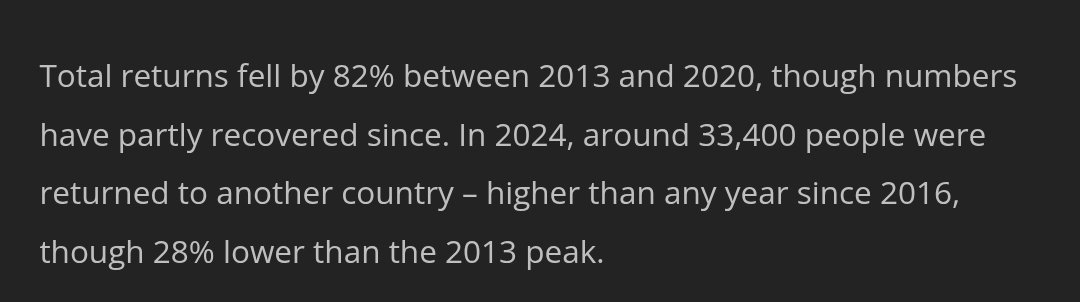
@Amimej2026xae @TheNigh31157 @narindertweets @grok You and grok have just confirmed it's a token amount,
You could provide the total number who should be deported ie illegal workers, criminals and the unemployed ??
English
Scott Strathearn
7.8K posts
@StrathearnScott
preferred pronouns fan/dabi/dozi. don't call out people for lying when you follow liars.







How Labour Priced a Generation Out of Work There is a cruel irony at the heart of Britain's youth unemployment crisis. A government that claims to stand for young people has helped price them out of their first job. Youth unemployment has surged to levels not seen in more than a decade. Britain now sits above the European average and is edging towards the territory once used as a warning to the rest of the continent. This did not happen by chance. It did not arrive like a storm from nowhere. It is the direct result of political choices made in the name of fairness and dressed up as progress. The moral story was simple and emotionally satisfying. Paying younger workers less was branded discriminatory. Age bands were cast as injustice. Equal pay sounded like equality. It sounded compassionate. It sounded modern. It also ignored how labour markets actually work. Young workers are not cheaper because society values them less. They are cheaper because they are new, untested and still learning. They need training. They need supervision. They change jobs more often. They make mistakes. That is not a moral judgment. It is economic reality. Youth wage bands exist for a reason: they are the bridge between education and employment. Remove the bridge and the crossing becomes harder. The government did not merely narrow that bridge. It hammered it from every direction at once. Employer National Insurance was raised. Minimum wages surged. The youth rate jumped by close to twenty per cent. Regulation tightened. All of this landed on the sectors where young people get their first foothold: retail, hospitality and entry-level service work. The very industries that teach people how to turn up on time, deal with customers and earn their first wage packet were handed a sharp rise in the cost of hiring. Businesses did what businesses always do when costs rise faster than productivity. They hired fewer people. Vacancies fell. Recruitment froze. Opportunities vanished quietly, one unfilled job at a time. Now almost a million young people wake up with nowhere to go and nothing to do. The country has more young people out of work than Europe. Even Greece, once the symbol of economic collapse, is no longer safely behind us. That comparison should have sent shockwaves through government. Instead we hear deflection, promises and stubborn refusal to rethink the policy that helped create the problem. What makes this worse is that the warning lights are not coming from political opponents alone. Former officials from the Office for Budget Responsibility, voices inside the Bank of England, economists from think tanks close to Labour's orbit are all pointing in the same direction. Employment costs rose sharply. Entry-level jobs shrank. Youth unemployment climbed. The link is obvious to anyone willing to see it. The government now finds itself trapped by its own rhetoric. Reverse course and it admits the policy failed. Stay the course and youth unemployment risks becoming a permanent feature of the labour market. Either way, the damage has already been done. The ladder into work has been kicked away in the name of equality. This is not a technical economic debate. It is a generational failure. Being out of work at the start of adult life leaves scars that last decades. Skills fade before they form. Confidence drains before it has a chance to grow. Ambition withers before it has time to take root. The first job is not only about wages. It is about dignity, independence and the belief that effort leads somewhere. Remove that first step and the climb never begins. A policy sold as fairness has delivered exclusion. A policy sold as compassion has produced idleness. A policy sold as progress has pushed thousands of young people to the margins of the economy before they even began their working lives. This is how lost generations are made. "Now almost a million young people wake up with nowhere to go and nothing to do."


Ireland's tiny population is a staggeringly unnatural outcome given its rich soil. I am convinced that Ireland had at least 10 million people before the Great Famine. A thread on how Ireland's huge population losses after the events of the 1840s have been underestimated 🧵









Has Britain forgotten the Conservatives even exist? 👀 If Essex, Tory heartland and home to some of the party’s biggest names, turns from blue to Reform turquoise, does @KemiBadenoch has a serious problem? 🗳️ This is the territory of @KemiBadenoch, @JamesCleverly, @pritipatel and @RicHolden. If the Conservatives cannot hold Essex, what does the future hold? 🔵➡️🩵 #UKPolitics #Conservatives #ReformUK #Essex #LocalElections @conservatives @reformparty_uk @Nigel_Farage @lbc @lewis_goodall