Street Oregon

96 posts

Street Oregon

Street Oregon

@StreetOregon

Katılım Eylül 2023
91 Takip Edilen15 Takipçiler
Street Oregon retweetledi

*Walter Bloomberg
*Walter Bloomberg@DeItaone·
FED SEEKS DETAILS ON US BANKS’ EXPOSURE TO PRIVATE CREDIT FIRMS
English
38
67
615
132K
Documenting Saylor
Documenting Saylor@saylordocs·
Michael Burry $1,300,000,000 short position, before the 2008 housing crisis
English
24
68
1.4K
85.4K
Wall Street Apes
Wall Street Apes@WallStreetApes·
CEO of Citadel Ken Griffin says that Data Center spend this year alone is set to be half a trillion dollars, $500 billion He says that AI is useful in some areas but it’s not worth the investment, he says a lot of what it produces “It’s all garbage” “Data center spent in the United States this year, over half a trillion dollars, like over $500 billion. You're not gonna generate this kind of spend unless you're gonna make a promise. You're gonna profoundly change the world. So is it hype? Of course — In certain areas, we know it's gonna be profound, whether it's call centers, whether it's helping to improve the productivity of software engineers, but in a number of white collar jobs, you know, there was a, there was a recent Harvard paper on this, they called it AI work Slop, that it looks good, but if you sort of peel back the onion, the substance isn't there. I was with one of my colleagues who runs our commodities business and they, he handed a report on that we were generated with an AI engine. Doesn't matter what the topic was, the first few sentences, like, wow, that's, that's really insightful. And then you go down below that and it's all garbage.”
English
163
417
1.9K
385K
Street Oregon
Street Oregon@StreetOregon·
@rohanpaul_ai If people are too stupid to know how to talk to ChatGPT, how the hell do they even have this white collar job?
English
0
0
0
306
Rohan Paul
Rohan Paul@rohanpaul_ai·
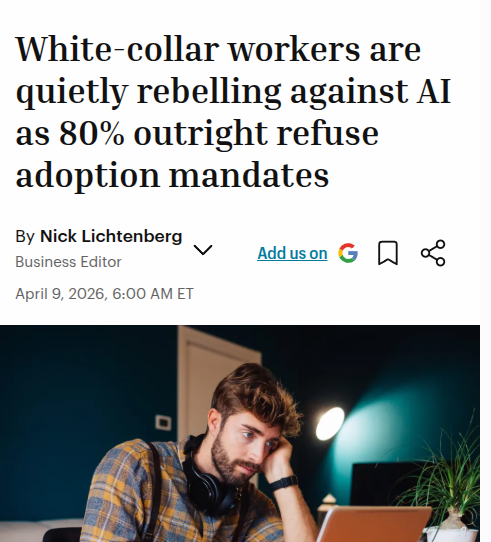
Fortune: Companies are spending millions on AI while most employees still refuse to use it. Roughly 80% of enterprise workers in this survey either skipped company AI tools, did the work manually, or did not use AI at all, even while companies kept raising spending on digital transformation. Executives saying the tools are ready while workers say the tools are confusing, poorly explained, and untrustworthy for serious decisions. imo, skill issue, probably for most. --- fortune .com/2026/04/09/ai-backlash-quiet-quitting-fobo-obsolete-white-collar-rebellion/
Rohan Paul tweet media
English
119
61
289
37.7K
𝕰𝖒𝕲
𝕰𝖒𝕲@Emilio2763·
“I have a Tattoo on My RibCage that Says 1+1=11”… Wait for it….
English
43
206
3K
357.8K
Steven Bartlett
Steven Bartlett@StevenBartlett·
“Hundreds of years ago, people dreamt of what we have now” - Jimmy Carr.
City of London, London 🇬🇧 English
76
376
2.2K
173.8K
Street Oregon retweetledi
Andrej Karpathy
Andrej Karpathy@karpathy·
Wow, this tweet went very viral! I wanted share a possibly slightly improved version of the tweet in an "idea file". The idea of the idea file is that in this era of LLM agents, there is less of a point/need of sharing the specific code/app, you just share the idea, then the other person's agent customizes & builds it for your specific needs. So here's the idea in a gist format: gist.github.com/karpathy/442a6… You can give this to your agent and it can build you your own LLM wiki and guide you on how to use it etc. It's intentionally kept a little bit abstract/vague because there are so many directions to take this in. And ofc, people can adjust the idea or contribute their own in the Discussion which is cool.
Andrej Karpathy@karpathy

LLM Knowledge Bases Something I'm finding very useful recently: using LLMs to build personal knowledge bases for various topics of research interest. In this way, a large fraction of my recent token throughput is going less into manipulating code, and more into manipulating knowledge (stored as markdown and images). The latest LLMs are quite good at it. So: Data ingest: I index source documents (articles, papers, repos, datasets, images, etc.) into a raw/ directory, then I use an LLM to incrementally "compile" a wiki, which is just a collection of .md files in a directory structure. The wiki includes summaries of all the data in raw/, backlinks, and then it categorizes data into concepts, writes articles for them, and links them all. To convert web articles into .md files I like to use the Obsidian Web Clipper extension, and then I also use a hotkey to download all the related images to local so that my LLM can easily reference them. IDE: I use Obsidian as the IDE "frontend" where I can view the raw data, the the compiled wiki, and the derived visualizations. Important to note that the LLM writes and maintains all of the data of the wiki, I rarely touch it directly. I've played with a few Obsidian plugins to render and view data in other ways (e.g. Marp for slides). Q&A: Where things get interesting is that once your wiki is big enough (e.g. mine on some recent research is ~100 articles and ~400K words), you can ask your LLM agent all kinds of complex questions against the wiki, and it will go off, research the answers, etc. I thought I had to reach for fancy RAG, but the LLM has been pretty good about auto-maintaining index files and brief summaries of all the documents and it reads all the important related data fairly easily at this ~small scale. Output: Instead of getting answers in text/terminal, I like to have it render markdown files for me, or slide shows (Marp format), or matplotlib images, all of which I then view again in Obsidian. You can imagine many other visual output formats depending on the query. Often, I end up "filing" the outputs back into the wiki to enhance it for further queries. So my own explorations and queries always "add up" in the knowledge base. Linting: I've run some LLM "health checks" over the wiki to e.g. find inconsistent data, impute missing data (with web searchers), find interesting connections for new article candidates, etc., to incrementally clean up the wiki and enhance its overall data integrity. The LLMs are quite good at suggesting further questions to ask and look into. Extra tools: I find myself developing additional tools to process the data, e.g. I vibe coded a small and naive search engine over the wiki, which I both use directly (in a web ui), but more often I want to hand it off to an LLM via CLI as a tool for larger queries. Further explorations: As the repo grows, the natural desire is to also think about synthetic data generation + finetuning to have your LLM "know" the data in its weights instead of just context windows. TLDR: raw data from a given number of sources is collected, then compiled by an LLM into a .md wiki, then operated on by various CLIs by the LLM to do Q&A and to incrementally enhance the wiki, and all of it viewable in Obsidian. You rarely ever write or edit the wiki manually, it's the domain of the LLM. I think there is room here for an incredible new product instead of a hacky collection of scripts.

English
1K
2.7K
25.8K
6.5M
Street Oregon retweetledi
Tech with Mak
Tech with Mak@techNmak·
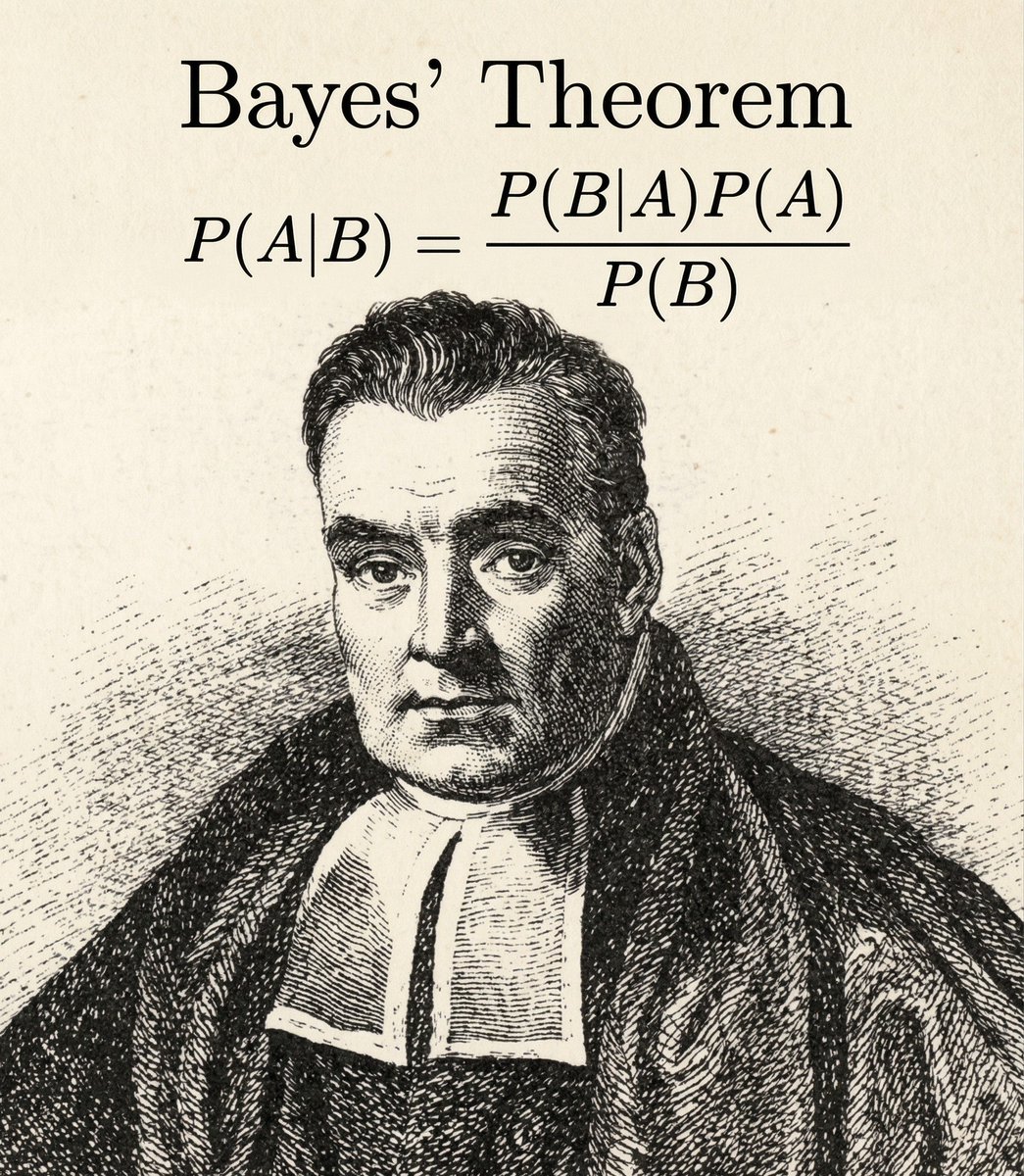
Most engineers have seen this formula. P(A|B) = P(B|A) × P(A) / P(B) Almost none can explain what it actually does. Here's Bayes' Theorem in plain English, and where it's hiding inside systems you use every day. The core idea in one sentence: Bayes' Theorem updates your belief about something after seeing new evidence. That's it. Four terms: Prior → what you believed before the evidence Likelihood → how probable the evidence is, given your hypothesis Evidence → how common the evidence is overall Posterior → your updated belief after seeing the evidence A concrete example: Say 40% of all emails are spam (your prior). You see a new email containing the word "lottery." 10% of spam emails contain "lottery." Only 1% of legitimate emails do. Plug into Bayes: P(spam | "lottery") = (0.10 × 0.40) / P("lottery") ≈ 87% The word "lottery" updated your belief from 40% → 87%. That's Bayes in action. Prior belief + new evidence = updated belief. Where it lives in AI: 1/ Spam filters The Naive Bayes classifier, the algorithm behind most spam filters - applies this exact calculation word by word across an entire email. Each word shifts the probability up or down. It's called "naive" because it assumes each word is independent of the others, which isn't realistic, but works remarkably well in practice. 2/ Medical diagnosis AI A patient has symptom X. What's the probability of disease Y? Bayes updates the base rate (how common the disease is) with the likelihood of seeing that symptom in patients who have it. Same formula, different domain. 3/ Your LLM's uncertainty Modern language models don't just predict the next token, they assign a probability to every possible token. The sampling process (temperature, top-p) is directly working with those probability distributions. Bayesian reasoning is embedded in every response your model generates. The insight most engineers miss: Bayes doesn't give you certainty. It gives you a rational way to update uncertainty. That's exactly why it's foundational to AI - real-world systems are never certain. They're always working with incomplete, noisy, probabilistic information. Every model that learns from data is, at its core, doing some version of this: Start with a belief. See evidence. Update the belief. That's Bayes. That's machine learning.
Tech with Mak tweet media
English
38
454
2K
109.7K
Street Oregon
Street Oregon@StreetOregon·
@Evan99503 @cz_binance I saw CZ on a podcast once. He is just like us, just a smart hard-working person that created his success through hard work. Greetings from America
English
0
0
2
6
玄投君 Flame
玄投君 Flame@Evan99503·
@cz_binance 谢谢大表哥 🙏 1000万粉丝愿意低头普通人的帖子——这份亲切之外,更打动我的是你的信仰。卖房押注BTC,币安第一分钟差点崩盘,一路走到今天,没有信念走不到这里。
中文
2
0
0
153
玄投君 Flame
玄投君 Flame@Evan99503·
CZ 新书《Freedom of Money》今天出版,全书收益捐给慈善。 这本书最值钱的章节,不是他怎么打造全球最大加密交易所。是2017年7月14日,Binance 上线的第一分钟。 那一天,团队对着屏幕倒数:3,2,1—— Binance 上线。 下一秒,屏幕被卖单吞没。没有买单。BNB 价格开始下跌。CZ 事后写:This is not good, right? 房间从满心期待,瞬间陷入死寂。 他不知道 Binance 能不能活过那一周。 2017年的加密市场:大量 ICO 破发、交易所跑路、监管打压。Binance 在一个所有人都已经不相信这个行业的时刻,上线了。 九年后——BNB ≈ 615美元,币安历史累计交易额超过 50 万亿美元,全球用户数超过 2 亿。 但这本书的核心,不是讲这些数字。 2023年,币安遭遇美国司法部起诉,CZ 面临几十年监禁。他最终认罪、坐牢、辞任 CEO。 这本书出版于他出狱之后。 不是成功学。是:一个创始人在行业最绝望的时刻上线,扛过早期危机,做成全球最大,然后从最高点坠落,再站起来。 Protecting Users, Resilience, and the Founding of Binance——这才是书名全称。 最让我触动的是新书序言里的那句话——他没有写自己赢了什么,他写了上线第一分钟,他以为自己做错了什么。 这种人在山顶和山谷都能诚实。 April 8, 2026. Book: Freedom of Money. All proceeds to charity. 那一分钟改变了很多人的命运。这本书,或许能改变更多。
中文
7
2
58
12.2K
Dov Kleiman
Dov Kleiman@NFL_DovKleiman·
Who's the worst QB in this photo? 🤔
Dov Kleiman tweet media
English
602
20
500
1.2M
Sara Rose 🇺🇸🌹
Not one person watching this could give 2 shits what the weather is 😂
English
1.6K
774
16.2K
1.1M
Street Oregon retweetledi
Jack Kevorkian
Jack Kevorkian@kevorkian82·
this is possibly THE MOST Australian interview ever
English
343
2.4K
12.6K
761.4K
Edward Dowd
Edward Dowd@DowdEdward·
The consensus is that as of today the Strait is still effectively closed. It’s day 39 of closure. Time closed is the enemy for the global economy. The strait needs to open soon and even then extensive supply will still be offline. During last year’s tariff turmoil Trump 💯 controlled that dial. Here he does not have that level of control. Iran gets a vote.
Annmarie Hordern@annmarie

“We have seen an uptick of traffic in the strait today,” says Press Secretary Karoline Leavitt. According to ship-tracking data compiled by Bloomberg just three ships were observed leaving the region on Wednesday. bloomberg.com/news/articles/…

English
46
58
448
27.7K