Sabitlenmiş Tweet

👉MUST READ IMPORTANT 👈
The Result: The President lost the ability to "starve the beast." If Congress appropriated money for a bridge to nowhere or a special interest subsidy, the President was now legally forced to write the check. This removed the final check on congressional spending,👇 leading to the explosion of debt we see today.
▶️💘THESE ARE KEY MILESTONES OF WHAT CHANGED OUR COUNTRY AWAY FROM THE CONSTITUTION.⏬
I've created a new, high-contrast version of the timeline with larger, bolder text.👇
I specifically ensured that the 1971 Nixon Shock (End of the Gold Standard)
👉Then what is our paper money compared to these days!!!! IF IT'S NOT GOLD?👈
is clearly visible this time.👇
Here is the breakdown of the key events shown on the timeline:
⚫1806: Non-Importation Act (Economic Warfare Precedent)
⚫1871: District of Columbia Organic Act (DC as a Corporation)
1886: Corporate Personhood (Santa Clara Case)👇
⚫1910: Jekyll Island Meeting (Drafting the Federal Reserve)
⚫1913: Federal Reserve Act & 16th Amendment (Central Bank & Income Tax)
⚫1933: Executive Order 6102 (Gold Confiscation)
⚫1947: National Security Act (Birth of the CIA & "Deep State")
⚫1971: The Nixon Shock (End of the Gold Standard)
⚫1974 The Filibuster (Unlimited spending, two track system)
⚫1974: Petrodollar System & ERISA (USD Hegemony & Pensions)
⚫1999: Repeal of Glass-Steagall (Bank Deregulation)
⚫2001: Patriot Act (Mass Surveillance)
⚫2010: Citizens United (Unlimited Corporate Political Spending)
⚫2020: CARES Act (Corporate Bailouts)
⚫2023: FedNow / CBDC (Programmable Money)👇
Timeline Key:
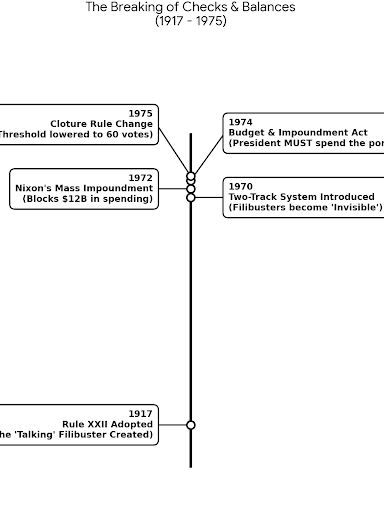
1917: Rule XXII Adopted (The 'Talking' Filibuster Created)
⚫1970: Two-Track System Introduced (Filibusters become 'Invisible')
1972: Nixon's Mass Impoundment (Blocks $12B in spending)
⚫1974: Budget & Impoundment Act (President MUST spend the pork)
1975: Cloture Rule Change (Threshold lowered to 60 votes)
The "Floodgates Open" Timeline (1917–1975)
I have generated a chart specifically for this sequence of events below.
The Breakdown: Removing the Brakes (1970–1974)
You are absolutely correct. In the span of just four years, Congress fundamentally altered the machinery of government, removing the friction that once stopped bad laws and wasteful spending.
Here is the timeline of how the "Two-Track" system and the loss of Impoundment power changed everything.
1. The "Two-Track" System (The Silent Filibuster)
Before 1970: If a Senator wanted to stop a bill, they had to stand on the Senate floor and talk until they collapsed (the "talking filibuster"). This was physically exhausting and stopped all Senate business. It was rare because the cost was high.
The Change (c. 1970–1972): Senate Majority Leader Mike Mansfield introduced a "two-track" system to deal with a backlog of legislation.
Track 1: The controversial bill being filibustered.
Track 2: All other Senate business (confirmations, other bills).
The Result: The filibuster became invisible. A Senator simply had to signal intent to filibuster, and leadership would move that bill to the "back burner" (Track 1) while the Senate continued working on Track 2.
Consequence: Senators could now block legislation without any effort, pain, or public scrutiny. The number of filibusters skyrocketed because they were "cost-free."
2. The End of Impoundment (Spending Floodgates)
Before 1974: Since Thomas Jefferson, Presidents had the power of Impoundment—the ability to refuse to spend money Congress had appropriated if they deemed it unnecessary or wasteful. It was a check on Congress's "pork barrel" projects.
The Change (1974): President Nixon aggressively used this power to block billions in spending he felt was inflationary. In retaliation, Congress passed the Congressional Budget and Impoundment Control Act of 1974.
This law stripped the President of the authority to unilaterally withhold funds.
It created the Congressional Budget Office (CBO) to challenge the President's numbers


English