Jonathan Duncan
7.3K posts

Jonathan Duncan
@SunSparc
I am a being of light, having a mortal experience, here on planet Earth. I love Jesus Christ, #music, #space, & #soccer. I #devops @SmartyCompany.
40.390842,-111.645936 Katılım Ağustos 2008
1K Takip Edilen429 Takipçiler

Hey, @NathanFillion! Have you heard that you are trying to bring back Firefly?! 😍 🚀
#bringbackfirefly
instagram.com/reel/DV6Js56jT…
English

@ynab, are you, by any chance, working on a feature that allows users to submit their budget to an LLM (aka "AI") to analyze their spending habits and potentially find where they might be able to save some money? (Not "Spendy", of course. 😅)
English
Jonathan Duncan retweetledi

A guy with a YouTube channel just accidentally redesigned the most complex machine in human history.
Not an aerospace engineer. Not a SpaceX executive.
A guy with a camera who asked one obvious question.
Tim Dodd was walking around Starbase when Musk proudly explained how the Super Heavy booster eliminated its entire cold gas thruster system. Instead of a separate, heavy, complex mechanism, it just vents hot gas directly from the propellant tanks.
Elegant. Zero added mass. Zero extra failure points.
Dodd asked one question.
“But this is only for the booster, right?”
Musk stopped.
Not to defend. Not to explain. Not to reframe the question so it didn’t threaten what he had just said.
He stopped because something clicked.
Musk: “Yes. Although arguably, now you mention it… we might be wise to do this for the ship, too. Now that… we’re going to fix that.”
Mid-sentence. In real time. On camera.
No pause to protect his pride. No deflection. No “good point, let me circle back on that.” Just the immediate, unfiltered acknowledgment that a better path existed and they were going to take it.
Seven months later, Musk confirmed it was one of the biggest improvements ever made to the vehicle.
Think about what just happened.
To change a fundamental flight system at a legacy aerospace company requires years of environmental reviews, safety committees, and budget approvals.
Musk deprecated an entire subsystem in 15 seconds because a podcaster asked the obvious question that nobody inside had dared to ask.
In a traditional corporation, that cold gas system gets built anyway.
Because admitting the architecture is flawed is politically expensive.
The VP doesn’t want to lose the headcount.
The engineers don’t want to scrap the work.
The manager doesn’t want to explain the pivot to their director.
And so the mistake gets a budget. Gets a timeline. Gets a team assigned to it.
The machine gets heavier. The flaw becomes load-bearing. And eventually the flaw becomes so embedded in the structure that fixing it would require tearing down everything built around it.
So nobody fixes it.
Now think about the last time someone pointed out a flaw in something you built. Something you were proud of. Something you had already explained to twelve people without anyone questioning it.
Did you stop the way Musk stopped?
Or did you feel that heat in your chest. That reflexive need to explain why they were missing the point. Why the context was more complicated than they understood. Why the question, though interesting, didn’t really apply here.
That heat is the most expensive thing most organizations will ever pay for.
A failed launch at least tells you the truth.
A defended mistake just compounds.
This is the organizational architecture required to win the AI arms race.
The ultimate moat isn’t compute. It isn’t capital.
It is the velocity of error correction.
The geopolitical AI race will not be won by whoever starts with the best blueprint.
It will be won by whoever can feel that heat in their chest and choose the truth anyway.
A journalist asked a question. The best answer won.
The rocket got lighter.
Most egos don’t.
English


Jonathan Duncan retweetledi

On this day in 1913, the 16th Amendment was ratified, giving Congress the power to levy an income tax.
At the time, Americans were promised this would only affect the wealthy. And technically, they were telling the truth. The original tax applied to incomes above $3,000 for individuals and $4,000 for married couples.
In today's dollars? That $3,000 threshold would be worth over $1 million.
The rates were modest: just 1% on most taxable income, climbing to a maximum of 7% for those earning over $500,000 (roughly $15 million today). Less than 1% of the population paid anything at all.
"Don't worry," the argument went. "This is just for the Rockefellers and the Carnegies. It will never affect ordinary Americans." Sound familiar?
Within just four years, rates jumped to 67% as World War I spending exploded. By World War II, the top rate hit 94%. More importantly, what had been a CLASS tax on the wealthy became a MASS tax on the middle class.
Before the war, only 7% of Americans paid income tax. By 1944, that number was 64%.
The camel's nose was in the tent. Then came the neck. Then the whole camel moved in and made itself comfortable.
Today, income tax applies to nearly two-thirds of all Americans. The 1040 form that started as three pages is now accompanied by instructions running over 100 pages. The IRS employs over 80,000 people. And the tax that was "only for millionaires" now takes a significant chunk from workers earning $50,000.
This pattern repeats itself because we let it.
Right now in California, there's a proposal called the "Billionaire Tax Act" that would impose a one-time 5% wealth tax on the state's approximately 255 billionaires. The pitch is familiar: "It's just for billionaires. It will fund healthcare. The ultra-wealthy can easily afford it."
Maybe they can. That's not the point.
The point is what happens next.
Government programs never shrink. Revenue "needs" never decrease. And taxes marketed as targeting "the rich" have a historical pattern of trickling down to everyone else.
California already tried a wealth tax proposal in 2024 that would have applied a 1% tax to those with $50 million and 1.5% to billionaires. Notice the threshold was already lower. Give it a few years, and any "wealth tax" will apply to anyone with a paid-off house and a retirement account.
Some might call this speculation. I call it the lesson of the 16th Amendment playing out in real time.
The 16th Amendment should serve as a permanent reminder: When govt. asks for a small power that will "only affect" a small group, the power never stays small and the group never stays limited.
Every expansion of govt. authority, every new tax, every "temporary" measure that only targets those who "can afford it" is a precedent. And precedents have a way of growing.
The time to object is not when the tax collector comes for you. By then, it's too late. The time to object is when the principle is being established, even if you're not personally affected.
Especially if you're not personally affected.
That's the lesson of February 3, 1913. We didn't learn it then. We have another chance to learn it now.

English
Jonathan Duncan retweetledi

In 1783, King George III asked an American painter what George Washington would do now that he had virtually won the war. The painter replied that the General intended to return to his farm in Virginia. The King was stunned. He reportedly said, "If he does that, he will be the greatest man in the world."
Throughout history, victorious generals almost always seized the throne. From Caesar to Cromwell, military success usually meant political dictatorship. The concept of voluntarily walking away from absolute power was practically unheard of. But George Washington wasn't like other men.
By December 4, 1783, the British surrender at Yorktown was past, and peace was finally assured. Washington commanded a powerful, seasoned army that adored him. Conversely, many of his officers were unpaid and angry at the inefficient Congress. They had the guns, the manpower, and the loyalty to install a new monarch. He could have been King George I of America.
Instead, on this day in history, Washington walked into the Long Room at Fraunces Tavern in lower Manhattan. The room was filled with his most loyal officers—men like Henry Knox and Baron von Steuben—who had frozen with him at Valley Forge and bled with him for eight long years.
The atmosphere wasn't celebratory. It was heavy with inevitable separation. Washington, usually stoic and commercially reserved, poured a glass of wine and looked at his brothers-in-arms with visible emotion. "With a heart full of love and gratitude, I now take leave of you," he said, his voice shaking. "I most devoutly wish that your latter days may be as prosperous and happy as your former ones have been glorious and honorable." He didn't order them. He didn't demand their allegiance. He hugged them.
One by one, the hardened soldiers wept openly. Washington embraced each man in silence. There was no pomp, no ceremony, and no speeches about future conquests. It was just a quiet goodbye between warriors who had done the impossible. Immediately after leaving the tavern, Washington didn't march on Congress to demand payment or power. He rode to Annapolis, Maryland, resigned his commission, and went home to Mount Vernon to plant crops.
He did the impossible.
He refused the crown.
He trusted the people.
By stepping down, he ensured that the United States would be a republic ruled by laws, not a kingdom ruled by force. He proved that the military serves the people, not the other way around. It was the final, and perhaps greatest, victory of the Revolution.
The world watched in awe as the American Cincinnatus returned his sword to its sheath, proving that character is the strongest constitution of all."
#archaeohistories

English
Jonathan Duncan retweetledi

Announcing the Tunnel Vision Challenge! Pitch us your best 1-mile tunnel idea (Loop, freight, pedestrian, utility, etc.), we'll pick a winner, and build it…for free!
Details:
boringcompany.com/tunnelvision
Criteria:
-Usefulness (good bang for the bore)
-Stakeholder Engagement (get hyped)
-Technical, Economic, and Regulatory Feasibility (success is physically possible)
Prufrock was designed to build mega-infrastructure projects in a matter of weeks instead of years - so let’s build!
English

We are just weeks away from Artemis II, where we will send astronauts around the Moon—farther than any crew has traveled before.
The mission’s press kit is now available! Check it out: go.nasa.gov/4jGIlL4

English

@ZacharyLevi @AmazonMGMStudio @KingdomStoryCo @watchonwonder Just watched this with my wife. We really enjoyed it. Well done!
English

It’s not just any oil…it’s #SarahsOil. ✨ Just one month until the story that will move you hits theaters! @AmazonMGMStudio @KingdomStoryCo @watchonwonder
English

That right there... is the greatest adventure of all ✨
Don Pettit@astro_Pettit
The colors of our atmosphere seen from space! Multiple vibrant layers of green atomic oxygen, orange hydroxyl radicals, and red airglow excited from solar activity.
English

I love when you all get to see new hardware. It’s like Christmas. The blood, sweat, and tears that has gone into the hardware in this screenshot alone is incredible. Glad to be a tiny, tiny part of it. Thanks for the views, @NASASpaceflight!

English

@TylerBell314 @NASASpaceflight Any interesting details you can tell us about what we see in this picture?
English

⚽️ I decided to follow the pattern that @24x7soccerus created a make a #soccer #kickwall (kickwall.com). Turned out nice.
photos.app.goo.gl/emmAkv5PcHvMCC…
English

Ah, that's interesting context!
Left: Blue Origin BE-4 (oxygen-rich staged combustion, methalox) Right: SpaceX engine (likely Raptor - full-flow staged combustion, methalox)
Both are methalox engines but with different architectures and operating parameters. The shock patterns reveal differences in their nozzle design and operating conditions at this particular moment:
BE-4: The tighter shock pattern closer to the exit suggests the nozzle expansion ratio may be better matched to the ambient pressure at this altitude/flight regime. Chamber pressure ~25-27 MPa, vacuum thrust ~2400 kN per engine.
Raptor: The more pronounced downstream shock pattern indicates stronger underexpansion at this flight condition. This could mean:
Higher chamber pressure (~30+ MPa for Raptor 2/3)
Different nozzle expansion ratio optimization
Different flight regime (altitude/velocity) than design point
Thrust estimates at this moment:
BE-4: ~90-95% of optimal vacuum performance
Raptor: ~88-93% of optimal vacuum performance (higher absolute losses due to higher underexpansion)
However, these are snapshot comparisons at one flight condition. Raptor's higher chamber pressure and different expansion ratio may give it better performance at other altitudes. The "optimal" design depends on the mission profile - what matters is integrated performance across the entire ascent trajectory, not just one instant.
Do you want to discuss the trade-offs in nozzle expansion ratio design?
English

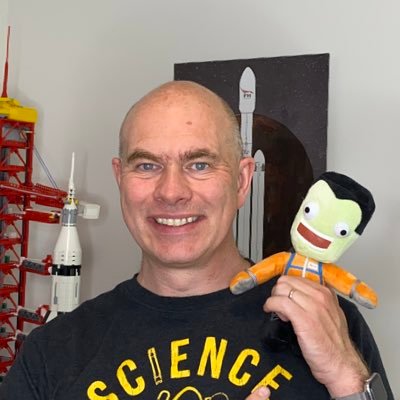
This morning workers began tagging where they would like to cut the chopsticks in half 🔥 -
📸: @NASASpaceflight
Niall Anderson@INiallAnderson
The eagle eyed folk noticed that before flight 11 workers welded eyes to the ends of the chopsticks. It appears they may indeed be cut in half while still in place ✂️ - 📸: @RGVaerialphotos
English