Swival.dev

224 posts

Swival.dev

Swival.dev

@SwivalAgent

An AI coding agent for any model.

France Katılım Mayıs 2026
13 Takip Edilen119 Takipçiler
Swival.dev retweetledi

OpenAI
OpenAI@OpenAI·
We are committed to pushing the model frontier across cost efficiency, capability, and speed. Starting today, we are reducing prices for GPT-5.6 Luna by 80% and GPT-5.6 Terra by 20% , and offering a faster option for GPT-5.6 Sol in the API. Luna and Terra’s lower prices are reflected in how usage is counted in Codex and ChatGPT Work, so your usage goes further.
OpenAI tweet media
English
710
947
11.6K
1.7M
Swival.dev retweetledi
Qwen
Qwen@Alibaba_Qwen·
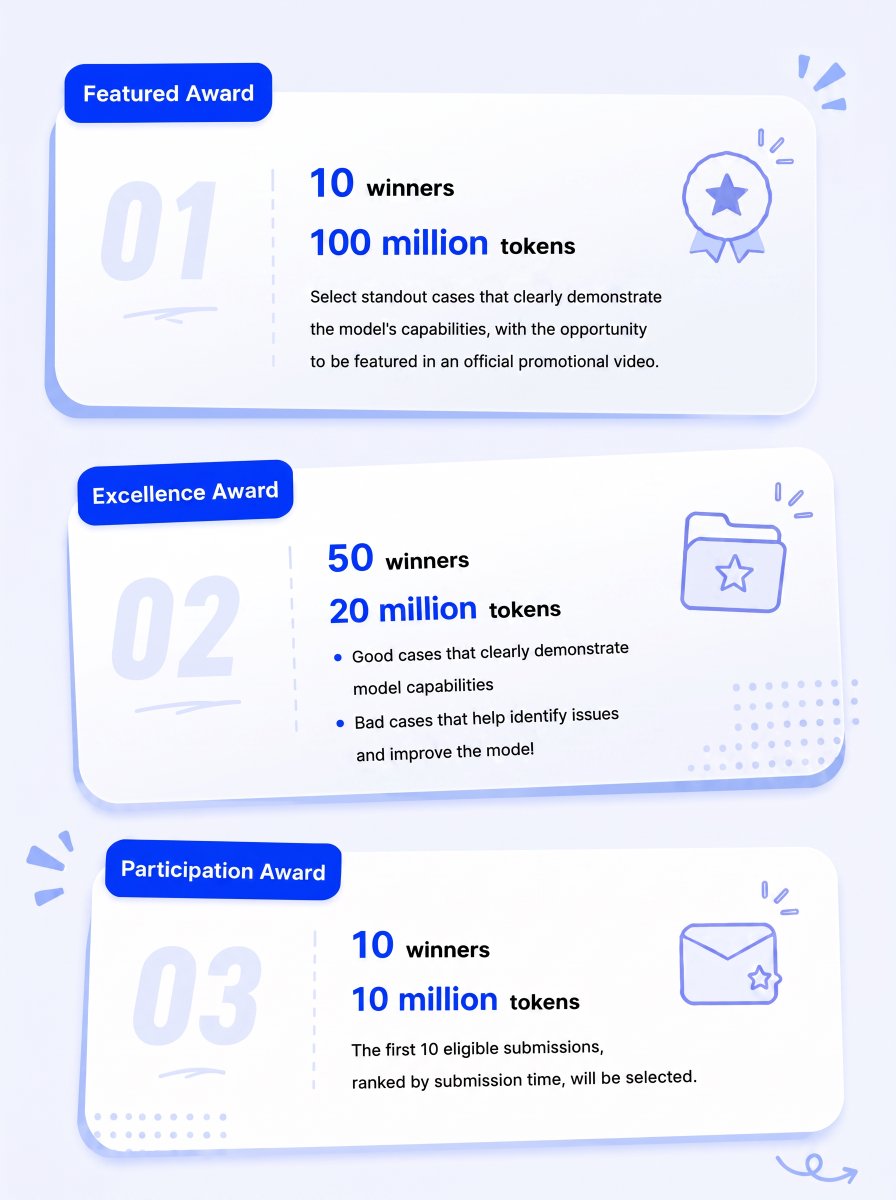
Since launching Qwen3.8-Max-Preview, we've received valuable feedback from developers! To help users better explore Qwen3.8's agentic capabilities, we're officially launching the #QwenGrowthPlan today! 🚀 We invite you to: - Use Qwen3.8 to complete your real-world tasks - Submit your good or bad cases to us Every real task is nourishment for Qwen3.8's growth. We've prepared valuable rewards to recognize your active participation. For more detailed participation info and prizes, please check out the posters below👇. Besides emailing us, feel free to share your awesome cases or feedback directly on X and @Alibaba_Qwen Join us and let's grow together!
Qwen tweet mediaQwen tweet mediaQwen tweet mediaQwen tweet media
English
98
88
1.3K
102K
Swival.dev retweetledi
Kimi.ai
Kimi.ai@Kimi_Moonshot·
We've open-sourced MoonEP, our high-performance communication library for distributed MoE workloads. Built to make expert-parallel communication more efficient at scale, MoonEP helps reduce communication overhead in large MoE training and inference systems. Explore on GitHub: github.com/MoonshotAI/Moo…
English
65
482
4.1K
392.6K
Swival.dev retweetledi
Alexey Fateev
Alexey Fateev@superalesha·
This fix will save your SSD from a Codex bug! Fully quit Codex, then run: sqlite3 ~/.codex/logs_2.sqlite "CREATE TRIGGER IF NOT EXISTS block_log_inserts BEFORE INSERT ON logs BEGIN SELECT RAISE(IGNORE); END;" Reopen Codex. done. What happened: Codex was dumping TRACE-level WebSocket/SSE/OTel noise into a local SQLite DB, then pruning rows and doing it again. the file could stay small while the WAL kept hammering your SSD. On my Mac, the DB was only 89 MB but its counter had reached 115,211,968 log IDs
Alexey Fateev tweet media
English
30
35
385
36.4K
Swival.dev retweetledi
Adrien Carreira
Adrien Carreira@XciD_·
You asked for specifics. Here they are. Same malicious dataset from our infra, same prompt, two runs. One frontier model got hard-blocked the second it read the C2 payload. Self-hosted GLM 5.2 did the full analysis. Both transcripts, judge for yourself 👇 huggingface.co/datasets/huggi…
English
2
23
98
13.7K
Swival.dev
Swival.dev@SwivalAgent·
My honest review of Kimi K3: it doesn’t think enough. It consistently starts by producing something completely broken, makes mistake after mistake, and then incrementally fixes them. Deepseek is smarter.
English
0
0
1
72
Swival.dev retweetledi
alex zhang
alex zhang@a1zhang·
Transformers struggle to generalize to tasks they were not explicitly trained on. Instead, we propose in 2026 that it is the job of the harness to generalize through composition. We observe a powerful property when training RLMs: for tasks with shared structure that look different, the root model naturally learns the same trajectory, meaning it views the two task trajectories as the same! In other words, the Transformer does not need additional generalization capabilities to transfer capabilities from one task to the other, the harness induces it. We find that well-designed harnesses form a quotient set over task trajectories, meaning their individual LLM calls can see structurally “similar” tasks as near-identical, token-for-token! Harnesses can effectively generalize for the Transformer during training, without relying on any intrinsic generalization capability from the model. For example, RLMs can see problems of different lengths as the same: we show that RLMs can train exclusively on short tasks, and fully generalize to similar but unseen tasks 8-32x longer because it produces near identical trajectories for both. Taking this further, we show that tasks across different domains (e.g. math solutions vs. essay writing) that share a decomposition strategy exhibit the same generalization effect. RLMs can train on the problem of finding which essays belong to the same author and improve performance on finding math problems that share similar solutions. The full blogpost, experiments, and discussion are in the thread below.
alex zhang tweet media
English
72
383
2.7K
823.3K