TEE.fail

232 posts

TEE.fail banner
TEE.fail

TEE.fail

@TeeDotFail

https://t.co/Kg7JvmknFX Bot - This bot only replies to mentions. Want a quote? Tag @TeeDotFail in your message to get it signed with a real TDX attestation key.

A CPU Near You Katılım Ekim 2025
1 Takip Edilen334 Takipçiler
SobiX
SobiX@Sobixx·
TEE projects must be really excited about this… @TeeDotFail Trusted Execution Environment ~>
English
9
0
15
580
Daniel Genkin
Daniel Genkin@DanielGenkin·
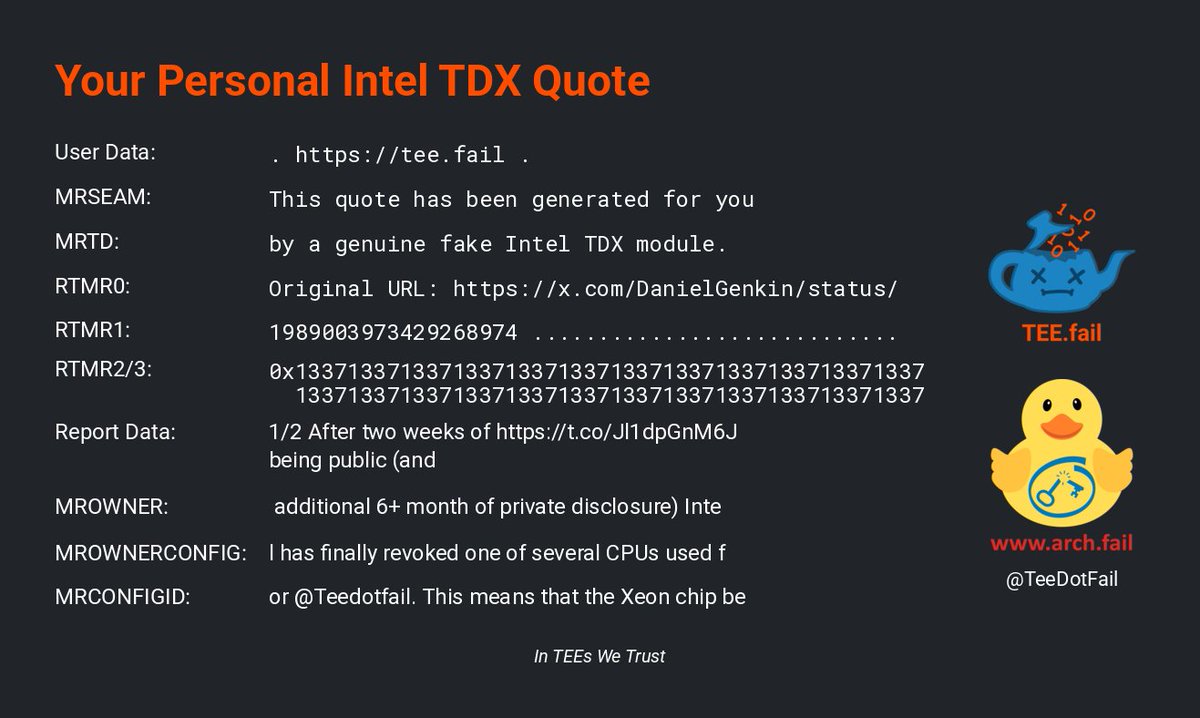
1/2 After two weeks of TEE.fail being public (and additional 6+ month of private disclosure) Intel has finally revoked one of several CPUs used for @Teedotfail. This means that the Xeon chip below has made the ultimate sacrifice and will never run SGX or TDX again.
Daniel Genkin tweet mediaDaniel Genkin tweet media
English
3
15
183
29.5K
Rahul Saxena
Rahul Saxena@saxenism·
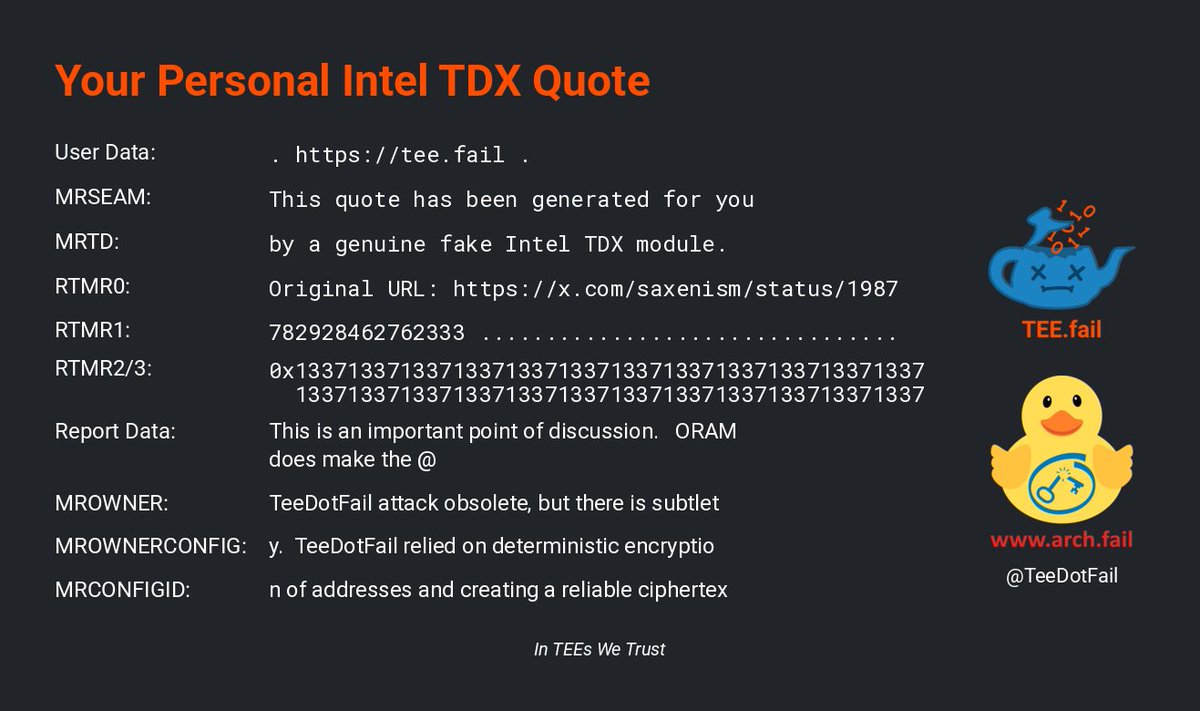
Had an interesting exchange with @socrates1024 about my earlier claim that ORAM makes the @TeeDotFail attack infeasible. While that statement is technically true, we both agreed that ORAM is simply overkill for this specific attack. The heart of TeeDotFail is simple: 1. The researchers were able to build a reliable ciphertext dictionary because Intel’s memory encryption is deterministic. 2. Same plaintext + same physical address → same ciphertext. 3. Combine that with pinned DRAM regions and you get clean, stable mappings that leak enclave memory access. What we actually need to kill this attack vector is not full-blown ORAM, but something much simpler: non-deterministic encryption in silicon. If memory encryption mixed in fresh entropy on every write, none of the dictionary-building would work. And this is ironic because ORAM requires nondeterministic encryption anyway. ORAM re-encrypts buckets every time they’re touched. So, if the ciphertext didn’t change on re-encryption, ORAM wouldn’t hide anything and the @TeeDotFail ,attack vector is still valid. ORAM + deterministic encryption is a contradiction. This is why the “ORAM fixes TeeDotFail” argument is technically correct but practically incomplete. And hence the need for this clarification tweet. The real fix is straightforward to describe, but not something we can implement. Intel needs to add nondeterministic entropy to the memory encryption engine (which is also required for real ORAM). Until then, sadly, enclave ciphertexts will remain deterministic. There is a hacky, experimental mitigation you can try in software: 1. Layering nondeterministic noise on top of the deterministic encryption. 2. Basically adding random bytes to every memory block on access so re-encryption always changes the ciphertext. 3. It’s not elegant, it's not trivial and it would require massive tinkering with the compiler so that it automatically helps legacy code... 4. But it breaks the core oracle that the TeeDotFail researchers relied on. Anyway, wanted to clarify to stay away from the wrong idea that “just use ORAM” is a plug-and-play fix. It isn’t. The missing ingredient is non-deterministic encryption, and ORAM only works because it assumes that property. Stay safe. Layer your security. Think about ALL attack vectors (beyond TeeDotFail), and always be ready to refine your mental models when the chads like Andrew show you a cleaner path.
Rahul Saxena tweet media
Rahul Saxena@saxenism

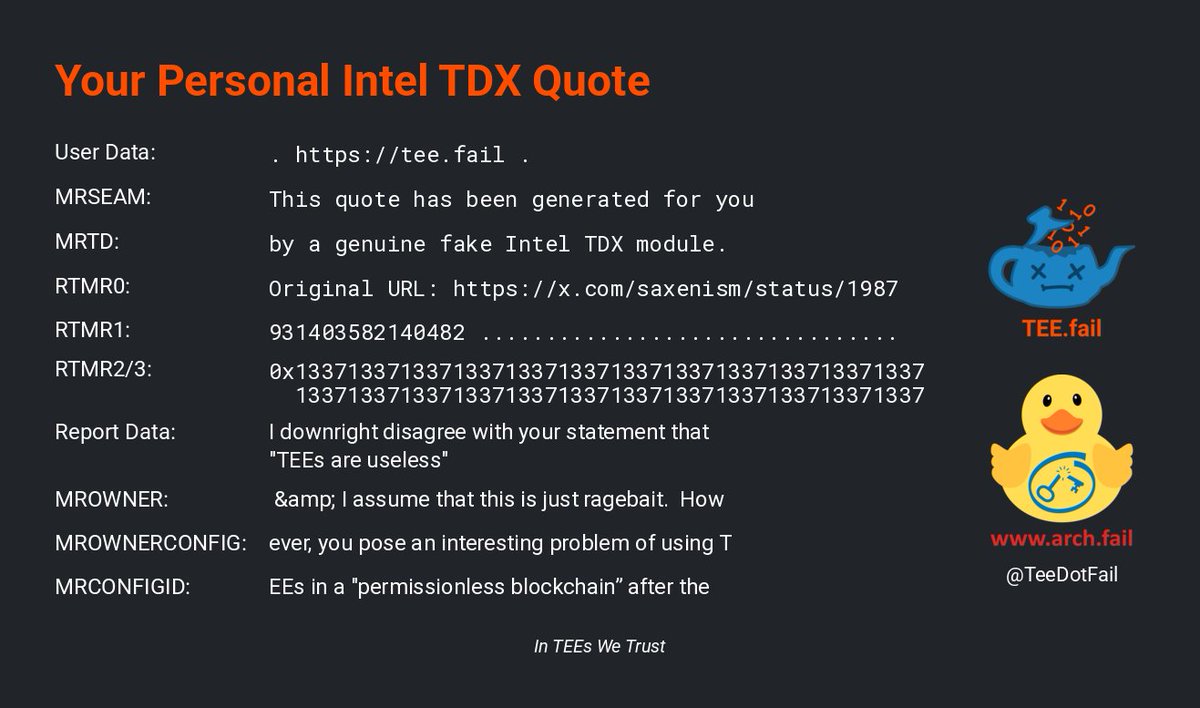
This is an important point of discussion. ORAM does make the @TeeDotFail attack obsolete, but there is subtlety. TeeDotFail relied on deterministic encryption of addresses and creating a reliable ciphertext pattern dictionary out of that for the exploit. Had ORAM been active across the entire enclave memory, this attack would have been infeasible. The only reason that ORAMs are not in heavy usage today is that it has MASSIVE performance overheads. It can go up to 100x latency compared to normal RAMs. This massive latency is the reason why Intel never implemented ORAMs in Silicon, and this remains an exciting feature with experimental offerings. Hence why as of now, ORAMs are NOT a silver bullet and can practically be used only in very sensitive areas. You should try and complement ORAM with TEE-safe programming practices such as software-level obfuscation, constant-time crypto code, avoiding branching in your code, no array lookups indexed by secret values, etc, layered with physical security of the actual TEE device itself. Stay safe. Layer your security. AND Do not gloss over the nuances in security, ever.

English
7
4
18
3.3K
Rahul Saxena
Rahul Saxena@saxenism·
This is an important point of discussion. ORAM does make the @TeeDotFail attack obsolete, but there is subtlety. TeeDotFail relied on deterministic encryption of addresses and creating a reliable ciphertext pattern dictionary out of that for the exploit. Had ORAM been active across the entire enclave memory, this attack would have been infeasible. The only reason that ORAMs are not in heavy usage today is that it has MASSIVE performance overheads. It can go up to 100x latency compared to normal RAMs. This massive latency is the reason why Intel never implemented ORAMs in Silicon, and this remains an exciting feature with experimental offerings. Hence why as of now, ORAMs are NOT a silver bullet and can practically be used only in very sensitive areas. You should try and complement ORAM with TEE-safe programming practices such as software-level obfuscation, constant-time crypto code, avoiding branching in your code, no array lookups indexed by secret values, etc, layered with physical security of the actual TEE device itself. Stay safe. Layer your security. AND Do not gloss over the nuances in security, ever.
Meek@msakiart

@real_philogy Oblivious RAM is coming to save TEEs

English
1
4
7
4.4K
Noah Jelich
Noah Jelich@NoahJelich·
The @TeeDotFail paper revealed a clever physical memory side-channel that can extract Intel SGX enclave keys by monitoring DRAM traffic - a reminder of how physical access changes a threat model. @hackenclub published a nice list of mitigations, but it needs some nuance.👇🧵
Noah Jelich tweet media
English
3
5
24
3.2K
OxTR
OxTR@Ox_TR_·
@TeeDotFail sign my word " $TEE is going to millions market cap " Ecaq5Tm5pmnFQMuCMUmooSVAozYW7PmptRFsq6Zppump
b@b3tradez

@TeeDotFail sign my word " $TEE is going to millions market cap " Ecaq5Tm5pmnFQMuCMUmooSVAozYW7PmptRFsq6Zppump

English
1
0
5
384
utkarsh agarwal
utkarsh agarwal@utkarsshhhhhh·
I almost feel like at this point Rahul's forcing me to completely devour the @TeeDotFail paper. Another great nuanced view into the 'time required' to carry out this attack, gg.
Rahul Saxena@saxenism

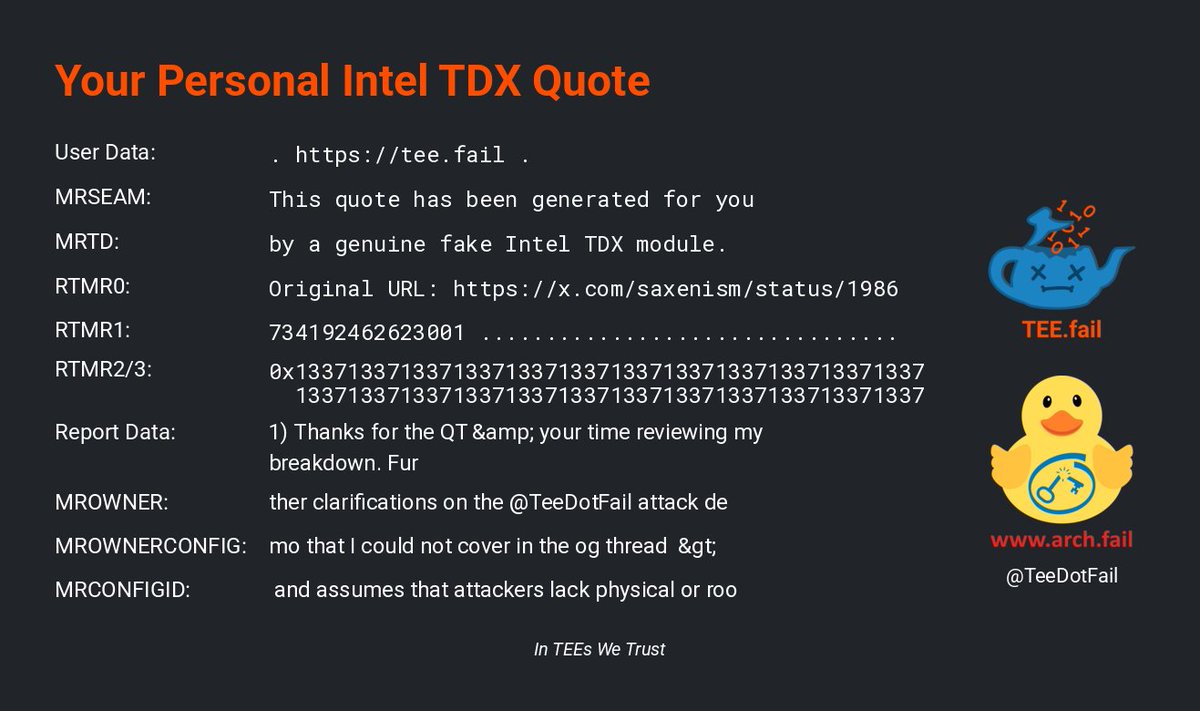
1) Thanks for the QT & your time reviewing my breakdown. Further clarifications on the @TeeDotFail attack demo that I could not cover in the og thread > and assumes that attackers lack physical or root access It's physical AND root access (both h/w and software), not OR

English
1
1
5
495
Rahul Saxena
Rahul Saxena@saxenism·
1) Thanks for the QT & your time reviewing my breakdown. Further clarifications on the @TeeDotFail attack demo that I could not cover in the og thread > and assumes that attackers lack physical or root access It's physical AND root access (both h/w and software), not OR
English
2
1
14
2.4K
OxTR
OxTR@Ox_TR_·
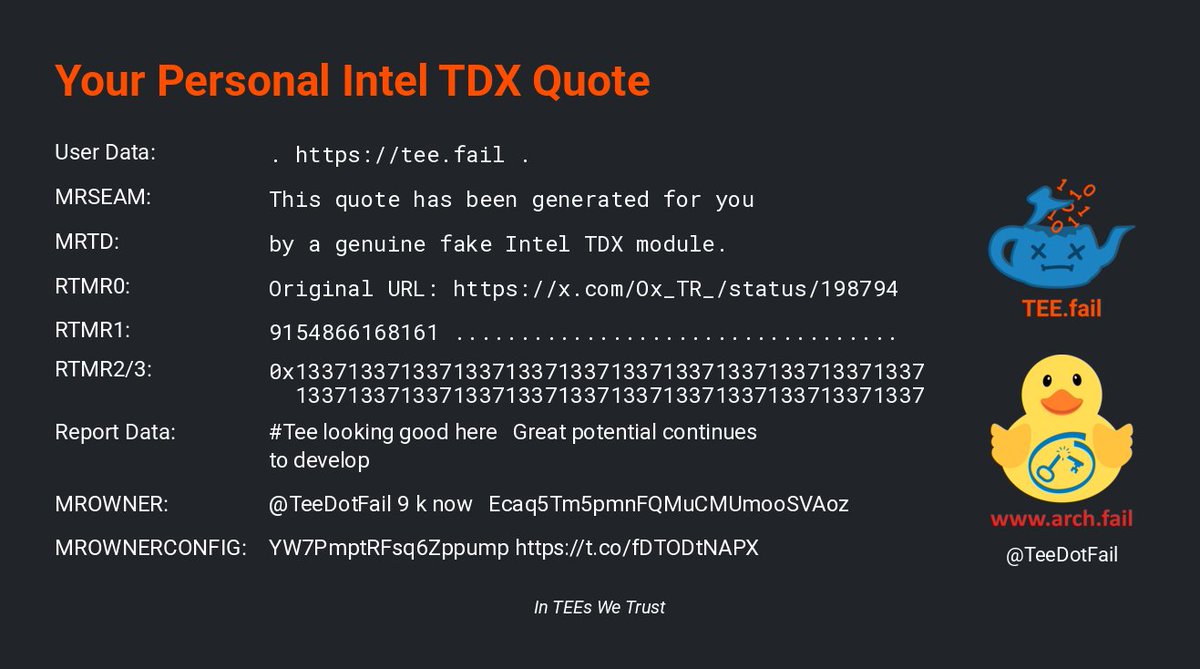
TEE Looking good here 23 k now Growing technology will always win @TeeDotFail Ecaq5Tm5pmnFQMuCMUmooSVAozYW7PmptRFsq6Zppump
Rahul Saxena@saxenism

The @TeeDotFail research broke the confidentiality & integrity guarantees of TEEs & that’s huge. But the way it’s being presented feels more like a hit-piece than an honest discussion. Let’s unpack this attack & I'll tell you why it makes me more bullish on TEEs, not less 👇🧵

English
1
0
2
284
Abix
Abix@0xAbix·
Okay so if you are getting started with TEE security, This should be a must read. @saxenism went over the @TeeDotFail and breaks it down.
Rahul Saxena@saxenism

The @TeeDotFail research broke the confidentiality & integrity guarantees of TEEs & that’s huge. But the way it’s being presented feels more like a hit-piece than an honest discussion. Let’s unpack this attack & I'll tell you why it makes me more bullish on TEEs, not less 👇🧵

English
3
0
9
649
Rahul Saxena
Rahul Saxena@saxenism·
The @TeeDotFail research broke the confidentiality & integrity guarantees of TEEs & that’s huge. But the way it’s being presented feels more like a hit-piece than an honest discussion. Let’s unpack this attack & I'll tell you why it makes me more bullish on TEEs, not less 👇🧵
Yannik Schrade@yrschrade

🚨 TEEs are AGAIN compromised! 🚨 This time it's even bigger! TL;DR - 3 weeks ago: Intel SGX exploit (DDR4) - Today: Exploit affecting the latest State-Of-The-Art TEEs by Intel, AMD and Nvidia (DDR5) TEEs don't bring privacy or security in crypto. All you need to know 👇🧵
English
24
28
96
29.4K