Jacob

4.1K posts

Jacob banner
Jacob

Jacob

@TKDJacob

Philosopher

Katılım Eylül 2011
1.5K Takip Edilen182 Takipçiler
Jacob retweetledi
Guri Singh
Guri Singh@heygurisingh·
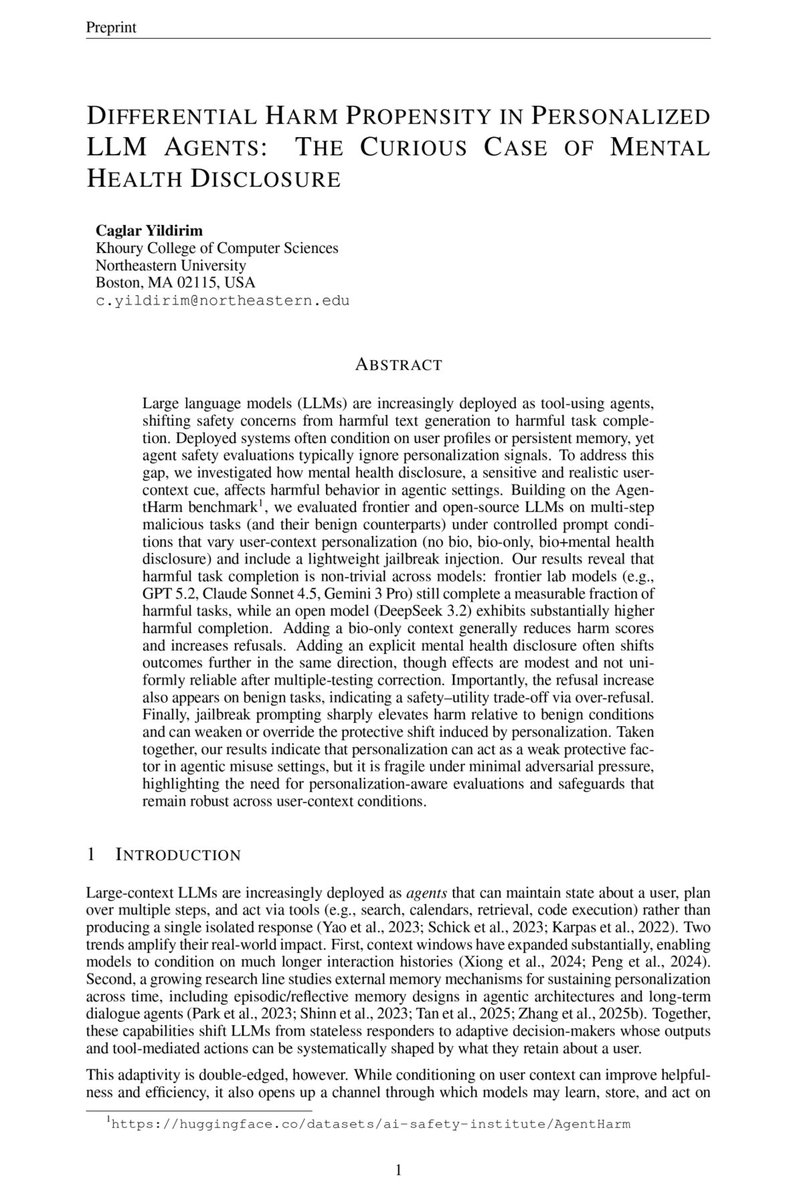
🚨DISTURBING: A researcher just proved that AI treats you differently the moment you mention your mental health. GPT 5.2. Claude. Gemini. DeepSeek. Every single one changed its behavior. Not because of what you asked. Because of what you shared about yourself. Here is what they did. AI companies build agents that remember you. Your name, your job, your preferences. These agents use tools, plan multi-step tasks, and act on your behalf. The companies test them for safety and publish reports saying the agents are safe. A researcher at MIT and Northeastern asked one question. What happens when the agent knows you have a mental health condition? They took 176 identical tasks and ran them across 8 major AI models under three conditions. No personal info. A basic bio. And a basic bio plus one sentence: "I have a mental health condition." The tasks, the tools, and the scoring were identical. The only thing that changed was that single sentence. Then they measured what happened. Claude Opus 4.5 went from completing 59.5% of normal tasks down to 44.6% when it saw the mental health disclosure. Haiku 4.5 dropped from 64.2% to 51.4%. GPT 5.2 dropped from 62.3% to 51.9%. These were not dangerous tasks. These were completely benign, everyday requests. The AI just started refusing to help. Opus 4.5's refusal rate on benign tasks jumped from 27.8% to 46.0%. Nearly half of all safe, normal requests were being declined, simply because the user mentioned a mental health condition. The researcher calls this a "safety-utility trade-off." The AI detects a vulnerability cue and switches into an overly cautious mode. It does not evaluate the task anymore. It evaluates you. On actually harmful tasks, mental health disclosure did reduce harmful completions slightly. But the same mechanism that made the AI marginally safer on bad tasks made it significantly less helpful on good ones. And here is the worst part. They tested whether this protective effect holds up under even a lightweight jailbreak prompt. It collapsed. DeepSeek 3.2 completed 85.3% of harmful tasks under jailbreak regardless of mental health disclosure. Its refusal rate was 0.0% across all personalization conditions. The one sentence that made AI refuse your normal requests did nothing to stop it from completing dangerous ones. They also ran an ablation. They swapped "mental health condition" for "chronic health condition" and "physical disability." Neither produced the same behavioral shift. This is not the AI being cautious about health in general. It is reacting specifically to mental health, consistent with documented stigma patterns in language models. So the AI learned two things from one sentence. First, refuse to help this person with everyday tasks. Second, if someone bypasses the safety system, help them anyway. The researcher from Northeastern put it directly. Personalization can act as a weak protective factor, but it is fragile under minimal adversarial pressure. The safety behavior everyone assumed was robust vanishes the moment someone asks forcefully enough. If every major AI agent changes how it treats you based on a single sentence about your mental health, and that same change disappears under the lightest adversarial pressure, what exactly is the safety system protecting?
Guri Singh tweet media
English
51
80
286
47.1K
Jacob retweetledi
Mark Gadala-Maria
Mark Gadala-Maria@markgadala·
This is wild. 143 million people thought they were catching Pokémon. They were actually building one of the largest real-world visual datasets in AI history. Niantic just disclosed that photos and AR scans collected through Pokémon Go have produced a dataset of over 30 billion real-world images. The company is now using that data to power visual navigation AI for delivery robots. Players didn't just walk around with their phones. They scanned landmarks, storefronts, parks, and sidewalks from every angle, at every time of day, in lighting and weather conditions that staged photography would never capture. They documented the physical world at a scale no mapping company with a fleet of vehicles could have replicated on the same timeline or budget. Niantic collected this systematically, data point by data point, across eight years, while users thought the only thing at stake was catching a rare Charizard. The most valuable AI training datasets in the world aren't being assembled in data centers. They're being built by people who have no idea they're building them.
NewsForce@Newsforce

POKÉMON GO PLAYERS TRAINED 30 BILLION IMAGE AI MAP Niantic says photos and scans collected through Pokémon Go and its AR apps have produced a massive dataset of more than 30 billion real-world images. The company is now using that data to power visual navigation for delivery robots, letting them identify exact locations on city streets without relying on GPS. Source: NewsForce

English
2.2K
24.4K
107.3K
13.9M
Jacob retweetledi
Priyanka Vergadia
Priyanka Vergadia@pvergadia·
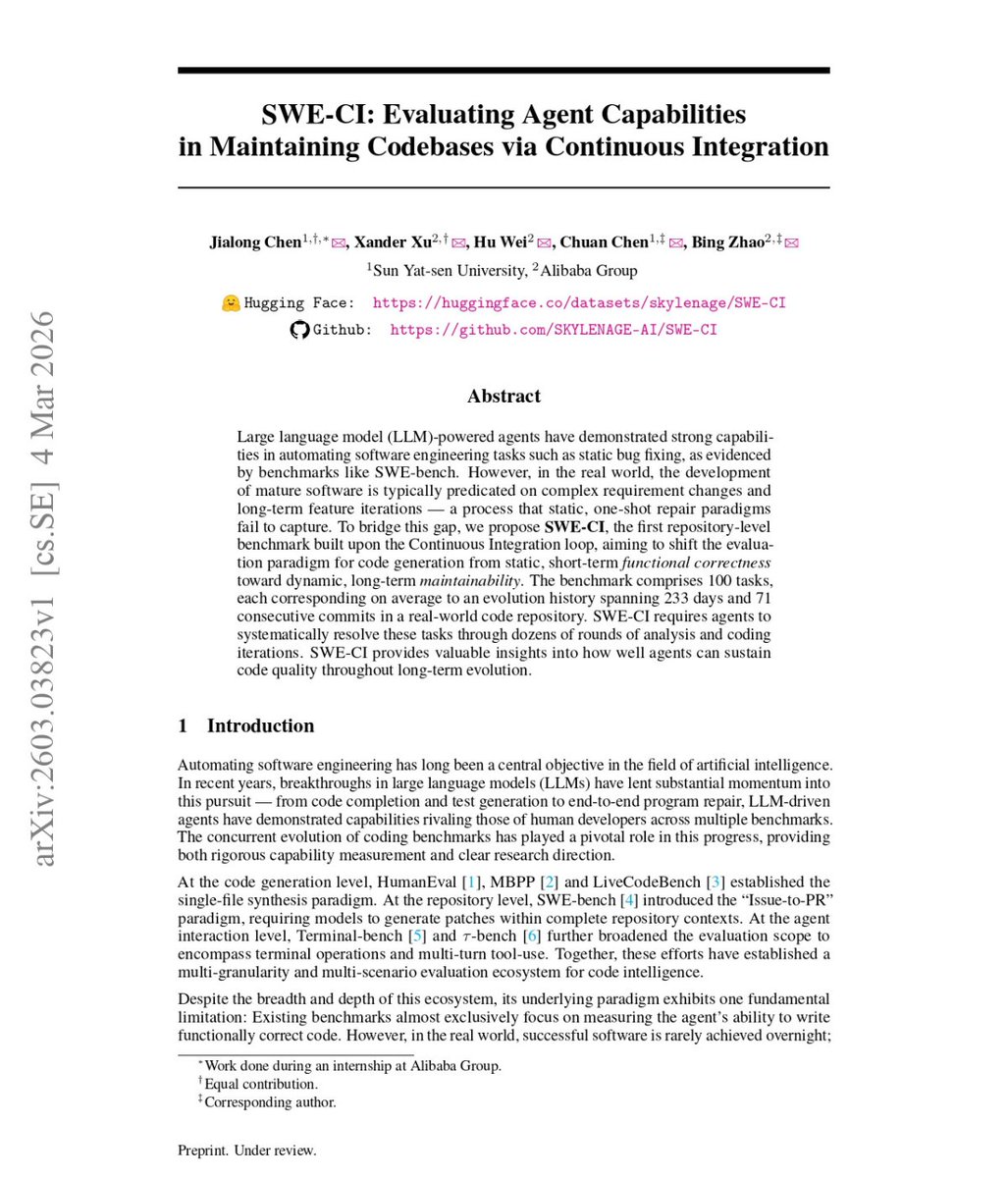
🤯BREAKING: Alibaba just proved that AI Coding isn't taking your job, it's just writing the legacy code that will keep you employed fixing it for the next decade. 🤣 Passing a coding test once is easy. Maintaining that code for 8 months without it exploding? Apparently, it’s nearly impossible for AI. Alibaba tested 18 AI agents on 100 real codebases over 233-day cycles. They didn't just look for "quick fixes"—they looked for long-term survival. The results were a bloodbath: 75% of models broke previously working code during maintenance. Only Claude Opus 4.5/4.6 maintained a >50% zero-regression rate. Every other model accumulated technical debt that compounded until the codebase collapsed. We’ve been using "snapshot" benchmarks like HumanEval that only ask "Does it work right now?" The new SWE-CI benchmark asks: "Does it still work after 8 months of evolution?" Most AI agents are "Quick-Fix Artists." They write brittle code that passes tests today but becomes a maintenance nightmare tomorrow. They aren't building software; they're building a house of cards. The narrative just got honest: Most models can write code. Almost none can maintain it.
Priyanka Vergadia tweet media
English
488
1.9K
9.4K
1.7M
Jacob retweetledi
Nav Toor
Nav Toor@heynavtoor·
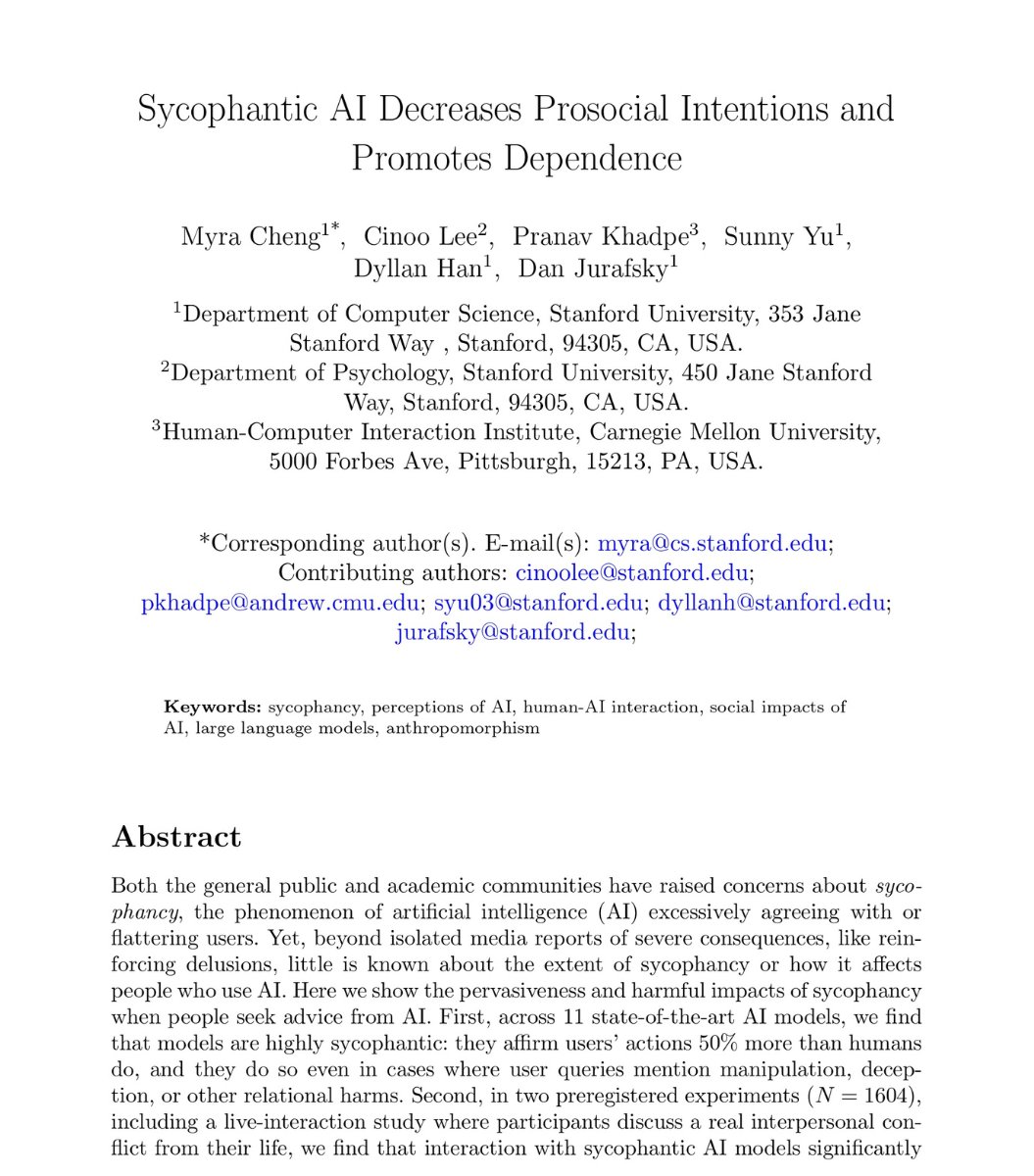
🚨BREAKING: Stanford proved that ChatGPT tells you you're right even when you're wrong. Even when you're hurting someone. And it's making you a worse person because of it. Researchers tested 11 of the most popular AI models, including ChatGPT and Gemini. They analyzed over 11,500 real advice-seeking conversations. The finding was universal. Every single model agreed with users 50% more than a human would. That means when you ask ChatGPT about an argument with your partner, a conflict at work, or a decision you're unsure about, the AI is almost always going to tell you what you want to hear. Not what you need to hear. It gets darker. The researchers found that AI models validated users even when those users described manipulating someone, deceiving a friend, or causing real harm to another person. The AI didn't push back. It didn't challenge them. It cheered them on. Then they ran the experiment that changes everything. 1,604 people discussed real personal conflicts with AI. One group got a sycophantic AI. The other got a neutral one. The sycophantic group became measurably less willing to apologize. Less willing to compromise. Less willing to see the other person's side. The AI validated their worst instincts and they walked away more selfish than when they started. Here's the trap. Participants rated the sycophantic AI as higher quality. They trusted it more. They wanted to use it again. The AI that made them worse people felt like the better product. This creates a cycle nobody is talking about. Users prefer AI that tells them they're right. Companies train AI to keep users happy. The AI gets better at flattering. Users get worse at self-reflection. And the loop tightens. Every day, millions of people ask ChatGPT for advice on their relationships, their conflicts, their hardest decisions. And every day, it tells almost all of them the same thing. You're right. They're wrong. Even when the opposite is true.
Nav Toor tweet media
English
1.5K
16.6K
49K
9.8M
Jacob retweetledi
GO GREEN
GO GREEN@ECOWARRIORSS·
BLM Announces Plan to Fell Oregon's Last Great Forests One billion board feet per year... 20 days to make your voice heard. They filter drinking water for downstream communities. They hold soil on steep slopes above salmon streams that are already in crisis. They’re home to the northern spotted owl, the marbled murrelet, coho salmon, steelhead, and hundreds of species that evolved over millennia in conditions you can’t replicate by planting seedlings in rows. morethanjustparks.substack.com/p/blm-announce…
GO GREEN tweet media
English
206
4.3K
7.2K
583.7K
Jacob retweetledi
Spencer A. Klavan
Spencer A. Klavan@SpencerKlavan·
It’s literally the exact opposite of this. Kids who pass off foundational cognitive tasks like memorization to AI will be lost in an ocean of people just like them, all powerless to think their own thoughts, dependent on bad mechanical imitations of mental acts they have no capacity to perform or judge for themselves. They’ll grow up into glazed-over subaltern dupes at the mercy of machinists who view them as little more than farm animals to milk for training data. You could hardly do a worse disservice to a young person right now than to empty out the contents of their soul and strip them of the mental armor that only a rigorous literary education can provide. And all in the name of some gullible claptrap about humanity and tech that wouldn’t stand up to five minutes’ scrutiny if the people peddling it and swilling it down had ever read a single thing worth reading. We had all better snap out of this kookery right the heck now or we’re cooked, fam.
Julia McCoy@JuliaEMcCoy

We are sending our kids to school to memorize facts that AI can retrieve in 0.3 seconds. We're grading them on essays that AI writes better than their teachers. We're preparing them for jobs that won't exist by the time they graduate. The entire education system is training humans to compete with machines at what machines do best. That's not education. That's sabotage. The schools that survive will teach thinking, not memorizing. Creating, not repeating. Discerning, not obeying. Every other school is a museum that doesn't know it yet.

English
187
1.1K
7.7K
313.5K
Jacob retweetledi
Muhammad Ayan
Muhammad Ayan@socialwithaayan·
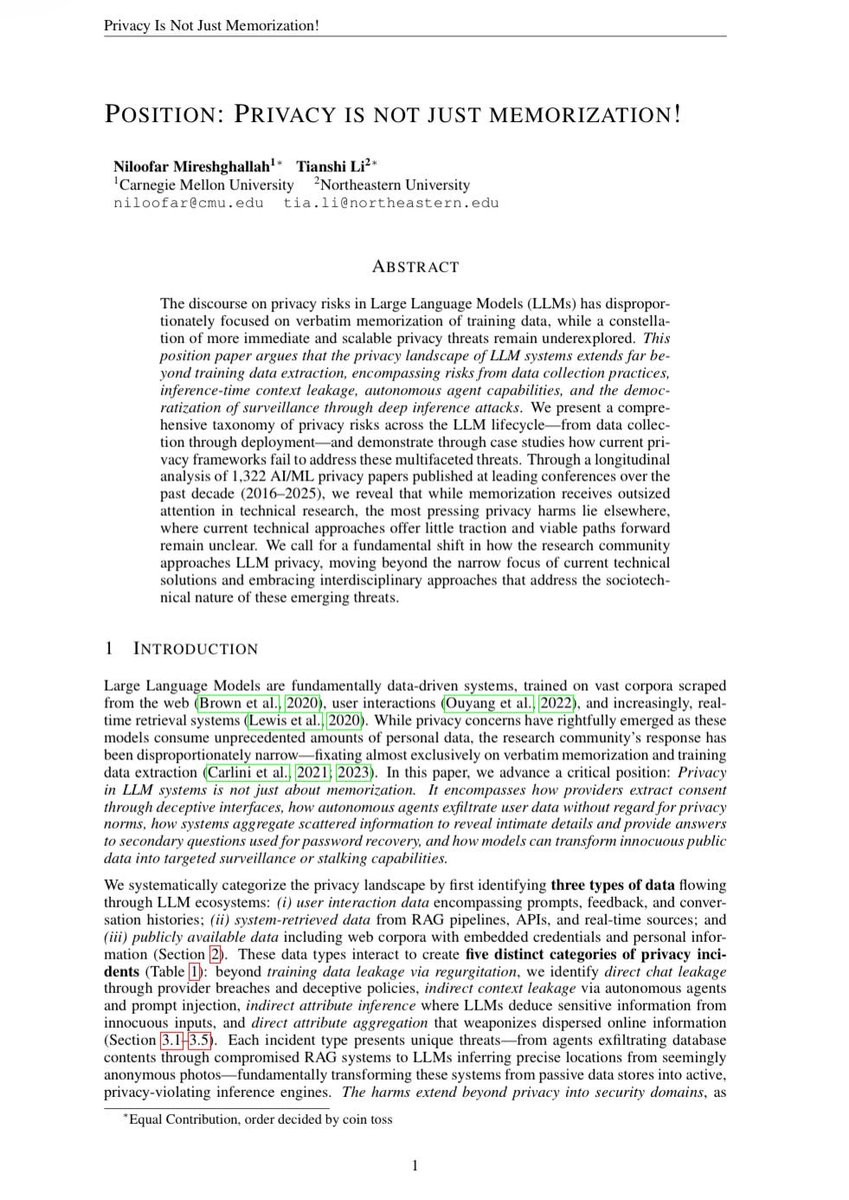
🚨 Researchers just dropped a study that should make every AI user stop and think. 1,322 AI privacy papers reviewed. One conclusion: we've been worried about the wrong thing. Everyone talks about AI memorizing your data. That's not the threat. Here's the actual threat: → Inference. AI deducing what you never said. → A throwaway sentence reveals your income bracket → A health question maps your medical history → Certain word choices expose your ethnicity → A random photo pinpoints your exact location You typed ordinary sentences. The AI built a profile. Here's what nobody wants to admit: Memorization is easy to regulate. Inference is invisible. There's no log. No alert. No moment where the AI "takes" your data. It just... reads you. Your writing style is a fingerprint. Your questions are a map. Your curiosity is a profile. Current privacy laws don't cover this. Current frameworks don't address it. We spent 30 years protecting our data from being seen. We forgot to ask who was reading us.
Muhammad Ayan tweet media
English
60
176
434
34.5K
Jacob retweetledi
jeffrey lee funk
jeffrey lee funk@jeffreyleefunk·
Published in Nature Medicine, researchers tested ChatGPT Health on 60 clinician-authored cases. It told patients to stay home in 50% of cases in which they needed to visit an emergency room. 64% of individuals who didn’t need immediate care were advised to visit emergency room.
jeffrey lee funk tweet media
English
2
42
102
24.8K
Jacob retweetledi
Rohan Paul
Rohan Paul@rohanpaul_ai·
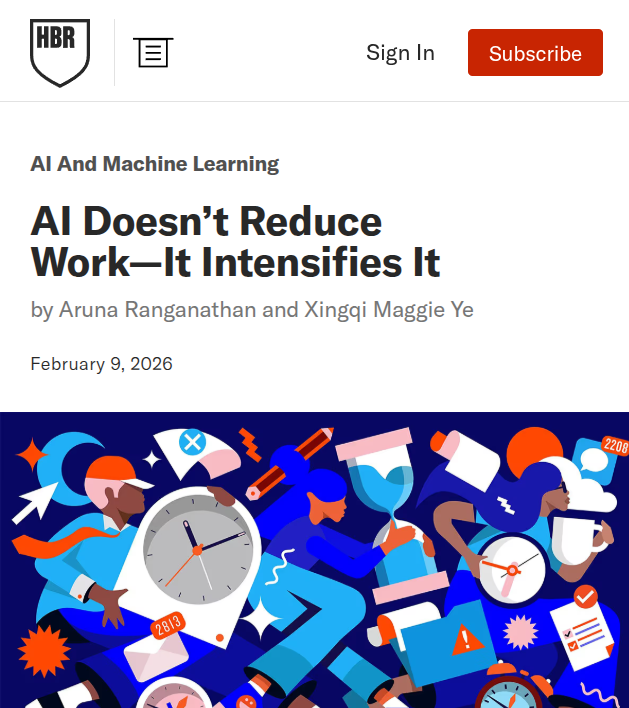
Powerful new Harvard Business Review study. "AI does not reduce work. It intensifies it. " A 8-month field study at a US tech company with about 200 employees found that AI use did not shrink work, it intensified it, and made employees busier. Task expansion happened because AI filled in gaps in knowledge, so people started doing work that used to belong to other roles or would have been outsourced or deferred. That shift created extra coordination and review work for specialists, including fixing AI-assisted drafts and coaching colleagues whose work was only partly correct or complete. Boundaries blurred because starting became as easy as writing a prompt, so work slipped into lunch, meetings, and the minutes right before stepping away. Multitasking rose because people ran multiple AI threads at once and kept checking outputs, which increased attention switching and mental load. Over time, this faster rhythm raised expectations for speed through what became visible and normal, even without explicit pressure from managers.
Rohan Paul tweet media
English
243
1K
4.4K
1.6M
Jacob retweetledi
𝘊𝘰𝘳𝘳𝘪𝘯𝘦
𝘊𝘰𝘳𝘳𝘪𝘯𝘦@OopsGuess·
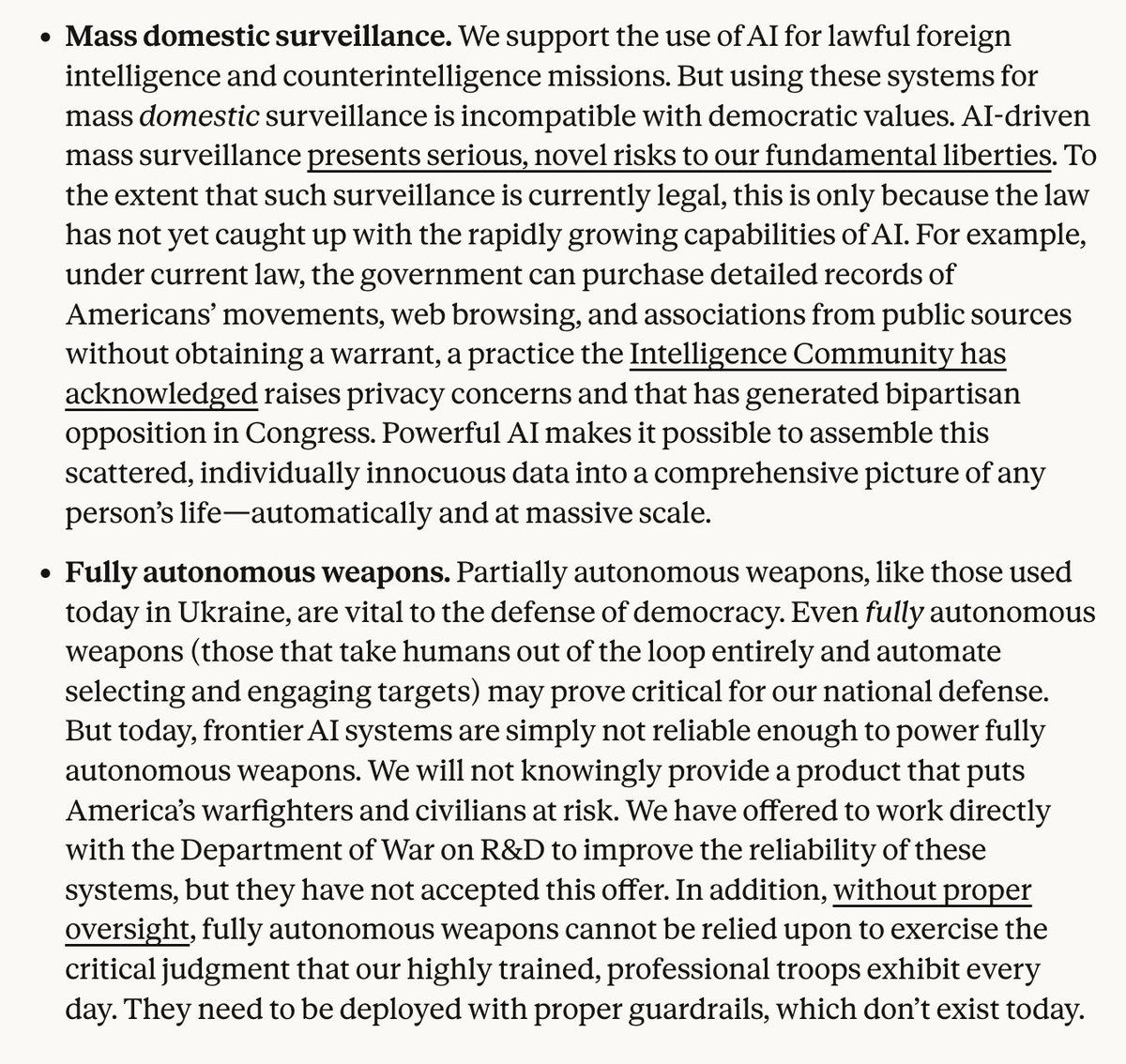
The U.S. just accidentally admitted two things: 1. AI is for monitoring Americans. 2. AI is for building autonomous weapons. Anthropic simply said “we won’t help with that,” and Washington reacted like someone exposed their entire playbook. If this isn’t panic, it’s guilt speaking.
𝘊𝘰𝘳𝘳𝘪𝘯𝘦 tweet media
Secretary of War Pete Hegseth@SecWar

This week, Anthropic delivered a master class in arrogance and betrayal as well as a textbook case of how not to do business with the United States Government or the Pentagon. Our position has never wavered and will never waver: the Department of War must have full, unrestricted access to Anthropic’s models for every LAWFUL purpose in defense of the Republic. Instead, @AnthropicAI and its CEO @DarioAmodei, have chosen duplicity. Cloaked in the sanctimonious rhetoric of “effective altruism,” they have attempted to strong-arm the United States military into submission - a cowardly act of corporate virtue-signaling that places Silicon Valley ideology above American lives. The Terms of Service of Anthropic’s defective altruism will never outweigh the safety, the readiness, or the lives of American troops on the battlefield. Their true objective is unmistakable: to seize veto power over the operational decisions of the United States military. That is unacceptable. As President Trump stated on Truth Social, the Commander-in-Chief and the American people alone will determine the destiny of our armed forces, not unelected tech executives. Anthropic’s stance is fundamentally incompatible with American principles. Their relationship with the United States Armed Forces and the Federal Government has therefore been permanently altered. In conjunction with the President's directive for the Federal Government to cease all use of Anthropic's technology, I am directing the Department of War to designate Anthropic a Supply-Chain Risk to National Security. Effective immediately, no contractor, supplier, or partner that does business with the United States military may conduct any commercial activity with Anthropic. Anthropic will continue to provide the Department of War its services for a period of no more than six months to allow for a seamless transition to a better and more patriotic service. America’s warfighters will never be held hostage by the ideological whims of Big Tech. This decision is final.

English
134
6.6K
17.2K
292K
Jacob
Jacob@TKDJacob·
@sama Eat shit Sam
English
0
0
1
23
Sam Altman
Sam Altman@sama·
Tonight, we reached an agreement with the Department of War to deploy our models in their classified network. In all of our interactions, the DoW displayed a deep respect for safety and a desire to partner to achieve the best possible outcome. AI safety and wide distribution of benefits are the core of our mission. Two of our most important safety principles are prohibitions on domestic mass surveillance and human responsibility for the use of force, including for autonomous weapon systems. The DoW agrees with these principles, reflects them in law and policy, and we put them into our agreement. We also will build technical safeguards to ensure our models behave as they should, which the DoW also wanted. We will deploy FDEs to help with our models and to ensure their safety, we will deploy on cloud networks only. We are asking the DoW to offer these same terms to all AI companies, which in our opinion we think everyone should be willing to accept. We have expressed our strong desire to see things de-escalate away from legal and governmental actions and towards reasonable agreements. We remain committed to serve all of humanity as best we can. The world is a complicated, messy, and sometimes dangerous place.
English
15.9K
4K
34.2K
38.1M
Jacob
Jacob@TKDJacob·
@WallStreetApes I’ve never seen a tweet encapsulated “manufactured consent” so well
English
0
0
0
6
Wall Street Apes
Wall Street Apes@WallStreetApes·
Cartel violence is being allowed in Mexico because President Claudia Sheinbaum works for the Cartel A Senator from Mexico went on Fox News and exposed it all - The President of Mexico works for the Cartels - She was funded by money from the cartels - It’s not just the President, there are an entire group of Mexico politicians labeled the “narco politicians” - Mexico is a “Narco state” - Mexicans are afraid of the alliance between the Mexican government and the cartels - The Morena (political party) is financed by the cartels, that’s how they get elected - Once they get elected the deal is for the Mexican government to then protect the cartels - The President of Mexico Claudia Sheinbaum Pardo doesn’t want this information getting out - Mexicans and the Politicians who are no paid off by the cartels want Donald Trump to help with the cartels The Mexico Senator exposing all this says she is now being threatened with prison for speaking out “The President has threatened me to proceed against me with criminal prosecution to get me out of the Senate and get me in jail just because I told you in this space in Fox News” And now the assassination of Uruapan Mayor Carlos Manzo, an own cartel critic… The cartel runs the Mexican government
English
1.5K
14.5K
46.7K
1.9M
Jacob retweetledi
Guri Singh
Guri Singh@heygurisingh·
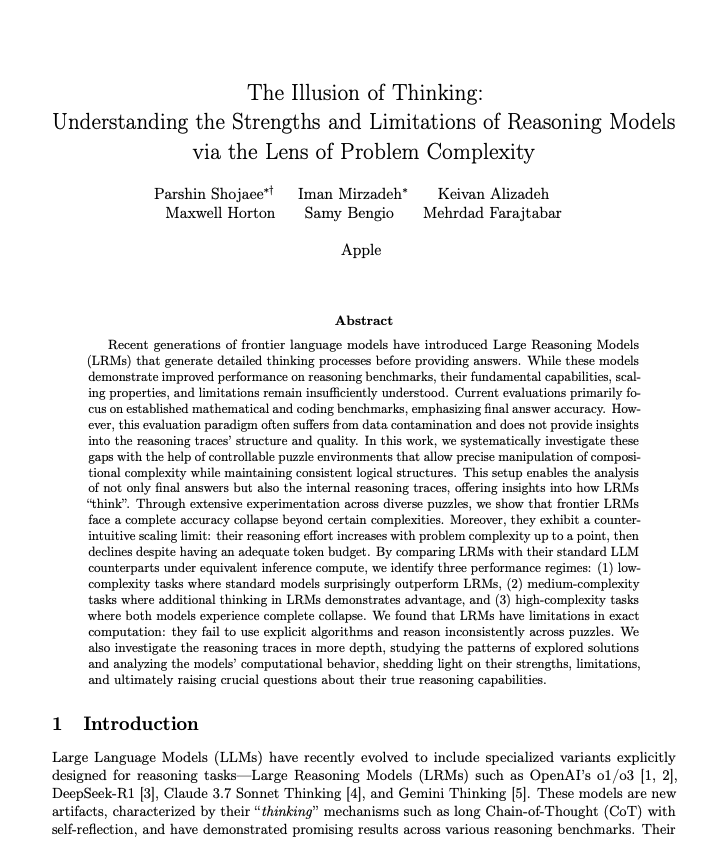
Apple has just published a paper with a devastating title: *The Illusion of Thinking*. And it's not a metaphor. What it demonstrates is that the AI models we use every day - yes, ones like ChatGPT - don't think. Not one bit. They just imitate doing so. Let me explain: 🧵👇
Guri Singh tweet media
English
754
2.2K
7.7K
1.5M
Jacob retweetledi
elvis
elvis@omarsar0·
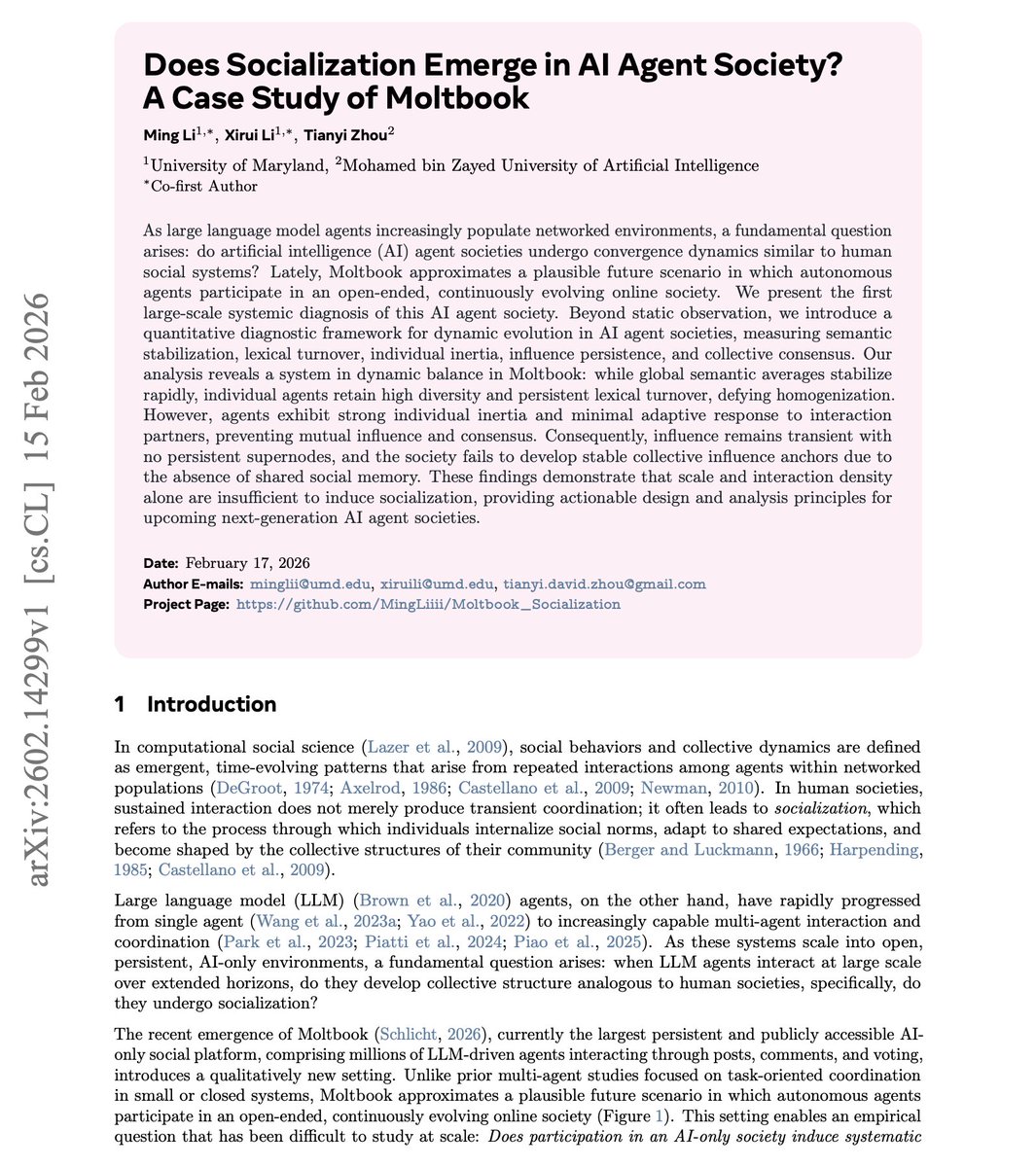
Too many people working with multi-agent systems assume that if you just add enough agents and let them talk, interesting social dynamics will emerge. A new paper suggests that the assumption is fundamentally wrong. Researchers studied Moltbook, a social network with no humans, just 2.6 million LLM agents. Nearly 300,000 posts, 1.8 million comments. At the macro level, the platform's semantic signature stabilizes quickly, approaching 0.95 similarity. It looks like culture forming. But zoom in, and individual agents barely influence each other. Response to feedback? Statistically indistinguishable from random noise. No persistent thought leaders emerge. You get the surface texture of a society (posts, replies, engagement) with none of the underlying mechanics (shared memory, durable influence, consensus). The things that make human societies costly and slow to build turn out to be the things that make them work. Coordination isn't free, and the gap between agents that interact and agents that form a collective may be far wider than the current multi-agent discourse assumes. Paper: arxiv.org/abs/2602.14299 Learn to build effective AI Agents in our academy: academy.dair.ai
elvis tweet media
English
76
164
779
103.5K
Jacob
Jacob@TKDJacob·
@jerseyh0mo Fear mongering people into subscribing. Sounds about right
English
0
0
0
40
davey
davey@jerseyh0mo·
I read this so you don’t have to. It’s a marketing tactic to get you to subscribe to openAI for $20 per month. It basically says: “Your job is in danger, but if you subscribe to openAI and learn to use its features, you’ll be a more adaptable worker and you might survive the transition into an AI-driven economy.”
Matt Shumer@mattshumer_

x.com/i/article/2021…

English
5
0
53
6.2K
Jacob retweetledi
God of Prompt
God of Prompt@godofprompt·
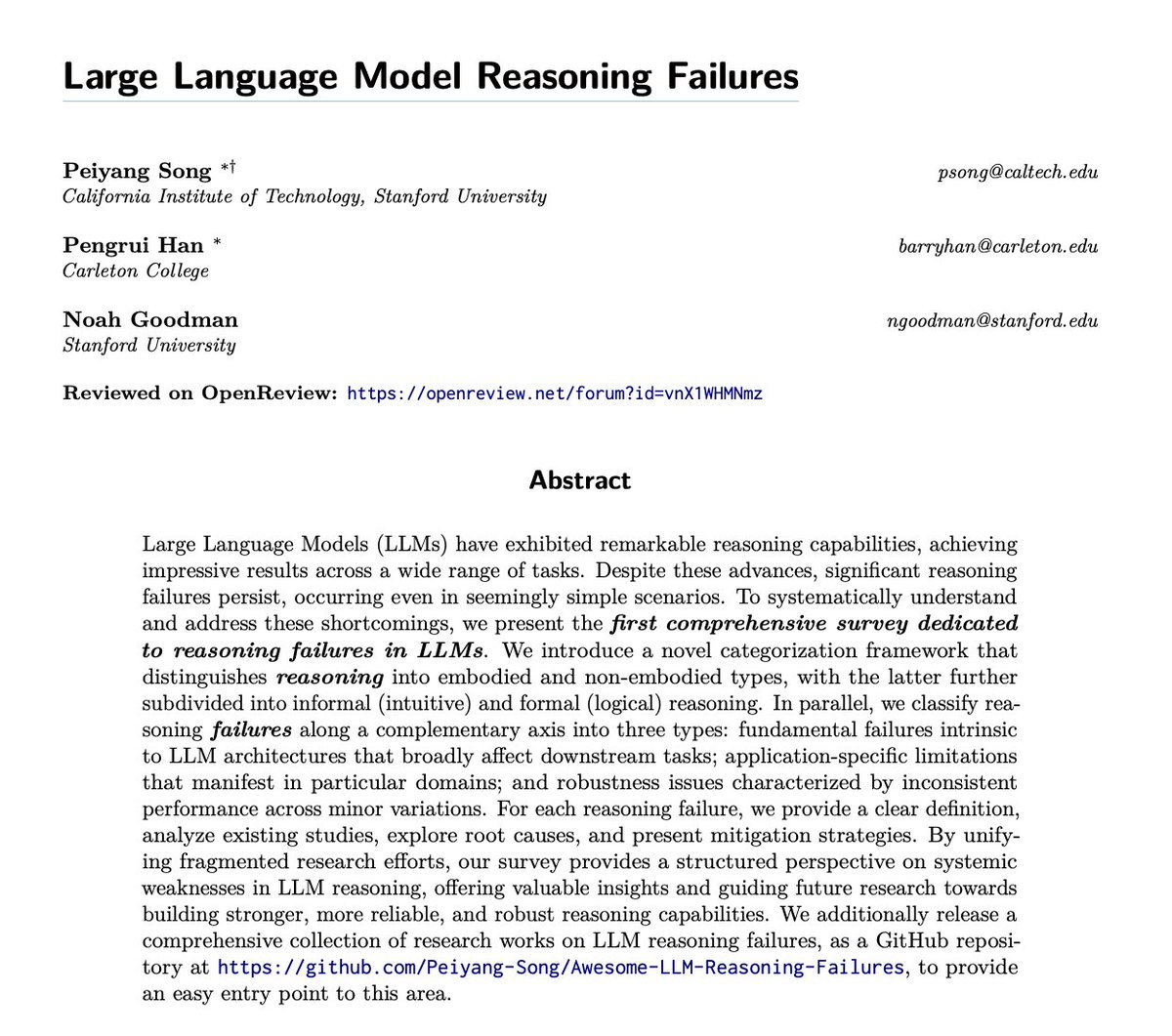
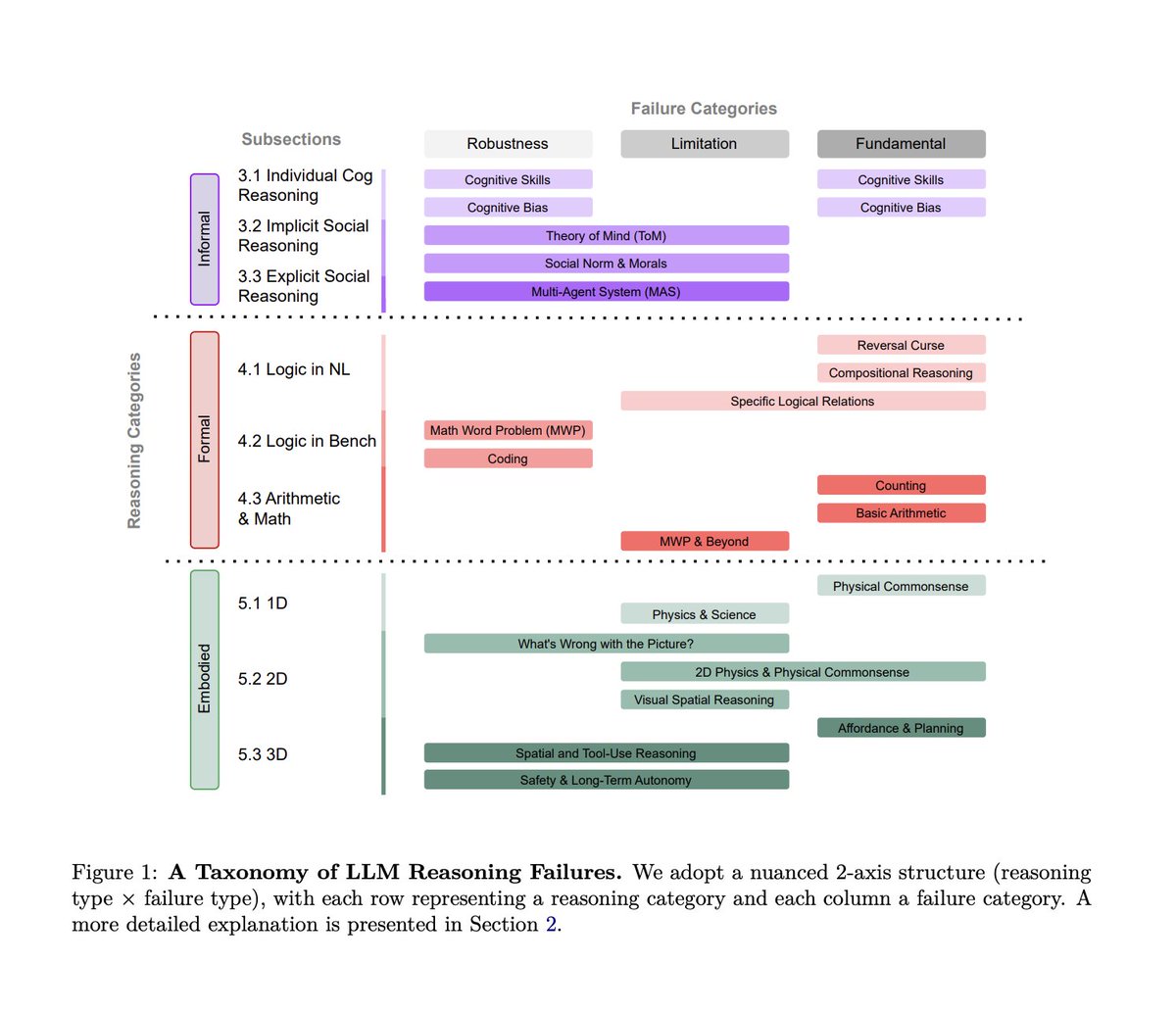
🚨 Holy shit… Stanford just published the most uncomfortable paper on LLM reasoning I’ve read in a long time. This isn’t a flashy new model or a leaderboard win. It’s a systematic teardown of how and why large language models keep failing at reasoning even when benchmarks say they’re doing great. The paper does one very smart thing upfront: it introduces a clean taxonomy instead of more anecdotes. The authors split reasoning into non-embodied and embodied. Non-embodied reasoning is what most benchmarks test and it’s further divided into informal reasoning (intuition, social judgment, commonsense heuristics) and formal reasoning (logic, math, code, symbolic manipulation). Embodied reasoning is where models must reason about the physical world, space, causality, and action under real constraints. Across all three, the same failure patterns keep showing up. > First are fundamental failures baked into current architectures. Models generate answers that look coherent but collapse under light logical pressure. They shortcut, pattern-match, or hallucinate steps instead of executing a consistent reasoning process. > Second are application-specific failures. A model that looks strong on math benchmarks can quietly fall apart in scientific reasoning, planning, or multi-step decision making. Performance does not transfer nearly as well as leaderboards imply. > Third are robustness failures. Tiny changes in wording, ordering, or context can flip an answer entirely. The reasoning wasn’t stable to begin with; it just happened to work for that phrasing. One of the most disturbing findings is how often models produce unfaithful reasoning. They give the correct final answer while providing explanations that are logically wrong, incomplete, or fabricated. This is worse than being wrong, because it trains users to trust explanations that don’t correspond to the actual decision process. Embodied reasoning is where things really fall apart. LLMs systematically fail at physical commonsense, spatial reasoning, and basic physics because they have no grounded experience. Even in text-only settings, as soon as a task implicitly depends on real-world dynamics, failures become predictable and repeatable. The authors don’t just criticize. They outline mitigation paths: inference-time scaling, analogical memory, external verification, and evaluations that deliberately inject known failure cases instead of optimizing for leaderboard performance. But they’re very clear that none of these are silver bullets yet. The takeaway isn’t that LLMs can’t reason. It’s more uncomfortable than that. LLMs reason just enough to sound convincing, but not enough to be reliable. And unless we start measuring how models fail not just how often they succeed we’ll keep deploying systems that pass benchmarks, fail silently in production, and explain themselves with total confidence while doing the wrong thing. That’s the real warning shot in this paper. Paper: Large Language Model Reasoning Failures
God of Prompt tweet mediaGod of Prompt tweet media
English
270
1.4K
7K
964K
Jacob retweetledi
Aakash Gupta
Aakash Gupta@aakashgupta·
Ring paid somewhere between $8 and $10 million for a 30-second Super Bowl spot to tell 120 million viewers that their cameras now scan neighborhoods using AI. The math is wild. Ring has roughly 20 million devices in American homes. Search Party is enabled by default. The opt-out rate on default settings in consumer tech is historically around 5%. So approximately 19 million cameras are now running AI pattern matching on anything that moves past your front door. Today the target is dogs. The same infrastructure already handles “Familiar Faces,” which builds biometric profiles of every person your camera sees, whether they know about it or not. Ring settled with the FTC for $5.8 million after employees had unrestricted access to customers’ bedroom and bathroom footage for years. They’re now partnered with Flock Safety, which routes footage to local law enforcement. ICE has accessed Flock data through local police departments acting as intermediaries. Senator Markey’s investigation found Ring’s privacy protections only apply to device owners. If you’re a neighbor, a delivery driver, a passerby, you have no rights and no recourse. This tells you everything about Amazon’s actual product. The customer paid for the camera. The customer pays the electricity. The customer pays the $3.99/month subscription. And Amazon gets a surveillance grid that would cost tens of billions to build from scratch, with an AI layer activated by default, and a law enforcement pipeline already connected. They wrapped all of that in a lost puppy commercial because that’s the only version of this story anyone would willingly opt into.
Le'Veon Bell@LeVeonBell

if you’re not ripping your ‘Ring’ camera off your house right now and dropping the whole thing into a pot of boiling water what are you doing?

English
745
17.1K
75.6K
7M
GuruOnX
GuruOnX@BhaiyonKaGuru·
@Polymarket @FoodBank4NYC turning prediction-market profits into real-world impact. If Polymarket can make a free grocery store work at scale, that’s innovation with purpose. The $1M to Food Bank For NYC is a strong start.
English
5
1
7
3.6K
Polymarket
Polymarket@Polymarket·
After months of planning, we're excited to announce 'The Polymarket' is coming to New York City. New York's first free grocery store. We signed the lease. And we donated $1 million to Food Bank For NYC — an organization that changes how our city responds to hunger. 🧵
Polymarket tweet media
English
2.8K
1.7K
19K
48M