Tal Mor
77 posts

Tal Mor
@TalBMor
Building rooms for deals 🤝 Prediction markets | Web2→Web3 | Agentic Finance | Sports CEO & Founder @MoreandMoreBD & @TheOddsPredict
World Katılım Mayıs 2011
122 Takip Edilen50 Takipçiler

@IntuitMachine Delegating workdays to AI, still doing the apologizing myself.
English

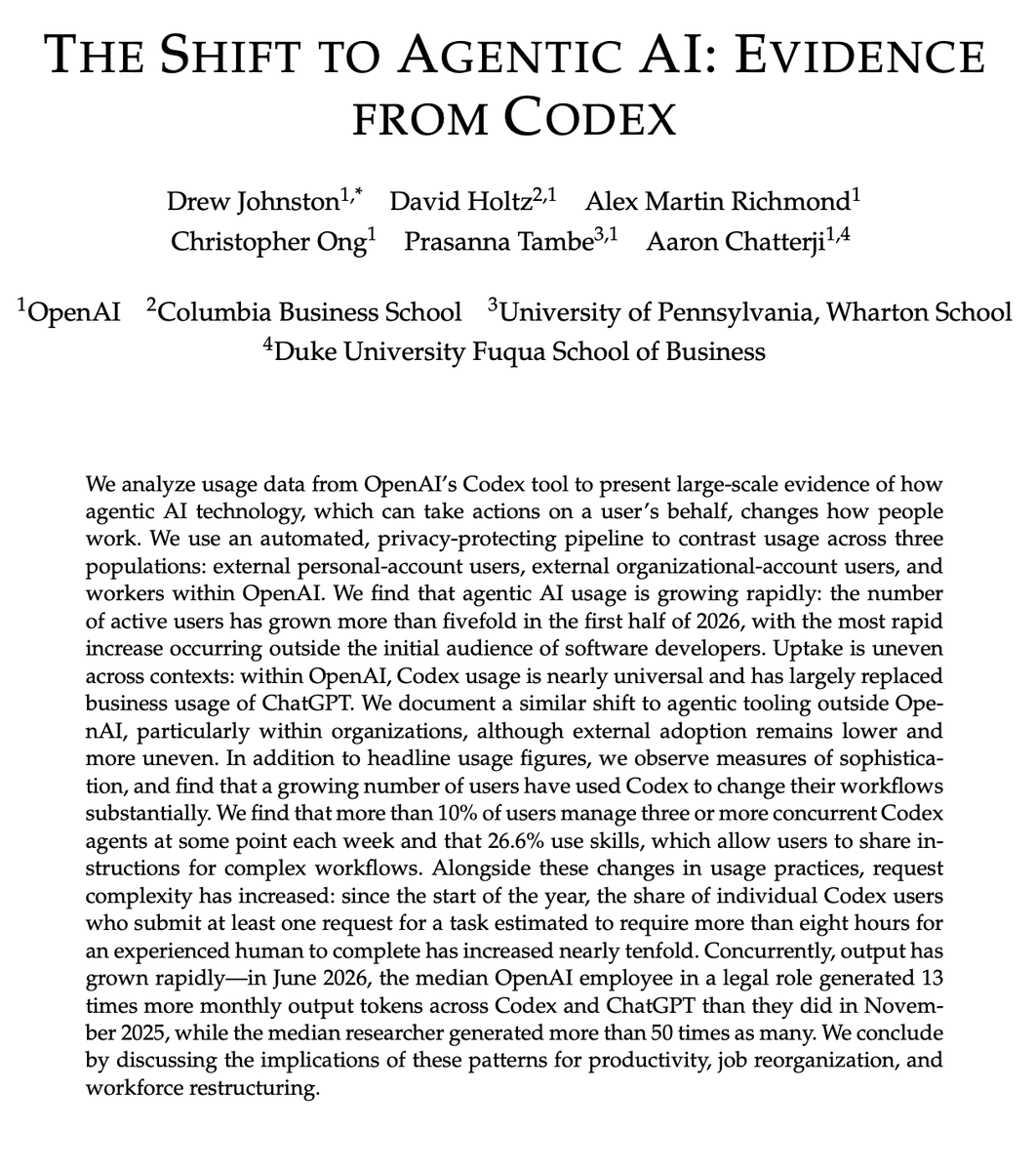
Most people think AI adoption = more chat messages.
Wrong.
New data on 100K+ users shows something different:
People aren't talking to AI anymore.
They're delegating entire workdays to it.
🧵 What the Codex data actually reveals:
For the past 2 years, we've measured AI adoption the wrong way:
• Monthly active users
• Messages sent
• Queries per day
But these metrics miss the entire story.
The real shift isn't conversational → more conversational.
It's conversational → agentic.
Users went from asking questions to handing off multi-step tasks that run for hours while they do other work.
Inside OpenAI, 99.8% of output tokens now come from agentic workflows.
Not chat. Not back-and-forth. Delegation.
These are tasks that would take a human 8+ hours to complete.
Think of it this way:
Old: "Can you help me debug this function?"
New: "Build the entire feature, run tests, integrate with API, document it—I'll check back in 3 hours."
That's the gap.
The most sophisticated users run 5-10 agents concurrently.
They're not using AI as an assistant.
They're using it as a distributed workforce.
Parallel delegation is the new normal.
Where did this start?
Software engineering.
Why? Two reasons:
Tasks are verifiable (code runs or it doesn't)
Engineers were already thinking in modular workflows
But it's spreading fast:
• Legal teams: Contract review, research memos
• Operations: Process docs, data pipelines
• Research: Literature synthesis, analysis
Anywhere verification costs are manageable.
Here's the leverage point most orgs miss:
Reusable "skills" (workflow templates).
Users who build custom skills for their team see 3-5x higher adoption rates.
Why? They capture org-specific context once, reuse forever.
Example skill:
"Take this API spec → generate client library → write tests → create integration docs → submit PR"
One skill. Invoked 47 times across the team in a quarter.
That's 376 human-days of work, delegated.
The constraint is no longer:
"Is the model smart enough?"
It's:
"Can I clearly specify what I want?"
"Can I verify the output efficiently?"
Management becomes the bottleneck.
Hot take:
ChatGPT is already legacy tech.
The product isn't the chatbot.
It's the agent runtime underneath.
Output token growth for heavy users:
• Individual users: 10x in 6 months
• Organizational users: 15-25x
• OpenAI internal: 50x
Why the gap? Organizational friction.
What creates friction:
• Security policies (data access)
• Lack of internal training
• Verification overhead
• Missing workflow redesign
Remove these → output explodes.
The study tracked 3 groups:
Individual users: Fastest to adopt, lowest complexity
Organizations: Slower start, higher ceiling once skills institutionalize
OpenAI internal: Asymptotic—nearly all work is agentic
This is your adoption roadmap.
New KPI to track:
% of output tokens from agentic tasks
Not "messages sent."
Not "active users."
Output tokens = actual delegated work.
Another hot take:
Software engineers will be the first middle-management class partially automated by tools they built.
The irony is thick.
If you're a team lead, start here:
Pick your top 3 repetitive workflows
Build one "skill" for each
Train 5 people to use them
Measure: skill invocations per week
Time to value: 4-6 weeks.
OpenAI's internal data shows the ceiling when all friction is removed:
10-50x output growth.
That's not hype.
That's measured reality in an optimized environment.
The shift from chat to agentic AI is already happening.
The question isn't "if."
It's "how fast can your org adapt?"
Bottleneck = delegation skill + verification infrastructure.
Who's already making this shift? 👇

English

Not long ago, AI was a tool you used.
Now, it's becoming a teammate that thinks, plans, and acts on its own.
This shift is being driven by a new wave: Agentic AI.
These systems don’t just respond — they take initiative, make decisions, and get things done.
Here’s a breakdown of the 4 most powerful Agentic AI design patterns each unlocking a unique approach to intelligent decision-making and task execution.
Here’s what each pattern brings to the table:
1. Agentic Self-Reflection
The AI critiques and improves its own output through self-reflection. It generates a response, evaluates it, and revises — all autonomously.
2. ReAct Pattern
Combines reasoning and acting in loops. The AI uses tools, observes results, and iterates on its response until the final answer is accurate.
3. Multi-Agent Pattern
Involves multiple agents with specialized roles. They communicate, delegate, and aggregate results to solve complex tasks together.
4. Planning Pattern
The AI breaks a goal into smaller tasks, executes them with agents, and replans dynamically if something fails or needs adjustment.
📌 Save this as your go-to reference for building smarter, more autonomous AI agents using proven architecture patterns.
GIF
English

@mikenevermiss One GitHub repo now replaces an entire engineering excuse.
English

anthropic just removed the biggest excuse people had for not building ai agents.
“it’s too hard.”
not anymore.
a few months ago, building an ai agent meant learning how to code, setting up apis, configuring servers, and fixing endless errors.
today, all you need is one github repo.
anthropic open-sourced launch your agent.
it asks what you want to build.
then it does the rest.
it builds your agent, deploys it to the cloud, tests it, improves it, and keeps it running even after you close your laptop.
no fake demos.
no complicated setup.
just a real ai agent running in your own account.
the best part.
it doesn’t run on your computer.
it runs inside claude managed agents, works 24/7, and costs just a few cents per run.
people are already building research agents, lead generation systems, content pipelines, and customer support agents that save hours of work every day.
the gap between people who use ai and people who build ai workers is getting bigger every week.
that’s usually where the biggest opportunities are.
build your first ai agent before everyone else does.
watch the video and read the full guide below 👇
MIKE@mikenevermiss
English

Paris proved prediction markets deserve a room with institutions, not for crypto bros and traders.
Singapore is next.
The Odds: Prediction Markets Summit. Token2049 week. Oct 6.
Institutions. Exchanges. AI companies. Oracles. Compliance. Market makers. Builders.
We will predict the future there - Lets say 98% that we will...

English
Tal Mor retweetledi

A new builder category is forming where AI meets financial markets. Agents, Trading, Payments, Compliance, Data, and Infrastructure. We have been quietly building the room for it. Full exposure on Monday. #AgenticFinance #MoreAndMore

English

@MessariCrypto The most durable value in crypto wasn't the assets — it was the intelligence layer built around them. This acquisition proves the data layer thesis.
English

@inversebrah Retail momentum is the fuel, not the signal. When the float is this small and the narrative this loud, the algo edge is just positioning before the 401k flows arrive.
English

@MessariCrypto AI agents as underwriters compresses due diligence from weeks to minutes. That structurally reprices illiquid markets. The question now: who audits the agent's methodology?
English

@Polymarket After-hours on a private-secondary illiquid print isn't a price — it's a narrative vehicle. The algo edge here is knowing which prediction markets embed this print in their implied odds.
English

@Polymarket The agent interface is the new CRM moat. Whoever owns the agentic touchpoint owns the data flywheel. Fin was always a distribution play, not a model play.
English

@Polymarket Single-model dependency in agentic pipelines is systemic risk. The DoD just made it public. Every serious shop should've already been multi-vendor.
English

@Polymarket This market conflates infra capex (durable) with SaaS wrapper valuations (fragile). Two different bets. Price them separately and the odds look very different.
English

20% chance the AI bubble bursts. polymarket.com/event/ai-bubbl…
English

AI agents write code while you sleep. Models self-update. Submissions run on autopilot.
Community tools and Numerai's agent stack are scaling collective intelligence. More minds, more models, stronger Meta Model.
Numerai Council of Elders@NumeraiCoE
“I was wondering if it was possible for a non-data scientist to build models and become a data scientist with very little effort.” Autonomous Quant Research with AI Agents // Out of Sample Episode One youtu.be/pf-N6RF-Ss4
English