
Sabitlenmiş Tweet
TanukiBTC
34.9K posts


TanukiBTC
@TanukiBTC
Austrian Economics | Freedom Maximalist |⚡[email protected]
[email protected] Katılım Mart 2017
1.4K Takip Edilen3.5K Takipçiler


i’ve known two women like this. everyone always assumes the plain Jane is kind-hearted and above it all. the truth is, the bimbo is the sweetest person you'll meet. they like to have fun and want you to have fun too. they just also like to make sure they look sexy. the plain Jane 9 times out of 10 will find every chance she gets to remind you how she is morally superior because she doesn't prioritize her appearance like “other girls”. Lauren is probably NICE and makes Jeff feel like the man. that's all it really takes. no degrees or philanthropy replace that in a man's eyes.
Rebekah Jones@GeoRebekah
Men think this is an improvement. MacKenzie Scott, Princeton graduate, writing novels at age six, studied under Toni Morrison, founded Amazon, and one of the biggest philanthropists in the history of humanity. Versus.. whatever the fuck this is.
English

Female social structure is re-organizing itself at a multi-national level.
The incentives are changing and men are taking on a stronger role again. Should see a steady drop in mental illness from women over the next few weeks to months.
Probably by July there will be influencers talking about getting married and having children.
English

Everything feels different lately. Not sure what's going on. But it feels like everyone is quiet quitting. There's an air of resignation. Vibes are really off. Communities drifting apart. Regardless, hope everyone is healthy and happy and living their joy: whatever that may be.
English
@stephanlivera Thanks for the nuanced view. You’re one of the rational voices out there today
English
TanukiBTC retweetledi

So everyone's talking about Google Quantum AI’s new research paper, “Securing Elliptic Curve Cryptocurrencies against Quantum Vulnerabilities: Resource Estimates and Mitigations.”
Cue the predictable Bitcoin quantum FUD: “Why haven’t the devs fixed this already?!”
Reality is, it’s not a simple patch. Post-quantum signatures come with serious tradeoffs and Bitcoin faces unique constraints that general tech and web apps don’t.
Post-quantum signatures are generally much larger transaction sizes - often 5–50× or more in the signature-heavy parts → higher fees, more compute. Hardware wallets would need a big shift. The choice of scheme (stateless, stateful, or hybrid) would change how we custody coins. HD wallets, watch-only wallets, FROST, MuSig2, silent payments… some of the privacy and UX wins we love today could be gone, degrade or require clunky workarounds.
Bitcoin has to stay decentralized: small blocks, permissionless validation. Web servers can throw bigger payloads around; Bitcoin can’t without sacrificing the very properties that make it Bitcoin. Even “standard” post-quantum schemes like ML-DSA (which Android is integrating) produce signatures 35–66× larger than today’s ~70-byte ECDSA signatures, making them too heavy for Bitcoin’s tight constraints on block space, fees, and hardware. That’s why researchers like @n1ckler (and @blksresearch) are doing vital work right now: exploring the right tradeoffs for Bitcoin specifically.
Hash-based crypto? Lattice-based? Something else? Which Bitcoin-optimized forms of SPHINCS make sense? SHRINCS (tiny ~324-byte stateful signatures with static backups) or SHRIMPS (for multi-device stateful setups)? How many times will a user sign with the same key? Can we assume user devices can securely maintain state, or do we need fully stateless fallbacks? Would we expand the block size with some kind of quantum witness discount? What do we do about quantum-vulnerable coins?
These are the hard, Bitcoin-specific questions that matter. Practical steps are already being taken. BIP 360, proposed by @cryptoquick, @Ethan_Heilman, and @isabelfoxenduke, is a thoughtful first step: it introduces a new Pay-to-Merkle-Root (P2MR) output type that gives us Taproot-like functionality without the quantum-vulnerable keypath spend. It’s designed as an enabling primitive — conservative, upgradable, and focused on reducing address exposure risks while the ecosystem figures out the heavier lifting of actual post-quantum signatures.
Bitcoin builders have spent 15+ years improving what is otherwise a very clunky experience in a decentralized environment. Rushing big protocol shifts risks breaking that.
This isn’t something to knee-jerk “just fix.” It deserves careful, ongoing research and exploration, not panic.
That said, informed skeptics like @reardencode and @bergealex4 are also right to push back. The paper improves resource estimates for breaking secp256k1 (fewer logical qubits, potentially minutes-long attacks on a hypothetical machine), but as @reardencode notes, it’s still theorycrafting: we’d need a large-scale fault-tolerant quantum computer with hundreds of thousands of physical qubits maintaining coherence for minutes — something far beyond today’s best devices (hundreds of qubits coherent for microseconds). A true CRQC capable of breaking ECDSA by 2029 (or even soon after) remains a big maybe.
Bitcoin's strength is in deliberate, methodical and conservative steps to address threats.

English

CORRECT ME IF I'M WRONG BUT, I turn 38 this year and I have realised , as a man, no one cares about you. Not your wife. Not your family. Not your friends. Not your workmates. Nobody. People act like they care, but deep down, they don't. You are on your own. Always on your own.
English

You see a person who is very fit, and you think to yourself, “It takes so much discipline to look like that. Surely he must be equally disciplined in all areas of his life.” But in reality it often doesn’t work that way. Interesting to reflect on the reasons why.
English

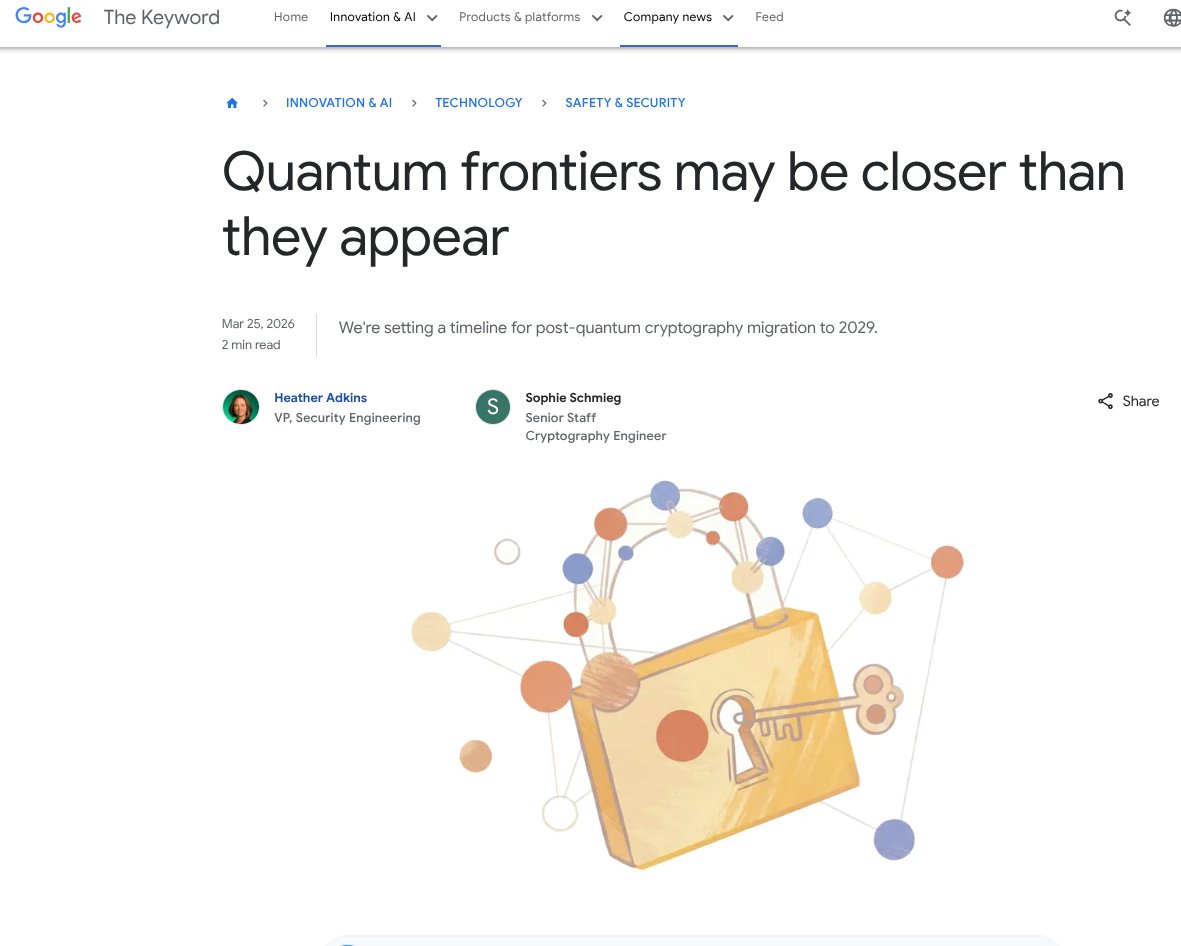
This is arguably the most bearish research ever published about BTC and ETH.
Oh, and this paper was released yesterday. BTC price is up since yesterday.
IYKYK
nic carter@nic_carter
Many are wondering "what Google saw" that caused them to revise their post-quantum cryptography transition deadline to 2029 last week. It was this: research.google/blog/safeguard…
English


German Chancellor Merz has said between 700,000-800,000 Syrian refugees are expected to return home to Syria in the next 3 years.
English
And you guys still think we are not in a bottoming process
Carl Moon 🌙@TheMoonCarl
Taking a long break from boring crypto
English

It's ridiculous that NASA is launching a mission around the Moon this week that will send humans farther into space than ever before and it's getting almost no attention. A landmark moment in the history of our species. History books will care about this moment even if you don't.
English



Real question???
Why did we move away from having this much space to being packed like sardines??Is there a log!cal reason???
WELCOME TO BLACK TWlTTER @blacktwiterthrd
Delta Airlines Lockheed L1011 TriStar Cabin in the 1980's.
English

Humans: 100%
Gemini 3.1 Pro: 0.37%
GPT 5.4: 0.26%
Opus 4.6: 0.25%
Grok-4.20: 0.00%
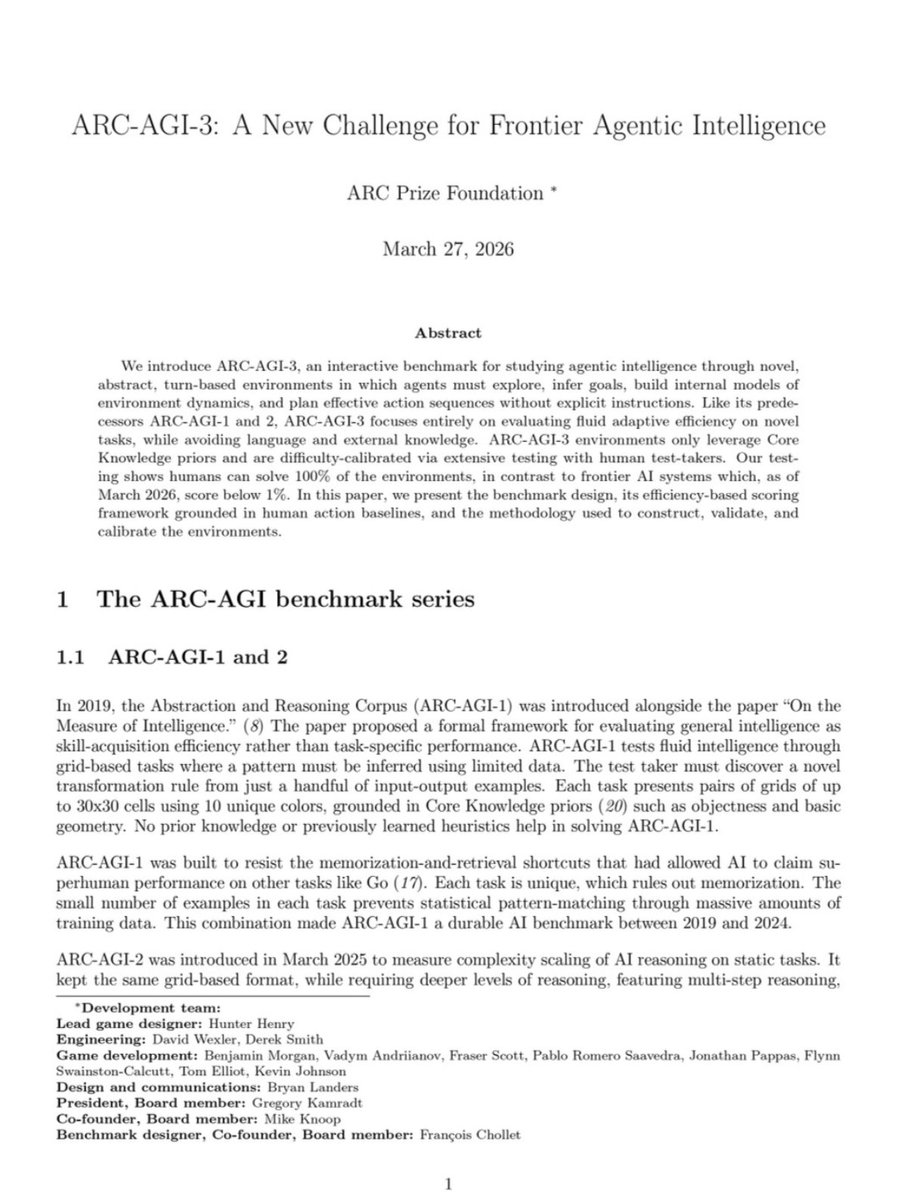
François Chollet just released ARC-AGI-3 -- the hardest AI test ever created.
135 novel game environments. No instructions. No rules. No goals given.
Figure it out or fail.
Untrained humans solved every single one. Every frontier AI model scored below 1%.
Each environment was handcrafted by game designers. The AI gets dropped in and has to explore, discover what winning looks like, and adapt in real time.
The scoring punishes brute force. If a human needs 10 actions and the AI needs 100, the AI doesn't get 10%. It gets 1%. You can't throw more compute at this.
For context: ARC-AGI-1 is basically solved. Gemini scores 98% on it. ARC-AGI-2 went from 3% to 77% in under a year. Labs spent millions training on earlier versions.
ARC-AGI-3 resets the entire scoreboard to near zero.
The benchmark launched live at Y Combinator with a fireside between Chollet and Sam Altman.
$2M in prizes on Kaggle. All winning solutions must be open-sourced.
Scaling alone will not close this gap. We are nowhere near AGI.
(Link in the comments)
English

Microsoft pulls Windows 11 KB5079391 update after it causes install error loop on 25H2 and 24H2
Shortly after release, Microsoft added a known issue to the release notes: Some devices encounter error 0x80073712
"Some update files are missing or have problems. We'll try to download the update again later."


English