TD

8.3K posts

TD banner
TD

TD

@TaylorDistler

✞ | Operator | Founder | Investor

🇺🇸 Katılım Şubat 2013
2.7K Takip Edilen1K Takipçiler
David Magee
David Magee@DavidMagee·
The potential is there, but you can’t really say the demand is (yet). I think adoption will (eventually) come, but I think the timing is very much up for debate. I also think we get lost in the difference between consumers wanting help from AI to discover vs they want to transact inside it.
English
2
0
1
173
Mani Fazeli
Mani Fazeli@mcfazeli·
Starting this week, millions of @Shopify merchants can sell in ChatGPT, into the US. Their PDP, their checkout, their customizations, no extra setup. AI is a new front door to commerce. Shopify is what’s behind it everywhere.
English
40
41
309
225.3K
TD
TD@TaylorDistler·
Donovan. You grew up around 90’s and early 2000’s baseball. You know this. The amount of love fans show is directly correlated to the pride, effort, and willingness to “lay it on the line” that a team or player shows. That’s the reason why fans are fans. It’s not the pre game fashion. Not political statements or activism. It’s something way more raw and real. Guts and glory. Sounds corny but that’s the truth.
English
0
0
5
1.9K
Mark Blankenbaker
Mark Blankenbaker@UofLSheriff50·
To the guys for Louisville Basketball that put it on the line for this program: Thank you. Cards fall to Michigan State 77-69 in the NCAAs 2nd round. UofL hasn't been to the 2nd weekend of the NCAA Tournament since 2015.
English
17
23
544
58.3K
NewsForce
NewsForce@Newsforce·
BLACKROCK JUST BET $100 MILLION ON TRADES, NOT COLLEGE DEGREES BlackRock is putting $100 million into training plumbers, electricians, and HVAC workers as the AI boom runs straight into a shortage of people who can actually build things. Turns out the future still needs someone with tools and a clue. Source: NewsForce
English
40
235
995
358.1K
TD
TD@TaylorDistler·
@jbarbier The accuracy of this…
English
0
0
0
4
Julien Barbier 🙃❤️🏴‍☠️ 七転び八起き
Using Claude Code has a weird side effect: You don't just get more productive, you actually want to work more. There's something addictive about watching a product being born in real time in front of your eyes. "One last feature" after "one last feature" and it's already past 3am.
English
377
668
7.5K
270.9K
TD retweetledi
Devon Eriksen
Devon Eriksen@Devon_Eriksen_·
Many people, even self-described conservatives, think socialism would work if human nature were different. No. Socialism cannot work, even in a hypothetical society of selfless genius saints. Why not? Because socialism centralizes economic choices. How much lumber do we produce? How much wheat? What should the hourly wage of a garbage collector be? How much should insulin cost? How about bread? Socialists think that if you elect the right people, they will make these decisions intelligently and altruistically, and everything will be great. But it doesn't matter how smart and benevolent you are... you can't make a good decision without the right information. The Socialist Central Planning Committee, however wise or benevolent, doesn't know what's wanted, or what's available, because that information is conveyed in prices, and accurate pricing is the very thing that socialist governments wipe away with the bureaucratic pen. Capitalist networks are decentralized. They distribute decision making to where the information is. A man selling metal doesn't know anything about desks, or lumber. He doesn't know how many desks people want, or whether they should be made out of oak, or folded metal. But he does know how much it costs him to smelt iron ore into steel, and roll it into sheets. So he sets a price, and others decide whether, and how much, to buy. That price contains the information others need to decide whether steel is plentiful, and should be folded into anything you can make out of sheet metal, or is scarce, and should be saved for things that can only be done with steel, and furniture should be made out of oak, or pine, instead. Socialism works, or rather doesn't, by using the threat of force to set the prices of things, or take money from one person and give it to another. But every time this happens, critical data on supply or demand is erased... data that you need to make decisions. Individual prices are a decision, a guess at where supply and demand cross paths. But since free markets reward those who guess correctly, or copy a correct guess, aggregate prices are data on supply and demand. For a socialist central planning committee to order the manufacture of the correct number of cars, or to correctly set the price of a car, they need to know a thousand thousand thousand things about steel and aluminium, welders and assembly robots, rubber and glass and lithium batteries and copper wire, which they must gather, along with trillions of other pieces of data, from literally everyone in their entire civilization. Tesla only needs to know how much people charge them for the stuff they need. At every transaction in a captialist society, vital data is compressed into its most compact and useful form, then passed along to the adjacent step, where abundant brainpower is waiting to make decisions with it. Any defective node in the web that fails to make good decisions receives swift and automatic feedback, and either heeds that feedback or goes out of business, to be replaced by someone who will. Yes, in a capitalist system, there are many undesirable results. But capitalism doesn't create these results. It discovers them. They are inevitable consequences of the state of technology, and will persist until something is invented that changes the terrain. In socialism, no such solution is possible, because all the inherent problems you need to solve with progress are hidden from view by the far worse problems you created for yourself by separating the place where decisions are made from the place where information is known.
Handre@Handre

Mises obliterated the entire socialist project in 1920 with one devastating insight: "Where there is no free market, there is no pricing mechanism; without a pricing mechanism, there is no economic calculation." The socialists spent the next century pretending this problem didn't exist while their economies collapsed around them. And yet here we are, watching politicians promise they can "fix" healthcare, housing, and energy markets through central planning. They can't even calculate the cost of their own programs correctly — how exactly are they going to allocate resources across an entire economy? Every Venezuelan breadline, every Soviet grain shortage, every Chinese famine was just Mises being proven right in the most brutal way possible. But sure, let's try democratic socialism this time. What could go wrong?

English
263
729
4.4K
397.6K
Dan Hillery
Dan Hillery@hillery_dan·
@BitcoinPulseX I think this will be one of the few things people don't expect. That's the reemergence of demand for L2's ontop of Bitcoin.
English
1
0
2
197
Bitcoin PulseX
Bitcoin PulseX@BitcoinPulseX·
🚨 BREAKING TETHER IS LAUNCHING USDT ON BITCOIN, WITH TRANSACTIONS SETTLING DIRECTLY ON THE BASE LAYER AND THE LIGHTNING NETWORK. A MASSIVE STEP FOR BITCOIN’S PAYMENT ECOSYSTEM. ⚡️
Bitcoin PulseX tweet mediaBitcoin PulseX tweet media
English
241
600
4K
437.2K
TD
TD@TaylorDistler·
@coreyganim This is a bigger deal than people realize. There’s a sweet spot of businesses that will benefit exponentially more from AI.
English
0
0
0
482
Corey Ganim
Corey Ganim@coreyganim·
This is WAY bigger than it looks. Right now, getting AI tools approved at a company is a nightmare: → Security reviews → Legal sign-off → Procurement paperwork → IT vetting → Weeks (or months) of waiting Claude Marketplace lets enterprises pre-approve AI tools in one place. For businesses: faster adoption, less friction, AI actually gets used. For solo operators selling to enterprise: this is your distribution channel. Get listed, skip the red tape. Anthropic just made it easier to buy AND sell AI tools at scale.
Claude@claudeai

Introducing the Claude Marketplace, a way for enterprises to simplify their procurement of AI tools. Now in limited preview.

English
18
20
346
67.7K
TD
TD@TaylorDistler·
Nodding yes to this post. Curious if Apple lucked into this or if it was intentional.
English
3
0
1
488
Aakash Gupta
Aakash Gupta@aakashgupta·
The math on Apple’s AI play is insane. The four hyperscalers are spending $700 billion on AI infrastructure in 2026. Apple spent $12.7 billion on total capex last year. The gap looks like Apple lost. But run the numbers differently. Apple has 2.5 billion active devices as of January 2026 and $157 billion in cash. The hyperscalers are burning through free cash flow so fast that Amazon is projected to go negative on FCF this year. Alphabet’s free cash flow is expected to drop 90%. These companies are borrowing against future revenue that doesn’t exist yet to buy GPUs that depreciate every 18 months. Meanwhile, API pricing has dropped 97% since GPT-3 launched. Every dollar the hyperscalers spend training proprietary models gets commoditized faster than they can recoup the investment. Apple’s internal leadership reportedly views LLMs as commodities not worth proprietary development costs. That read looks increasingly correct. This tells you everything about distribution economics vs infrastructure economics. OpenAI has committed $1.15 trillion in infrastructure deals through 2035. Apple already has the thing OpenAI would trade all those GPUs for: 2.5 billion devices with system-level integration, payment credentials, health data, and app ecosystem lock-in. That distribution can’t be replicated at any price point. The hyperscalers are betting that building the best model wins. Apple is betting that models become cheap and distribution becomes everything. One of those bets requires $700 billion a year and growing. The other requires a software update. If models commoditize, and pricing trends say they will, the entire AI capex cycle becomes Apple’s subsidy program. Everyone else funded the R&D. Apple ships the product.
Ejaaz@cryptopunk7213

i find it fucking hilarious how Apple "failing" at AI is now the exact reason they're about to win it: - watched everyone else burn $1.4T+ building models... then picked the winner (gemini) to use for... $1B - while everyone fights to grow users, apple flips a switch and 2.5 billion devices get AI siri tmrw. - $150B to splurge on the device / app layer. zero competition (because everyones spent their cash). - while openAI charges $200/mo subscriptions, Apple lets you run models on-device (cheaper, faster, private, personal) - while openAI struggles to build an AI device, Apple just dropped 5 powered by the best AI chips for hand-held devices. they "lost" the model race because they didn't need to win it in the first place greatest to (accidentally) ever do it.

English
32
59
414
117.8K
TD
TD@TaylorDistler·
Really need some @WHOOP MCPs
English
0
0
0
71
TD retweetledi
Rohan Islam
Rohan Islam@Heyrohanislam·
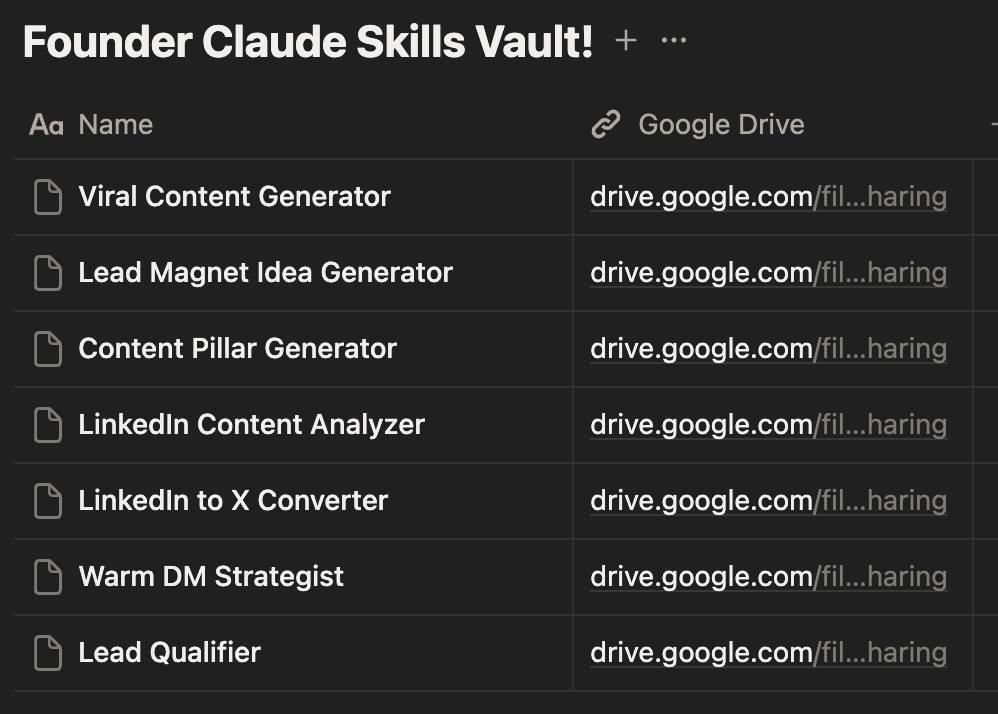
I built 7 Claude Skills that replaced 6+ hours of weekly marketing work. Now I’m giving them all away. The Founder Skills Vault: → Viral Content Generator → Content Pillar Generator → LinkedIn Content Analyzer → Lead Magnet Idea Generator → LinkedIn-to-X Converter → Warm DM Strategist → Lead Qualifier This isn’t a prompt pack. These are production-grade tools that run inside Claude. It’s the same system I used to grow 7,000+ followers in 3 months. Want it? → Like + RT → Comment “FOUNDER”
Rohan Islam tweet media
English
490
277
641
36.3K
TD
TD@TaylorDistler·
The Age of the Idea Guys is upon us. @hillery_dan
StockMarket.News@_Investinq

Silicon Valley got a HUGE warning from one of its own founders. Not about regulation or about competition. About the entire belief system the tech industry was built on. Peter Thiel says AI is not coming for the writers first. It is coming for the math people. The coders, quants, engineers. The people Silicon Valley put on a pedestal for two decades. His argument is devastatingly simple. Within a few years, AI will solve the hardest math problems on Earth faster than any human alive. Google DeepMind already won gold at the International Math Olympiad last summer. Solving five of six problems in natural language within the time limit.​ Here is the part nobody talks about. Math has been the gatekeeper of power for over 200 years. It started during the French Revolution, verbal ability ran in aristocratic families. Math was seen as the great equalizer, distributed randomly, impossible to inherit.​ So society made math the test for everything. Medical school, engineering, finance, tech hiring. Want to be a neurosurgeon? First prove you can do calculus. Thiel asks the obvious question: What does calculus have to do with operating on someone's brain?​ Then he goes darker. By the Soviet era, putting math geniuses and chess grandmasters on pedestals was not about celebrating intelligence. It was about control. The math people, Thiel says, are singularly clueless about the world. Elevating them keeps everyone else trying to be like them instead of questioning the system.​ Sound familiar? Silicon Valley in the 21st century took this bias and supercharged it. Leetcode interviews, algorithmic screening and the entire industry filters for one type of mind. And that type of mind is about to be replicated by a machine for pennies. Thiel has seen this movie before. In the late 1980s, he was a competitive chess player. He believed chess should be the universal test of intelligence. Then IBM's Deep Blue crushed Garry Kasparov in 1997.​ Chess mastery went from pinnacle of human genius to party trick overnight. And math is next. So who wins? The word people, he says. The communicators, storytellers, negotiators. The ones who understand context, nuance, and human complexity. LinkedIn's 2026 data already shows it. Communication skills appear twice as often in job postings. Leadership, public speaking, and storytelling are the fastest rising demands.​ The creator of Anthropic's coding tool admitted he has not written a single line of code himself since November.​ Companies are cutting thousands of technical workers. Block went from 10,000 employees to under 6,000.​ The math moat is not shrinking, it is gone. For 20 years, society told liberal arts majors they were wasting their time. Barista degrees, they called them.​ Turns out the people who learned to think in words, not numbers, may have been training for exactly this moment. The question is whether the institutions built on math supremacy universities, tech companies, hiring pipelines can adapt before they become obsolete. Peter Thiel is betting they cannot and he has been right before.

English
0
0
4
2.9K
Conor
Conor@jconorgrogan·
@hypersoren sort of both- short term what Comfort Systems is doing. rolling up and professionalizing fragmented mechanical contractors long term, better cooling architecture, thermal control software,etc
English
1
1
6
830
TD
TD@TaylorDistler·
I sense that you’re asking a rhetorical question that you already know the answer to, but… They have a projected CAGR of Bitcoin measured in USD that must be higher than their cost of capital. If true, it manifests in appreciating value of the common and higher demand for the prefs (due to credit worthiness). They sell shares in both the common and prefs to raise USD to pay the yield. Right, wrong, or indifferent, it can be compared to adding positive cash flowing businesses via M&A to the incumbent business to increase value and/or distributions. It all hinges on the CAGR of bitcoin being greater than their cost of capital.
English
0
0
2
77
MandleHu
MandleHu@MandleHu·
@WooBtc @IIICapital Yeah i get its todo with bitcoin, but where does the yield come from ?
English
3
0
1
209
TD
TD@TaylorDistler·
“We don’t have time for nuance…we have to push forth the most extreme narrative…” There it is. They want eliminate your critical thinking and do / repeat exactly as you’re told. What an incredible testimony. Credit to her for thinking for herself.
Johnny Midnight ⚡️@its_The_Dr

I guess she finally figured it out!

English
0
0
0
110