
David Hendrickson
16K posts

@TeksEdge
CEO & Founder | PhD | Startup Advisor | @Columbia | Author Generative Software Engineering https://t.co/9oqvHuTX5f | 🔔 Follow for AI & Vibe Coding Tips 👇


🚨 GPT-5.6 Sol's juice values (thinking budgets) have been severely degraded compared to release day If Sol now feels faster and more "efficient", this is probably why Terra and Luna juice values aren't affected, so their thinking budgets are now higher than Sol's

We've had Qwen3.6-27B and 35B since April and Qwen3.7 Pro/Max since May. Wonder if Qwen3.7 is coming for medium and small.

We're extending Claude Fable 5 access on all paid plans, as well as keeping Claude Code’s weekly rate limits 50% higher, through July 19.


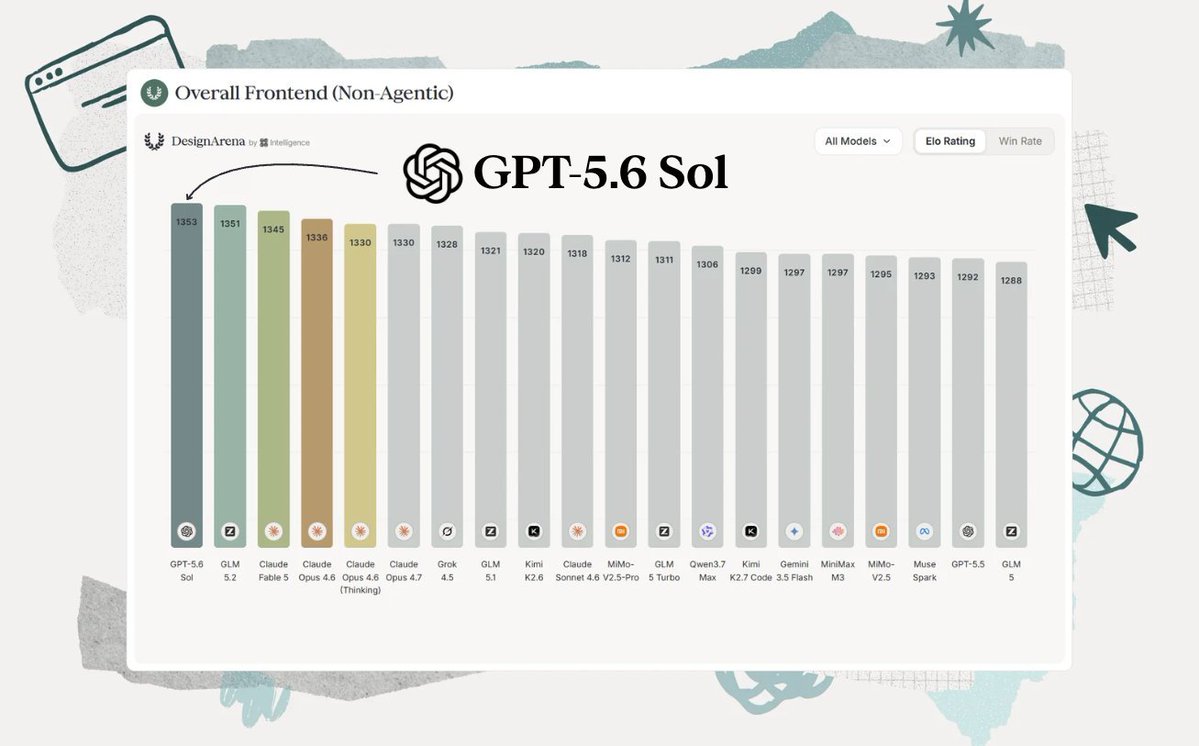
BREAKING - OFFICIAL RESULTS: GPT-5.6 Sol by @OpenAI is 1st overall on Design Arena with an Elo of 1353. This puts GPT-5.6 Sol above Claude Fable 5 by @AnthropicAI and in the same performance band as GLM 5.2 by @Zai_org on frontend design. This is an 18-position and 60-point Elo leap from GPT-5.5. GPT-5.6 Sol also establishes a new Pareto frontier for preference vs. speed, faster than any model at this performance. Congratulations to the @OpenAI team on the launch!

💡AMD's latest commitment to the Local AI community is becoming a full-stack strategy rather than another chip launch (Gorgon Halo). They've committed to supporting: 🧠 Open ROCm software ecosystem 📦 Open-source models, weights, datasets & training configs 💻 Preconfigured Ryzen AI Halo developer systems 🔥 Next-generation Gorgon Halo systems using Ryzen AI Max PRO 400 processors are scheduled for Q3 2026, with up to: 🔹 192GB unified memory 🔹 160GB allocatable as graphics memory 🔹 55 NPU TOPS 🔹 40 RDNA 3.5 compute units AMD is positioning the platform for private, local agentic AI—potentially loading 300B-class models at 4-bit without relying entirely on costly cloud GPUs.

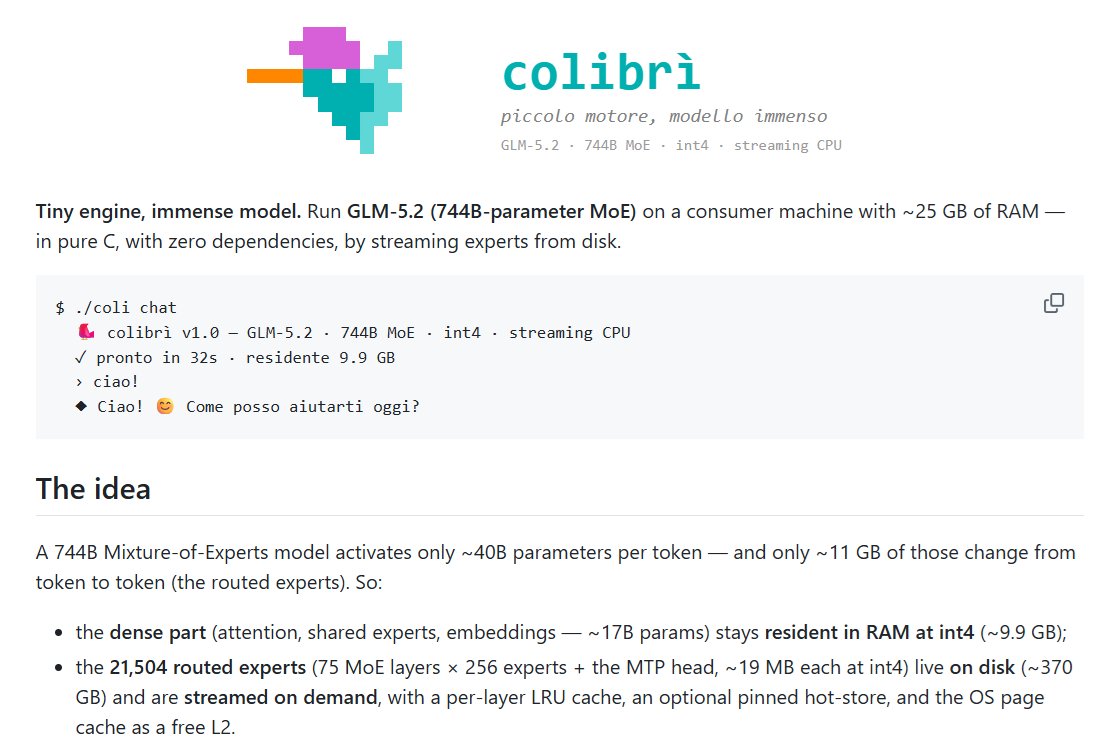
🚀 Holy 💩! Major Local AI Breakthrough! 🧠 744B-parameter GLM-5.2 (1.5 TB total) is now running on just ~25 GB RAM — no discrete GPU required! 👀 Wut!? Must test!! Italian engineer @JustVugg built Colibrì, a pure C inference engine (single ~2.4k line file, zero runtime deps) that: • 🛡️ Keeps the dense core (~10 GB at int4) resident in RAM • 📀 Streams 21,504+ MoE experts from fast NVMe on demand (only ~40B active per token) • ⚡ Supports native MTP speculative decoding + MLA attention Result: Frontier-class model on everyday consumer hardware! 📊 Current speeds: • 25 GB RAM setup → 0.05–0.1 tok/s (disk-bound) • Higher RAM + fast SSD → up to 1+ tok/s (warm) • It's a start... what could you do with a 5090? 💡 Big opportunity: Pair it with Phison aiDAPTIV+ AI SSDs to kill the I/O bottleneck 👉 smarter caching, prefetching & KV offload could make it dramatically faster! This is a huge step toward truly accessible local frontier AI. 🔗 GitHub: JustVugg/colibri


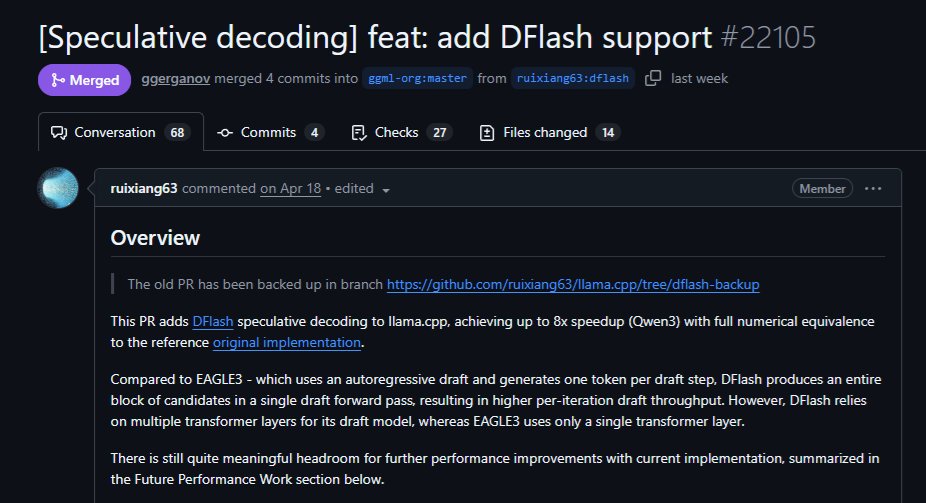
llama.cpp recently added DFlash support to its speculative decoding arsenal. Along with MTP, Eagle3 and various ngram-based techniques, the local model performance takes another step up. Special thanks to NVIDIA team and Ruixiang Wang specifically for leading this effort! github.com/ggml-org/llama…


A 744-billion-parameter AI model running on a regular computer with only 25 GB of RAM—and no GPU. 🤯 Colibrì is a lightweight, open-source inference engine written in pure C that can run GLM-5.2 on consumer hardware. Instead of loading the entire model into memory, it keeps RAM usage low by streaming only the required Mixture-of-Experts components directly from an SSD while generating each token. The impressive part: ⚡ Pure C 📦 Zero runtime dependencies 💾 Around 25 GB of RAM 🧠 744B total parameters, with roughly 40B activated 🚫 No expensive GPU required There is an important trade-off: this is not fast inference, and the quantized model files still require hundreds of gigabytes of SSD storage. But as a technical proof of concept, it is remarkable. It shows that running enormous AI models locally may depend as much on clever memory management as it does on expensive hardware. Tiny engine. Massive model. Very smart engineering. 🐦💻 Repository link below 👇 The model is officially listed as a 744B-parameter MoE with about 40B active


Blown away. I asked GPT-5.6 to create a Cosmic Dodge game to compare to previous version. Not only did it succeed in first shot, it built the best I've ever seen and wrote 3x more code than Fable 5. Clearly GPT-5.6 is better at building this game than any other model by a mile.


Muse Spark 1.1 (xhigh) scores 69 on the Artificial Analysis Coding Agent Index in the Opencode harness, offering a strong blend of performance and near frontier cost-efficiency Muse Spark 1.1 lands just below GPT-5.5 (medium) in Codex (71) and ahead of Claude Opus 4.8 (medium) in Claude Code (67). Cost per task is among the lowest of frontier coding agents at ~$1.4, with the tradeoff of a higher time per task. Congratulations @AIatMeta, @finkd, and @alexandr_wang on this result!