Tesla Tracker
1.2K posts

@TeslaSpaceXMars
ALL-IN $Tsla since 2016 Entrepreneur at heart No filters and business sucess insights


@wholemars Yes but there’s a 2 order of magnitude delta (100x) between what he says and what he does/delivers.


@AdamLowisz It should be able to do a good analysis today. Grok outputting files in different formats is coming next week.


My joy as a homeowner in Canada is having a tenant in my basement that pays 40% of my mortgage. I highly recommend 💯


Hey @aelluswamy please fix this ASAP.


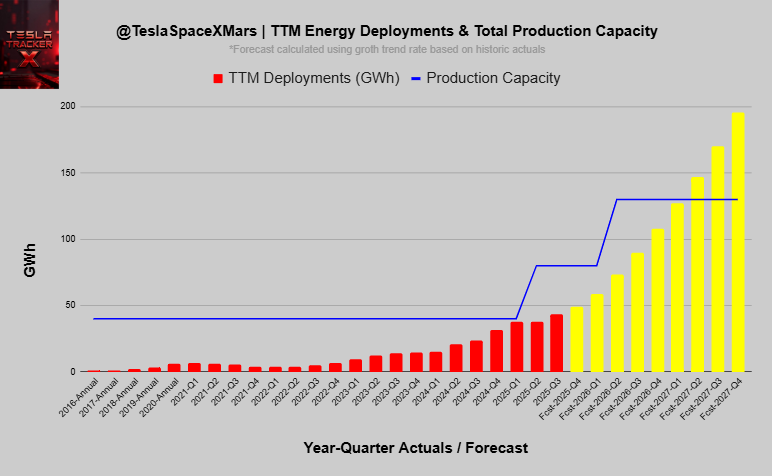
Tesla Energy is now the largest energy storage provider in the world ~46.7 GWh deployed in 2025 alone, powered by Megafactories in Lathrop and Shanghai From ~4 GWh in 2021 to ~47 GWh in 2025 Nearly 12× growth in four years Tesla now holds ~15–20% of global grid-scale battery storage That’s enough energy to power Las Vegas for about 5 days straight Grid-scale storage is scaling fast TW-scale energy storage is getting closer to reality


Are Tesla Gigafactory Berlin’s days numbered? electrek.co/2026/01/08/are… by @fredlambert

I'm in the Nvidia Q&A with Jensen and someone just asked the difference between Alpamayo and Tesla FSD Jensen said: “As to your second question: Tesla’s FSD stack is completely world-class. They’ve been working on it for quite some time. It’s world-class not only in the number of miles it’s accumulated, but in the way it’s designed—the way they do training, data collection, curation, synthetic data generation, and all of their simulation technologies. Of course, the latest generation is end-to-end Full Self-Driving—meaning it’s one large model trained end to end. And so… Elon’s AD system is, in every way, 100% state-of-the-art. I’m really quite impressed by the technology. I have it, and I drive it in our house, and it works incredibly well. Alpamayo was designed around a different idea. The first difference is that NVIDIA doesn’t build self-driving cars—we build the full stack and the technology for everybody else to build self-driving cars. And we build—like we do for humanoid robotics—three computers: the training computer, the simulation computer, and the robotics computer, which is the self-driving car computer. We have software stacks across all of that. Our customers can use all of it, some of it, or parts of it—whatever makes sense for them. And so we’re working with the entire industry—Tesla for their training system, Waymo for the car computer, and XPeng. Nuro—who I think just announced they’re going into the robotaxi business—with Lucid and Uber; and NVIDIA is part of that. So our system is really quite pervasive because we’re a technology platform provider—that’s the primary difference. There’s no question in our mind that, of the billion cars on the road today, in another 10 years’ time, hundreds of millions of them will have great autonomous capability. This is likely one of the largest, fastest-growing technology industries over the next decade. And the last thing we do is: we open-source everything. If a customer would like to use the model that we train, they’re welcome to do that. If they would like to use our model technology but train it themselves, we even help them do that. We’re not a self-driving car company—we just want to enable the world’s autonomous industry. Everything that moves should be autonomous.”