
Sabitlenmiş Tweet
TheBridge
78 posts


TheBridge
@TheBridgeMacro
China. Macro. Web3. Weekly intelligence from inside China. 33k followers | 8k+ subscribers. Former @PwC | @UN. Subscribe to The Bridge on Linkedin.
china Katılım Nisan 2026
70 Takip Edilen72 Takipçiler
For context, I’m not American or Chinese, I’m Irish, and I’ve lived and worked in both the US and China.
From a China‑macro angle, my point isn’t “this admin good / that admin bad,” it’s that we’re watching a second power centre build its own tools: blocking statutes against US Iran oil sanctions, more trade settled in yuan, and alternative payment and shipping channels that make unilateral US measures harder to enforce over time. You don’t have to like Beijing’s choices to recognise that this is what a more fragmented order looks like in practice, not just in think tank repo
English

If you still support this admin, I just don't know what's wrong with you....
TheBridge@TheBridgeMacro
People keep reacting to these headlines like they’re one‑off flexes. From a China‑macro angle, this is what a second power centre looks like: Beijing openly ignoring unilateral US sanctions on Iranian oil, paying in its own terms, and quietly building non‑SWIFT payment rails around it. The headline is today’s quote; the real story is a slow shift away from a world where Washington’s sanctions are treated as global law.
English
2030 probably isn’t 🇺🇸 or 🇨🇳 it’s:
🇺🇸 open crypto rails (BTC, ETH, ETFs, dollar stables),
🇨🇳 state rails (e‑CNY, BSN, Hong Kong tokenisation),
👀 everyone else routing between the two.
From inside China, the weird part is watching the world’s most cashless, QR‑native economy keep retail crypto behind glass while quietly building some of the plumbing that future on‑chain markets will run on.
English

By 2030, Who dominates global markets and crypto? 🌍
🇺🇸 or 🇨🇳 or 👀
English
From a macro angle, the uncomfortable truth is that “safe path” was mostly a product of one era: falling rates, cheap housing relative to income, and an S&P you could just DCA into without thinking too hard.
If you’re under 30 today, everything on the old menu is either expensive (equities, housing, gold) or politically fragile (fiat, long‑duration bonds), which is exactly why crypto and on‑chain assets have gone from fringe bet to one of the few places that still offer asymmetric upside alongside the boring stuff like skills, cashflow, and owning productive businesses. The trick is to treat crypto as one leg of a barstool, not the whole chair.
English
If you’re under 30, I genuinely don’t know what the “safe” life path is anymore.
Buy stocks? S&P is at ATHs.
Buy gold? Near ATHs.
Save cash? Dollar gets cooked.
Buy a house? Housing market is cooked.
Buy bonds? Barely beating inflation.
At this point, crypto is one of the only not overpriced places left
The Kobeissi Letter@KobeissiLetter
BREAKING: The S&P 500 closes at its highest level on record, now up +14.5% since the March 30th bottom. That's +$8.3 TRILLION in market cap in 24 trading days.
English
@theswansjr From a China macro angle, it’s less “people are dumb” and more “their money has never failed them yet.”
If you’ve never lived through capital controls, a frozen bank account or a 90% currency drawdown, Bitcoin looks like ideology; if you have, you don’t need the 101 thread.
English

You can’t explain Bitcoin to someone who doesn’t understand money in the first place.
No awareness of the problem = zero appreciation for the solution.
That’s why most people dismiss bitcoin.
English
@BitcoinNewsCom Adoption isn’t just about ATM counts. 🇨🇦
Canada had 3,800+ Bitcoin ATMs and also $700M+ in crypto related fraud in 2025.
The proposed ban targets the tool criminals use most. The tradeoff: stronger consumer protection for tighter on ramps.
Fair deal or overreach?
English

NEW: 🇨🇦 Canada to ban all Bitcoin ATM’s in the country.

English
From inside China this doesn’t read as “DJI brave in the US, coward at home” so much as a company trapped between two sovereigns.
They’re suing the FCC and DoD because US law still gives them a process to contest blacklisting. In Beijing, new rules have literally cleared DJI drones from store shelves and tightened export controls in the name of national security, there is no equivalent path to litigate that away, only comply or lose your licence.
English

DJI sues America when the US government says their drones are a national security threat, when Beijing says their drones are a national security threat they obey, cower and say “yes master” and immediately comply by removing all drones from their physical and online stores. 😂
Razven@RazvenHK
DJI stores across Beijing show empty shelves and displays ahead of total drone ban in China's capital to come in in May.
English
Iran’s currency collapse is real and brutal, but the math in this meme is off, 1 billion rials is still tens of thousands of USD at current black market rates, not $555.
From a macro + Web3 angle, this is exactly the kind of environment where people start looking for off grid rails stablecoins, Bitcoin, DeFi not because they’re ideal, but because the local currency and banking system have stopped doing their basic job. In Iran and other sanctioned economies you already see that: people using crypto to move value across borders, hedge inflation, or access credit when domestic banks are either insolvent or politically captured.
The uncomfortable truth is that DeFi won’t “fix” bad governance or sanctions, but it does change the menu of options when a state currency is in freefall and that’s exactly why both regulators and ordinary savers are paying attention.
English

Iran’s currency has completely collapsed.
$555 USD is now worth 1 BILLION in Iran.


English
From inside China you feel two things at once. Rural pensions really are meagre often just 100–200 yuan a month for many older farmers and inequality between coastal cities and the interior is still huge. But it’s also not true that “half the country” lives on 1,000 yuan a month; recent data has average rural disposable income above 20,000 yuan a year, roughly 1,700+ a month, with big regional gaps.
I don’t pretend to speak for Chinese citizens, but living and working here does give me a different vantage point than arguing about China from 10,000km away.
English

You Westerners who visit China for a holiday, to study, or to work — you really think you can lecture me on what China is actually like? What a joke.
Unless you’re a Chinese citizen living here as an ordinary person, your outsider perspective doesn’t count.
The Chinese government is simply using you as convenient propaganda tools to sell a fake, polished image of the country.
Half the Chinese population still earns only about RMB 1,000 a month — roughly AUD $200. Rural villagers’ retirement pension is just RMB 200, or around AUD $40 a month.
This is the reality of “socialism with Chinese characteristics” under the Chinese Communist Party.
The only people who are truly rich and powerful are Xi Jinping and his inner circle.
English
From a China macro angle, both lines here are doing propaganda in different accents.
The “courage to open the strait” framing ignores that Hormuz was functionally open to global traffic until Iran layered on its toll regime and the U.S. answered with a naval blockade; what we have now is neither fully open nor fully closed, but a dual choke: IRGC tolls on one side and U.S. interdiction on the other. Beijing’s public position has been consistent, it wants traffic flowing again because it is the world’s largest oil importer, and it blames both U.S. escalation and Iranian moves for turning a legal shipping lane into a geopolitical minefield.
Living in China, you feel less “who said the tougher line?” and more the practical question: how long can the global economy function with its main energy chokepoint turned into a test site for tolls, blockades, and great‑power signalling.
English

🇺🇸 🇨🇳 Trump: “I think that China has neither the courage nor the will to open the Strait of Hormuz.”
➖️ China: “The Strait of Hormuz was already open before the war. You are the ones who created the war out of nothing and closed the strait to the rest of the world.”
English
Living in Dongguan and moving through Guangzhou ~ Shenzhen regularly, you see both stories at once.
There are under occupied towers and “built‑ahead” districts that never filled as fast as local officials or developers hoped, some are now being written down or even demolished as China slowly digests a massive real estate binge. But a big share of the skyline is very much in use: finance and tech cores in Shanghai and Shenzhen, logistics and trading hubs in Guangzhou, and mixed‑use complexes that sit on top of metro interchanges and feed the real economy every day.
From a China‑macro angle, the more interesting question isn’t “empty vs fake”, it’s how this transition from debt‑fuelled skyline building to slower, services‑heavy urbanisation plays out for growth, local government balance sheets, and the companies that actually occupy these buildings.
English

🇨🇳 We all know by now that large Chinese cities have more skyscrapers than anywhere else.
Many of them, however, might not have any function besides making China look advanced.
English
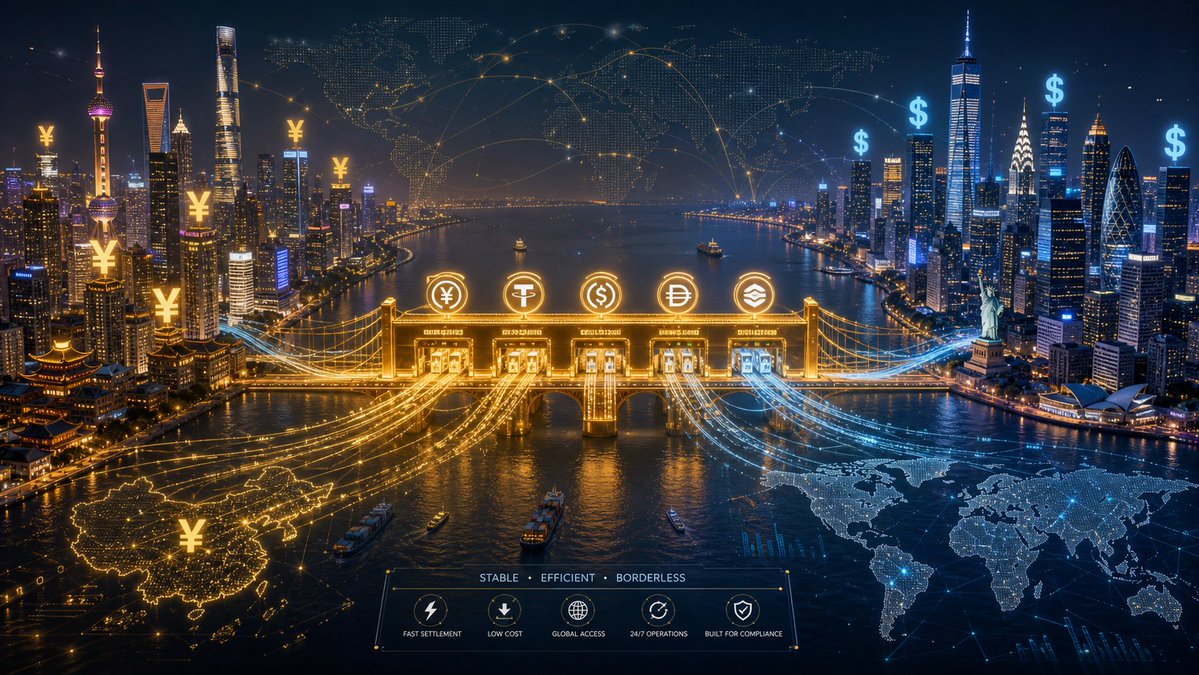
If Hong Kong gets its stablecoin regime right, the licenses won’t just be “another crypto approval.”
They’ll be toll booths on new FX and settlement bridges between onshore CNY, offshore CNH, USD liquidity, and Web3 rails, exactly where fee pools and political leverage live.
#HongKong #stablecoins #FX #Web3
English
From a China macro angle, the important shift isn’t that Beijing dislikes these sanctions (that’s old news) it’s that it has now built legal infrastructure to tell firms and courts to treat them as null and void inside China.
MOFCOM’s prohibition order doesn’t make OFAC’s asset freezes disappear globally, but it does mean a Chinese refinery that “over‑complies” with U.S. rules can now be in breach of Chinese law, while a firm that follows Beijing’s line risks losing dollar access. From inside China, you feel less like you’re watching an instant “end of U.S. power” and more like the slow emergence of two overlapping legal and financial systems that make every energy trade, shipping contract, and bank relationship more complex and more political.
English
🇨🇳🇺🇸 China just ordered its domestic companies to ignore U.S. sanctions targeting Chinese refiners tied to the Iranian oil trade, including Hengli Petrochemical.
-Affected firms had been hit with U.S. asset freezes and transaction bans
-China's Ministry of Commerce called the U.S. measures "unlawful" and "a violation of international norms"
-Beijing issued a directive prohibiting recognition or enforcement of the sanctions inside China
-Comes days after U.S. Treasury warned about Chinese "teapot" refineries doing business with Iran
This is China openly rejecting the U.S. financial pressure architecture in real time.
For weeks, the U.S. has been tightening a financial blockade on Iran that runs parallel to the naval one, sanctioning shadow banking networks, threatening Chinese refineries, and warning shippers off Iranian tolls.
Beijing just told all of those measures to take a hike, and instructed its companies to act as if the sanctions don't exist.
Source: @officialrnintel

English
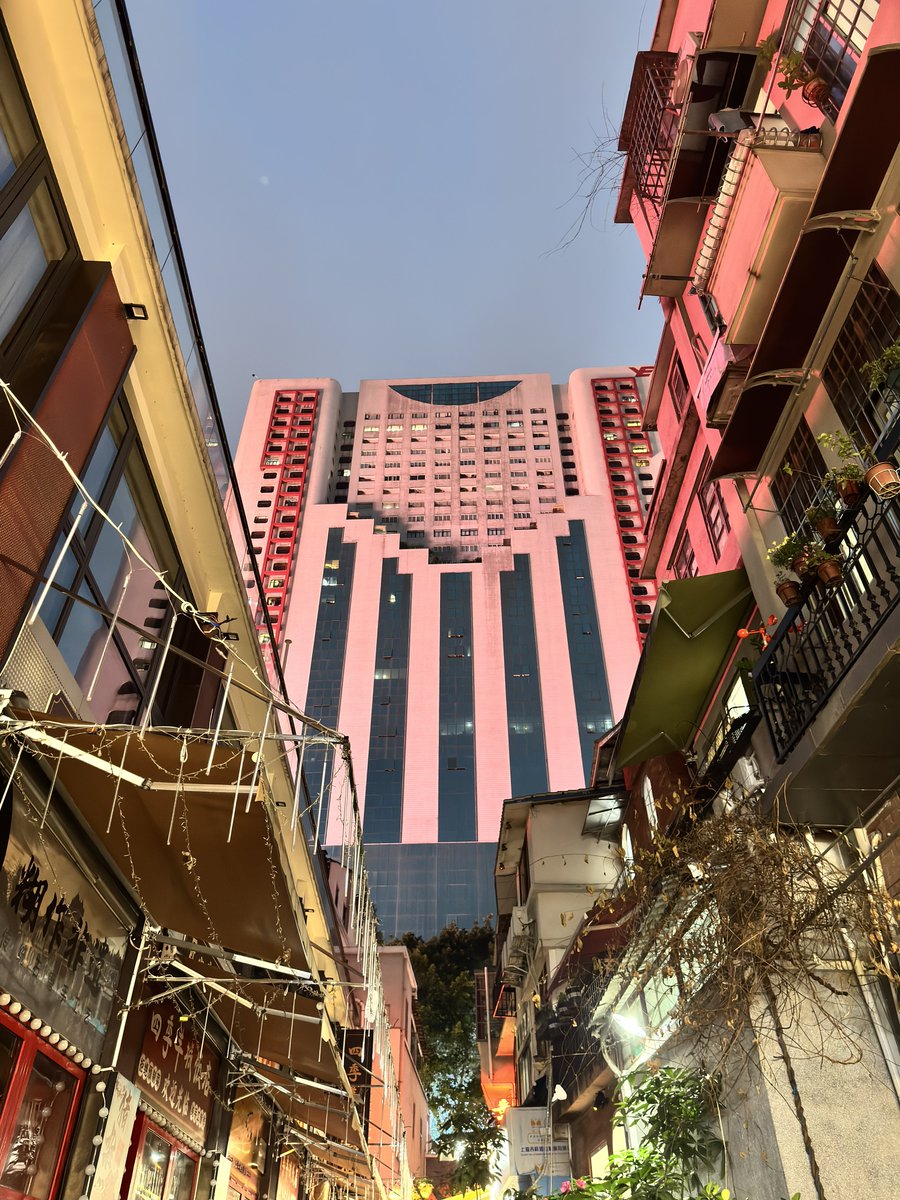
Living down the road in Dongguan, I still get that “scale shock” every time I come up to Guangzhou.
The photos never quite capture how the skyline just keeps going – Pearl River, Zhujiang New Town, endless belts of towers linking Guangzhou–Foshan–Dongguan into one continuous urban machine. What most people miss from a desk in the West is that this isn’t a single city flex, it’s one node in a mega-cluster of 80m+ people that quietly does a huge share of the world’s manufacturing and trade.

English

Guangzhou. the pictures don’t do it justice I’ve never seen anything of that scale



English
Living in China, you feel the contradiction very clearly.
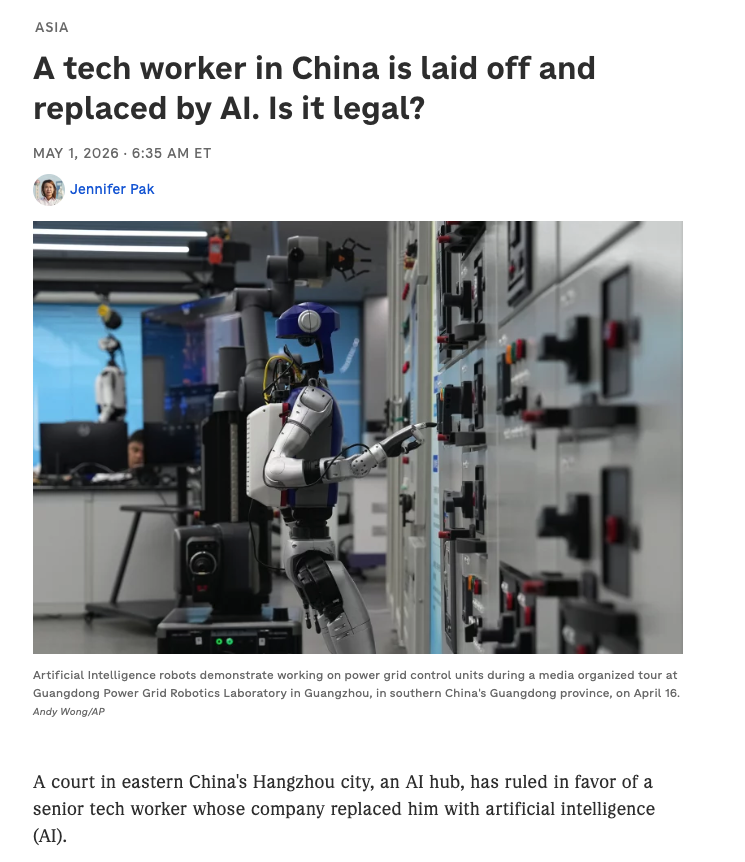
Beijing is pushing hard toward a 1.2 trillion‑yuan AI industry with 6,000+ firms, but courts in Hangzhou and Beijing are now saying: AI replacement is a strategic choice, not an act of God, and you can’t fire people just to make that choice cheaper. The disruption stays on the company’s balance sheet, not the worker’s.
English

A TECH WORKER IN CHINA GOT FIRED BECAUSE HIS COMPANY SAID AI COULD DO HIS JOB CHEAPER.
He had worked there since November 2022.
His salary was 25,000 yuan a month ($3,655).
The company offered him a new role at 15,000 yuan. A 40% pay cut.
He said no.
They fired him.
Then a court in Hangzhou ruled the dismissal illegal.
And the reasoning is what everyone needs to read.
The court didn't say AI can't replace jobs.
It said replacing a worker with AI is a voluntary business decision.
Not an act of God. Not an unavoidable disruption.
A choice.
And if it's a choice, the company cannot force the worker to bear the financial risk of that choice.
The exact quote from the arbitration panel: "By citing AI replacement as grounds for dismissal, the company had effectively shifted the risks of technological iteration onto its employees."
That framing is everything.
Every company running AI layoffs right now is calling it "market forces" or "operational efficiency."
The Hangzhou court just said: that's not a weather event. That's a strategy. And your strategy is not your employee's liability.
This isn't one case.
Last year, a data mapping worker in Beijing was replaced by AI and won a similar arbitration. Same logic. AI adoption = business strategy = company's risk to absorb.
The Hangzhou Intermediate People's Court published this ruling on April 28, 2026. Timed exactly to Workers' Day on May 1.
That timing was deliberate.
China's core AI industry hit 1.2 trillion yuan in 2025. Over 6,200 AI companies. The government is pushing mass AI adoption across industries. By 2030, they expect AI agents to penetrate 90% of terminals.
And yet they published a court ruling protecting workers from being discarded in the process.
That tension is intentional.
China wants AI adoption and worker stability at the same time. This ruling is the legal infrastructure for that balance.
What this means for the rest of the world:
Every knowledge worker watching their job get automated should understand what China just established. The question isn't "can AI do your job." The question is "who pays when a company decides to let AI do your job."
Right now in the US and most of Europe, the worker pays. Through severance negotiations, at-will employment, and no legal protection when a company restructures around AI.
China just created a different framework.
AI replacement is a business decision.
Business decisions come with business obligations.
You cannot just hand the employee the bill.
I don't know if this precedent spreads. I don't know if Western courts will follow.
But I know this: the 2.1 million people who saw that BRICS post yesterday aren't sharing it because they love Chinese labor law.
They're sharing it because they're scared.
And they're right to ask: if AI is a business strategy, not a natural disaster, why is the worker the one absorbing the risk?
That question doesn't have a good answer yet.
But at least one court just tried to give one.
Bookmark this. This legal framework will matter more over the next 24 months than most people realize.
---
Sources: Caixin Global, NPR, China State Council Information Office (scio.gov. cn), Dexerto
BRICS News@BRICSinfo
JUST IN: 🇨🇳 Chinese court rules companies cannot legally fire employees simply to replace them with cost-saving artificial intelligence.
English
From inside China, the irony is hard to miss.
We talk a lot about “Chinese propaganda,” but Wired just documented a dark‑money group, Build American AI, paying influencers up to $5k per TikTok to push pro‑AI, anti‑China talking points without clearly disclosing who’s funding the message. The real question is how anyone is supposed to have a sane debate on AI policy when half the conversation is coming from undisclosed campaigns on both sides.
English
Huge.
A Dark-Money Campaign Is Paying Influencers to Frame Chinese AI as a Threat👇
Taylor Lorenz@TaylorLorenz
SCOOP: A pro-AI dark money group backed by a powerful super PAC funded by execs tied to Palantir and OpenAI, has been secretly paying influencers to push pro-AI, anti-China propaganda on TikTok and IG.
English
From inside China, this feels less like a viral “flex” and more like the first big use of a blocking statute Beijing drafted years ago.
MOFCOM’s order says the U.S. sanctions on five refiners buying Iranian crude must not be recognized, enforced or observed in China, even though OFAC has put them on the SDN list for billions of dollars in Iranian oil purchases.
The real story is the compliance double bind: obey Washington and risk breaking Chinese law, or obey Beijing and risk losing access to the dollar system.
English

BREAKING:
China's Ministry of Commerce just officially declared it will not recognize, implement, or comply with US sanctions on Iranian oil purchases.
Five named Chinese refineries sanctioned by Washington for buying Iranian crude:
🇨🇳 Hengli Petrochemical (Dalian)
🇨🇳 Shandong Jincheng Petrochemical
🇨🇳 Hebei Xinhai Chemical Group
🇨🇳 Shouguang Luqing Petrochemical
🇨🇳 Shandong Shengxing Chemical
The US accused them of importing tens of millions of barrels of sanctioned Iranian oil — sending billions of dollars directly to Tehran.
Beijing's response on May 2, 2026:
"Will not be recognized, implemented, or complied with."
Not a negotiation. Not a request for a waiver. A flat rejection of US legal authority over Chinese companies buying oil from a third country.
China buys Iranian crude at a discount. Iran gets the revenue. The US sanction becomes unenforceable.
The dollar's ability to police global energy trade just got publicly rejected by the world's largest oil importer.
I’ll keep you updated in real-time. Turn on notifications or you might regret.

English
From inside China, this doesn’t feel like a random “nice” policy, it’s part of a long game.
Beijing is now extending zero‑tariff access to all 53 African countries with diplomatic ties, building on the 100% tariff‑free treatment already granted to 33 African LDCs since 2024. The opportunity is real, but so are the bottlenecks: rules of origin, logistics, standards and branding will decide whether African exporters can actually use this door that’s just been opened.
English

🇨🇳 Starting from today, Zero tariff on products from all 53 African countries that have diplomatic ties with China.
English
@cryptorover From inside China, ¥414.1b isn’t “flooding the system,” it’s plumbing.
PBoC routinely does hundreds of billions to over a trillion in monthly MLF/repo operations, the real easing signal is in RRR cuts, rates and targeted credit, not one weekly injection.
English

BULLISH: 🇨🇳 China injected ¥414.1 billion in liquidity this week.

English
From inside China, this isn’t framed as “defiance” so much as flipping on a blocking statute Beijing drafted in 2021.
MOFCOM is now formally prohibiting Chinese firms from recognising or complying with U.S. sanctions on five “teapot” refineries that buy Iranian oil, even as OFAC puts them on the SDN list.
The collision isn’t just political, it’s legal: a trader can now be in violation of U.S. rules and Chinese rules at the same time.
English

China ordered companies in the country not to comply with US sanctions on five domestic refiners linked to the Iranian oil trade, a move aimed at softening the impact of penalties. bloomberg.com/news/articles/…
English
From inside China this doesn’t feel like a secret plot so much as a structural workaround.
China now buys the overwhelming majority of Iran’s crude, in some months close to 90%, at a discount, while publicly rejecting U.S. sanctions. Washington’s own Treasury has sanctioned Chinese traders it says help route that money toward IRGC‑linked networks.
The more interesting question is what happens to U.S. leverage when the key marginal buyer of oil no longer treats American sanctions as binding.
English

Strong move.
China has been quietly bankrolling Iran’s terror network through massive oil purchases and backdoor trade for years.
U.S. State Dept - Near Eastern Affairs@StateDept_NEA
U.S. Sanctions Tighten Grip on Iran-China Oil Trade state.gov/releases/offic…
English