"...you cannot unlearn what you've learned..." IAEA's @rafaelmgrossi explains the UN's view on the sophisticated state of Iran's nuclear capabilities now v 2015 JCPOA-era program, & his view that bombing alone won't destroy nuclear capabilities. @FaceTheNation
Inst for Science
21.2K posts

Inst for Science
@TheGoodISIS
A think tank focused on nuclear nonproliferation. Employing science in pursuit of peace since 1993. contact us: [email protected]
Washington D.C. Katılım Haziran 2009
595 Takip Edilen20.4K Takipçiler
Inst for Science retweetledi
More comments on DG Grossi interview: The puzzle mentioned in the Grossi interview transcript below refers to a nuclear weapon and the officials were Iranian.
It should be noted that Iran had already done considerable work on advanced centrifuges by 2015. Its plans to develop and deploy its advanced centrifuges were well known as part of the 2015 nuclear deal, and there were agreed upon plans (see our website) about how many Iran would be deploying now and through 2030 (a lot) under those 2015 rules. And inspectors conversant in centrifuges judged in 2025 that the IR-6 was its likely best model based on work Iran had already accomplished. So, the difference between 2015 and now is a matter of degree, not some quantum jump.
If the JCPOA had continued, Iran would have had today a fully functioning advanced centrifuge manufacturing complex primed to make thousands of them a year. I feel far more secure knowing that thousands of gas centrifuges are now a gleam in Iran’s eye rather than watching them being deployed legitimately, protected by the JCPOA. While knowledge cannot be eliminated, its use can be thwarted, and Israel and the United States have done so with regard to Iran’s centrifuges. So, the task before us now is simpler, ensuring that Iran does not start over.
Margaret Brennan@margbrennan
English
Inst for Science retweetledi
A reaction to DG Grossi’s interview with @CBSNews @margbrennan that Iran’s knowledge about centrifuges cannot be destroyed. Valid point, but Iran’s centrifuge knowledge can be lived with in the short to medium term, the enriched uranium can’t be. It poses too much of an immediate threat.
Each centrifuge, even Iran’s most advanced, enriches very little. Therefore, if Iran has to start with natural uranium, it would need to build and install thousands of centrifuges and need additional time to produce enough weapon-grade uranium for a nuclear weapon. For example, with 3000 IR-6 centrifuges, probably now needing a few years to make and get up and running, starting with natural uranium and factoring in the traditional inefficiencies Iran has faced, the plant would need four months to produce enough weapon-grade uranium for a nuclear weapon. 1000 IR-6’s would need 12 months.
On the other hand, the existing stock of HEU allows Iran, with far less effort, to get enough for one nuclear weapon in a few weeks with about 350 centrifuges, or two cascades, and enough for 10 in four months. Therefore, enriched uranium stocks are the crown jewels of Iran’s enrichment and nuclear weaponization programs. The knowledge can be lived with in the short to medium term, the enriched uranium cannot.
PS: a gentle nudge about a mistake by the DG in the interview, who said, “Now Iran has the most sophisticated, fast and efficient machine [centrifuge] that exists.” That is not true, several countries have more sophisticated centrifuges, spinning faster and more efficiently. In terms of enrichment output, these others far surpass Iran’s. Interesting, Steve Witkoff made the same mistake.
English

NEW REPORT
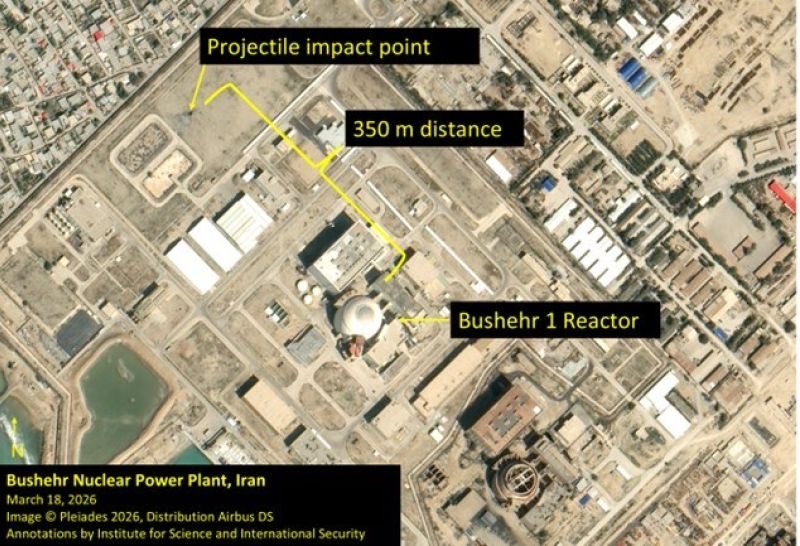
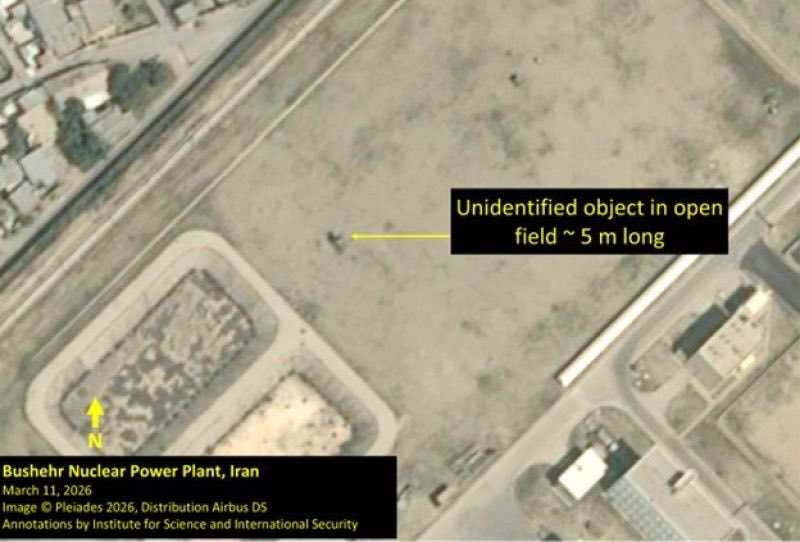
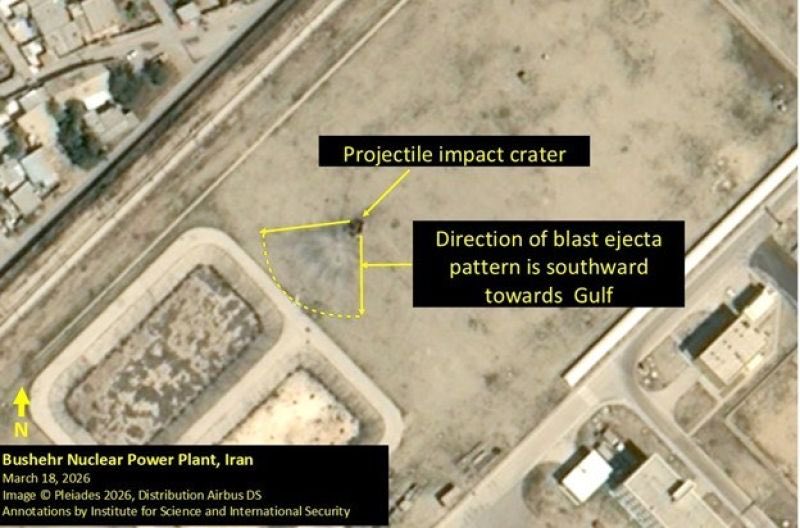
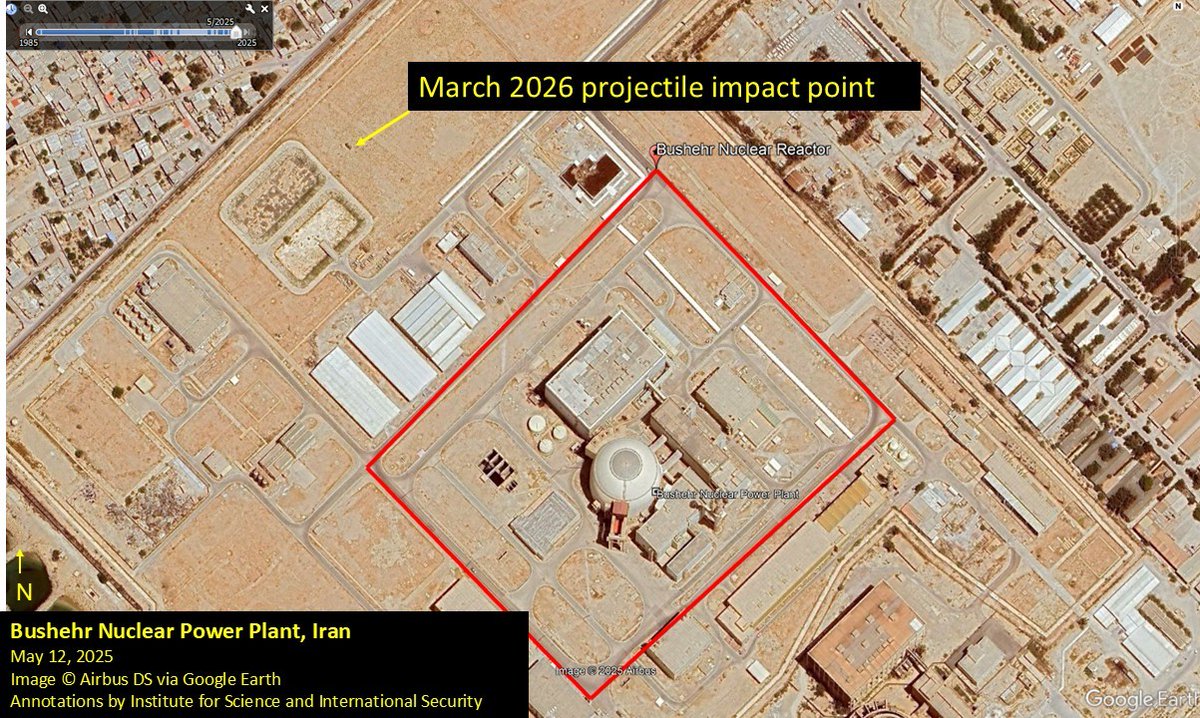
Update to Bushehr strike analysis: We annotated the image to show the debris pattern is fan shaped away from an apparent crater towards the south, which is more suggestive of an incoming projectile from the north and not from the Gulf. See the impact point and Bushehr's location on the coast below. This adds Iran to the suspect list, along with Israel and the United States. The IAEA provides no details about the "structure" that was "hit and destroyed," but satellite imagery taken a week before the strikes shows an unidentified object in an open field, measuring about 5 meters in length.
We join IAEA DG Grossi in condemning any attacks in the vicinity of the reactor or of any electrical lines coming into the plant that may be needed to provide power to run reactor emergency systems.
Israel and the United States must make sure that the communication channels with Russia remain open and functioning, and all US and Israeli operational personnel are fully aware of the risks.
Link to the full report: isis-online.org/isis-reports/i…


English

We have a few comments about Richard Nephew's interpretation of the 2007 NIE in his recent article in the Bulletin of Atomic Scientists, titled, "Revisionism at Fordow: Why the WSJ is wrong about the history—and future—of Iran’s nuclear program."
Nephew's article is in summary an attack on Trump, a statement against the war, and a defense of the 2007 NIE. We think that the unclassified 2007 NIE should be renounced, not reinterpreted to say something it did not state. It has been misused and misunderstood long enough, now by people claiming there was no reason to attack Iran because Iran's secret nuclear weapons program largely stopped in late 2003 (according to Matt Bunn) or that it was simply a nuclear weapons "option" (according to Nephew).
Hanging his reinterpretation on the line in the NIE that Iran was "keeping the option open to build nuclear weapons" can more logically in the paragraph's context be interpreted as applying only to a decision to do so a later time, not construct a sophisticated alternative type of nuclear weapons program that better prepares Iran to build nuclear weapons, if a decision were made to do so.
Think of the people who looked at the unclassified 2007 NIE and took it literally, Iran’s nuclear weapons program ended and had not restarted, citing the NIE, repeating that mantra whether it was 2007, 2009, 2015, or 2026. Iran has no nuclear weapons program, they bleated. If nothing else, the unclassified NIE was unbelievably misleading and led many people to falsely characterize Iran’s post Amad nuclear weapons program as an off/on switch rather than a different type of nuclear weapons program, focused on shortening timelines, being prepared, once the order came to build from the leadership. The methodological flaw was thinking that there is only one type of nuclear weapons program, one that starts only when the order is given to build them.
Before the June war, Iran had whittled down breakout time to a few days, timeline to build the bomb to months. Iran was racing to shorten timelines and preparation timelines, to allow nuclear weapons to be built quickly, once the order came. Israel stated a reason for striking in June was the timeframes were getting too short to tell whether Iran was further whittling down the time or building the weapons. Think of Mojdeh, Shahid Meysami, Sanjarian, Taleghan, Golab Dareh, Shahid Shariarti, or Min-Zadayi. All of these many sites were working on aspects of developing nuclear weapons. It is a nuclear weapons program.
English

NEW: High resolution Airbus imagery taken today confirms a projectile impact 350 m away from the Bushehr power reactor. See before image for comparison.


IAEA - International Atomic Energy Agency ⚛️@iaeaorg
Following information from Iran of a projectile incident on Tuesday evening, the IAEA can confirm that a structure 350 metres from the Bushehr NPP reactor was hit and destroyed. “Although there was no damage to the reactor itself nor injuries to staff, any attack at or near nuclear power plants violates the seven indispensable pillars related to ensuring nuclear safety and security during an armed conflict and should never take place,” DG @Rafaelmgrossi said.
English

IAEA Director General @rafaelmgrossi states the new enrichment plant at Esfahan is underground, saying, “It is underground, but we haven’t visited it yet." This statement strengthens our assessment that it is inside the Esfahan mountain tunnel complex, based on Iranian statements that the facility was affected by June strikes but well protected, and satellite imagery analysis of construction around the tunnel entrances in recent years.
Before panicking about HEU and unknown stages of an enrichment plant being co-located, a few facts to consider:
Following the June attacks, only one out of three entrances appears to have been accessed by vehicles.
All vehicle entrances to the Esfahan mountain tunnel were blocked in early February, strongly indicating no ongoing operations.
No evidence of alternative tunnel entrance, whether makeshift or by design.
Damage inside the tunnels is unknown but could be more significant than widely believed, depending on the specific warheads on the Tomahawks.
Some external ventilation structures were clearly targeted and destroyed. Unclear to what extent power supply, water, and communications were disrupted, but all are needed to run an enrichment plant.
Lastly, Iran was planning an IAEA visit. If the IAEA had come back and reported a fully equipped centrifuge enrichment plant that Iran had built in secret, this would have provided additional cause for military attacks.
However, the Esfahan tunnel facility needs to be dealt with one way or another, and there are multiple options, the most straightforward being the entombment as was done to Fordow.
English

FREE PDF VERSION OF OUR BOOK: Iran's Perilous Pursuit of Nuclear Weapons
In light of the current events and debates surrounding Iran's nuclear weapons ambitions, we want to make a free PDF of our book, Iran's Perilous Pursuit of Nuclear Weapons, available. The Wall Street Journal in its opinion piece this weekend, The Real Nuclear History of Iran, clearly identified the need to set the record straight on Iran's ambitions, and it provided a great summary of what everyone should know. Our 500 page book is for those who seek more: It richly illustrates Iran's nuclear weapons program from its beginning in the 1980s, to the crash program of the early 2000s, to the preparedness program of the modern days. It provides ample reference and context for sites, names, and capabilities attacked by Israel in June 2025 and again in February/March this year.
Find the PDF here: isis-online.org/books/irans-pe…
A few reviews: “The most comprehensive unclassified recounting of Iran's nuclear aspirations ever written...careful, meticulous recitation of the full reality of Iran's efforts."-Wall Street Journal
"Most complete account of Iran's nuclear programme available to the general public. Albright and company have taken a deep dive into the archives and come up with many gems."-Survival
English
Inst for Science retweetledi
Reading articles this morning about the failed US/Iran nuclear negotiations and disappointments among some in DC and UK about their end. But they lament not continuing with an Iranian effort to end up, after a long negotiation (enabling a build up of its threatening missile and proxy forces), with another, likely weaker JCPOA. They dismiss Trump’s goals of verified denuclearization, including a permanent end to enrichment, as “maximalist.” Yet, Iran is not enriching and its centrifuge program is essentially destroyed. Rather than building on making that permanent, they want to facilitate rebuilding Iran’s centrifuge program, while likely willing in the end to accept a nuclear deal that would not have sufficient verification to be an “effective bulwark against weaponization.” It is not surprising that the Trump administration did not want to continue down that path.
From @ArmsControlNow:
“The Iranian proposal, as presented on Feb. 26, did not meet the maximalist terms that the White House demanded, including no enrichment, dismantlement of Iran's nuclear facilities, and removal of enriched uranium gas from Iran. Nor did it appear to be sufficiently restrictive from a nonproliferation perspective to be an effective bulwark against weaponization.”
English
Inst for Science retweetledi
NYT statement below expresses a concern about nuclear criticality with regard to Iranian HEU but the criticality concern with regards to handling or recovering HEUF6 in Iranian facilities is exaggerated. The HEU is in hexafluoride form in thick steel canisters, each holding no more than 25 kg of HEUF6, well below the amount needed to go critical. The Iranians are well aware of criticality concerns, so canisters would be spaced accordingly. Anyone from US or Iran recovering canisters would be well aware of proper, safe criticality and safety procedures. They would not just toss them together in the back of a wagon, as the NYT statement would appear to suggest.
If canisters were pierced, the HEUF6 would react violently with moisture in the air. The atmosphere and surfaces would be highly toxic from the fluorine byproducts, requiring great care in approaching. The radioactive risk would be very manageable. But because of the risk from fluorine, it would best to leave any dispersed HEUF6 in place. It would be very hard to recover and use in any case. Moreover, it would be very difficult for the reacted material to form a critical mass in the tunnels. With adequate hazmat suits, non-ruptured canisters could be recovered in such an environment.
HEUF6 is already entombed in the destroyed Fordow enrichment plant. The amount is unclear publicly, but it could be over 100 kgs. This material is very hard to get at in this destroyed, deeply buried facility. Entombing the HEU in the Esfahan tunnels may be safest option overall. If recovery is undertaken, however, the US is well able to do so safely and to determine the risks of doing so.
From NYT today: “There is little room for error: If the canisters were pierced and moisture entered them, the result would be both highly toxic and radioactive. If they were kept too close together, there would be risk of triggering a critical nuclear reaction.”
English

JOIN our webinar tomorrow at noon: David Albright on Iran's Nuclear Program: Battlefield Damage and Implications
Friday, March 13, 2026 12 PM - 1.30 PM EST
isis-online.org/uploads/isis-r…
English

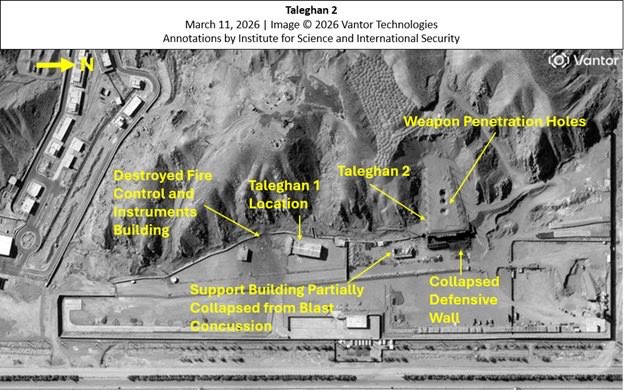
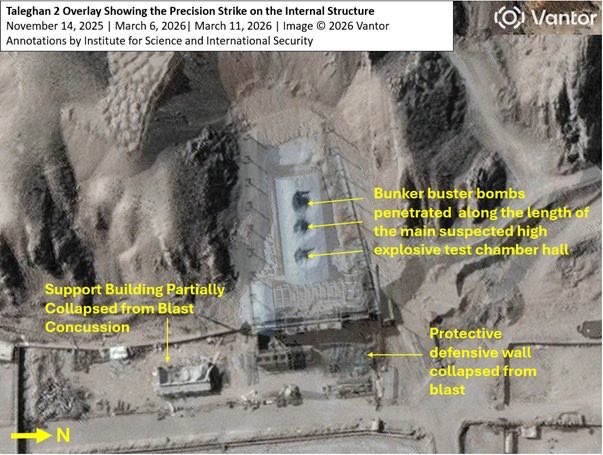
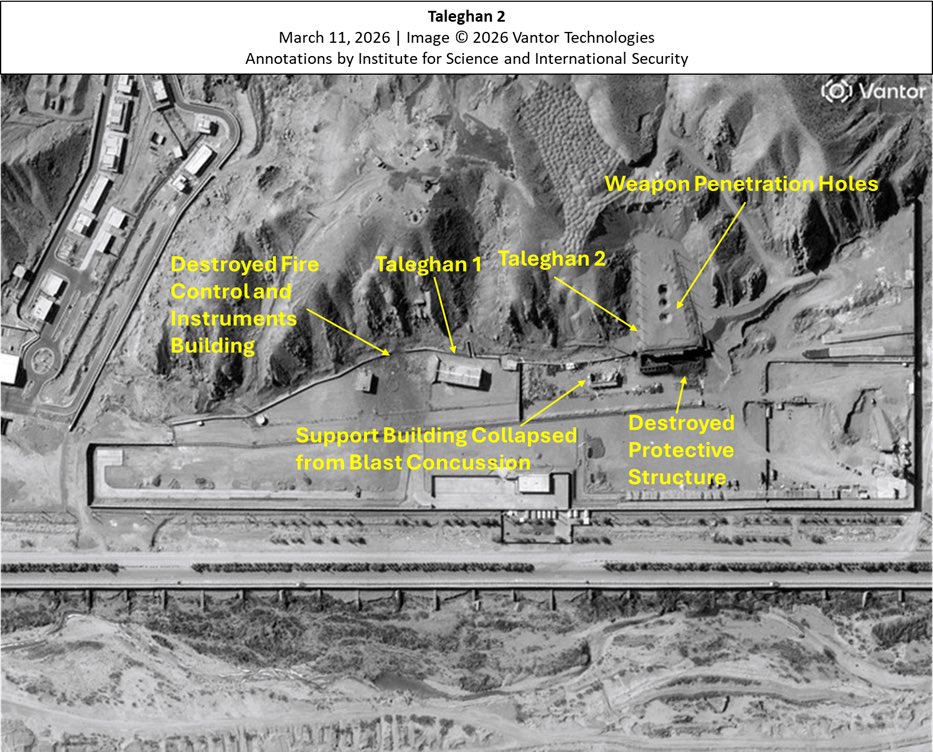
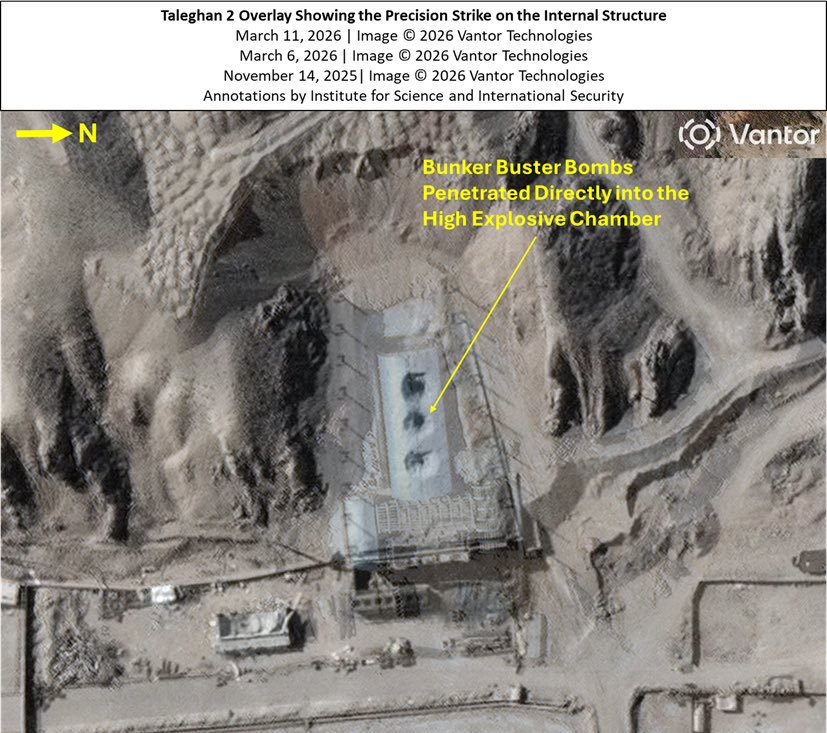
NEW: Detailed assessment of the Israeli strike on Taleghan 2, a site "used by the Iranian regime to advance nuclear weapons capabilities," according to the IDF. We detail the damage done to the newly constructed, bunkered facility, and nearby structures. Below is a composite image created by transparently overlaying the post-strike satellite photograph taken by @vantortech on 11 March 2026 onto earlier pre-strike imagery.
The overlays are designed to demonstrate the high precision of the bombing campaign, accurately targeting the facility despite its recent reinforcement — including full concrete encasement and a thick overlying layer of earth. They show that the bunker buster bombs were not only precisely on target along the length of the main suspected high explosive test chamber hall, but it is clear that the bombs successfully penetrated the encasing concrete sarcophagus into the interior given the evidence that the main blast(s) traveled outward from the interior to cause significant collateral damage in knocking down a protective defensive wall just outside the northern entrance. A small building southeast of the facility appears to have been partially destroyed by the concussion from the main bunker buster blasts.
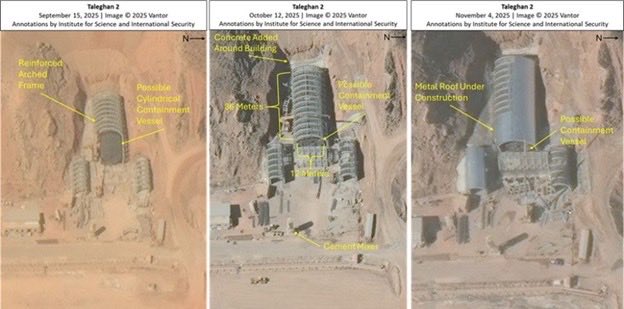
Construction of the new facility only started in May 2025, following Israel's October 2024 strike on the previous facility. During construction, satellite imagery showed the front cylindrical portion of what may have been a high explosive containment vessel (see below). We also provide background on the broader Taleghan site, which includes a location known as Taleghan 1 rooted in Iran's Amad Plan and which we have been monitoring for almost 15 years.
isis-online.org/isis-reports/p…


English

Satellite imagery from March 11, 2026, provided to the Institute by image @VantorTech shows that Taleghan 2 was attacked. Imagery shows three large bunker buster penetration holes entering the top of the facility, directly into the area where a suspected high explosive containment vessel suitable for nuclear weapons development related testing may have been. The overlay shows that the bunker buster bombs were not only precisely on target along the length of the main HE test chamber hall, but it is clear that the interior was destroyed as well given that the main blast(s) traveled outward from the interior to cause significant collateral damage, showing that it knocked down a protective defensive wall and destroyed a small building southeast of the facility by concussion from the main bunker buster blasts. The fire control and instrumentation building at Taleghan-1 was also fully destroyed. This site has been under construction since before the June 2025 war and continued unabated until now. Iran made significant efforts to harden and protect the site, but clearly those efforts weren’t enough. The penetration holes indicate that the internal facility is likely bombed out, destroying anything that was inside. See the images below.


English

RT @DAVIDHALBRIGHT1: Taleghan 2 has been attacked, likely destroyed internally. Three holes can be seen in the soil covering its roof. More…
English

🚨 Event: David Albright on Iran's Nuclear Program: Battlefield Damage and Implications
Friday, March 13, 2026
12 PM - 1.30 PM EST
Join us on Friday for a live Zoom Webinar. David Albright will talk about Iran's nuclear program and the impact and implications of the war on that program, using satellite images and other open sources. We will leave plenty of time for questions.
Albright will discuss the following questions:
What was the status of Iran's nuclear program prior to the war?
What was known about Iran's inventories of enriched uranium and gas centrifuges?
What can be said about the chance of Iran building nuclear weapons before the war? Today?
Which nuclear sites have been attacked in this war, and why, to the extent that the purpose can be determined?
What can be said about the risk of diversion of dangerous nuclear assets, faced with the growing Iranian loss of national, regional and local C&C?
What about the safety of the Bushehr reactor?
conta.cc/3NxN46f
English