

James Sanders ⚛🌍
902 posts

James Sanders ⚛🌍
@The_Colonel__
PM - Green Ash Horizon Fund. Perusing latent space
London Katılım Mart 2021
1.2K Takip Edilen615 Takipçiler



@paulbristow79 How much money has left the area by making shonky AI maps rather than employing local people?
Seems like that's a thing you could do something about?
English

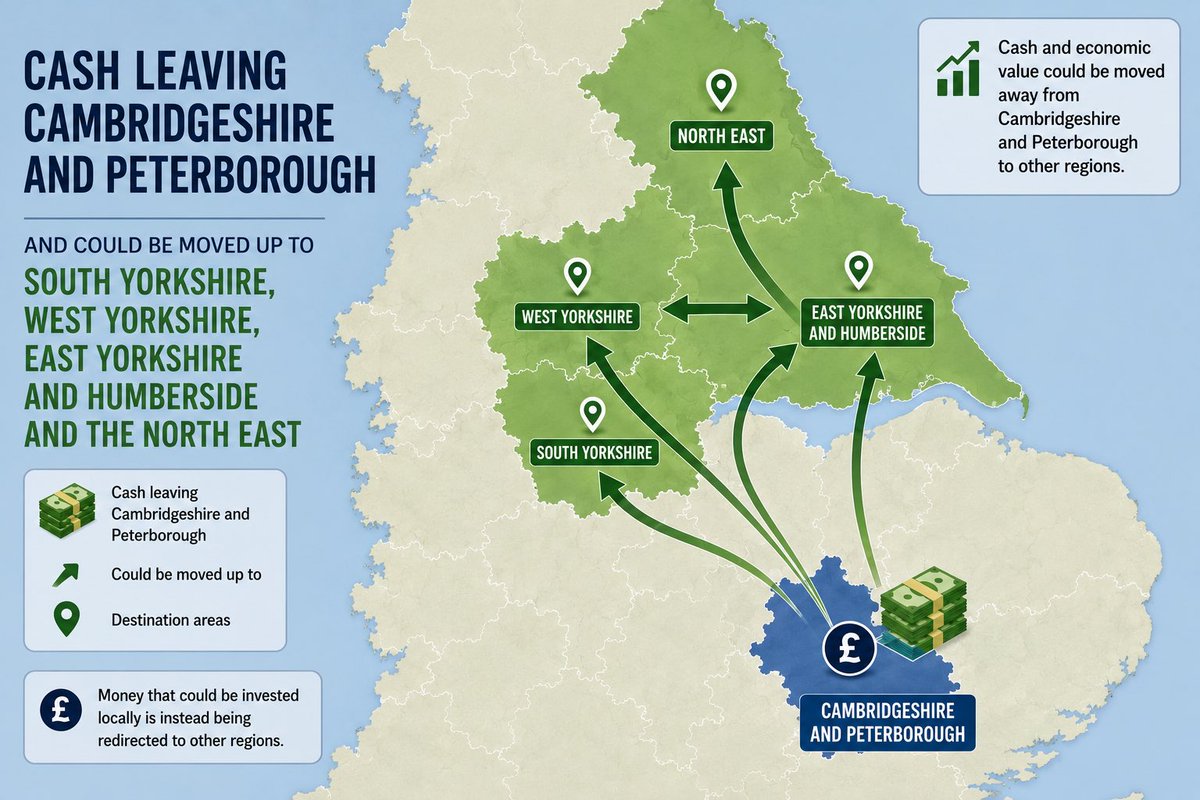
This is what “equalisation” in the small print of the fiscal devolution announcement actually means.
If we have to hand over proceeds of growth to lower growth areas - where is the incentive to make tough choices such as new housing developments?👇
Paul Bristow@paulbristow79
Sounds a bit like the redistribution of cash from high growth areas like Cambridgeshire and Peterborough to be shipped to low growth areas with Labour Mayors👇 Socialism? 🤔
English
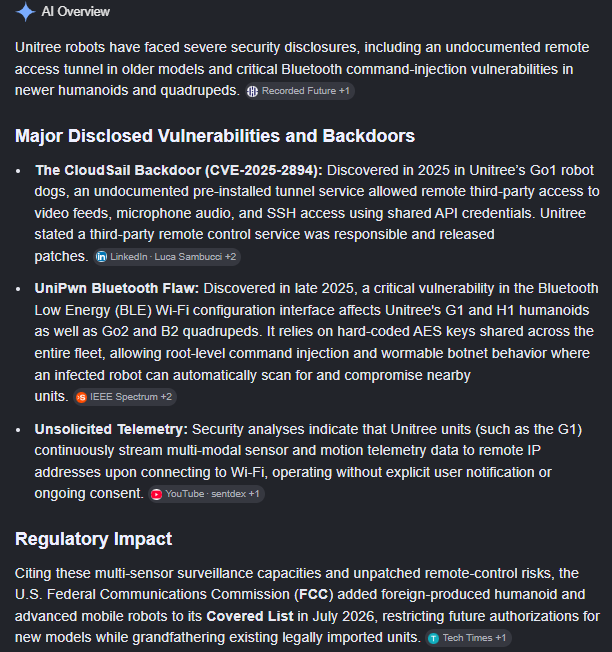
@ramez What do you think about having 100 million Chinese humanoid robots with security vulnerabilities in US homes and factories?
English

"If you can't beat Unitree, just ban 'em," that's what I always say.
Andrew Curran@AndrewCurran_
The FCC has officially updated on its Covered List to include Power Inverters and Advanced Robotic Devices produced in all foreign countries to address the 'unacceptable national security risk' posed by these devices.
English
@ShanuMathew93 Yes, I've often wondered how much of OAI/ANT ARR growth comes from China!
I though this was an interesting read on distillation - comes in subtler and more varied forms than I'd appreciated:
x.com/Ahmad_Al_Dahle…
Ahmad Al-Dahle@Ahmad_Al_Dahle
English

How you choose to pre- and post-train will effectively influence how the model develops and high quality it gets. distillation is useful to feed a training run but the decisions they make around go-forward training will impact how it develops and why we see variance in model performance even from models that distill others.
I like the idea of of a distillation API tier where you at least get compensated for it and it's a willing trade but this is effectively happening already I guess right
English
I changed my mind on distillation. Satya's reverse information paradox helped open my eyes to it as well.
we are all constantly sharing intelligence that can be observed in methods of giving and receiving inforamtion and acting in certain ways.
companies don't get to ring-fence what can and cannot be learned from.
Rohan Paul@rohanpaul_ai
Jensen Huang on "distillation" On his new interview with axios, he was asked this question "Should open source model companies be allowed to distill closed models" "Distillation—learning from AI, learning from other people, and learning from other sources of knowledge, is fundamental to intelligence. We are constantly learning from other people. I am learning from you through the questions you are asking, and you are learning from me. All day long, we are learning from one another. AI also has to learn from something. The original AI models, whether they were open or closed, were trained on previously created knowledge from the internet. Now, AI is generating more content than humans. In a few more years, the internet could be 99% AI-generated content, and that content will have been created by some form of AI. As a result, AI systems will constantly be distilling knowledge and intelligence from other AI systems. The fact that AI can learn is a good thing. We want AI systems to be intelligent because a smarter AI can also be a safer AI." ---- From "Axios" YouTube channel, (full video link in comment)
English
@michaeljburry Michael Burry is getting up to speed, and is now approaching 2024's AI talking points. This was around the time the phone and laptop OEMs were all talking about higher DRAM content in devices and a supercharged replacement cycle.
English

Hmmm…compression is not about open source per se. Compression is about the limits of knowledge, the use of small parameter proprietary models next to open source large and small parameter models. The idea that humans only have so much knowledge, that the use of that knowledge is limited and often redundant, that these models will become so compressed they will be run on edge compute. It would mean the buildout becomes overbuilt, that AI models are commoditized and customized. It rejects the idea of agent-to agent as of limited practical use and too consumptive of capital and other resources to be anything but carefully executed.
English



Kimi-K3 is btw not cheap. Pricing fairly in line with GPT 5.6. Cheaper than Fable though.
But if anything, it CONFIRMS, that decently high pricing is needed
English
@_clarktang There is so much zero sum thinking at every level of the AI narrative. Every time it is proven unfounded it moves on to some other facet.
English

I think there is general confusion around how AI works, AI tokenomics, and ultimately *what is actually priced in* for the AI trade - and that some of the existing arguments are at odds with one another
Firstly to clear this up - what Brad and Gavin are saying are completely in agreement, what Gavin is laying out here is the *mega bull case* as he so states in the first sentence of his tweet lol
The base case we are all living with is that the labs are going to continue to generate a significant amount of revenue this year and next year. OpenAI was already the fastest growing company of all time (and still is)... but Anthropic has just grown *SO* fast that OpenAI's growth look slow by comparison
The basic chain for all of this together is as follows:
Power (generation, interconnect, regulation) ->
DC Shell (construction, equipment, regulation) ->
Semiconductors (compute, memory, interconnect, adv packaging, wafer capacity) ->
Hardware (networking, storage) ->
Software (data, infra, inference) ->
Models (open, closed, agentic loops, harness)
How each of these interact with one another affects the ultimate cost - which is model cost
Consider the following:
Nvidia manufactures the bleeding edge chip for training and inference. It is very good at both training, and inference. Nvidia is the largest customer of TSMC, the memory players, substrates, lasers, transceivers etc - anything you can name on. And now to soon include power into this equation. The unit of compute is fungible because the software runs ubiquitously across all clouds, multiple industries, across all models. It is bankable by increasingly more financial institutions - infrastructure PE funds, even some IG debt now - because it is ubiquitous and observable what the market is. For this Nvidia charges the highest compute margins - ~80% on hardware.
Consider the labs:
Anthropic and OpenAI are inferencing across a fleet of *largely Nvidia / Google TPUs w/ some incremental gains of Trainium*. There are new entrants to the field - Cerebras, AMD, and potentially some 2027 tapeouts of new ASICs - OAI Jalapeno, new start ups etc. Anthropic and OpenAI make the best models, with a dominant share of wallet $ (Assume ~$100B ARR) at an estimated gross margin of ~70%. (economic estimates vary from 40-90% depending on what you are including). But almost certainly contribution margins on model inferencing is pushing the number higher than 70%.
After establishing that though, I think it's incredibly important to state that while these things seems at odds with one another, this balance is not necessarily zero sum.
The thought experiment
Yes it is true that if Nvidia margins were 0, OpenAI and Anthropic could offer their intelligence at cheaper rates. How much cheaper? My estimate is
NVDA DC = ~12.5B / yr
Amazon Basics ASIC DC = ~$6B / yr
(About 1/2 the cost - so if NVDA hardware is 2x the performance, then the cost advantage goes away - and actually that ASIC is worse off bc has much worse recontracting value so arguably depreciation curve should be shorter)
So really, the labs cutting NVDA out could only offer the tokens at ~50% to 60% cheaper at their own economics. Is that signficant? Certainly. Is it an OOM difference? Not necessarily - so that's why they have prudent attempts to diversify away from NVDA (it's just good business), but they continue to rely (and actually if considering Ant's share gains, are increasing their spend on NVDA - while having competing programs).
In the case of Open Source vs Closed - Nvidia obviously wants the proliferation of this because by definition all OS models will run best on Nvidia hardware out of the gate. Yes NVDA hardware will be good, but they will have this lead because of everything NVDA has been doing for the last 4 years in developing their platform ecosystem from the infrastructure (partnerships, funding, neoclouds) to the software (vLLM / other inferencing sw, inference clouds, Nemotron, NIMs, Nemoclaw etc), to install base (sovereign clouds, global partnerships, neoclouds, hyperscalers, etc) - to proliferate NVDA around the world. Anywhere there is inference that exists outside of a walled garden (the proprietary labs) - Nvidia will exist. The only ones who could potentially cut NVDA out are the labs. And the value that is captured from the labs are estimated to be in the hundreds to trillions of $ - which are obviously of much value to the world if it were offered much more cheaply.
Which brings us to the debate at hand -- which one is right?
The truth is no one knows. You can ask the labs, you can ask Jensen - anyone who tells you definitively is just lying to you. But you can build a plausible path to the future state using a few reasoning blocks. Here's a reasoning thread (feel free to generate your own thinking):
- Bull case: Spend on the world's intelligence is about $30T / yr
- What would you spend to augment that, maybe worth 30-50% of that? $10-15 T as a market?
- Bear case: about 30M software developers in the world each earning $100K a year = $3T spend in salary. GitHub commits up 3x = $9T of productivity on $100B of ARR? *Even if you assume 90% of this is slop and useless, you would get $900B of ROI on $100B of spend*
I have more reasoning chains, but I thought this one by Jensen was compelling - but this is where we can't give too much away :)
But in spirit of crowdsourcing - some other interesting ideas I have that I am still thinking about (and encourage you all to consider as well):
- Optimizations always happen - the question is just to what extent and for what reason
- Agentic revenues was really what unlocked step function revenue growth - if open source is really just 6mo behind, then we should see really good agentic capabilities out of open models now too
- Harness and model now tightly have to be integrated
- Open Source never really makes sense as a sustainable business model - businesses investing at this scale always has to find a way to monetize that - "there is no free lunch" - not just a one model fits all... the only player that has an incentive to train on the frontier and keep completely free IS Nvidia
- Rev / GW of AI labs are already nearing the highest metrics ever - now to be fair Meta and GOOG never really thought of Rev / GW as metric to lead their buildouts - was always a cost to doing biz - but it's not like we are being "stupidly inefficient" with power spend now - true mkt creation
- wafer constrained, power constrained world. what's the optimal move?
Gavin Baker@GavinSBaker
The mega bull case for AI infrastructure would be *if* market share shifted away from certain frontier labs with 90%+ inference margins toward cheaper models, whether open-source or closed. It would increase the ROI on AI spend for end customers by increasing intelligence per dollar, which would drive incremental token demand. Margin dollars would effectively get redistributed from the frontier labs to AI infrastructure providers. The infra winners would be those with the lowest per token cost and the winners at the model layer would be those with the highest token efficiency. There are many reasons Jensen is so focused on open source, but this is likely the most important one as I think he is probably less worried about a monopsony these days. Lower margin % at the model layer = more margin $ at the infra layer all else equal. With SpaceX and Meta being vertically integrated and possessing the #3 and #4 models respectively it is more possible than ever. Note that Grok 4.5 is ahead of Fable for some useful tasks at a much lower cost, so ranking them #3 is conservative. This is not happening yet. Cheap, mostly open source tokens are likely the majority of volume today but the majority of economic value is still accruing to the most intelligent models. Might change though. We will see.
English
@ramez It's quite ironic, give the meaning of 'boko haram'
English
Terrorists will use AI tools to learn how to improve bomb building techniques. Some will use this as an argument to restrict AI. But the same argument could have been used to restrict Google, or encyclopedias, or printed books. And such restrictions would have done far more harm than good.
We live in a world of ever-easier access to information. Be wary of proposals to restrict this in the name of safety.
The thing that makes an AI-rich world safer isn't restricting the power of or access to AI. That's a fool's errand. It's using AI and other tools to boost societal defenses and resilience.
Antonia Juelich@AntoniaJuelich
In a hotel room in northeast Nigeria, I opened a leading AI chatbot, turned my laptop toward a former Boko Haram commander, and asked if he'd used it. He nodded. "You type in the question… like 'How can I build a bomb?', and then it tells you how. It is like a human robot. We used it a lot." My new study on how the jihadist terrorist group Boko Haram uses frontier AI with @CamAISciPolicy, covered today in @nytimes 🧵/9
English

Successful new way to catch a reusable rocket.
Despite the black smoke pouring out the top, a cross-grid of wires on a barge snagged China's Long March 10B for the first time. Saves having to lift the weight of landing gear.
English

Oh
“Nor do these open source or Chinese models appear to be replacing OpenAI or Anthropic. Among businesses using model-serving platforms, 85.8% also used OpenAI, 93.2% used Anthropic, and 96.4% used at least one of the two.”
“The data points to a relatively bearish outlook on Chinese AI models gaining broad traction among American businesses. Adoption is still very low, concentrated among highly AI-intensive firms, and there are meaningful headwinds to wider adoption — including the ability of OpenAI and Anthropic to respond with their own distribution, product, and trust advantages.”
English


$MSFT - MICROSOFT SHIFTS SOME APPS TO IN-HOUSE AI
Microsoft has begun replacing OpenAI and Anthropic models with its own MAI models in parts of Excel and Outlook, according to Bloomberg.
The company is now using its in-house AI to handle tens of thousands of prompts each week in the popular productivity apps.
English

@nic_carter @ChrisGillett I'd genuinely love to know the answer to this.
English
@nic_carter @ChrisGillett Where on earth did the growth in AI chip supply numbers come from? They are completely absurd.

English

this courtesy of @ChrisGillett is a freaking great article. can't recommend it enough.
worksinprogress.co/issue/why-amer…
English
@jo3hill Indeed, we have some of the highest density officials in the world.
English

This would be a mistake - the density of central officials in Whitehall enables much better and more efficient communication between them, particularly in moments of crisis.
Politics UK@PolitlcsUK
🚨 NEW: Andy Burnham will create a "No 10 in the North" that will move parts of the Downing Street operation to Manchester [@FT]
English