Barrett Linburg@DallasAptGP
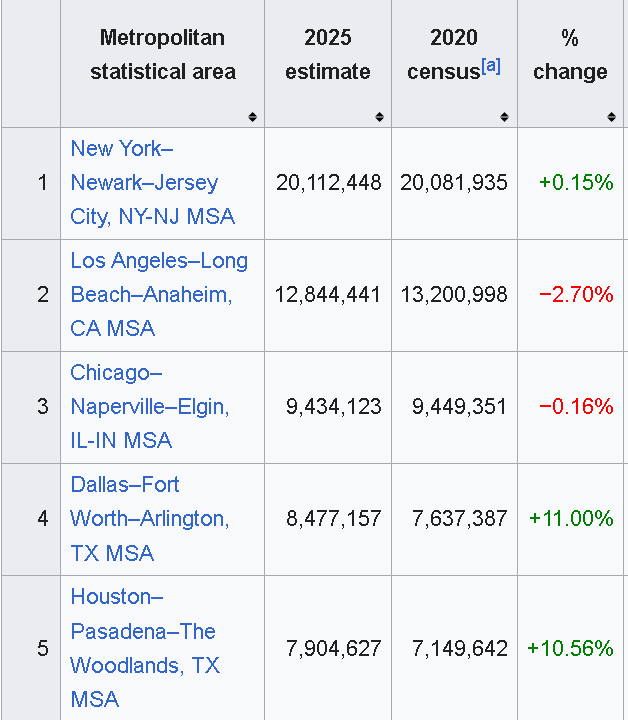
Dallas-Fort Worth attracted 100 corporate headquarters from 2018 to 2024. More than any metro in America.
Now it has three stock exchanges and Apollo is shopping for a second HQ.
Dallas is on the shortlist. Here is why:
TXSE. NYSE Texas. Nasdaq Texas. All three based in Dallas.
NYSE Texas opened last year. Nasdaq Texas launched three weeks ago. The Texas Stock Exchange starts trading this summer.
TXSE just became the most well-capitalized exchange the SEC has ever approved. It raised $270 million from BlackRock, Citadel Securities, Charles Schwab, JPMorgan, and Goldman Sachs.
That is the headline. Here is what’s happening on the ground.
Goldman Sachs is spending $500 million on a new campus near Victory Park. It will hold 5,000 employees and become the firm’s largest office by square footage outside Manhattan.
JPMorgan Chase now employs 31,000 people in Texas. That is more than New York. Their Plano campus is adding another 4,000.
Bank of America is building a 30-story tower in Uptown overlooking Klyde Warren Park. Opening early 2027. They have 14,000 employees in the metro.
And Schwab did not open an office. They moved their headquarters. Five years ago, Charles Schwab left San Francisco for Westlake, Texas. Between 5,000 and 10,000 DFW employees.
Today, Apollo Global Management announced it is looking for a second headquarters outside New York. The shortlist: Texas or south Florida. Apollo manages $840 billion in assets.
This is not about low taxes.
That is part of it. Zero state income tax matters. A 0.75% franchise tax instead of a 7.25% corporate income tax matters.
Office rent at $35 a square foot instead of $85 matters.
But taxes alone do not explain $270 million in institutional capital backing a brand new stock exchange.
What explains it is critical mass.
When Goldman builds a campus, their fund administrators follow. Their outside counsel follows. Their prime brokerage counterparties follow. The consultants follow. The accountants follow. The talent follows.
Then the next firm looks at the map and sees that half their counterparties sit in Dallas.
So they come too.
And when they arrive, they bring their own vendors and service providers. Those providers pull in more firms.
The cycle compounds. Each new entrant reduces the cost of doing business for every firm that came before it.
New York is not going anywhere. Wall Street will always be Wall Street. But the financial sector is no longer a one-city industry.
Welcome to Y’all Street