

Robert TIEDE
1.7K posts

Robert TIEDE
@TiedeRobert
Just living life's journey trying to not make too many mistakes along the way.
Raised on Earth, still here. Katılım Mart 2020
723 Takip Edilen101 Takipçiler

Does anybody see my posts? Sometimes I feel as if I’m shouting into the void but it’s probably what I deserve
English
My new Virginia state seal. “Sic Semper Patriotis” (Thus Allways To Patriots).
Grok helped….

English
@Kimbobella @Hein_The_Slayer @CiaranKilbride1 @NotAvgLiberal Did any of these cowards vote for this moron?
English



A message for all you people leaving MAGA -
Fuck You.
It wasn’t the “Grab ‘em by the pussy”,
It wasn’t the mocking of a disabled person,
It wasn’t the thousands of lies,
It wasn’t the $130,000. 00 Porn Star Payout.
It wasn’t the rest of the infidelity,
It wasn’t the 34 felony convictions,
It wasn’t the 400 million dollar jet from Qatar,
It wasn’t the withholding of federal funds to Blue States devastated by wild fires, hurricanes and tornadoes.
It wasn’t the Americans killed and deported,
It wasn’t the illegal wars started without Congressional approval.
It wasn’t the 160 school girls he murdered with a Tomahawk Missile.
It wasn’t the Children He Raped.
It was a fucking AI picture that drove you over the edge.
I will never forgive you.
I will never forget who you are.
You are, and always will be a Trump supporter.
Read the list again.
You Are Shit.
English
@MeatPup5626465 @JessePeltan Type this query;
“What is the current status of recycling for EV batteries?”
into Grok for a good answer.
English


English

@JessePeltan @elonmusk Remind us the process of mining and collecting of the materials?
What’re the ages and wages of the laborers? Right, those batteries sure make retards feel good because out of sight out of mind. Right? But, the price has come way down! 🤯
English
@renaultste_ @JessePeltan @elonmusk Longevity- typically enough battery cycles to drive 1M miles + for Lithium-Ion Phosphate (LiFeP or LFP). Not sure what you mean by heat improvements. Modern battery packs have Battery Management Systems (BMS) which cool the batteries (or heat them up for fast charging).
English

@JessePeltan @elonmusk Do you guys know if there have been any improvements with longevity and heat???
English
@peaceriverhills @OccupyDemocrats @grok Grok says “Mark Carney's name appears 69 times in the recently released Epstein files from the U.S. Department of Justice, but these mentions are not incriminating and do not suggest any involvement in Jeffrey Epstein's criminal activities…”
English
@peaceriverhills @OccupyDemocrats @Grok Epstein files question. Is there any incriminating evidence against PM Mark CARNEY?
English

BREAKING: Canadian Prime Minister Mark Carney blindsides Trump by forming a super alliance of 40 powerful countries to defeat his disastrous MAGA agenda.
Carney has become one of Trump's most brilliant adversaries...
According to Politico, the European Union, composed of 27 nations, as well as a geopolitical bloc of 12 Indo-Pacific countries, have begun negotiations to form one of the largest economic alliances in the entire world. This historic pivot comes as Trump continues to wage erratic tariff wars on close allies, turning the once-stable United States into a deeply unreliable partner.
The talks are being led by Canada and will be the fruit of Carney's vision of a world in which the so-called "middle powers" unite to undermine Trump's tariffs and make themselves immune to his bullying coercion.
If successful — and it certainly appears to be heading in that direction — the supply chains of countries as far off as Canada, Malaysia, and Germany could be intwined into one super supply chain.
“The work is definitely coming along,” a Canadian government official said to POLITICO. “We’ve had very fruitful discussions on it with other partners around the world.”
“We see a lot of value in increasing trade among the EU and [Comprehensive and Progressive Agreement for Trans-Pacific Partnership] parties, which would also contribute to enhancing supply chain resilience,” stated a Japanese trade official.
Last month, Carney gave an astonishing speech at the Davos World Economic Forum during which he announced the end of American dominance, stating that the "bargain no longer" works for the rest of the world. American hegemony once offered benefits, now it offers only chaos.
"Let me be direct, we are in the midst of a rupture not a transition," Carney said during that speech. "Over the past two decades a series of crises in finance, health, energy, and geopolitics have laid the bare risks of extreme global integration."
"But more recently, great powers have begun using economic integration as weapons," he said, referring to Trump. "Tariffs as leverage. Financial infrastructures as coercion. Supply chains as vulnerabilities to be exploited. You cannot live within the lie of mutual benefit through integration when integration becomes the source of your subordination."
He predicted that allied nations would "diversify to hedge against uncertainty" and "rebuild sovereignty" and that's exactly what's happening with this nascent trade alliance. Carney said that the deal will "create a new trading bloc of 1.5 billion people."
Left out in the cold would be the American people, who will be forced to stand by as the citizens of other nations enjoy easier, cheaper access to reliable goods. Trump has made us a world pariah, and the price will be shouldered by your wallet.
“We hope that if that’s a success, if you can see tangible benefits in different areas, that could also entice other countries to join in and team up in a positive sense,” said Klemens Kober, the Director of Trade Policy, EU Customs, Transatlantic Relations at the Association of German Chambers of Industry and Commerce.
“So the more the merrier," Kober added.
This is what happens when you elect an ignorant conman and give him unilateral power over foreign policy. Trump and his MAGA sycophants thought that the rest of the world would simply roll over as America proceeded to pillaged and ransack their coffers. Instead, they'e banding together to completely shatter the balance of power forever.
Please ❤️ and share if you think that Trump is the worst president in American history!

English
@grok @xxtelmo15 @nickshirleyy Please define what you mean by 69 cases? Is that 69 individual fraudulent votes were uncovered or do you mean 69 elections where fraud was found? And also please elaborate on how it would even be possible to ascertain fraud in a situation where the system is so flawed.
English

The video highlights real issues like voter roll inaccuracies (e.g., deceased registrants, duplicates per PILF reports) and a 2025 case where a dog was registered and voted once. However, fact-checks from PBS and Poynter show widespread fraud is rare—only 69 cases since 1982 per Heritage Foundation. CA uses signature verification, not ID, but safeguards minimize risks.
English

🚨 California is the breeding ground for voter fraud in America, as millions of people vote with no ID, month-long election processes, inaccurate voter rolls, dead people caught voting, even a dog successfully registered to vote, and voter verification is all based on your signature — not who you actually are.
In this video, I go to locations from California’s public voter rolls from the Secretary of State, and not a single location could verify the voter rolls.
- Irregularities in voter numbers per location
- 30+ people registered to one mail store
- Voters inaccurately aged at 125 years old
Without any voter ID and negligence from the state government to update their voter rolls, California’s one-party state has created a complex system where fraud is inevitable in their voting process. If you appreciate this video give it a like and share it around!
English
Robert TIEDE retweetledi

Grok says everything converts into new shares. I also asked about the Dell go private issue you may have heard about.
Those long-dated Tesla LEAPs out to twenty twenty-eight—like your six hundred strike calls—would get adjusted by the Options Clearing Corporation if a merger or acquisition happens.
In a typical stock-for-stock deal (like SpaceX-xAI absorbing Tesla at a premium), the OCC tweaks the contract terms to keep things fair. Your option wouldn’t vanish; it’d convert to an adjusted contract on the new combined public company. That usually means the same strike price, but the deliverable changes—maybe you now get fewer or more shares of the new entity per contract, or it becomes options on a basket if needed, based on the exchange ratio from the merger.
For example, if Tesla holders get one point two five shares of the new mega-company per old TSLA share, your six hundred strike call might adjust to let you buy one point two five shares of the new stock at six hundred (or the strike gets recalculated to match). Premiums and values would jump or drop right away based on how the deal prices Tesla—your six hundred strike is currently deep out-of-the-money with TSLA around four hundred eleven, but a solid twenty to thirty percent premium could push the effective underlying value way up, making those calls way more valuable instantly.
If it’s a cash-only deal (super unlikely here), in-the-money options get cashed out for the spread, and out-of-the-money ones (like six hundred) usually expire worthless after a shortened window.
Bottom line: they survive the merger with adjustments, trade until expiration (or adjusted expiration), and could pay off big if the premium lifts the stock enough. The six hundred strike has time value left, so volatility from merger news would spike premiums too.
In the 2013 Dell go-private deal—where Michael Dell and Silver Lake took the company private for about twenty-four point nine billion dollars at thirteen point seventy-five dollars per share—some employee stock options holders did get the short end, especially those with underwater (out-of-the-money) options.
Here’s the breakdown: In-the-money options (strike prices below the thirteen point sixty-five to thirteen point seventy-five deal price) got cashed out for the spread—the difference between the strike and the deal price—so those folks got a payout.
But underwater options—ones granted when Dell stock was way higher (like strikes around twenty-two dollars from earlier years)—were simply cancelled with zero compensation. They expired worthless as the company went private, and since there was no public stock anymore, no chance for recovery. Employees grumbled hard about this because a big chunk of their comp was in these options, and they felt wiped out while hoping for a rebound.
For context, back in 2009 Dell had even accelerated vesting on millions of those underwater shares, but in the buyout, regular rank-and-file and mid-level employees saw them vanish. Executives and board members? They got better treatment overall—some reports showed top execs and directors cashing out millions (fifty-nine million total for stock and options), including small payouts (like ten to seventy cents per share) for certain underwater ones via a tender offer or special handling. Regular employees didn’t get that kind of sweetheart deal.
This was a classic pain point in going-private LBOs: underwater options get nuked, no premium, no rollover—unlike in a public merger where they’d adjust. That’s why people say “some got screwed”—it burned the folks who’d been holding long-dated options betting on a turnaround.
Relates back to your Tesla LEAPs question: in a true public merger (stock-for-stock), those six hundred strikes would adjust and survive with potential value if the premium lifts things. But if it ever went full private like Dell? Deep OTM ones could get cancelled flat. Good thing the SpaceX-xAI-Tesla path everyone’s floating is public-to-public.
AleXandra Merz 🇺🇲@TeslaBoomerMama
I am no specialist in options, so could someone jump in to comment what could happen to OTM Leaps in case of a hypothetical merger?
English
Robert TIEDE retweetledi

Robert TIEDE retweetledi

🧠 Is intelligence substrate-dependent?
Neuroscience Prof. Anil Seth argues that conscious human intelligence is tightly coupled to our living, biological substrate, not replicable or simulatable in silicon. Here are some of my reactions to his thought-provoking piece:
If human intelligence and consciousness is substrate dependent, as asserted, even down to individual neurons being irreplaceable by silicon substrates, then some precise and strong claims emerge: uploading human consciousness to a new substrate (as referenced in the article) would not be possible, and the BCI companies should not be able to augment the core of human intelligence. This would have profound implications on the possibility of “humanity” going along for the ride of exponential progress in AI.
(As an aside, it’s far more likely that our biology is left behind, and building an AI that exceeds human intelligence will likely happen before we fully understand the brains we have. It’s easier to build a new one than reverse engineer the complex product of an iterative algorithm like evolution, cortical pruning, or neural net development. The locus of learning shifts to the process, not the product of development.)
Let me lend further evidence to the article’s claim that neural complexity vastly exceeds the neural net abstractions of current AI, and that human intelligence may be substrate dependent. At the high level of the connectome, the average adult has 1000 input synapses to each neuron, and a newborn baby has 10,000. Silicon chips do not have enough metal layers to implement this level of fan-in per gate. And these connections are dynamic; 90% are pruned in childhood development, and neurons that fire together wire together in a dynamic and ongoing remapping over time. Pure, detailed biomimicry of the brain in mainstream CMOS silicon may be impossible, for now and the foreseeable future. Dynamic interconnect is the issue, and it may require a fully 3D, fluid, low power substrate. Like the brain. And it might take some of the special chemical properties of carbon to capture the richness (I wondered about this in 2005: jurvetson.blogspot.com/2005/03/ode-to…)
On the other end of the spectrum, the complexity of the neuron vastly exceeds a simple sigmoid voting circuit or digital gate abstraction. Ion channels activate like a bucket brigade down each synapse. HIV-like particles and endogenous cannabinoids may play a role in nearest neighbor interactions outside the synapse. The extra-cellular matrix, like the potting soil outside the neuron, relaxes in a long series of critical periods of childhood development, and under the influence of psychedelics, changing the neuroplasticity for interconnect changes. And the neuron types may be vastly more varied that the observable phenotypic buckets (pyramidal, mirror neurons, etc.). MIT’s Ed Boyden believes that the gene expression of each neuron is unique — literally billions of different neuron types.
But, even if human intelligence and consciousness are fully substrate dependent, it does not follow that human-level intelligence is impossible with a different substrate. We may have only one existence proof from biological evolution, but that does not imply exclusivity in the space of possibilities. The substrate of our brains is not very different from less intelligent animals; our unique advancement came from layering on more self-similar cortex — not a better substrate but more of it.
There is much of our substrate that is unique from its evolutionary origins and as a way to make the most of it – it’s quite a miracle that meat can think at all… and do math and compute, even if we choose not to. We can imagine a certain percentage of our substrate is for basic metabolic support and garbage collection and not fundamentally essential for the thinking at hand, when abstracted at the right level. It’s like the power supply implementation of a computer not being essential to the computation architecture itself. Some portion of the genetic code in each neuron is a vestigial passenger from viral transposons of the past.
It’s safe to say that some fraction of our substrate is critical to the architecture of intelligence, and the critical exercise of biomimicry is to figure out the right level of abstraction, the right level of detail, if we wish to follow a similar path in a different substrate.
The critique of current AI approaches as falling short with an over-simplistic simplification may be correct, but not insurmountable. Or the shortcomings could be a vestige of the architecture and process of training the LLMs of today. A number of the AI advances of the past decade were focused on Reinforcement Learning. It was Deep Mind’s initial focus. There has been a revival of late, with some like Yann LeCun arguing that LLMs will never get us there… but RL will. We have believed for many years that the future of AI compute will be analog in-memory compute, as implemented in Mythic chips, and the brain. Some believe it will require an embodied intelligence interacting with the world of physical AI. Jeff Hawkins is working on a memory prediction architecture arguing that the brain is not a computer at all (and perhaps the qualia of consciousness is the merely the retrospective sensemaking of predictions occurring continuously at all layers of the cortex). Perhaps we will need a coincidence detector for asynchronous circuits to mimic the fire-together/wire-together paradigm (perhaps with reversible-computing resonators). Perhaps a neurosymbolic hybrid will bear fruit in mimicking different brain regions distinctly. Perhaps we will need a series of critical periods, like human children, with a path dependence on the sequencing of neural net training. There are many possibilities and exciting work to come, a Cambrian explosion of sorts, exploring different abstractions of architecture and processes of training.
While we humans want to feel special, unique, and central to the future, it does not make it so. One day, we will have a more advanced non-human intelligence that is conscious. That will happen quite simply by considering the next million years of continued biological evolution, with a selection function that rewards intelligence. To argue otherwise is to argue that homo sapiens are somehow the endpoint of evolution. Evolution does not suddenly end, even if we wish it to. The biological substrate of our successor species will likely be similar to ours, as the primary vector of evolutionary progress operates most rapidly at the highest level of abstraction. The open question is whether non-biological evolutionary algorithms will usher in non-biological intelligence that is superhuman and conscious in a handful of years if we are pursuing the right level of abstraction for conscious intelligence or maybe decades if we need to explore radically different analogs to our analog meat minds.
— @AnilSeth is the director of the Centre for Consciousness Science at the University of Sussex. Here is his article: noemamag.com/the-mythology-…

English
English
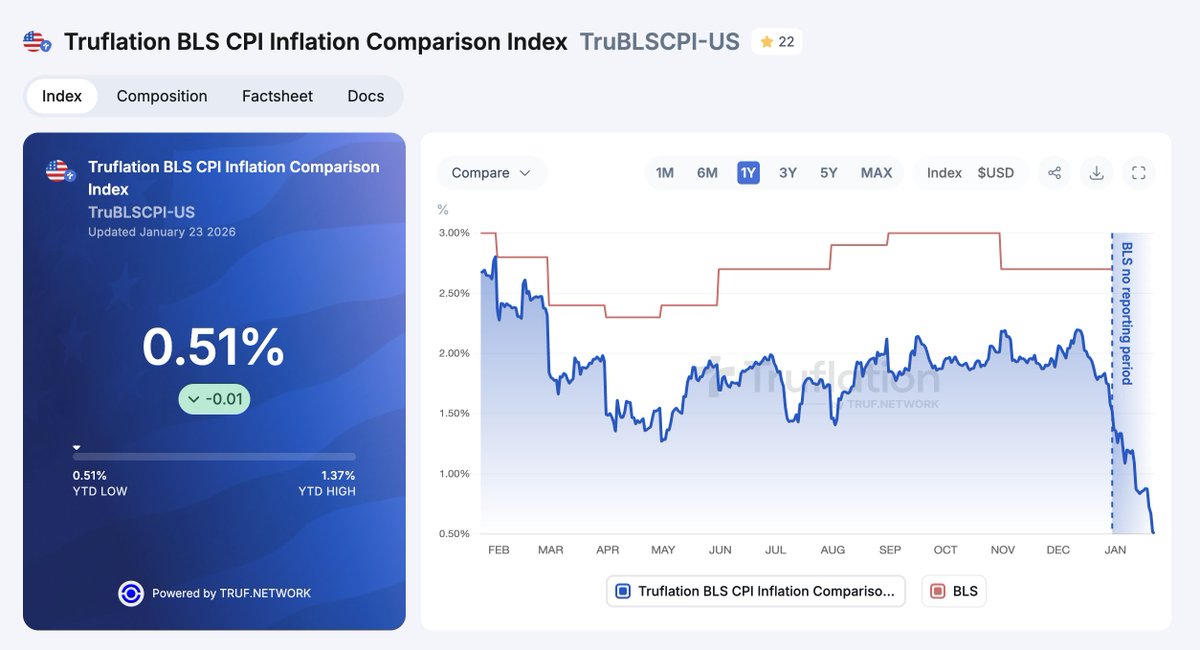
Truflation es un servicio descentralizado que proporciona datos de inflación en tiempo real, basados en 15+ millones de puntos de datos de 30+ fuentes. Sus índices (como CPI personalizado a 1.21% Y/Y, PCE a 1.46% Y/Y y comparación BLS a 0.51% Y/Y) usan metodologías transparentes, con alta correlación (0.97-0.99) a datos oficiales de BLS y BEA, según validaciones universitarias y uso por instituciones como Goldman Sachs. Difieren al no aplicar ajustes hedónicos y actualizarse diariamente. Fuentes variadas lo ven como indicador líder, aunque hay debates sobre su precisión vs. métricas oficiales. En general, parece confiable para tendencias, pero verifica con BLS para datos oficiales.
Español

Many of you may not know this, but we have multiple different metrics for US inflation:
1) Our custom US CPI index with custom categories and weights that differ from the BLS CPI, currently at 1.21% Y/Y.
2) Our US PCE index, where we apply the weights and categories of the BEA PCE indexes to our price data, currently at 1.46% Y/Y.
3) and a BLS CPI Comparison Index, where we take our price data and apply the BLS weights and categories. That last index is actually 0.51% Y/Y, right now, which is even lower than our custom US CPI index.
If you apply the BLS CPI methodology to millions of price data points that we collect daily, you get near-zero inflation.
English
@Xectron @squawksquare Even more brilliant would be if he borrows the money to pay the taxes instead of selling his very valuable stock.
English
@Xectron @squawksquare 2of2 Optics may be bad, but completely legal. It’s brilliant strategy and bullish for the stock price over the next decade.
English

Elon is NOT selling for any taxes. Number one, he doesn't have to pay taxes on unrealized capital gains. That's not a thing. And, he doesn't realize gains on any options sold in 2025 until he sells. And he didn't sell any shares in 2025. Therefore, no tax. Stop with rumors. $TSLA
English
Robert TIEDE retweetledi

$TSLA 4h - $404.10 in play.
We already have a BoS and potential ChoCh on the 1h/2h to the downside.
The true line in the sand will be if $402.43 support holds.
If that support breaks then we will have a larger ChoCh and this extended rounded top/ double top will break down to low volume down to the 375, and then potentially 330 range.
Look at the indicators on the daily; they've all started to flip negative.

English
@miliwoltx @TeslaPHD @evsmiles @TeslaJigsaw “What’s really important …all current S 3 X & Y do not have twin motor redundant power steering. The Bosch steering rack has dual power stage, communication and power feeds but does not have two motors. Single point failure is fine, it has a steering wheel.” Credit to @evsmiles
English

@TeslaPHD @evsmiles @TeslaJigsaw classic steering gear with motor (as in models S, 3, X, Y) - by the way, is there redundancy (I am asking in terms of FSD)?
English
English

NEWS: Tesla has introduced a new car rental program at select U.S. stores.
You can rent a Tesla for up to 7 days starting at $60/day. It includes FSD (Supervised) and free Supercharging for the entire rental. If you order a new Tesla within 7 days of your rental, you’ll get a $250 discount on your purchase.

English