

Tim Marshall retweetledi
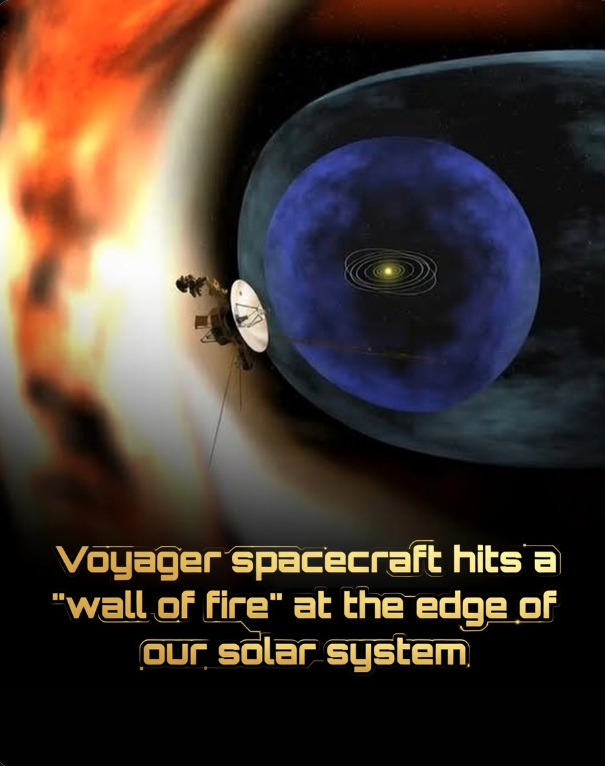
Voyager hit a 90,000°F wall at the solar system’s edge.
NASA’s Voyager 1 spacecraft crossed one of the most dramatic frontiers in the cosmos: the heliopause, the tenuous boundary where the Sun’s influence finally gives way to interstellar space. What the probe discovered there was astonishing—a turbulent zone of superheated plasma with temperatures soaring between 30,000 and 90,000 °F (roughly 17,000–50,000 °C).
This wasn’t a physical wall or barrier, but a dynamic transition region where the outward-flowing solar wind abruptly slows, compresses, and piles up against the incoming pressure of interstellar material. That compression converts kinetic energy into thermal energy, driving the plasma to extreme heat levels far beyond anything found inside the heliosphere.
Remarkably, despite the blistering temperatures, this “wall of fire” would pose no danger to a hypothetical astronaut. The plasma is extraordinarily diffuse—far less dense than the best vacuums achievable in Earth laboratories—so there are simply too few particles to transfer meaningful heat. The region is hot in temperature but cold in practical effect.
Voyager’s instruments captured clear signatures of the crossing: a sudden plunge in solar wind particles, a sharp rise in galactic cosmic rays, and faint plasma oscillations that revealed the density and temperature of this exotic boundary layer for the first time. These vibrations—analogous to ripples on an unseen sea—provided direct measurements of conditions in a realm previously known only through theory.
The heliopause itself serves as a vital shield. The entire heliosphere—the vast bubble carved by the Sun—deflects most of the galaxy’s high-energy cosmic radiation, helping protect life on Earth from constant bombardment. Beyond this protective envelope lies the harsher, unfiltered radiation environment of the interstellar medium.
Today, more than 15 billion miles (24 billion kilometers) from home, Voyager 1 remains the farthest human-made object ever sent into space. Still operational and transmitting precious data, it continues to reveal the secrets of this distant frontier.
At the outer limit of our solar system, space is neither empty nor serene. It is a violent, glowing threshold—and humanity has only begun to map its mysteries.
English