

Tirth Nath Jha
2.2K posts
Tirth Nath Jha
@TirthNath
An IITian by qualification, a mining engineer by profession, a passionate physics and maths tutor. Eagerly waiting the discovery of life on exoplanet!
India Katılım Mayıs 2018
453 Takip Edilen137 Takipçiler
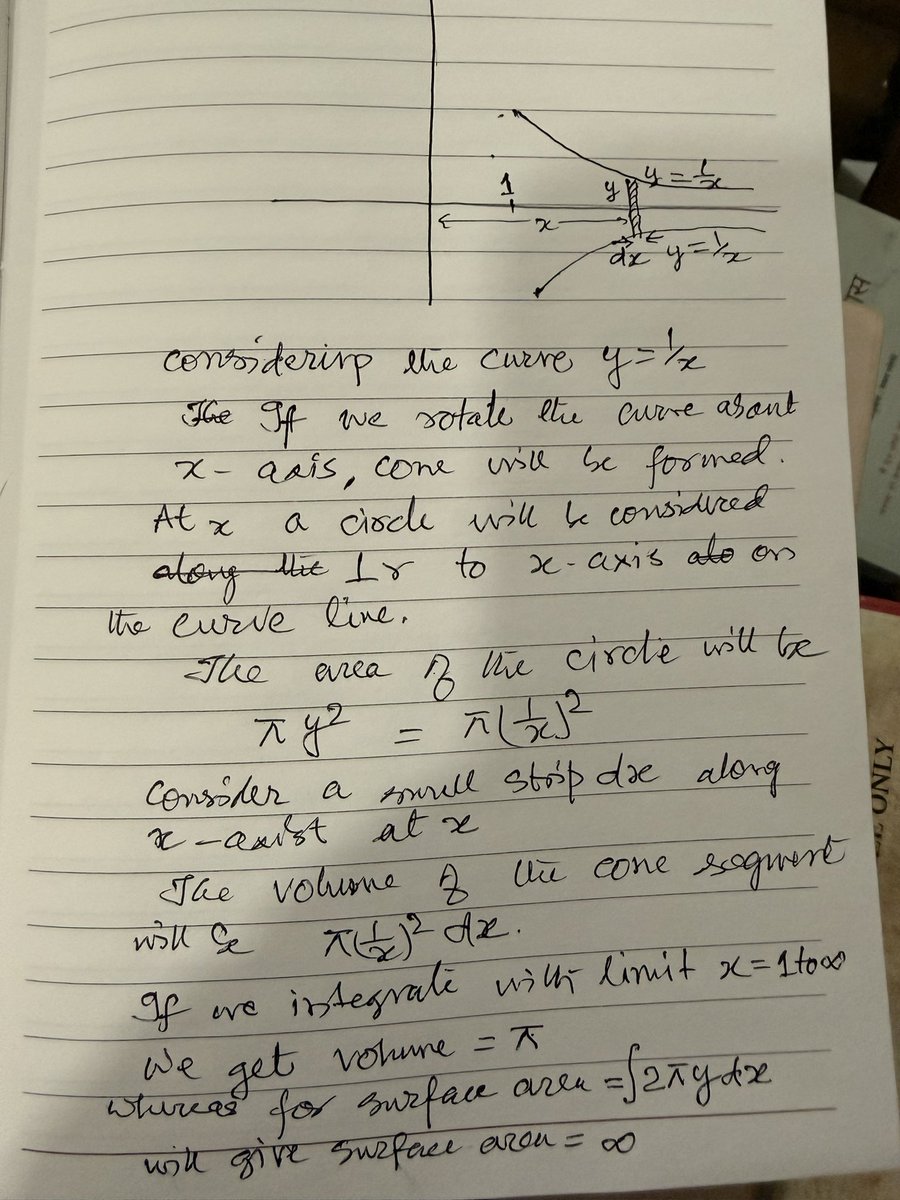
@Math_files I think the curve in the start is not representing y=1/x properly. It starts from negative side of x where as y remains positive. Instead it should start with, say x=1 and goes up to x= infinity. In that case a cone with finite volume but infinite surface area will emerge.
English

There is a shape in mathematics that can hold a finite amount of paint, yet would require an infinite amount of paint to coat its surface. It is called Gabriel’s Horn.
Imagine rotating the curve y=1/x around the x-axis. The result is a long, tapering surface that stretches infinitely, like a tunnel that never ends.
Here’s where the paradox appears. The volume of this shape converges—if you add up all its infinitesimal slices, the total stops growing. In other words, you can completely fill it with a finite amount of paint.
But the surface area diverges. No matter how far you go along the horn, there is always more surface to cover. The outer “skin” keeps extending, demanding more paint without end.
So while you could pour paint inside and fill it entirely, you would never finish painting the outside.
This is not a trick, but a consequence of how infinity behaves. The radius shrinks quickly enough for the volume to remain finite, yet not fast enough to keep the surface area from growing without bound.
It reveals a deeper truth: infinity does not simply mean “very large”—it means unending. And sometimes, the infinite can exist within the finite in ways that defy our intuition, even while remaining perfectly consistent in mathematics.
English


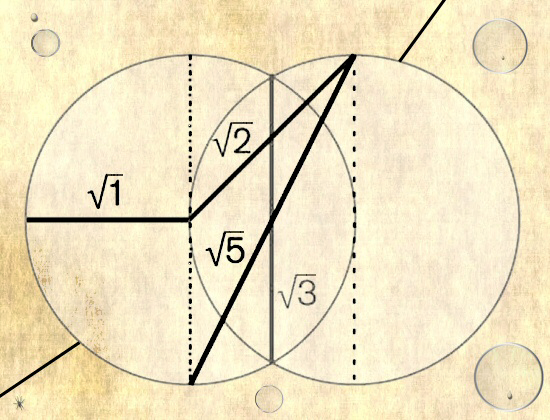
@pickover Why did you forget ‘square root 4’ for diameter of the circle?
English
Mathematics.
Which "God" decided this would be the best way to set up the universe?
English

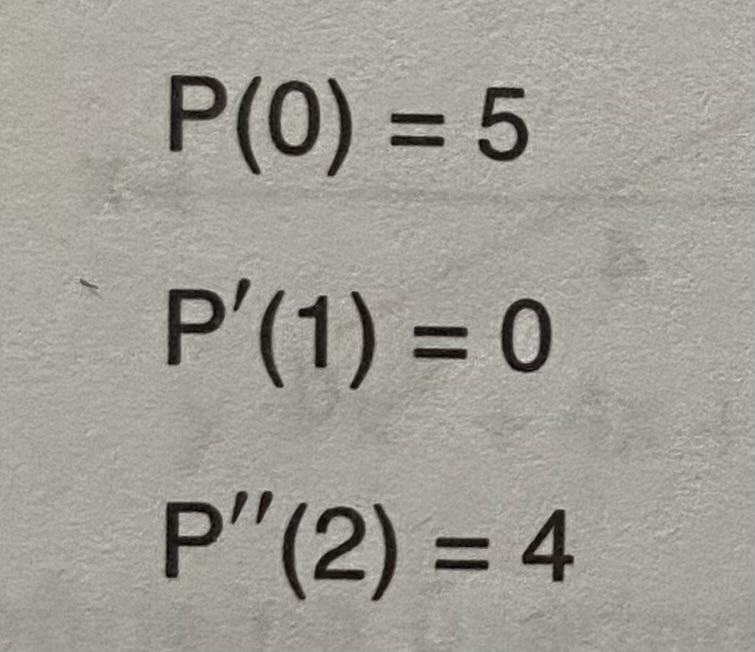
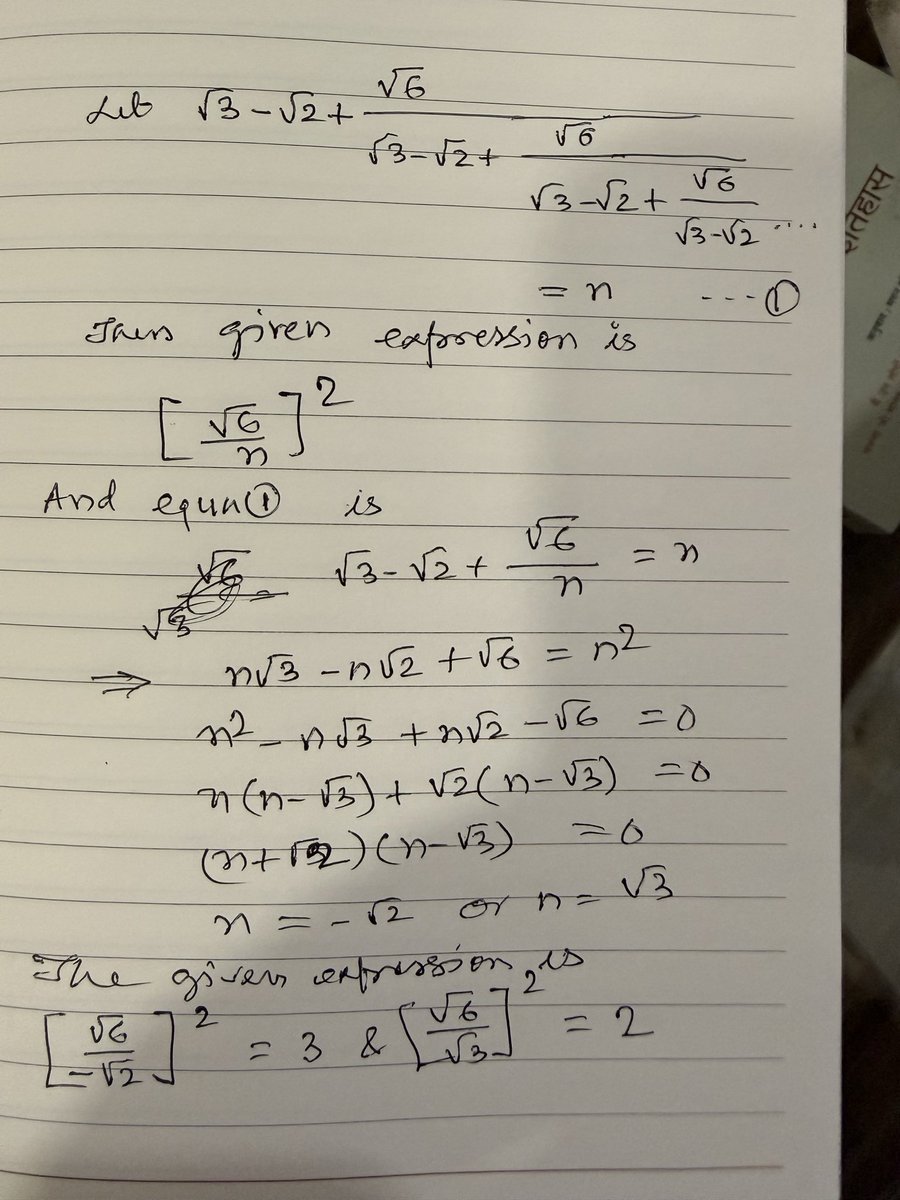

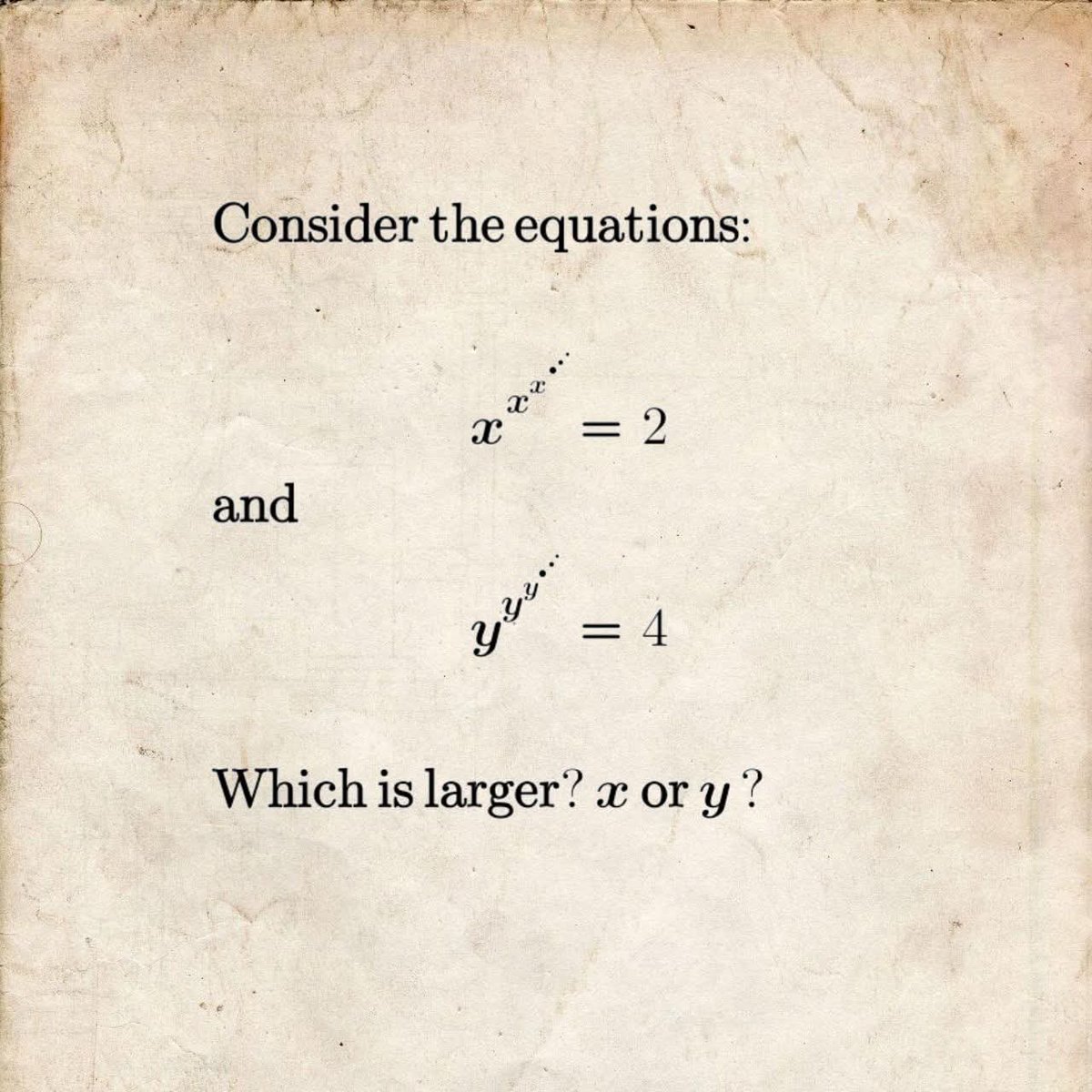
A mathematician emerges from a cave, hands you the piece of paper below, and asks "What is the largest number less than 1?" What is your answer?

English
@surajit_ghosh2 Why did they not capture the site where they had landed in 1969 and planted the American flag?
English

Tirth Nath Jha retweetledi

STAR Boy TARUN@Starboy2079
Hon’ble Prime Minister @narendramodi Ji, Food adulteration in India has become a serious public health threat, contributing to chronic diseases and long-term toxicity. Despite its mandate, FSSAI and state food safety departments have failed to enforce regulations effectively, with widespread concerns about corruption and weak accountability. Even the food standards set by FSSAI are so weak that the same companies and brands sell lower-quality products in India compared to Western countries. The most alarming part which I know you will not appreciate is that when concerned citizens began exposing FSSAI’s wrongdoing on social media, instead of addressing the issues, the authority reportedly responded by filing FIRs against them to silence their voices. I urge the dissolution of the current system and the creation of a transparent, strictly accountable food safety authority. Accountability must be fixed, if any citizen takes food sample and get it tested from private laboratory and food is found adulterated then concerned accountable officer must be immediately suspended Yours sincerely, Tarun Cc to @PMOIndia @JPNadda @MoHFW_INDIA
English
@bsec_wales @pickover @__Libra1 Writing is also manual with chalk in case of A while it is smooth like screen in case of B. This is revealed by zooming out the picture.
English

English


Prove that the triangle whose vertices coordinates are integers can’t be an equilateral triangle.
#math
English
@InterstellarUAP Trillions of Galaxies, billions of stars in each galaxy, each star having approx 10 planets still ‘we are alone’; doesn’t fit into any probability theory. Not having any planet with Earth 🌍 like condition out of so many defy scientific logic.
English

🚨 Elon Musk dropped this chilling take: No aliens might be WAY scarier than we thought! 🛸👽
“If the universe is really 13.8 billion years old shouldn’t there be aliens everywhere and if not why not?”
“There’s either a lot of aliens or no aliens… either one is equally terrifying.”
“If there are no aliens then what we have here is very rare… no aliens is more terrifying.”
“I have not seen any evidence of aliens and I think that’s more likely though.”
The Fermi Paradox hits different when Elon says it. Are we truly alone… or is the silence hiding something worse?
What do you think — would discovering aliens be scarier, or realizing we’re the only ones? Have you seen anything in the sky that makes you question this? Drop your thoughts below 👇
English
Tirth Nath Jha retweetledi

I hope our engineering talent solves this … times will change.
Normal Guy@Normal_2610
India pays a premium for the privilege of not learning anything :) Every Indian car Tata, Mahindra, Maruti, all of them has a tiny computer inside called an ECU (Engine Control Unit) This computer decides everything - how much fuel to inject, when to shift gears, how brakes work, how the battery behaves in an EV. Think of it as the car's brain. India makes zero of these brains for passenger cars. All of them come from foreign companies, mainly Bosch (Germany). If you don't control the brain, you don't really control the car. Indian OEMs can't even add a simple valve to their own engine without asking Bosch for permission. They can't change a single line of code. They are selling cars with someone else engineering inside. This isn't really about technology being too hard. It's a business model designed to keep you dependent. Three layers lock you in :) First, every new car programme needs Bosch to do setup work (Rs 10-30 crore). Second, you pay full price for software Bosch already developed for Volkswagen so Bosch gets paid twice for the same work. Third and this is the killer every time you want to change anything in the software, even something tiny, it costs around $500,000. So Indian OEMs simply stop trying to innovate. They accept whatever Bosch gives them. The calibration trap means tuning the car's brain for Indian conditions, how should the engine behave in Ladakh cold vs Chennai heat? Indian OEMs outsource even this to AVL in Austria. AVL reuses work they already did for European cars, charges India full price, and transfers zero knowledge. So Indian engineers never even learn how their own cars work from the inside. What Korea did is Hyundai faced the exact same situation in 1987. They set up Kefico as a joint venture with Bosch, learned everything from the inside, and by 2015 they owned the full technology themselves. The sequence was simple - first learn calibration (tuning) → then write your own software → then build your own hardware. It's a ladder. India never climbed the first rung. Why India didn't do this - It's not a talent problem Indian engineers design ECUs at Bosch offices worldwide. It's a combination of things like Indian OEMs won't fund Indian startups to develop alternatives. They demand that Indian suppliers first prove themselves in Europe before getting a chance at home (while European companies protect their own). Middle managers won't risk their careers backing a Pune startup when they can safely pick Bosch. India spends 0.64% of GDP on R&D vs Korea's 4.9%. Private sector funds only 36% of India's R&D, in Korea it's 79%. SEDEMAC - the one exception - One Indian company (IIT Bombay founders, Pune-based) actually makes ECUs for two-wheelers and generators. They have real IP, real patents, millions of units shipped. But even they couldn't break into passenger cars. Tata Motors is literally in the same city and doesn't use them. EVs are simpler to control than petrol/diesel engines. This should have been India's fresh start. Instead, Mahindra's new EV platform has Bosch (Germany), Valeo (France), BYD (China), Mobileye (Israel), Continental (Germany) - zero Indian ECUs. The dependency just migrated from ICE to EV with different foreign names. swarajyamag.com/technology/the…
English


@TirthNath Hi,
We have already escalated your issue to our concerned team and they are looking into it. Appreciate your patience!
* * Regards,
Daikin Team
English

Daikin ke दो AC खरीद गलती कर दी, after sales service रूला रही है, वरिष्ठ नागरिक हूं, परेशान हो गया हूं, 9 मार्च को सर्विस के लिए बोला, आजतक कोई नहीं आया, सर्विस सेंटर से केवल फोन आया, ब्रांच कंट्रोलर सर्विस फोन नहीं उठाता, Complaint ID 49880117, 49880433 @DaikinIndia
हिन्दी
@DaikinIndia It is felt that Daikin service is not upto mark. I drop my service request. Don’t send any technician Pl.
English
@DaikinIndia A technician Mr Khan calls me with this no: 9372016209, another no: 7775990372. But no message from Daikin as to what will be the charges etc.
English
@DaikinIndia Your automated WhatsApp service is not effective. I Jane received the the service I’d but unable to track the service request. No phone no of the engineer provided. My service I’d is 49988854.
English