Sabitlenmiş Tweet
The Pilgrim's Progress 🍇
3.3K posts

The Pilgrim's Progress 🍇
@ToCelestialCity
Heb. 11:16 • Mark 8:36 • Reformed (RPCNA) • 🇺🇸
Country of Beulah Katılım Nisan 2023
485 Takip Edilen578 Takipçiler
The Pilgrim's Progress 🍇 retweetledi

The whetstone of us all
The Presbytery Inn@PresbyInn
Fill in the blank. Richard Baxter was ________________
English

RICHARD BAXTER ON WHETHER THE POPE OF ROME IS THE ANTICHRIST.
Quest. IV. Whether it is necessary to believe that the pope is the antichrist?
It is one question whether he is antichrist, and another, whether it is necessary to believe it. To the first I say that there are many antichrists, and we must remove the ambiguity of the name before we can resolve the question. If by antichrist it is meant one that usurps the office of a universal vicar of Christ and the constitutive and governing head of the whole visible church, and hereby lays the ground of schisms, contentions, and bloodshed in the world, and would rob Christ of all his members who are not of the pope's kingdom, and that form a multifarious ministry for this service, and corrupts much of the doctrine, worship, and discipline of the church; in this sense no doubt but the pope is antichrist.
But if by antichrist is meant him particularly described in the Apocalypse and Thessalonians, then the controversy de re is about the exposition of those dark prophecies. Of which I can say no more but this, 1. That if the pope is not him, he had ill luck to be so like him. 2. That Dr. More's moral arguments, and Bishop Downame's and many others' expository arguments are such as I cannot answer. 3. But yet my skill is no so great in interpreting those obscure prophecies as that I can say that I am sure that it is the pope they speak of, and that Lyra, learned Zanchi, and others that think it is Mohammad, or others that otherwise interpret them, were mistaken.
[...]
[A]s the suspicion should make all Christians cautious what they receive from Rome, so the obscurity should make all Christians take heed that they draw from it no consequences destructive to love, or order, or any truth, or Christian duty. And this is the advice I give to all.
–– A Christian Directory, Bk. 3, "Ecclesiastical Cases of Conscience"
English

@ToCelestialCity @jonathanramont I thought you might have been sarcastic. I couldn’t tell for sure and didn’t want to come across as touchy about it.
I don’t think I was flaunting anything. What I said was relevant, and you’ll notice I didn’t lead with that. I only mentioned it after a dumbass reply by Ramont.
English

My defense of the immediate vision of God against critiques by Bavinck and other Neo-Calvinists:
open.substack.com/pub/jonathanra…
English

@JoshBranscomb @jonathanramont I was being sarcastic. Nobody cares about credential flaunting.
English

@ToCelestialCity @jonathanramont haha yeah.
Filipino

@JoshBranscomb @jonathanramont You went to Stanford Law?! 🤯
English

@jonathanramont Your reply isn't worthy of the substack post (nor of my remarks). I wish to hear from the writer of that post. I didn't mean to convey false modesty the other day. I went to Stanford Law and have an MDiv from Gordon-Conwell. I'm not a theologian, but I'm not a layman either.
English

That analogy collapses because it directly contradicts what the Church dogmatically teaches.
The Deposit of Faith is not hidden, evolving, or discoverable by guesswork. It is:
👉 Closed with the apostles
👉 Publicly known
👉 Definitively taught
Magisterial teaching:
•Dei Verbum (DV 4)
Revelation is complete in Christ, no new public revelation.
•Catechism of the Catholic Church (CCC 66)
“No new public revelation is to be expected.”
•First Vatican Council (Dei Filius)
The faith was once for all delivered and entrusted to the Church.
•Dei Verbum (DV 10)
Scripture and Tradition form one deposit, authentically interpreted by the Magisterium.
Scripture:
•“Guard the good deposit” (2 Tim 1:14)
•“The Church… pillar and bulwark of the truth” (1 Tim 3:15)
Your analogy (“blind man’s bluff”) implies:
❌ The faith is hidden
❌ The Church is guessing
❌ Doctrines are being “found” later
Catholic doctrine explicitly denies all three.
Doctrinal development is not “finding new secrets,”
it is definitively clarifying what was always there.
Scripture itself shows doctrinal development:
👉 The Trinity (fully divine Father, Son, Spirit → later defined)
👉 The Gentiles’ inclusion (always intended → clarified at Acts 15)
👉 The Resurrection (taught by Christ → only fully understood later)
Same truths, progressively understood and authoritatively clarified, not invented.
Turn the critique around:
If there is no authoritative Church:
👉 Who definitively identifies doctrine?
👉 Who resolves contradictions?
👉 Who settles interpretation?
Answer: no one.
That’s where you actually get:
👉 competing claims
👉 shifting doctrines
👉 no final authority
👉 thousands of differing interpretations in as many Protestant denominations
That’s blind man’s bluff.
Bottom line:
The Catholic Church teaches a closed, public, and divinely guarded deposit, definitively interpreted, not discovered in the dark.
Your analogy doesn’t describe Catholicism.
It describes private interpretation.
English
The Pilgrim's Progress 🍇 retweetledi

@LaymansSeminary @TomHicks2LCF Man, old people really got one shotted by AI.
English

Is Richard Baxter’s View of Justification Essentially Roman Catholic? (A Super Layman / GPT5 response)
TL;DR: The article accurately shows that Richard Baxter modified classic Reformed justification to combat antinomianism. Historically, Baxter did move toward a conditional covenant model. However, the article reflects a strict Reformed-orthodox polemic that somewhat overstates the Trent comparison. Baxter is better classified as neonomian covenant theology, not straightforward Roman Catholicism. From a Free Grace perspective, Baxter still collapses justification into obedience and shifts justification away from faith alone.
Text / Observations
The article argues three claims about Baxter:
1.Denial of double imputation – Baxter rejected the classic Reformed idea that Christ’s active obedience is imputed as the believer’s righteousness.
2.Faith as evangelical righteousness – Faith itself (as obedient faith) becomes the righteousness counted for justification.
3.Final justification by obedience – Continued justification and final salvation depend on covenant faithfulness.
These claims are supported with quotations from Baxter’s works: Aphorismes of Justification, Treatise of Justifying Righteousness, and Of Justification.
Historically these citations are legitimate. Baxter clearly taught:
• faith as a covenant condition
• obedience as necessary for final justification
• Christ’s work securing a new covenant law
This explains why later Reformed theologians called him neonomian (“new law”).
Inference
The paper’s thesis is that Baxter’s theology became difficult to distinguish from Trent because he replaced imputed righteousness with covenant obedience.
This inference has partial validity but also historical overreach.
Why?
Because Baxter still affirmed Protestant distinctives:
• justification begins through faith
• salvation grounded in Christ’s work
• grace initiates the covenant
But he also introduced:
• conditional continuation of justification
• evangelical obedience as covenant righteousness
• final justification tied to perseverance
Thus Baxter sits between Protestant orthodoxy and Roman Catholicism, not identical to either.
System Analysis (Free Grace Framework)
R1 — Eternal Life
Biblical justification (Rom 4:5; John 5:24)
= forensic declaration based solely on faith.
Indicators:
• instantaneous
• irreversible
• apart from works
Baxter modifies this by making obedience necessary for final justification.
Result: R1 becomes conditional.
R2 — Forensic Standing
Baxter effectively shifts justification into a covenant status maintained by obedience.
R3 — Sanctification
Many elements Baxter places in justification belong here:
• obedience
• covenant faithfulness
• perseverance
These are sanctification realities, not justification.
Decision
The article’s central thesis is mostly correct historically: Baxter reshaped justification into a conditional covenant framework to combat antinomianism.
However the comparison to Trent is partly rhetorical rather than precise.
More accurate classification:
Baxter = Neonomian Covenantalism
Structure:
Christ’s work → creates new covenant law
Faith + obedience → covenant righteousness
Final judgment → confirms justification
This differs from both:
• Reformed orthodoxy (imputed righteousness)
• Free Grace (faith alone permanently justifies)
Objection
A defender of Baxter might argue he still taught justification by faith and simply emphasized obedience as evidence.
But Baxter explicitly says obedience is a condition for continuation and final justification, which goes beyond evidence.
Conclusion
Historically the article correctly identifies Baxter’s shift toward neonomian conditional justification.
Theologically, from a Free Grace perspective Baxter’s model still confuses justification and sanctification, placing obedience where Scripture places faith alone.
Confidence: High on historical description; moderate on the Trent comparison.
English

@PsalmWarfare @EddyEkofo You definitely should, worth whatever price RHB has it at.
English

@PsalmWarfare @EddyEkofo Highly recommend Van Maastricht.
English

@EddyEkofo I was looking for Van Mastrichts the other day, but I bought the 4 volumes then RHB came out with #5 a week later 🙄 so let me know what you find.
I do like what I’ve seen what Turretin has said on it.
English

@ToCelestialCity What is even the goal in posting a quote like this w out what the “if this be” present?
English

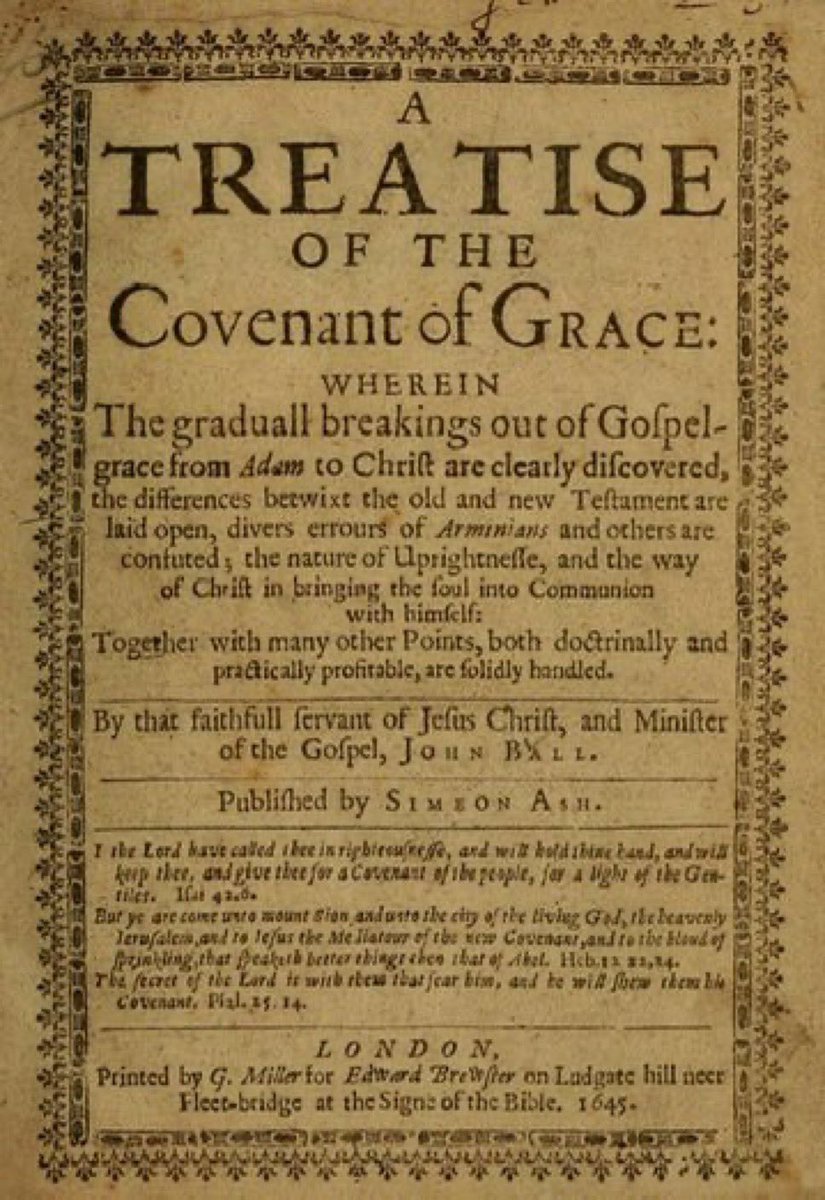
John Ball on whether a lack of perfect obedience makes one a covenant [of grace] breaker, per scriptural commands to keep God’s law:
“Which must not so be understood, as if he that did of frailty and infirmity offend in any one jot or tittle, should be held a Covenant breaker: for then no man should be innocent, but the promise must be interpreted according as the Law or rule of obedience is given, which calleth for perfection but accepteth sincerity. In the Covenant of mercy we bind ourselves to believe and rest upon God with the whole heart, so as doubting or distrust of weakness and infirmity, must be acknowledged a sin, but every such frailty doth not argue the person to be a transgressor of the Covenant. And the same holds true of obedience.”
-John Ball, 𝐴 𝑇𝑟𝑒𝑎𝑡𝑖𝑠𝑒 𝑜𝑛 𝑡ℎ𝑒 𝐶𝑜𝑣𝑒𝑛𝑎𝑛𝑡 𝑜𝑓 𝐺𝑟𝑎𝑐𝑒, ch. 3

English

@MarkMacdonald75 @reformedtexan A tinkerer who disturbed him by knocking on his door…
English

@ToCelestialCity @reformedtexan Ha!
Who is he supposed to have murdered?!
Other than the Reformed doctrine of justification…;)
English

Richard Baxter’s response when he was FALSELY ACCUSED OF MURDER:
“And as to this story, I do here solemnly profess that I never killed, wounded, or hurt any man in my life (save one man whose leg I hurt while playfully wrestling when I was a boy, and once or twice boxing with schoolboys, and correcting lads when I was one year a schoolmaster).”
😆
English

@Matteo816575109 @PresbyInn What does it matter?
English


You should stop trusting in the finished work of Christ for the satisfaction of your sins because *checks notes*
...a 19th century mentally ill German woman said so.
Grainne 🕊️☘️@GrainneMcD92925
I have seen in purgatory, Protestants who were pious in their ignorance, they are very desolate, for no prayers are offered for them. Bl. Anne Catherine Emmerich 🕊️

English
The Pilgrim's Progress 🍇 retweetledi