TokenPhysicist
460 posts

TokenPhysicist
@TokenPhysicist
"all the tokens fit to mint"

Katılım Ekim 2021
903 Takip Edilen897 Takipçiler

@zengjiajun_eth Neat! I've seen a few of similar products as well as building my own. A few things I'm curious how you are thinking about:
1) structuring liquid markets for the options
2) improving UX for rolling over options
3) what assets/positions you think there is demand for using this w/
English

Leverage on ETH that can't be liquidated. Now live on testnet.
Cleave splits 1 ETH into a cash half and an upside half that always add back to 1 ETH. No loan, no margin, nothing to liquidate.
Try it free, no wallet needed 👇
testnet.cleave.market

English

@alpeh_v "too big to lose" (the bet)
I agree this is ironically already how the economy is structured
English

Bit overdue, but I've joined the @angstromxyz team.
I've been excited about MEV recapture for a long time now, and we're building cool stuff over here!
$1B in total volume is just the beginning; more coming soon 👀
Angstrom@angstromxyz
We just crossed $1B in total volume!

English

@stemcellpaul1 it was softer than I expected! most shelf fungi like this are wooden to the touch, but apparently reishi are soft enough that they can be eaten fresh instead of just going into tea
English

@WazzCrypto The problem is everything else seems to be dropshipping now too. eBay, etsy, WayFair, etc. are all identical.
Retail stores will sell store-branded versions of the same no-name chinese crap to the point that there are websites for finding the cheapest retailer of identical items
English

@thedefivillain seems like a trap that is highly likely to go low-yield + illiquid again. no guarantee of liquidation if SKY drops enough either; might as well just lend to Rune directly w/ a handshake.
@ImperiumPaper has a lot of good posts on it, e.g. x.com/ImperiumPaper/… and its QTs
PaperImperium@ImperiumPaper
This is still subsidized, by the way. Hope everyone who aped into this at 40% and 20% and 15% are monitoring it 🫠 As pointed out before, the risk here is illiquidity. There’s no incentive for the one large borrower to repay, and they also control all the parameters (hence manual adjustments of yield ever lower to a target range that’s absurdly low). So once other depositors withdraw and utilization gets high, you’re stuck until new depositors show up.

English

@ImperiumPaper any good recs for my reading list? currently I'm on a monetary theory kick but I'll read anything interesting. I just learned about the pre-WWI "Latin Monetary Union" in Europe from Silvio Gessel's book
English

@TokenPhysicist You find weird things when your education and career were archaeology and econ/fintech
English

You may have heard of RWAs that consist of “revenue-based financing” — where a loan is granted, but the lender has a lien on receivables or even control of accounts where the borrower is paid.
What you may not have heard of is that this is an old practice, with some interesting variations. Let’s take a look at a *spiritual* revenue-based financing RWA (is it still a real-world asset if it’s spiritually collateralized?) that helped spark the Protestant Reformation and change the course of history.
The medieval Catholic Church found itself allowing indulgences — forgiveness for sins, so I guess less time in purgatory or better neighborhood in Hell when you die — to be granted in exchange for charitable donations. In theory, they weren’t supposed to be sold, and only given for virtuous acts.
However, one fellow wanted to be the Archbishop of Mainz (who also was one of the seven Electors in the Holy Roman Empire). This required a donation of 20,000 guilders to Rome — around $9-10m in today’s gold prices. How was Albrecht, the would-be Archbishop-Elector, going to come up with the scratch to assume this important office?
He did what people always do when financing a large purchase — he went to the bank. In this case, it ws the Fuggers, a family of bankers based in Austria.
Understandably, the Fuggers wanted to make sure they got paid back. And it’s not like they could repossess an archbishopric that belonged to the Church. What to do?
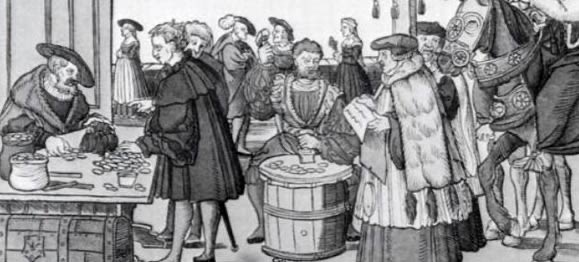
The answer came in revenue-based financing! Albrecht got permission from Pope Leo X to aggressively sell indulgences in his domains (he was already the Archbishop of Magdeburg). Before long, a priest was traveling around Albrecht’s domains with a piggy-bank-like chest for sinners to insert coins and receive a spiritual pardon.
To enforce their rights to the income from indulgences, the collection chest had three keys, all of which were required to open the chests and get the gold and silver coins out. One of the three keys was held by the Fuggers, and the chest accompanied by their watchful agents to ensure the revenue was used to repay the large loan.
Of course, this was seen as an abuse of Church power and was directly challenged by Martin Luther in his 95 Theses that sparked the Reformation and the onset of many religious wars within Europe.
But I do love weird, unique, and clever financial structures find their way onchain as RWAs. Maybe someday a religious organization will tokenize their future “donations receivable” and borrow on @WildcatFi or @Morpho and have those claims zipping around DEXs by eagle-eyed traders on @okutrade. Onchain finance can and definitely will be much weirder than traditional finance eventually.

English