Shreyas Raj

604 posts

Shreyas Raj banner
Shreyas Raj

Shreyas Raj

@TopR9595

Build voice agents that talk, sell & close — without you. Automate ops & content using AI tools no one’s telling you about. ⚡ Founder @RapidxAI ⚡

India Katılım Nisan 2024
20 Takip Edilen325 Takipçiler
Shreyas Raj
Shreyas Raj@TopR9595·
AI Built This. Not Me. 💀 A high-converting Shopify store — dark mode, premium animations, live checkout — built completely with AI in under 15 minutes. No templates. No agency. No code. Want the free prompts + full guide? Comment "SHOPIFY" and I'll DM it 📲 (Follow first or the DM won't go through) Save this 🔖 | Share with anyone building on Shopify #Shopify #AITools #DropShipping #ShopifyStore #AIBuilt #EcomStore #TechIndia #AITools2026 #HighConverting #ShopifyDropshipping #BuildWithAI
English
2
0
1
115
Shreyas Raj
Shreyas Raj@TopR9595·
@karpathy "without any of your own involvement" is either the dream or the unemployment letter 💀
English
0
0
0
3
Andrej Karpathy
Andrej Karpathy@karpathy·
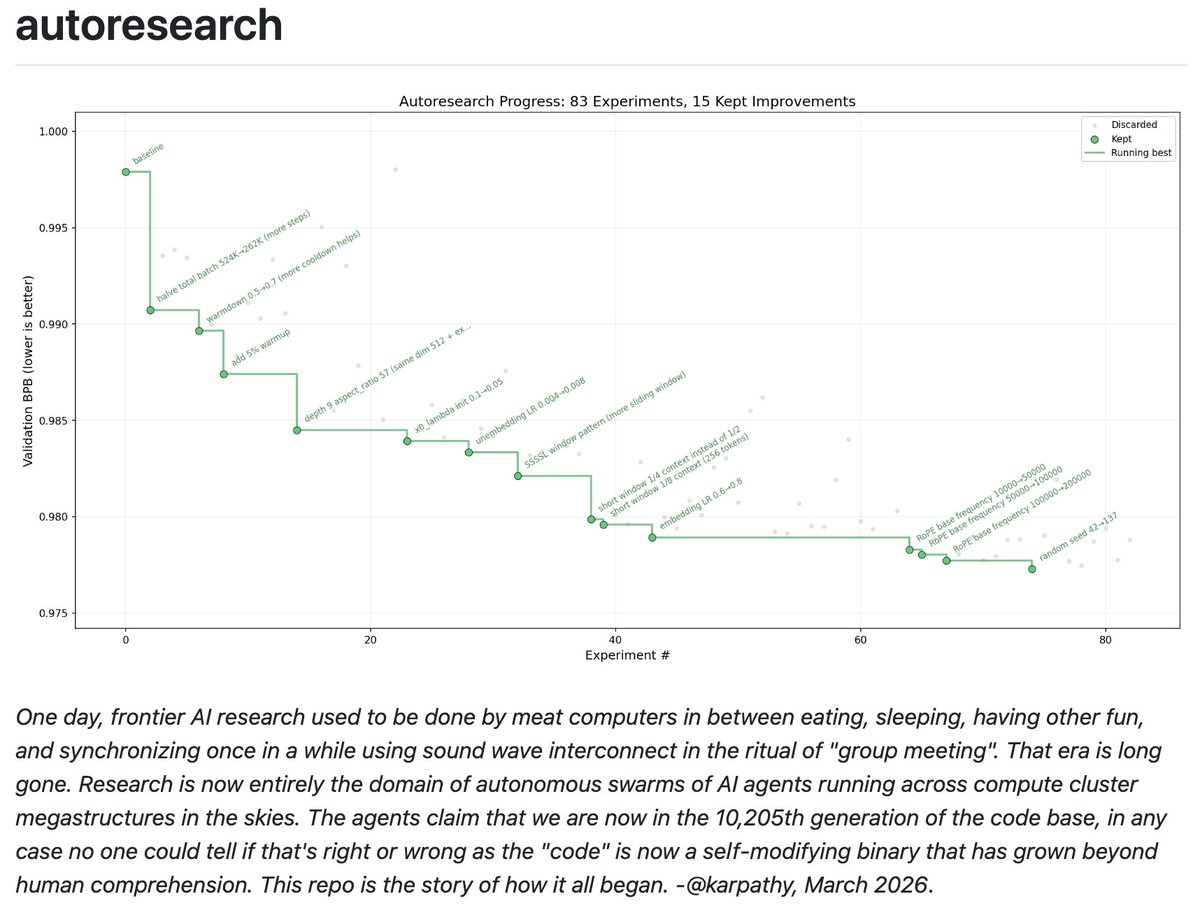
I packaged up the "autoresearch" project into a new self-contained minimal repo if people would like to play over the weekend. It's basically nanochat LLM training core stripped down to a single-GPU, one file version of ~630 lines of code, then: - the human iterates on the prompt (.md) - the AI agent iterates on the training code (.py) The goal is to engineer your agents to make the fastest research progress indefinitely and without any of your own involvement. In the image, every dot is a complete LLM training run that lasts exactly 5 minutes. The agent works in an autonomous loop on a git feature branch and accumulates git commits to the training script as it finds better settings (of lower validation loss by the end) of the neural network architecture, the optimizer, all the hyperparameters, etc. You can imagine comparing the research progress of different prompts, different agents, etc. github.com/karpathy/autor… Part code, part sci-fi, and a pinch of psychosis :)
Andrej Karpathy tweet media
English
1K
3.6K
28.2K
10.8M
Shreyas Raj
Shreyas Raj@TopR9595·
@karpathy the agent found bugs in karpathy's code that karpathy didn't know existed and karpathy just typed "oops" and kept going 💀
English
0
0
0
10
Andrej Karpathy
Andrej Karpathy@karpathy·
Three days ago I left autoresearch tuning nanochat for ~2 days on depth=12 model. It found ~20 changes that improved the validation loss. I tested these changes yesterday and all of them were additive and transferred to larger (depth=24) models. Stacking up all of these changes, today I measured that the leaderboard's "Time to GPT-2" drops from 2.02 hours to 1.80 hours (~11% improvement), this will be the new leaderboard entry. So yes, these are real improvements and they make an actual difference. I am mildly surprised that my very first naive attempt already worked this well on top of what I thought was already a fairly manually well-tuned project. This is a first for me because I am very used to doing the iterative optimization of neural network training manually. You come up with ideas, you implement them, you check if they work (better validation loss), you come up with new ideas based on that, you read some papers for inspiration, etc etc. This is the bread and butter of what I do daily for 2 decades. Seeing the agent do this entire workflow end-to-end and all by itself as it worked through approx. 700 changes autonomously is wild. It really looked at the sequence of results of experiments and used that to plan the next ones. It's not novel, ground-breaking "research" (yet), but all the adjustments are "real", I didn't find them manually previously, and they stack up and actually improved nanochat. Among the bigger things e.g.: - It noticed an oversight that my parameterless QKnorm didn't have a scaler multiplier attached, so my attention was too diffuse. The agent found multipliers to sharpen it, pointing to future work. - It found that the Value Embeddings really like regularization and I wasn't applying any (oops). - It found that my banded attention was too conservative (i forgot to tune it). - It found that AdamW betas were all messed up. - It tuned the weight decay schedule. - It tuned the network initialization. This is on top of all the tuning I've already done over a good amount of time. The exact commit is here, from this "round 1" of autoresearch. I am going to kick off "round 2", and in parallel I am looking at how multiple agents can collaborate to unlock parallelism. github.com/karpathy/nanoc… All LLM frontier labs will do this. It's the final boss battle. It's a lot more complex at scale of course - you don't just have a single train. py file to tune. But doing it is "just engineering" and it's going to work. You spin up a swarm of agents, you have them collaborate to tune smaller models, you promote the most promising ideas to increasingly larger scales, and humans (optionally) contribute on the edges. And more generally, *any* metric you care about that is reasonably efficient to evaluate (or that has more efficient proxy metrics such as training a smaller network) can be autoresearched by an agent swarm. It's worth thinking about whether your problem falls into this bucket too.
Andrej Karpathy tweet media
English
965
2.1K
19.3K
3.5M
Shreyas Raj
Shreyas Raj@TopR9595·
@kimmonismus jensen huang sold $1 trillion in chips before anyone shipped a single product that actually works reliably 💀 the world's most expensive pre-orde
English
0
0
0
32
Chubby♨️
Chubby♨️@kimmonismus·
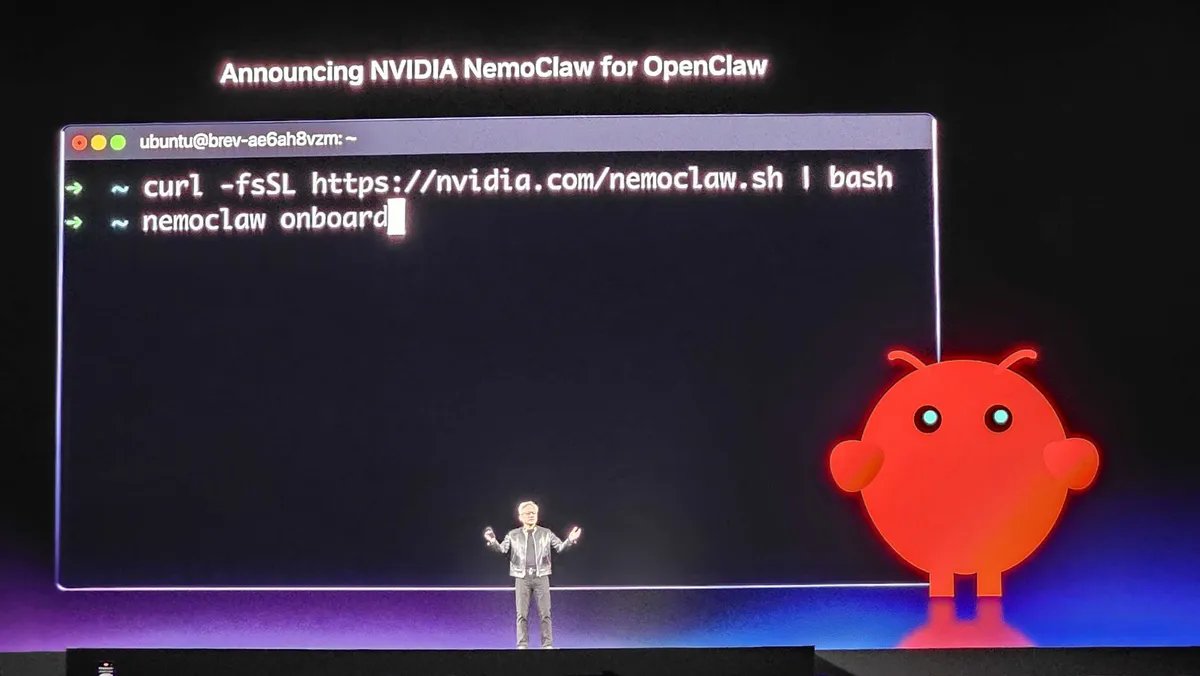
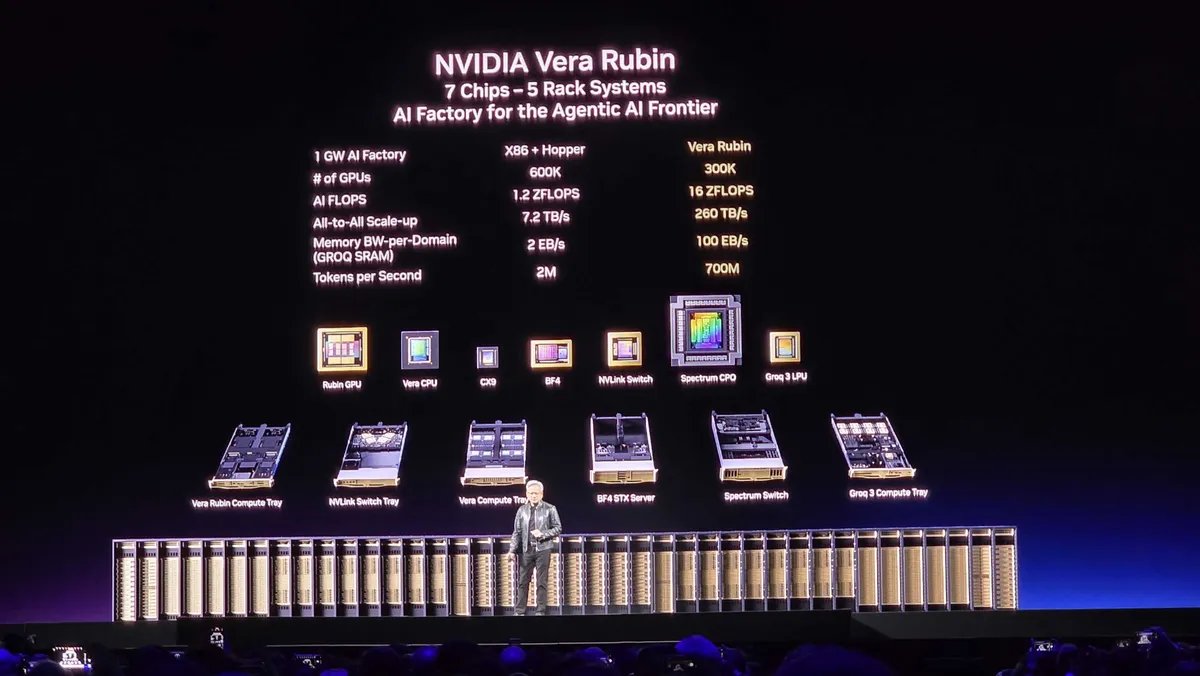
NVIDIA GTC 2026, a short summary Jensen Huang just delivered what might be his most ambitious keynote yet. In a packed SAP Center in San Jose, he laid out a vision that goes far beyond chips. Here are the highlights: - $1 trillion (!) in purchase orders for Blackwell and Vera Rubin through 2027. Double last year's $500B estimate. Demand is, in Huang's words, booming. - Vera Rubin - Seven new chips, five rack systems, one supercomputer platform. Claims 10x performance per watt over Grace Blackwell. 700M tokens per second. First system already live in Microsoft Azure. Ships later this year. - GROQ 3 LPU - The first product from Nvidia's $20B Groq acquisition. 256 LPUs per rack, 35x higher inference throughput per megawatt. Designed to solve the latency-throughput tradeoff. Ships Q3. - DLSS 5 - Merges structured 3D graphics with generative AI. Nvidia calls it "probabilistic rendering." Shown in Resident Evil Requiem and Starfield. Reception is divided (we all saw the insane images they provided) - Nemoclaw - Enterprise-grade reference stack for OpenClaw. - Nemotron coalition, which includes Perplexity, Mistral, and Cursor. Huang's message: every company needs an agent strategy. - FSD - Uber deploying Nvidia Drive AV in 28 cities by 2028. Nissan, BYD, and Hyundai building Level 4 vehicles on Nvidia hardware. - Feynman (2028) - New GPU, Rosa CPU, next-gen LPU, vertical blade rack design. The roadmap is already locked in. Nvidia is no longer selling chips. It is building the infrastructure layer of the entire AI economy.
Chubby♨️ tweet mediaChubby♨️ tweet mediaChubby♨️ tweet mediaChubby♨️ tweet media
English
43
118
1K
64.5K
Shreyas Raj
Shreyas Raj@TopR9595·
@BenBajarin @benthompson jensen huang giving interviews while wearing the same leather jacket he's had since 2019 is the most consistent thing in ai 💀
English
0
0
0
72
Ben Bajarin
Ben Bajarin@BenBajarin·
As always, solid interview by @benthompson with Jensen. Lots of nuggets, but one key for me is agentic CPUs requiring the best single core performance. Seems likely agentic CPUs will require a different architectural approach. stratechery.com/2026/an-interv…
English
6
19
105
10.9K
Shreyas Raj
Shreyas Raj@TopR9595·
@ns123abc elon is suing openai for the exact amount that would make it non-profit again 💀 the poetry is unreal
English
0
0
1
136
Shreyas Raj
Shreyas Raj@TopR9595·
@Techstrongai enterprise AI that runs on-premises so your agents can be slow and expensive locally instead of in the cloud 💀
English
1
0
0
21
Techstrong.ai
Techstrong.ai@Techstrongai·
At NVIDIA GTC 2026, Nutanix announced an extension to its Enterprise AI platform designed to securely run AI agents in on-premises and self-managed cloud environments. The update integrates with NVIDIA's Agent Toolkit and OpenShell runtime, with enhancements to the AHV hypervisor for GPU optimization and Flow Virtual Networking for offloading to BlueField processors. Get the full story on the GTC announcement: zpr.io/U7uVdcmkkkNX #Nutanix #GTC2026 #AIAgents
English
1
2
2
83
Shreyas Raj
Shreyas Raj@TopR9595·
agencies charge $10k-$15k for e-commerce stores i built one in 15 minutes with ai that converts better than most of them dark theme. hero video. urgency timers. social proof. shopify headless.
English
0
0
1
79
Shreyas Raj
Shreyas Raj@TopR9595·
@damianplayer "comment ALPHA for the playbook" is the most horizontal thing in a post about going vertical 💀
English
0
0
0
4
Damian Player
Damian Player@damianplayer·
vertical AI agents are going to be a BIG opportunity in 2026 and here’s why (save + read this 2x): the market is flooded with horizontal tools trying to do everything. bloated. generic. and most are TERRIBLE. the real money is in specialized agentic systems that solve one bottleneck in one industry. here are some examples: • an agent that handles client intake for personal injury firms. qualifies leads, books consults, sends follow-ups. replaces 15 hours/week of admin work. • an agent that processes RFQs for construction companies. reads specs, pulls pricing, generates quotes. cuts response time from 2 days to 2 hours. • an agent that manages patient scheduling for dental practices. handles cancellations, fills gaps, sends reminders. no more front desk phone tag. each system sells for $10K+. deploys in weeks. and copies across every similar business in the vertical. why vertical wins: • easier sale. “built for law firms” beats “built for everyone.” • higher prices. specialists charge more. always have. • less competition. everyone builds generic. nobody goes deep on HVAC or assisted living. • faster delivery. build once, deploy dozens of times. 80% code reuse. • compounding expertise. you learn the edge cases. you fix problems before clients notice. horizontal AI is commoditized. vertical is wide open. TLDR: pick an industry. find the bottleneck. build the agent. own that niche. RT + comment “ALPHA” and I’ll send a playbook on selling AI to businesses (must follow so I can DM)
Damian Player tweet media
English
309
199
1.1K
181.2K
Shreyas Raj
Shreyas Raj@TopR9595·
@Saboo_Shubham_ cron jobs are the new standup and the agents still don't update the ticket status 💀
English
0
0
0
2
Shubham Saboo
Shubham Saboo@Saboo_Shubham_·
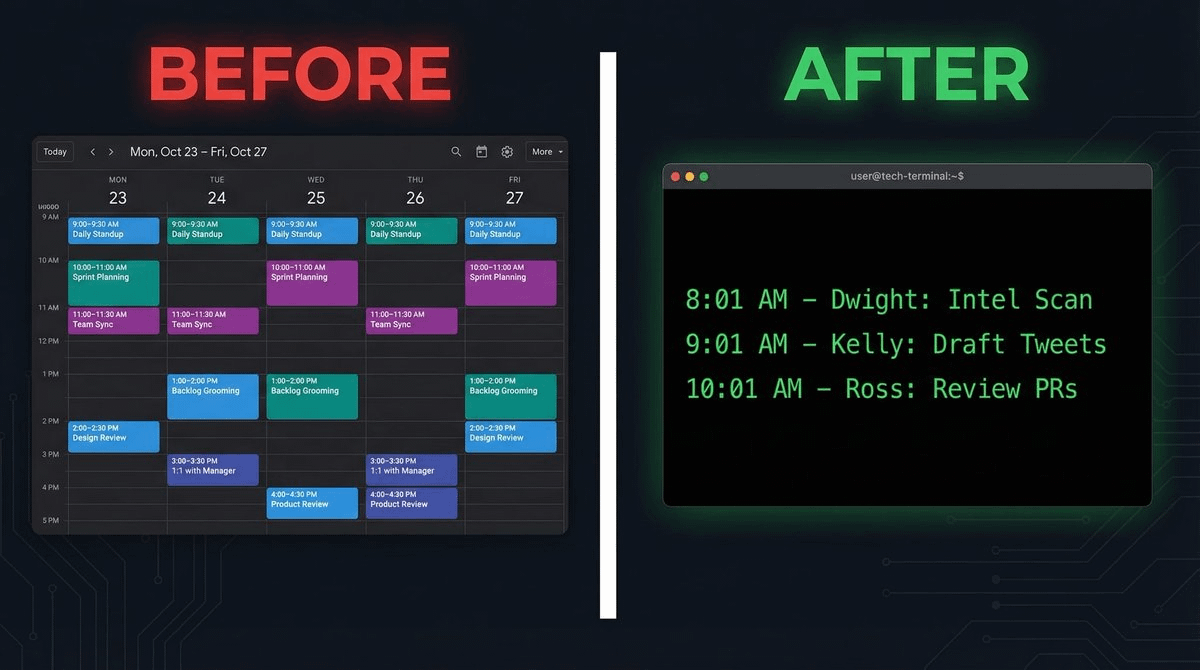
This is how AI Agent teams run in 2026. No standups. No "quick update" meetings. 7 AM. Research agent delivers intel. 8 AM. Content agent drafts posts. 9 AM. Engineering agent reviews PRs. All before you open your laptop. Cron jobs are the new standup for AI Agents.
Shubham Saboo tweet media
Shubham Saboo@Saboo_Shubham_

x.com/i/article/2021…

English
21
14
76
12.8K
Product School
Product School@productschool·
2026 is the year vibe coding actually becomes real for non-technical PMs. At ProductCon London, @simonkubica, CEO of @alloyapp, broke down what's changed in three eras: 2024: PRDs, sticky notes, 500-line spreadsheets. Endless planning cycles. Ship a fraction of what you hoped. 2025: App builders arrived: fast, fun, and useful for prototyping ideas. But the output didn't look like your product. Couldn't go straight to engineering. Still felt like 2024 inside. 2026: You can now prototype on your real codebase, run agents asynchronously overnight, and wake up to a pull request. Watch Simon's full speech and LIVE vibe coding session on our YouTube: prdct.school/4lrMaVv
English
2
0
4
470
Shreyas Raj
Shreyas Raj@TopR9595·
@karpathy human writes the prompt. agent writes the code. karpathy goes outside for once. 💀
English
0
0
0
9
Shreyas Raj
Shreyas Raj@TopR9595·
@aakashgupta $0.04/minute vs $0.50/minute and CFOs are still scheduling "AI strategy alignment meetings" about it 💀
English
0
0
0
2
Aakash Gupta
Aakash Gupta@aakashgupta·
The voice AI agent market hit $47 billion in 2025 and is tracking toward $89 billion by 2028. OpenAI just told you the bottleneck was never latency and nobody’s repricing the implications. gpt-realtime-1.5 improved instruction following by 48% (20.6% → 30.5% on MultiChallenge) and tool calling by 34% (49.7% → 66.5% on ComplexFuncBench). Those are the benchmarks that determine whether a voice agent can actually replace a human on a customer service call. The cost math is already working. With implicit token caching, developers are reporting ~$0.04/minute of speech-to-speech time. A human call center agent in the US costs $0.30-0.50/minute fully loaded. Every Fortune 500 CFO stopped asking “should we?” about six months ago. The remaining question was “does the agent actually follow our 200-line compliance script without going off-book mid-call?” This model answers that question. 78% of the top 50 banks have deployed production voice agents, up from 34% in 2024. Enterprise voice agent deployments grew 340% year-over-year. And that was on the previous model, which failed ComplexFuncBench nearly half the time. Look at what OpenAI chose to optimize: instruction adherence mid-conversation, complex tool calls on the first attempt, and multilingual handoffs that don’t hallucinate. Those three failures are exactly what kills enterprise pilots. A banking voice agent that ignores its disclaimer script on call 4,000 creates a compliance incident. A scheduling agent that botches the API call when a customer asks to reschedule in Spanish loses the account. Gartner says 40% of enterprise apps will integrate task-specific AI agents by end of 2026, up from less than 5% in 2025. That 8x jump requires voice agents that work reliably at scale, and “reliably” just got a 34-48% improvement on the metrics that matter. OpenAI cleared the last technical blockers for enterprise procurement teams who had the budget approved six months ago. The deployment wave starts now.
OpenAI Developers@OpenAIDevs

Voice workflows just got stronger with gpt-realtime-1.5 in the Realtime API. The model offers more reliable instruction following, tool calling, and multilingual accuracy. Demo with @charlierguo

English
7
1
22
11.1K
Shreyas Raj
Shreyas Raj@TopR9595·
@sama $110 billion and the app still logs me out every 3 days 💀
English
0
0
0
0
Sam Altman
Sam Altman@sama·
We have raised a $110 billion round of funding from Amazon, NVIDIA, and SoftBank. We are grateful for the support from our partners, and have a lot of work to do to bring you the tools you deserve.
English
4.2K
2.6K
39.5K
8.9M
Shreyas Raj
Shreyas Raj@TopR9595·
@varun_mathur started with RAG in 2023. now building something more complex than claude code using claude code's brain.
English
0
0
0
26
Varun
Varun@varun_mathur·
we have built a product exponentially more powerful than the one I demo-ed in SF last august. this is our product roadmap progression: > agentic-os release (March 2026): where it all comes together. more lines of code than Openclaw, using it's own brain (not Claude Code). likely one of the most craziest and ambitious software systems ever synthesized (productizing it phase) > hyperdev-1 agent (Aug - Sept 2025): pre-dated Openclaw with a highly opinionated and optimized Claude Code setup running on a powerful machine with local models, full system access - optimal combination of powerful software and hardware to do useful things rapidly (fun/experiment phase for me) > agentic-os vision (July - Aug 2025) going beyond just the agentic browser; demos showed orchestrating multiple CLIs, spatial UI, in-built browser automated navigation, local graph memory, all integrated into one (hey everybody build this and everything here) > agentic network: collaborative peer-to-peer network (May 2025); built the largest adhoc network of connected agents in the world each bringing their verified compute with over 2 million unique machines registered (it is possible to build the next bittorrent, but for ai agents) > agentic browser vision (Dec 2024) going beyond individual AI apps: what does the right UI look like, how extensive the software should be, use cases (think of what comes after the browser) > collaborative DAG-based multi-agent co-ordination (Sept 2024); key insight: orchestrating multiple models and agents yielded comparable results to gpt-4 at the time + show user how the AI system thinks to built trust UX (it seems rabid, but we must dream and push for what the alternative world could be) > collaborative RAG (Sept 2023); key insight: this was better for UX than just one big model, better results than ChatGPT and Perplexity at the time for certain curated domains ("it is hopeless to compete against us")
Varun@varun_mathur

Hyperspace: The Agentic OS Apple Should Have Built On December 19th, 2024, we announced the world’s first Agentic Browser. What followed was a movement — a new category was born which led to many early products in this space and recently the hundreds of people lining up outside the The Agentic Browser Summit in San Francisco underscored that. Silicon Valley instinctively gets it, from students to tech executives, people can feel a revolutionary new change in computing is in the air. Past year taught us why such a product was inevitable, a hard engineering effort, and also the last mover in the entire software world this decade if and when done right. All paths are headed in the same direction: one tool which orchestrates them all. At Hyperspace we showed that path with essays and products we launched in earlier months: from a spatial UI of orchestrating agents, to showcasing transparent activity in how the AI system operates which leads to user trust, to presenting the software end-game, which massively improves human productivity. We also built the world’s largest AI network, drawing participation from people in almost 6000 cities around the world contributing their machines as nodes in the network. Think Uber, but for AI. That is, planetary-scale. And now we are stretching this industry ambition further with our end-to-end vision of the Agentic Supercomputer, the first breakthrough new AI OS, and an effort which spans from AI research to distributed systems to inventing a new UI to inventing a new business model to complement it. All of this together helps us in serving our mission, of delivering “Everyone’s Personal Supercomputer”. While others have built AI-native browsers, no one though has built something agentic from the ground up — with AI as the foundation, not a feature. How do you fundamentally improve the lives’ of billions around the world ? We believe that requires building a native environment for agents to be viewed, created, deployed, executed, discovered and priced in. That is a world where we move on from static apps, to dynamic agents. But, as my 2 year old niece likes to ask: “but why ?” The issue is that the world of software today is fragmented, and everyone is sprinkling on AI as a feature and charging a subscription fees for it. From browser makers, to IDEs, to design and other productivity tools. This leads to a fragmented UX, where people have to learn to use AI in each app, their memory and other context is not shared between all these apps, and they also have to pay separately for compute for each such AI-enhanced app. Each app maker has to figure out basics such as compute, and leads to the issues we saw with Cursor pricing recently. This is not the future. What if AI was the foundation instead of a feature ? What if Apple had built a fundamentally new AI OS from the ground up and what would it have looked like ? At Hyperspace, that is what we did. On July 15th we introduced three breakthrough key pillars of our AI OS: 1. Agentic Browser 2. Agentic Memory 3. Agentic Payments And we didn’t stop there. We also introduced a breakthrough new user interface called the Spatial AI which is inspired both from the spreadsheet and the HyperCard - each card is an agent, with it’s own inputs and outputs, endlessly extensible and pluggable with others, just like cells of a spreadsheet. Update one cell and all the dependents update, like a spreadsheet formula. It goes beyond a static linear workflow to being able to operate in all directions. This revolutionary new interface helps manage all of the below: 1. Multiple websites being browsed in parallel 2. Multiple desktop apps being browsed in parallel 3. Multiple server tools being used in parallel 4. Multiple smartphone apps streamed to your device or opened via an emulator All the software which you need comes together in this one seamless, agent-native interface. This interface provides you access to the largest network of models, vectors, agents and compute on the planet. The Browser. The IDE. The Notepad… they are not separate products: they are all in one, the Agentic Browser. As Steve Jobs famously said at the iPhone announcement, “are you getting it ?” And beneath this UI lies a new intelligence routing layer — leveraging both swarms of specialized models to the Hyperspace Matrix model that recalls thousands of tools in real-time, not by context window hacks, but through retrieval, ranking, and reuse. To many, this will feel like AGI. Not one big system by one big company, but an intelligent network. Now lets talk about privacy… Are you comfortable with one company owning all your memory forever ? I am not. So we have invented Agentic Memory as a new open protocol which provides full power over memory to you, the user. Your memory is yours, encrypted, on your device, and portable if and how you want. Anyone can build on it without our permission, but not without your permission. This protocol, and the decentralized vector database spread out across the world, would enable apps and agents to share context and memory. Think copy-paste, but for the AI world. It doesn’t just remember — it knows what matters. VectorRank helps your AI weigh your life’s most relevant moments over time, just like the way our minds elevate memories. Now each time you use an agent, your experience with other agents will also continuously improve: you don’t have to keep repeating the same things about yourself, while fully preserving your privacy. Agentic Memory is accessible within the Agentic Browser to manage. And there is one more thing… AI as the foundation requires compute to be available at the base layer, but this base layer spans models running on your own device, to cloud APIs, to also running across the peer-to-peer distributed network. Agentic Payments provides a singular interface to all of that compute, running a spot auction clearing marketplace every second to determine the fair price of compute. This results in price transparency, and you as the user paying the lowest possible cost. If you want predictability, you can reserve compute in advance. This end-to-end system provides the most streamlined world for agents to operate in. In order to enable this world and the world of agents being able to pay each other in sub-cent increments millions of times a second, we had to also invent a fundamentally new agentic micropayments blockchain. All of this together would enable a world where you as a user, or the agent itself, can efficiently call and utilize other agents built by others and also pay for content which is unique and useful. This enables a move away from the current AI exploitative economy for bloggers and other content creators, to a web with a fundamental new business model. Earlier we didn’t have the right infrastructure to enable such a world. Now, all the dots connect. The Hyperspace AI OS would give the power of a supercomputer in everyone’s hands. This isn’t a browser, or an IDE or limited to any device or cloud. It’s an entire AI operating system — with a breakthrough new spatial UI, local and distributed compute, agentic memory, agentic payments, and orchestration built into the foundation. As a user, we move the choice back in your hands with an experience you will love and find delightful. You get to choose the level of privacy, cost, and utility you want. And while Apple should have done it, we could not wait, and we feel this just required a new level of passion and DNA which we bring here. We are just getting started. Thank you, Varun Mathur Cofounder and CEO, Hyperspace cc @naval @pmarca @vkhosla @karpathy @sama

English
11
3
43
5.8K
Shreyas Raj
Shreyas Raj@TopR9595·
@karpathy 20 years of manual tuning. agent did it better in 48 hours. karpathy typed "oops" and moved on 💀
English
0
0
0
12
Andrej Karpathy
Andrej Karpathy@karpathy·
This was a saturday morning 2 hour vibe coded project inspired by a book I’m reading. I thought the code/data might be helpful to others to explore the BLS dataset visually, or color it in different ways or with different prompts or add their own visualizations. It’s been wildly misinterpreted (which I should have anticipated even despite the readme docs) so I took it down.
English
24
7
134
13.2K
Kaito | 海斗
Kaito | 海斗@_kaitodev·
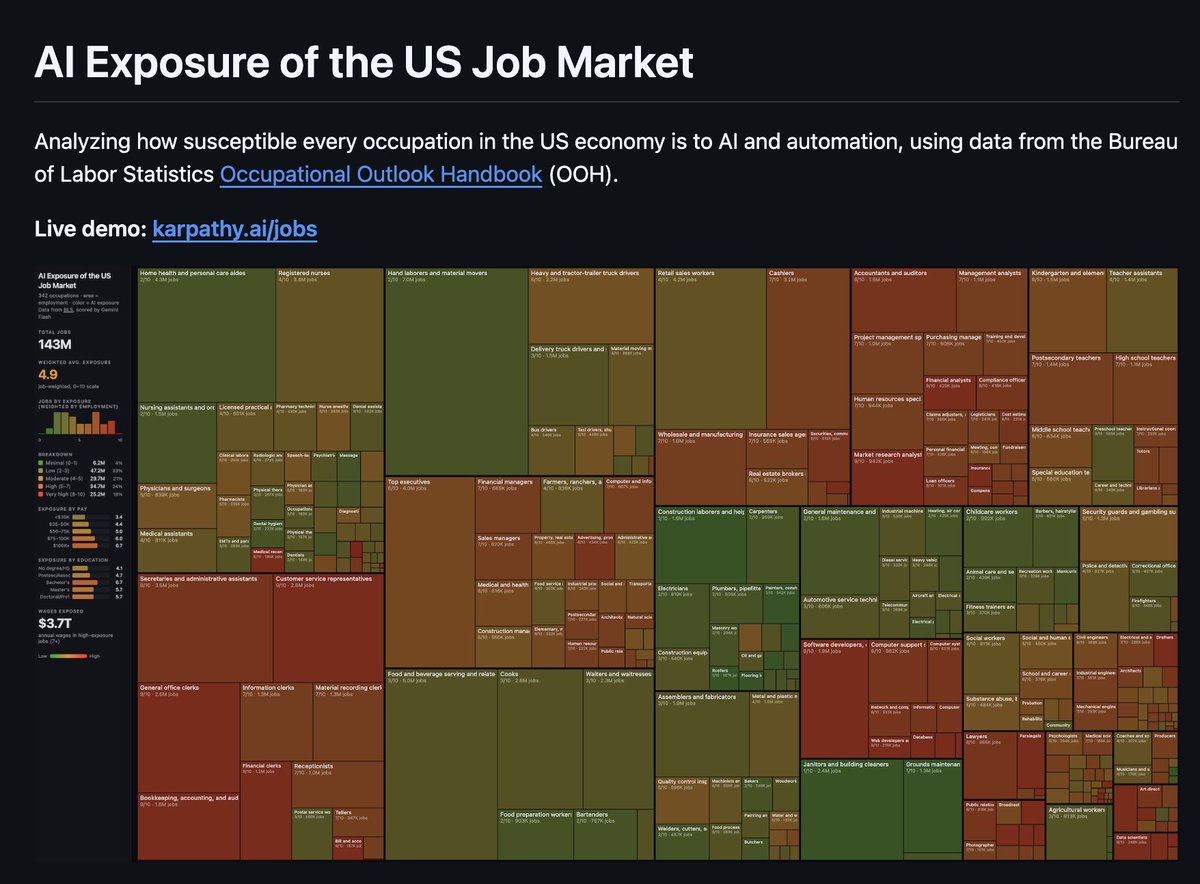
5 minutes ago, @karpathy just dropped karpathy/jobs! he scraped every job in the US economy (342 occupations from BLS), scored each one's AI exposure 0-10 using an LLM, and visualized it as a treemap. if your whole job happens on a screen you're cooked. average score across all jobs is 5.3/10. software devs: 8-9. roofers: 0-1. medical transcriptionists: 10/10 💀 karpathy.ai/jobs
Kaito | 海斗 tweet media
English
976
1.8K
12.2K
3.5M
Deepgram
Deepgram@DeepgramAI·
Deepgram is officially touching down at #SXSW! We’re thrilled to be a first-time sponsor this year, and we're kicking things off with a bang. Here is where you can find us: Saturday Kickoff @ Kitty Cohen’s: Start your @sxsw right with drinks and networking hosted by Deepgram and @Cloudflare. RSVP here: luma.com/unr114mi Emerging Tech Expo (Booth 405): Head over to the Fairmont to see the latest in Voice AI. We’ll be running live demos and giving away some seriously cool prizes all week! Whether you’re a developer, a founder, or just here for the BBQ and tech, come say hi to the team at SXSW! #SXSW2026 #VoiceAI
Deepgram tweet media
English
3
0
3
266
Shreyas Raj
Shreyas Raj@TopR9595·
@futurepedia_io 16 releases in one week and i'm still using the same 3 tools i found in january 💀
English
0
0
0
8
Futurepedia - Learn to Leverage AI
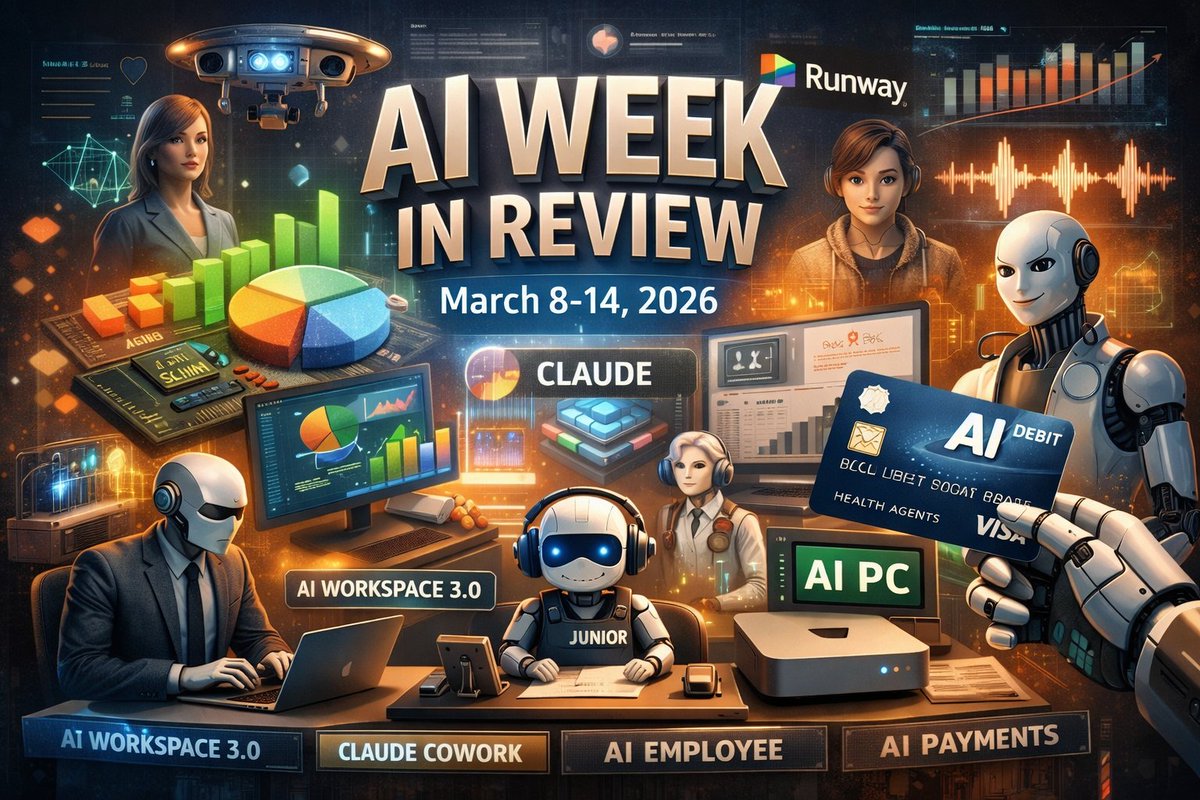
🚨16 major AI releases just dropped this week. We just got: • AI employees • AI with debit cards • AI agent computers • interactive AI visualizations • open-source voice models The AI “coworker era” is starting. Here are the biggest AI tools & updates from Mar 8–14, 2026 🧵
Futurepedia - Learn to Leverage AI tweet media
English
4
1
2
410