
Ohlac
104 posts




Ohlac retweetledi

My first interview with @sama, Co-Founder of @OpenAI.
0:04 How to start a startup
3:30 Trusting exponentials
4:57 Operating in chaotic environments
6:12 Learning to enjoy painful experiences
8:03 Creating abundant intelligence
11:15 Keeping core suppliers on OpenAI’s timelines
12:10 Invention of the joint-stock company
15:30 The best CEOs aren’t sociopaths
16:46 We are in the singularity
18:09 AI authoritarianism vs liberty
19:24 Texting 300-400 people a day
20:32 Having a small number of deep beliefs about the future
21:41 Critical path
22:25 Thinking about what’s next
23:38 Getting on planes in marginal situations
28:16 Buying lots of compute
30:51 Ambition
34:00 Google shouldn’t have let OpenAI survive
37:54 Having his life shot through a cannon after the launch of ChatGPT
41:20 The growth of Codex
42:02 The Death Star tweet
44:46 Status games and desire to be useful
47:57 Not being ambitious enough on compute investments
50:26 Execution
51:45 Ask for what you want
54:11 First few weeks of OpenAI
55:15 Shutting down Sora to focus on Codex
57:44 Designing beautiful products
59:01 Getting addicted to TikTok
1:01:03 Inventing a new device
1:02:53 Try to get better at your strengths
1:05:57 Masa is an n of 1
1:07:11 Real trends vs fake trends
English
Ohlac retweetledi

Ohlac retweetledi

Ohlac retweetledi

There's something missing from the open vs. closed models debate that has been bothering me.
The better analogy, to me, is managed vs. self-hosted infrastructure for AI.
Maybe a company wants to use an open weight model because they want to do additional training on top, bringing their data and domain knowledge.
This requires software and services to do additional training (e.g. Tinker and friends) as well as to serve the model (e.g. SGLang). Not all of this software is open source today!
Once you have successfully trained a model with your enterprise data and expertise, you now need to deploy and serve it for customers. You can partner with an inference company to run the software and hardware. But if ownership was your primary concern, you still want to control the hardware and storage, and you now also need to run infra and secure GPU capacity.
There are other valid reasons to be open. In particular, the entire industry benefits when companies training models release data or research about their work. It also allows capitalism and free markets to do their thing, increasing competition and ultimately providing better options for customers. So we should all encourage openness.
The reason I prefer the managed vs. self-hosted infra framing is that we can learn from the past decade of cloud infrastructure. It's important and healthy to have both, and a great self-hosted alternative ultimately pushes the managed versions to innovate.
The decision to run infra then comes down to more standard business reasons: attracting talent, the cost and maintenance of the hardware, and the importance of uptime and reliability to the business.
Many businesses will say, actually, I don't want to staff and run a training and inference team, and I'm happy to pay API pricing for intelligence. And others will do the opposite and invest heavily here. We need both!
As an aside, the capability of open models will reach a point where we need to be very intentional about how they are deployed. But I think this problem is solvable, whether it is sharing research early and weights later, or also open sourcing the safety stack to properly serve the model. I don't have a perfect answer here but I think the ecosystem should figure it out together.
Full disclaimer, I work at a company which has released both open and closed models. There are probably people more knowledgable than myself of the open weights ecosystem. If that's you, curious if you disagree with any of this.
English

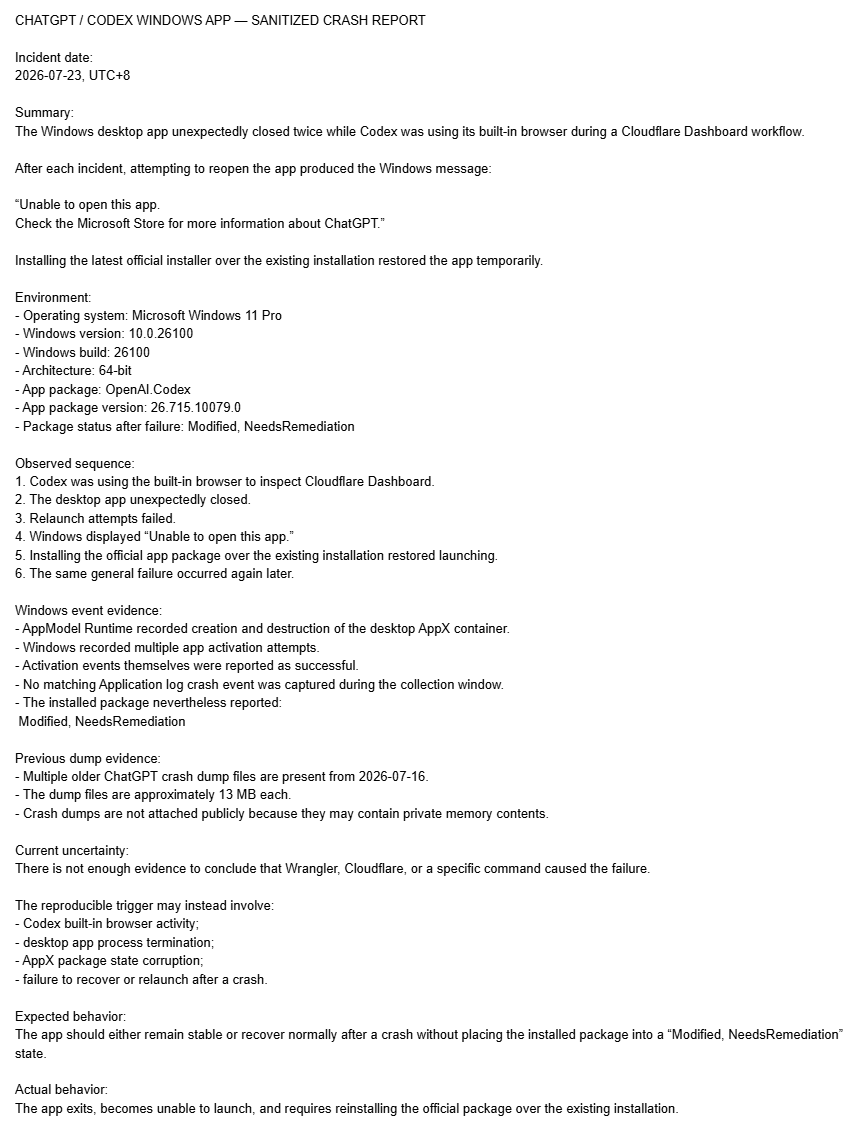
Bug report: ChatGPT for Windows crashed twice while used the built-in browser on Cloudflare Dashboard. After each crash, Windows said “Unable to open this app”; reinstalling restored it. Win11 build 26100, app 26.715.10079.0, package state: NeedsRemediation.@thsottiaux @OpenAI


English

Ohlac retweetledi

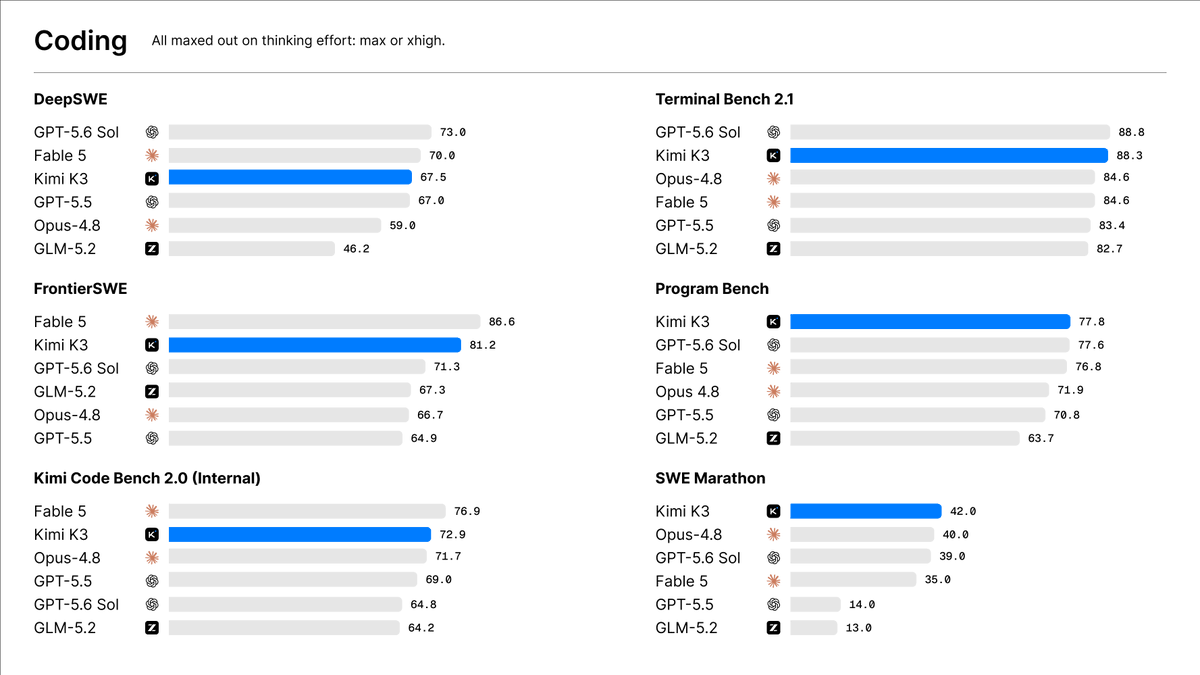
Introducing Kimi K3: Open Frontier Intelligence
🔹 2.8 Trillion Parameters, 1 Million Context, Native Multimodal
🔹 Kimi Delta Attention enables up to 6.3x faster decoding in million-token contexts
🔹 Attention Residuals deliver ~25% higher training efficiency at <2% additional cost
🔹 Built for long-horizon agentic coding and self-evolving workflows
Kimi K3 is now live on on Kimi.com, Kimi Work, Kimi Code, and the Kimi API.
Open Weights by July 27, 2026.
🔗 API: platform.kimi.ai
🔗 Tech blog: kimi.com/blog/kimi-k3

English
@thsottiaux I would like OpenAI to address the current performance hiccups with Codex running on Windows
English