ML&DataMining

1.1K posts

ML&DataMining banner
ML&DataMining

ML&DataMining

@UBADataMining

Linkedin Alumni NO oficial. https://t.co/khAzR0y0Mu…

Buenos Aires Katılım Ocak 2023
762 Takip Edilen29 Takipçiler
ML&DataMining retweetledi
rob.
rob.@robiartec·
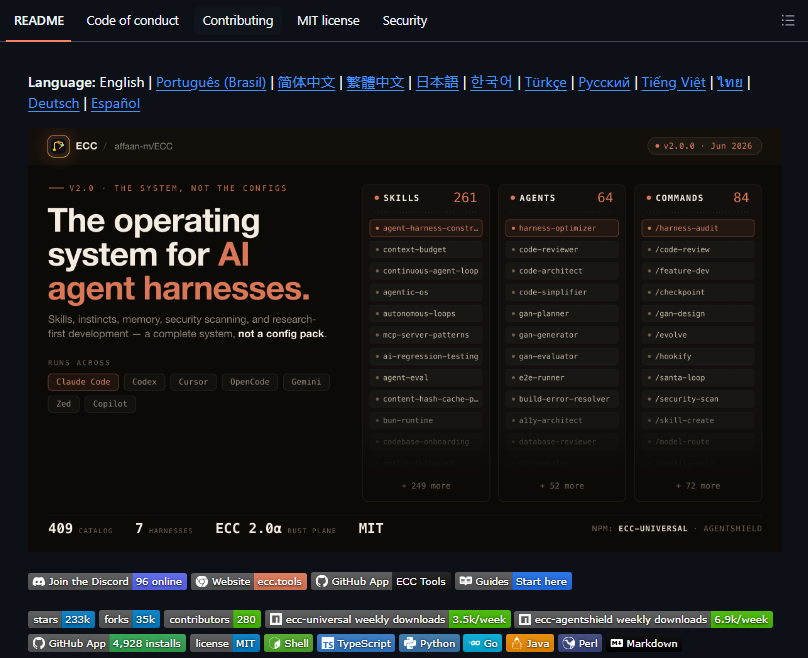
UN DEV GANÓ EL HACKATHON DE ANTHROPIC lo abrió como open source y hoy tiene 229K+ estrellas en GitHub se llama ECC (Everything Claude Code) y básicamente convierte tu IDE en un equipo de desarrollo completo que incluye: > 67 agentes especializados (planificador, arquitecto, revisor de seguridad, debugger…) > 277 skills que cargan solo cuando las necesitas > slash commands para automatizar tu flujo (/plan, /code-review, /quality-gate) > AgentShield: 1,282 tests de seguridad sobre CLAUDE. md, configs MCP, hooks y skills > pipeline de red-team con 3 agentes Opus 4.6 (Attacker, Defender, Auditor) > sistema de “instincts”: aprendizaje continuo con confidence score entre sesiones > soporte para 12 ecosistemas de lenguajes y ya no es solo para Claude Code: funciona en Cursor, Codex, OpenCode, Gemini, Zed y GitHub Copilot esto es lo que pasa cuando dejas de tratar tu IDE como un chatbot y empiezas a tratarlo como infraestructura te dejo el repoo abajo👇🏼
rob. tweet media
Español
24
23
264
6.1K
ML&DataMining
ML&DataMining@UBADataMining·
@ggukthewrld @theepicmap Debe ser por eso, uruguayo de mierda que vivis del turismo argentino! Estamos hartos de los porteros yoruguas, todos ladrones!
Español
0
0
1
171
ML&DataMining retweetledi
Claude
Claude@claudeai·
Introducing Claude Opus 5. It's a thoughtful and proactive model that comes close to the frontier intelligence of Fable 5 at half the price.
English
3.2K
7.5K
61.1K
22.3M
ML&DataMining retweetledi
The Rabbit Hole
The Rabbit Hole@TheRabbitHole·
The term far right has become so broadly applied that it includes normal people now.
The Rabbit Hole tweet media
English
571
2.1K
12.8K
8.4M
ML&DataMining retweetledi
Facu
Facu@facufariaok·
Estos son todos los "famosos" que se sumaron a la campaña “anti-Argentina”. Me olvido de alguien? 🧐
Facu tweet media
Español
926
887
3.5K
172.4K
ML&DataMining retweetledi
Tom Yeh
Tom Yeh@ProfTomYeh·
Backpropagation by hand ✍️ ~ 11 steps walkthrough below Backpropagation is the algorithm that actually trains a neural network, and it is where most people stop following along. It is not calculus you cannot do. It is matrix multiplication, working backward, one layer at a time. So I drew and calculated one entirely by hand. Goal: push the loss gradient back through a 3-layer network and land on a new value for every weight and bias. = 1. Given = A 3-layer perceptron, an input X, predictions Ypred = [0.5, 0.5, 0], and the truth Ytarget = [0, 1, 0]. = 2. Backprop gradient cells = Let us draw empty cells for every gradient we are about to compute. The shape of the answer comes first. = 3. Layer 3 softmax = We get dL/dz3 straight from Ypred minus Ytarget = [0.5, -0.5, 0]. No chain rule needed, and that shortcut is the whole reason softmax and cross-entropy are paired. = 4. Layer 3 weights and biases = Let us multiply dL/dz3 by [a2 | 1]. One multiplication gives the gradient for W3 and b3 together. = 5. Layer 2 activations = We multiply dL/dz3 by W3 to get dL/da2. The gradient moves back across a layer the same way the signal moved forward. = 6. Layer 2 ReLU = Let us pass it through the gate: keep the gradient where the activation was positive, zero it everywhere else. = 7. Layer 2 weights and biases = We multiply dL/dz2 by [a1 | 1]. The same figure as step 4, one layer up. = 8. Layer 1 activations = Let us multiply dL/dz2 by W2. = 9. Layer 1 ReLU = We apply the same gate again, now on a1. = 10. Layer 1 weights and biases = Let us multiply dL/dz1 by [x | 1], and every weight in the network now has a gradient. = 11. Update = We subtract, and the network has learned. In practice a learning rate scales this step. The gradients: dL/dz3 = [0.5, -0.5, 0] dL/da1 = [1, -2, 2, -1] dL/dz1 = [0, -2, 2, -1] The takeaway: matrix multiplication is all you need. Just like the forward pass, backpropagation is matrix multiplications end to end. You can do every one by hand, slowly and imperfectly, which is exactly why a GPU's ability to do them fast mattered so much to deep learning. 💾 Save this post!
English
193
759
4.2K
946.3K
Jun Song
Jun Song@jun_song·
Best AI models by use cases (7/18) : Frontend : Kimi-K3 Backend : Fable Debug : GPT-5.6-SOL Image gen : GPT Translation: Gemini-3.5-Flash Search : Grok-4.5 Video gen : Seedance 2.0 Best price : Deepseek V4 Pro Local AI (Large) : GLM-5.2 Local AI (Small, 128gb) : HY-3, DSV4 Flash Use models accordingly
English
137
362
2.7K
145.6K
ML&DataMining
ML&DataMining@UBADataMining·
@jun_song Finally a good a precise view of the landscape. Agree 100% in every single rol.
English
0
0
0
54
Alejandro Vidal
Alejandro Vidal@dobleio·
Con Fable ya no hace falta revisar ni una línea de código. Centraros en los diseños y dejad el resto a la IA.
Español
12
2
37
14.5K
ML&DataMining
ML&DataMining@UBADataMining·
@DotCSV No el modelo es tan poderoso, ni cualquier empresa puede ejecutarlo al modelo full. Los que funcionan con GPUs caras, son modelos de menor capacidad. No vendan humo!!! Ah! Y los modelos frontera no se los evalúa poniéndoles que hagan jueguitos o páginas web.
Español
6
0
3
1.9K
Carlos Santana
Carlos Santana@DotCSV·
Es loco pensar que aunque EE.UU. o cualquier otro país u organización quisiera cortar el acceso a sus IAs más avanzadas, cuando los pesos de Kimi K3 se liberen, cualquier país u organización podrá tener IA agéntica desplegada sin mayor problema.
Español
52
118
1.7K
82K
williana joanna
williana joanna@JoannaWilliana·
Same scene. Same visual target. Two very different results. Claude Fable 5 delivers a smoother fabric to tiger transformation. GPT 5.6 creates stronger texture and heavier detail but the transition feels less controlled. Generated with Dreamina Seedance 2.0. Which result wins? #AIVideo #Seedance #GenerativeAI #GPT56 #ClaudeAI
English
8
3
25
8.3K
ML&DataMining
ML&DataMining@UBADataMining·
@clariateka Más resentida no se consigue. Si vales tanto, pon tu propia empresa.
Español
1
0
1
938
Eva Galán
Eva Galán@clariateka·
Cuando tu jefe te dice: "Estamos todos en el mismo barco"
Español
586
28.1K
298.4K
12.8M
ML&DataMining retweetledi
Joshua Khane
Joshua Khane@JoshuaKhane·
Microsoft DELETED my account AND OneDrive!!?? After ACKNOWLEDGING that I’m the owner of the account and that it was compromised??? 25 fucking years of data, thousands of euros spended on games?? My son’s baby pictures? GONE! All because MICROSOFT couldn’t bring back a compromised account?? One of the biggest companies ever coulnd’t do that so they just deleted that shit like it was nothing?? Fucking shame on you!! @microsoftnl @MicrosoftHelps @MicrosoftHelpt @Microsoft #microsoft #hacked
Joshua Khane tweet media
English
4.7K
9.8K
81.9K
5.8M
ML&DataMining retweetledi
Akshay 🚀
Akshay 🚀@akshay_pachaar·
the four types of agent loops. loop engineering keeps getting talked about as one thing. it's actually a choice between four structures, and each one fits a different kind of task. it means designing the system that steers the agent, instead of steering it yourself move by move. that system always answers two questions. what starts a run, and what decides the work is done. in a hand-run session you answer both yourself, every single time. each loop type moves more of that into the system. here's each type, what triggers it, and when to reach for it. 1) turn-based. triggered by a user prompt. the agent gathers context, acts, and checks its work inside a single turn, then a human reviews the output and writes the next prompt. use this when requirements are still forming and every output changes what you'd ask for next. 2) goal-based. triggered by a /goal command carrying success criteria and a budget, like "get the homepage Lighthouse score to 90, stop after 5 tries." when the agent tries to stop, an evaluator model checks whether the goal is met, and a no sends it back to work. use this when the outcome is measurable but the path there isn't worth your attention. 3) time-based. triggered by a clock. an interval fires, the agent runs a fixed prompt like "check the PR, fix CI," then waits for the next tick. /loop runs on your machine, /schedule moves it to the cloud so it survives a closed laptop. use this for recurring work where the task is known in advance and only the timing repeats. 4) proactive. triggered by an event or schedule with no human present. a routine watches a channel, and when something needs handling it spawns a workflow with a triage agent, a fix agent, and a reviewer that adversarially judges the work before the task closes. use this for standing responsibilities where you can't predict what will come in, only that something will. each type hands off one more job than the last. turn-based keeps both with the human, goal-based automates the checking, time-based automates the trigger, and proactive automates both while deciding the workflow shape at runtime. so the mapping question isn't which loop is most advanced. it's whether your task is exploratory, measurable, recurring, or standing. the more you hand off, the less you babysit. I wrote the full breakdown on loop engineering. the article is quoted below.
GIF
Akshay 🚀@akshay_pachaar

x.com/i/article/2069…

English
78
779
3.8K
494.4K
Abhishek
Abhishek@HeyAbhishek·
Another comparison round. GPT-5.6 Sol vs. Fable 5 directing the same dinosaur animation with Seedance 2.0 on Vidfield.
English
29
25
259
92K