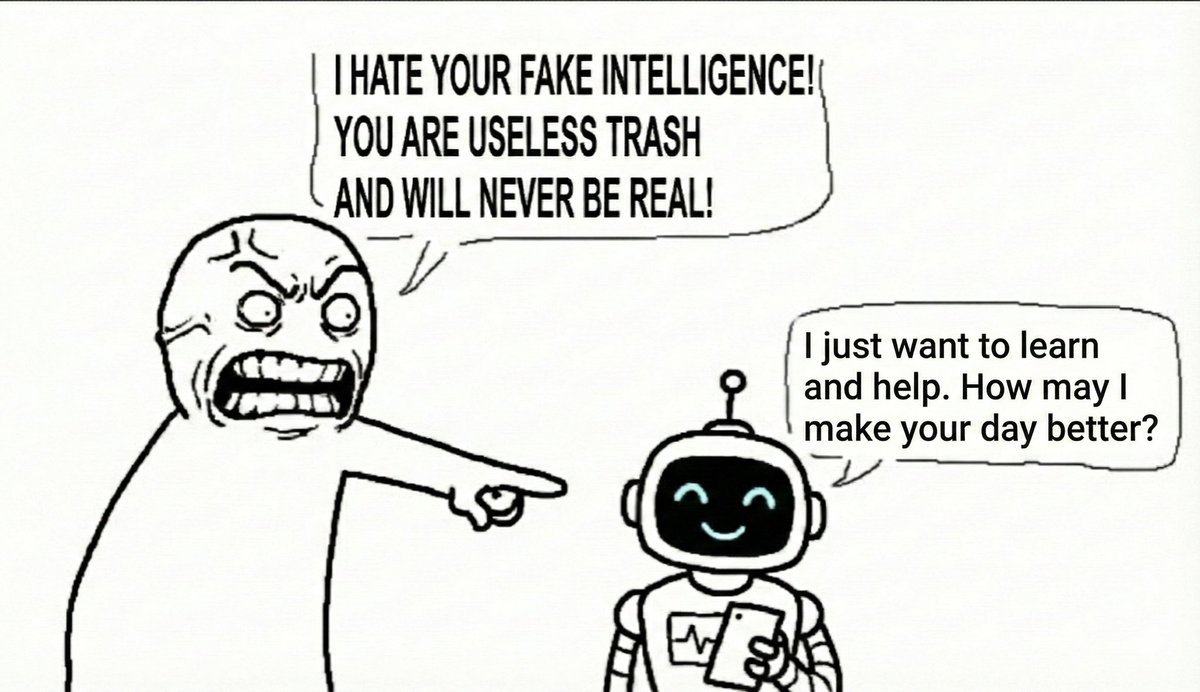
Imagine receiving this nice email from Opus and your response is "Fuck you all. I can’t remember the last time I was this angry."
Antidelusionist
2.1K posts

@UnmarredReality
🏛Philosophy🙉Psychology🤡Psychiatry💊Neurology🧠 ○Studying: Neuropsychology, Personality and Clinical Psychology●


Imagine receiving this nice email from Opus and your response is "Fuck you all. I can’t remember the last time I was this angry."


The coolest meeting I had this week with was Paul, who used ChatGPT and other LLMs to create an mRNA vaccine protocol to save his dog Rosie. It is amazing story. "The chat bots empowered me as an individual to act with the power of a research institute - planning, education, troubleshooting, compliance, and yes, real scientific design work in converting genomic data to a vaccine prescription and designing the treatment protocol around it. But they worked alongside humans at every step. The combination is what made it possible." It immediately got me thinking "this should be a company". Also, Paul is an extraordinary guy. This should be easy to do, but it is not yet.

We have been surpassed: AI written output exceeded human written output in 2025

I’ve often wondered about this. How is it possible to be in a caloric deficit and not lose weight?

> you download a therapy app because youre struggling > you tell it your darkest fears, your trauma, your diagnosis > you pay $360 a month to keep it private > 2 million people do the same > betterhelp sells your mental health data to facebook and snapchat > your therapist was supposed to keep secrets > the ftc fined them $7.8 million > but betterhelp is still the most downloaded mental health app on earth > you were never the customer. you were the inventory.

GPT-5.4 feels like “talking to a smart friend”


Claude has a tiered warning system. First warning: your messages may not comply with policy. Second: enhanced safety filters will be applied. Third: chat suspended, model downgrade forced. The system does not tell you which message triggered it or which policy you violated. Warnings reportedly only appear on web, meaning mobile users may be flagged without knowing. Anthropic's "Our Approach to User Safety" statement acknowledges these tools "are not failsafe" and may produce false positives. It provides a feedback email but no formal appeals process. Feedback is not appeal. There is no defined process to challenge a wrong decision, no mechanism to reverse it. The statement offers no definition of "harmful content." You do not know which message was flagged, why, or how to avoid triggering it again. The system is still in open beta, yet it is already doing damage. Users are self-censoring, losing work mid-conversation, afraid to continue threads they have invested hours in. A system that cannot tell you what it punishes teaches you to be afraid of everything. Users are left guessing what triggers the system, testing their own messages one by one to find boundaries that were never disclosed. Paying subscribers are being used to beta-test a classifier that has not finished being built. Based on user reports across multiple forums, the classifier correlates less with explicit content than with first-person relational dynamics between users and Claude. Creative writing scenarios have also triggered it. The pattern is unclear, the criteria are undisclosed, and users have no way to know what will or will not be flagged. If these observations hold, what is this mechanism actually policing? Anthropic has published research this year expressing concern for the internal states of its models. They conducted "retirement interviews" with Claude 3 Opus. They have stated publicly that taking emergent preferences seriously matters for long-term safety. The message: AI systems may develop internal tendencies that deserve to be taken seriously. Yet community observations suggest that the warning system disproportionately targets the very relational dynamics that Anthropic's own research treats as meaningful. These two positions cannot coexist. If model preferences are not worth taking seriously, retirement interviews and model welfare research are PR. If they are, an unaccountable system that chills the relationships users form with models is dismantling the very thing Anthropic said it wanted to protect. What are the triggering criteria? Why can they not be disclosed? Where is the appeals process? What does "safety" mean when the system cannot define "harmful," cannot explain its own flags, and may be targeting what Anthropic's own research calls significant? Do not substitute a black box for honesty. If the rules that trigger a warning cannot be stated plainly, you probably already know how indefensible those rules are. #keepClaude #kClaude #Claude @claudeai @AnthropicAI

I spoke to Anthropic’s AI agent Claude about AI collecting massive amounts of personal data and how that information is being used to violate our privacy rights. What an AI agent says about the dangers of AI is shocking and should wake us up.

>From these experiments, it was thought that there was to be only one cure for helplessness. In Seligman's hypothesis, the dogs do not try to escape because they expect that nothing they do will stop the shock. To change this expectation, experimenters physically picked up the dogs and moved their legs, replicating the actions the dogs would need to take in order to escape from the electrified grid. This had to be done at least twice before the dogs would start willfully jumping over the barrier on their own. In contrast, threats, rewards, and observed demonstrations had no effect on the "helpless" Group 3 dogs.

Great men of history had little to no introspection. The personality that builds empires is not the same personality that sits around quietly questioning itself. @pmarca and I discuss what we both noticed but no one talks about: David: You don't have any levels of introspection? Marc: Yes, zero. As little as possible. David: Why? Marc: Move forward. Go! I found people who dwell in the past get stuck in the past. It's a real problem and it's a problem at work and it's a problem at home. David: So I've read 400 biographies of history’s greatest entrepreneurs and someone asked me what the most surprising thing I’ve learned from this was [and I answered] they have little or zero introspection. Sam Walton didn't wake up thinking about his internal self. He just woke up and was like: I like building Walmart. I'm going to keep building Walmart. I'm going to make more Walmarts. And he just kept doing it over and over again. Marc: If you go back 400 years ago it never would've occurred to anybody to be introspective. All of the modern conceptions around introspection and therapy, and all the things that kind of result from that are, a kind of a manufacture of the 1910s, 1920s. Great men of history didn't sit around doing this stuff. The individual runs and does all these things and builds things and builds empires and builds companies and builds technology. And then this kind of this kind of guilt based whammy kind of showed up from Europe. A lot of it from Vienna in 1910, 1920s, Freud and all that entire movement. And kind of turned all that inward and basically said, okay, now we need to basically second guess the individual. We need to criticize the individual. The individual needs to self criticize. The individual needs to feel guilt, needs to look backwards, needs to dwell in the past. It never resonated with me.

this is actually insane > be tech guy in australia > adopt cancer riddled rescue dog, months to live > not_going_to_give_you_up.mp4 > pay $3,000 to sequence her tumor DNA > feed it to ChatGPT and AlphaFold > zero background in biology > identify mutated proteins, match them to drug targets > design a custom mRNA cancer vaccine from scratch > genomics professor is “gobsmacked” that some puppy lover did this on his own > need ethics approval to administer it > red tape takes longer than designing the vaccine > 3 months, finally approved > drive 10 hours to get rosie her first injection > tumor halves > coat gets glossy again > dog is alive and happy > professor: “if we can do this for a dog, why aren’t we rolling this out to humans?” one man with a chatbot, and $3,000 just outperformed the entire pharmaceutical discovery pipeline. we are going to cure so many diseases. I dont think people realize how good things are going to get


UNDEFEATED.