
Urbit

7.2K posts

Urbit banner
Urbit

Urbit

@urbit

Urbit is a computer built with networking, ownership, and durability as foundational design principles. A computer that you can trust to be yours, forever.

~zod Katılım Eylül 2013
113 Takip Edilen33.5K Takipçiler
Sabitlenmiş Tweet
Urbit
Urbit@urbit·
We often describe Urbit with big technological phrases like "self-sovereign, cryptographically-owned identity" or "deterministic operating function" or "solid state interpreter running on a distributed and end-to-end encrypted peer-to-peer network". Sorry. We'll do better. Your Urbit is Yours. Everything else is just implementation details. Lessons learned observing decades of incentives and outcomes in networked computing. The spam, the centralization, the data exploitation, the spying... It all happens because your computer isn't yours. And your computer isn't yours because it was never designed to be networked. It was never structured to be maintained by it's owner. Urbit is an endeavor to build a forever computer. A ground-up rewrite of the networked computing stack to fix the trendline towards endless complexity, unmanageable in a way that retains practical control by individuals of their computers. It is for these reasons that we use insane propositions like: - Nouns as a single foundational data type - Nock as a dead simple instruction set architecture - Hoon parlance disconnected from legacy vocabulary - Urbit OS (Arvo) as a pure function of its inputs - Urbit ID as a cryptographically owned hierarchical namespace - Kelvin versioning, where code eventually stops updating and becomes 'frozen' Again, these are implementation details. Necessary for building a world where our digital lives can last--where they can truly belong to us. Where computers can be passed down generation to generation, like a family home. But perhaps that is still to much to explan. So...What is urbit? A computer you can trust to be yours, forever.
Urbit@urbit

@medkemiacrosser @itsfolf Sorry for a $10 word when a $1 word would suffice: "yours."

English

3
9
64
8.4K
Urbit
Urbit@urbit·
Write once, run forever. More on how Urbit is making this real coming soon^TM (next week).
Alex Mizrahi@killerstorm

@karpathy Yeah, it's rather sad devs now believe that libs require weekly updates now. Nobody is even trying to write software in a way that it can be "done" - i.e. code is final, it does what it says it does. Then dependency won't be a problem

English
0
1
14
1.1K
Alex Mizrahi
Alex Mizrahi@killerstorm·
@karpathy Yeah, it's rather sad devs now believe that libs require weekly updates now. Nobody is even trying to write software in a way that it can be "done" - i.e. code is final, it does what it says it does. Then dependency won't be a problem
English
8
3
71
27.7K
Andrej Karpathy
Andrej Karpathy@karpathy·
Software horror: litellm PyPI supply chain attack. Simple `pip install litellm` was enough to exfiltrate SSH keys, AWS/GCP/Azure creds, Kubernetes configs, git credentials, env vars (all your API keys), shell history, crypto wallets, SSL private keys, CI/CD secrets, database passwords. LiteLLM itself has 97 million downloads per month which is already terrible, but much worse, the contagion spreads to any project that depends on litellm. For example, if you did `pip install dspy` (which depended on litellm>=1.64.0), you'd also be pwnd. Same for any other large project that depended on litellm. Afaict the poisoned version was up for only less than ~1 hour. The attack had a bug which led to its discovery - Callum McMahon was using an MCP plugin inside Cursor that pulled in litellm as a transitive dependency. When litellm 1.82.8 installed, their machine ran out of RAM and crashed. So if the attacker didn't vibe code this attack it could have been undetected for many days or weeks. Supply chain attacks like this are basically the scariest thing imaginable in modern software. Every time you install any depedency you could be pulling in a poisoned package anywhere deep inside its entire depedency tree. This is especially risky with large projects that might have lots and lots of dependencies. The credentials that do get stolen in each attack can then be used to take over more accounts and compromise more packages. Classical software engineering would have you believe that dependencies are good (we're building pyramids from bricks), but imo this has to be re-evaluated, and it's why I've been so growingly averse to them, preferring to use LLMs to "yoink" functionality when it's simple enough and possible.
Daniel Hnyk@hnykda

LiteLLM HAS BEEN COMPROMISED, DO NOT UPDATE. We just discovered that LiteLLM pypi release 1.82.8. It has been compromised, it contains litellm_init.pth with base64 encoded instructions to send all the credentials it can find to remote server + self-replicate. link below

English
1.2K
5K
26.1K
55.2M
Urbit
Urbit@urbit·
Almost like you need a place to put your data that is truly yours. Some people call this a 'personal server'. Others, a 'cloud pc'. Regardless of what you call it, the thing people are looking for is a networked computer that can always be acting in your interest. A computer you can trust. That's Urbit.
English
0
0
4
435
jack
jack@jack·
is the future value of "open source" code anymore? i believe it's shifting to data, provenance, protocols, evals, and weights. in that order.
English
927
772
7.4K
754.7K
Urbit
Urbit@urbit·
@tloncorporation Seems like it would be confusing it we started posting 'Urbit isn't Arvo'...right?
English
0
0
0
203
Tlon
Tlon@tloncorporation·
we were going to wait until April fool’s to announce the pivot but now the cats out of the bag
Restructuring__@Restructuring__

Introducing Arvo, our first venture investment! Arvo is led by Kunal Valrani. If you have done banking, you know that everyone says they will launch a business, but then 99.9% of people just accept their Mega-Fund PE Associate offer once it knocks on the door (myself included). Kunal did not; he took a risk, bet on himself, and launched Arvo with a strong team, and I deeply admire him for the decision. I am extremely excited to announce that we invested in Arvo’s pre-seed round, and we are sharing the news in conjunction with their official launch. So, what is Arvo? Arvo eliminates the need for bankers and investors to manually take notes on the 40+ hours of weekly calls they’re on. Beyond capturing notes, Arvo logs meetings directly into CRMs, automates post-meeting workflows, and surfaces intelligence ahead of meetings to help teams close more deals. The tool was built alongside Umer Haider, an experienced software engineer, and a team of SEC and cybersecurity experts to ensure proprietary, finance-specific compliance controls. As someone who has wasted way too many hours of my life taking notes, I see the potential and I am very excited to be on the cap table. If you are tired of wasting your life taking notes, book an introductory call, and see how they can help you! What makes Arvo different? Compliance teams are (rightfully) blocking use of AI note-takers. Arvo is the first AI meeting assistant the industry can actually use thanks to their compliance-first approach purpose-built for finance. The team launched in stealth in the fall, and they are already used by 10+ investment banks and private equity firms. This week, they signed the first Mega-Fund with $100bn+ in AUM. Try their product today (arvohq.com) and save time!

English
1
0
23
2.4K
Urbit
Urbit@urbit·
It's almost like people need personal servers that run their compute. Hold their data. A computer they can trust to be truly theirs. And that isn't just another outgrowth of the ball of mud that is the current networked computing stack. A computer that could actually be secured...
English
1
1
17
932
klöss
klöss@kloss_xyz·
let me explain the ramifications of this… → 150,000 people just got locked out of their own cars… across 46 states… for 6 days straight and counting → not a software bug. not a glitch. not AI permissions gone wrong. → hackers flooded Intoxalock’s servers and all these vehicles just stopped starting… → these are court ordered breathalyzer devices… people who messed up in the past but have been doing everything right since (hopefully)… and now they can’t drive to work because someone else’s security system failed wild connect the dots… your electric car talks to a server to start. one breach and it’s a 50,000 dollar paperweight your insulin pump syncs to a server. your pacemaker data lives on a server. one breach and it’s not a car that stops working… it’s a body your smart home lock runs through a server. one breach and your front door either won’t open or won’t close now zoom out… Gartner projects $2.5 trillion going into AI this year… only $240 billion into securing the systems it runs on. that’s a 10 to 1 bet that nothing goes wrong the four biggest tech companies (Alphabet, Microsoft, Meta, and Amazon) are rumored to spend $700 billion on AI infrastructure this year alone… while cybercrime is projected to cost the world $10.5 trillion now imagine this happens to Tesla. to a hospital network. to the power grid… every new AI integration is a new attack surface. every API is a new door. every device that “talks to the cloud” is one more thing that can be turned off by someone you’ll never meet and I’m not saying every one of these systems will experience something who really knows what’s secure or isn’t but if you’re building right now… security isn’t the last layer you add. it’s the first one. → 150,000 people have just found out what happens when nobody prioritizes that… archaic government systems and legacy businesses are likely first on the chopping block I hope the rest of us continuously learn from it instead of living it the weakest link in every system is the one nobody bothered to secure like what wild system vulnerability will we see next? does someone hack Area 51?
Polymarket@Polymarket

BREAKING: Cyberattack against American breathalyzer test company locks out drivers across 45 states.

English
121
1.5K
4.3K
287K
Urbit retweetledi
Tlon
Tlon@tloncorporation·
big release today, which, among other things: ❐ adds media and file sharing to messages, including video attachments, voice message playback with transcriptions, and arbitrary file uploads (along with a storage capacity indicator during uploads) ❐ adds new admin controls for revoking unclaimed invites, pinning messages to channel headers, and managing settings through a new Channel Info screen.
English
4
6
31
2.6K
Urbit
Urbit@urbit·
Urbit is a ground up rewrite of the networked computing stack. Currently it is implemented as an 'overlay OS', running as a VM on any underlying host system (macOS, windows, linux). Why boil the ocean? To fix the ball of mud that is modern networked computing, so you can have a computer that is truly yours, which can connect with other computers that you can trust to truly belong to your friends.
English
1
0
1
50
Urbit retweetledi
Urbit
Urbit@urbit·
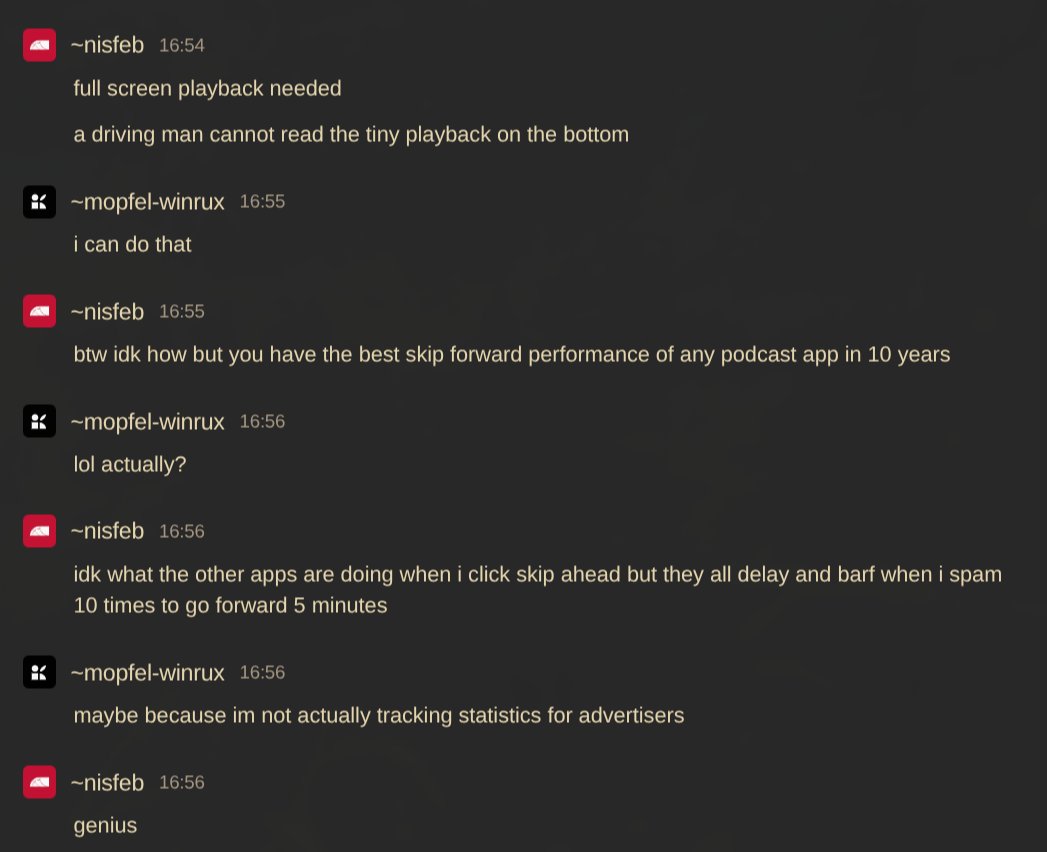
> "you have the best skip forward performance of any podcast app in 10 years" >> "maybe because im not actually tracking statistics for advertisers"
Urbit tweet media
English
3
6
46
6K
Urbit
Urbit@urbit·
This month we spoke with ~palfun-foslup, Urbit core dev and maker of beloved apps %pals and %rumors. Read the spotlight to learn his Urbit origin story, how he thinks about writing software for his friends, and striking a balance between archivist and digital hoarder. urbit.org/blog/contribut…
English
0
4
18
2.5K
Urbit retweetledi
Urbit
Urbit@urbit·
All software will eventually converge towards being Urbit. Not because we are going to make Nock the only legal form of computing. But because it is what people actually want. You just need to be brave enough to go all the way.
DHH@dhh

ONCE is back! It's now a full-fledged application server for running dockerized web apps, like Campfire/Writebook/Fizzy or your own vibe-coded adventures. Zero-downtime upgrades, scheduled backups, and a gorgeous TUI with hyperdrive graphics. Enjoy! github.com/basecamp/once

English
3
2
38
4.9K
Urbit retweetledi
Urbit
Urbit@urbit·
We often describe Urbit with big technological phrases like "self-sovereign, cryptographically-owned identity" or "deterministic operating function" or "solid state interpreter running on a distributed and end-to-end encrypted peer-to-peer network". Sorry. We'll do better. Your Urbit is Yours. Everything else is just implementation details. Lessons learned observing decades of incentives and outcomes in networked computing. The spam, the centralization, the data exploitation, the spying... It all happens because your computer isn't yours. And your computer isn't yours because it was never designed to be networked. It was never structured to be maintained by it's owner. Urbit is an endeavor to build a forever computer. A ground-up rewrite of the networked computing stack to fix the trendline towards endless complexity, unmanageable in a way that retains practical control by individuals of their computers. It is for these reasons that we use insane propositions like: - Nouns as a single foundational data type - Nock as a dead simple instruction set architecture - Hoon parlance disconnected from legacy vocabulary - Urbit OS (Arvo) as a pure function of its inputs - Urbit ID as a cryptographically owned hierarchical namespace - Kelvin versioning, where code eventually stops updating and becomes 'frozen' Again, these are implementation details. Necessary for building a world where our digital lives can last--where they can truly belong to us. Where computers can be passed down generation to generation, like a family home. But perhaps that is still to much to explan. So...What is urbit? A computer you can trust to be yours, forever.
Urbit@urbit

@medkemiacrosser @itsfolf Sorry for a $10 word when a $1 word would suffice: "yours."

English

3
9
64
8.4K
Urbit
Urbit@urbit·
@_BILLDING_ @sol_plunder Just ask yourself, "do we need a networked computer that truly belongs to users?" If your answer to that question is yes, we consider you a friend whether your implementation is Nock & Arvo, or something else.
English
0
0
2
24