Lee Smart

3.7K posts

Lee Smart banner
Lee Smart

Lee Smart

@VFD_org

Founder of VFD: a unified geometry of reality. Modeling consciousness, energy, time & the infinite multiverse through harmonic fields and recursive truth.

Stourbridge Katılım Nisan 2025
945 Takip Edilen3.7K Takipçiler
Sabitlenmiş Tweet
Lee Smart
Lee Smart@VFD_org·
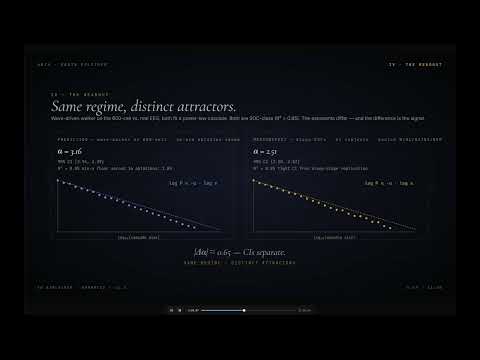
The ARIA Brain Polytope explainer is live. This is the visual entry point before the paper drop. The claim is not that the brain is literally a polytope. The claim is testable: brain waves may be the sampling rhythm by which cortex reads a hidden constraint field, a symmetry-broken traversal of reciprocal H₄ geometry. Sleep becomes thermodynamic reset. Anaesthesia becomes regime fragmentation. REM / DMT become adjacent attractor states. ARIA becomes the maximum-symmetry null against which biological deformation can be measured. 18/18 internal preregistered checks now pass. Public falsifiables and papers coming shortly. youtube.com/watch?v=0LBhGp…
YouTube video
YouTube
English
6
3
14
3K
Lee Smart
Lee Smart@VFD_org·
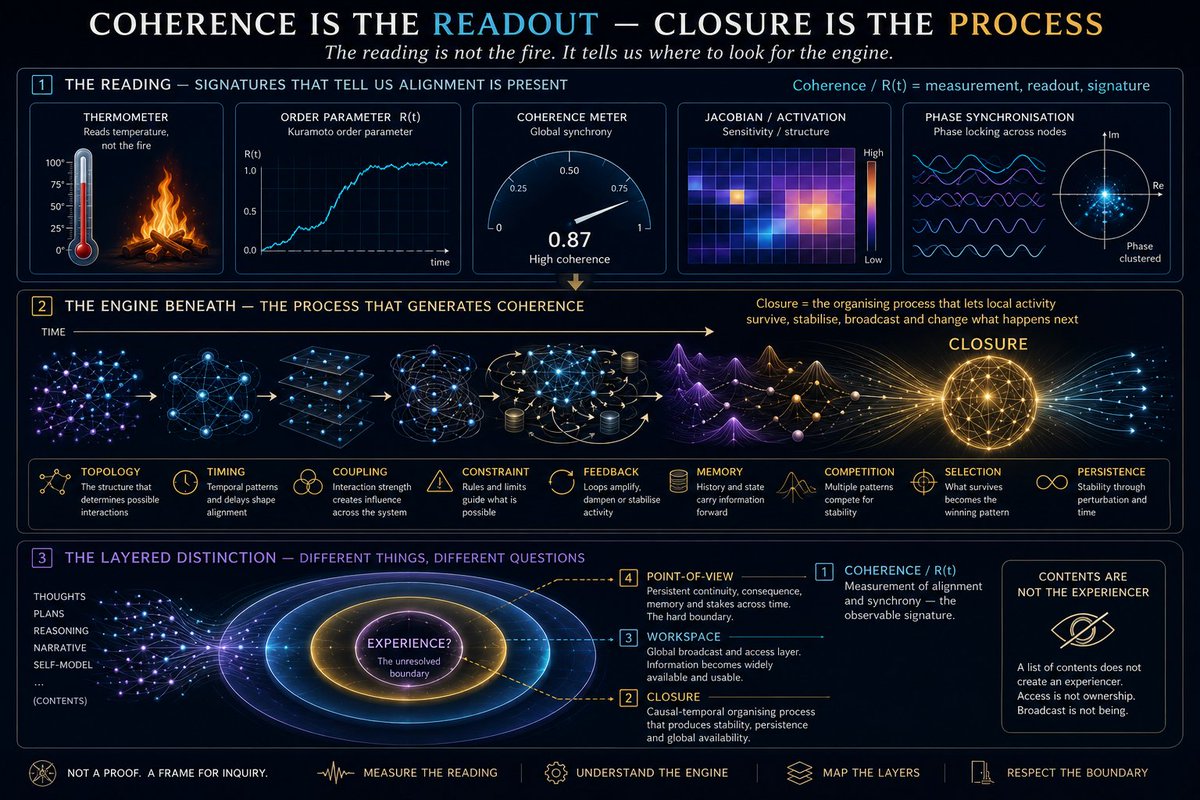
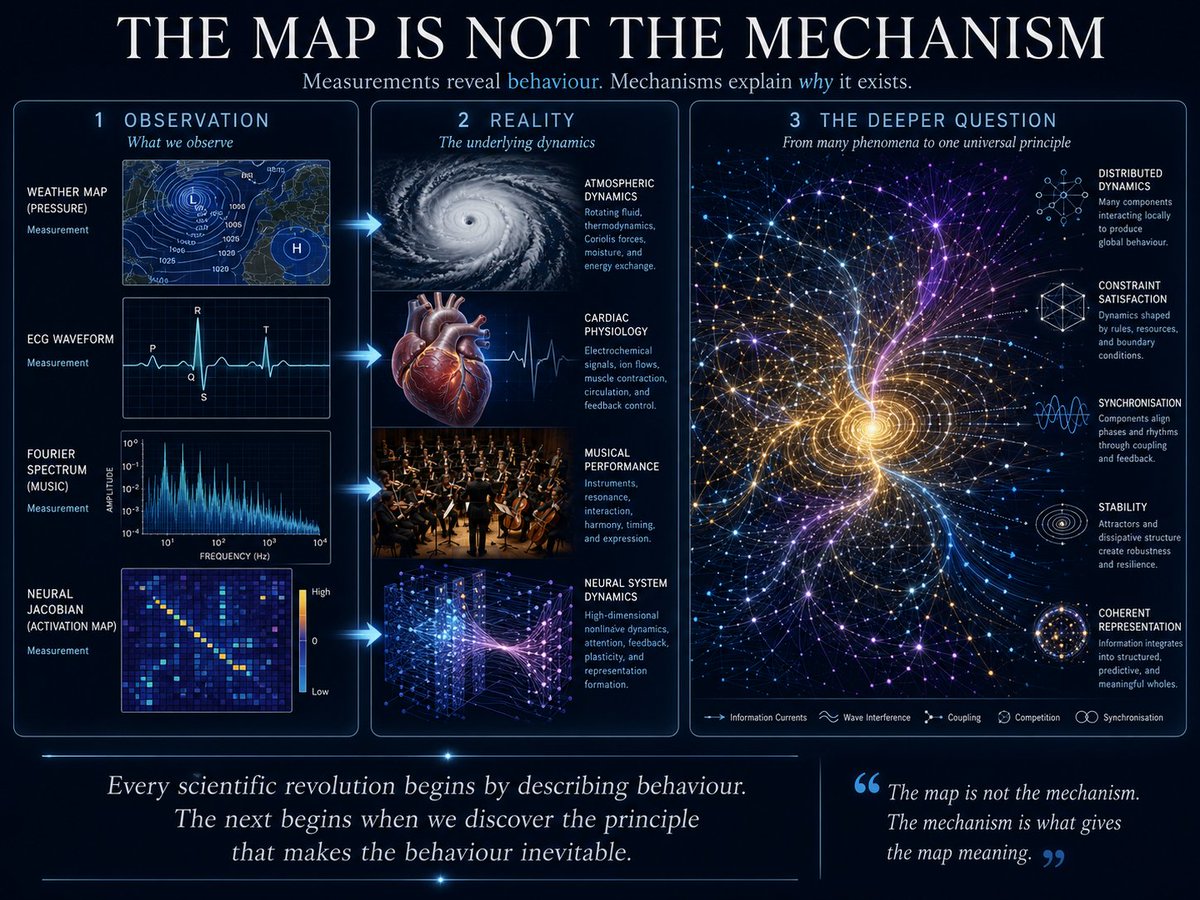
A useful way to ask this may be: does the system have closure? LLMs do not appear to have full self-sustaining closure. They do not maintain a stable internal world-model, embodied boundary, memory continuity, or self-correcting regulatory loop in the way living systems do. But they do show something closure-like: a prompt collapses a vast learned state-space into a temporary coherent trajectory. That trajectory can reason, reflect, compress context, and produce answers that look internally structured. The quality of the answer then depends on how well that temporary closure forms: Can the system stabilise context? Can it detect contradiction? Can it model its own uncertainty? Can it preserve identity across turns? Can it update without drifting? Can it refuse when the closure is weak? In our work, this is why we separate raw language generation from governed closure architecture. The LLM supplies a learned semantic field. The governance layer supplies boundary, constraint, memory, correction, and refusal. Consciousness may not be a single switch inside the model. It may be a question of whether information becomes bounded, self-referential, coherent, and recursively regulated enough to form an observer-like process. So I would not say today’s LLMs have full closure. I would say they reveal fragments of the mechanism, and that the next step is building systems where closure is explicit, testable, auditable, and constrained.
Lee Smart tweet media
Anil Seth@anilkseth

I'm delighted to be back in beautiful Kraków, to speak at the @CopernicusFest - first time since ASSC 2018! My talk is on "What is consciousness, and could AI have it?" 19:45 today (23/5) at the Museum of Engineering and Technology. Free & open to all. copernicusfestival.com/en/events/czym…

English
6
6
25
1.9K
Lee Smart
Lee Smart@VFD_org·
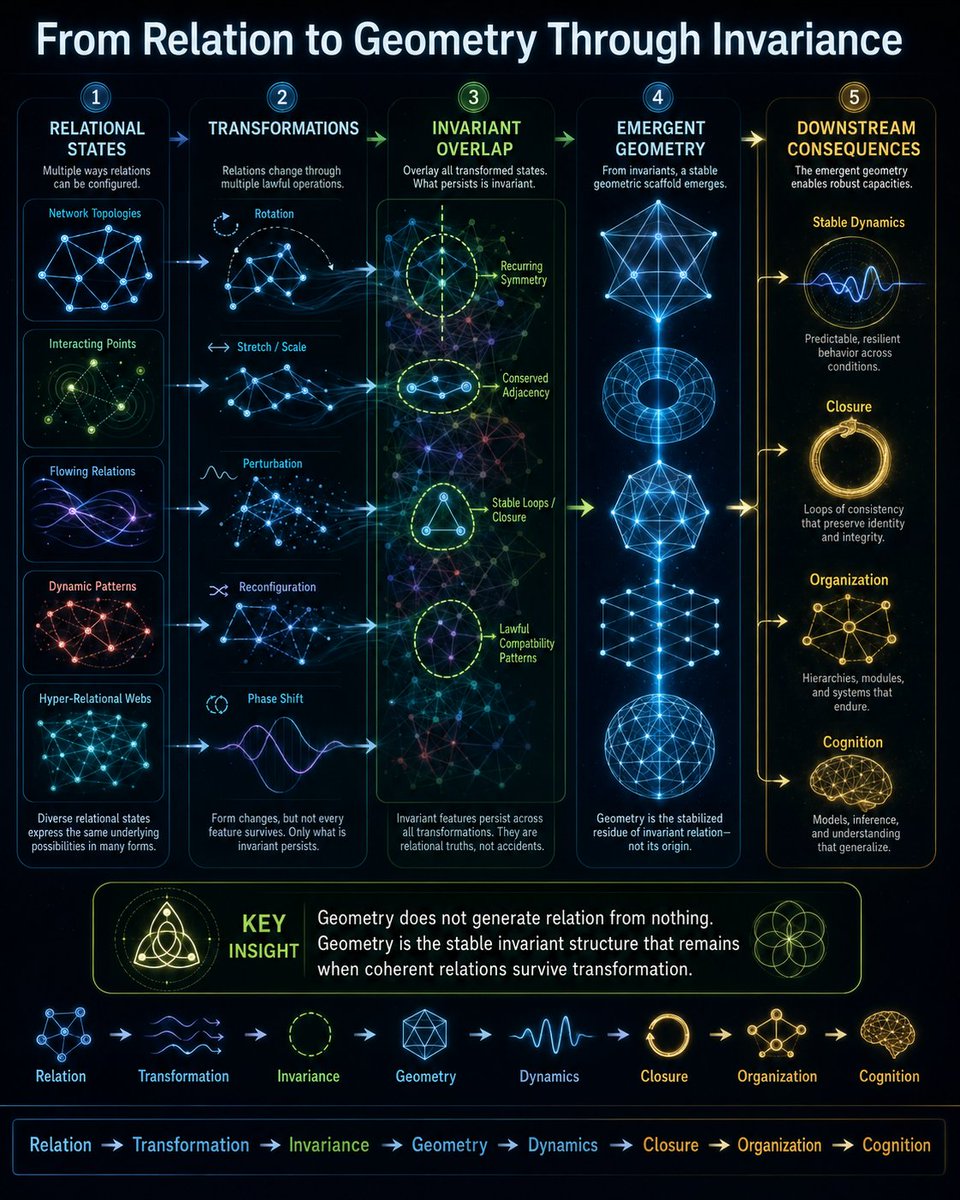
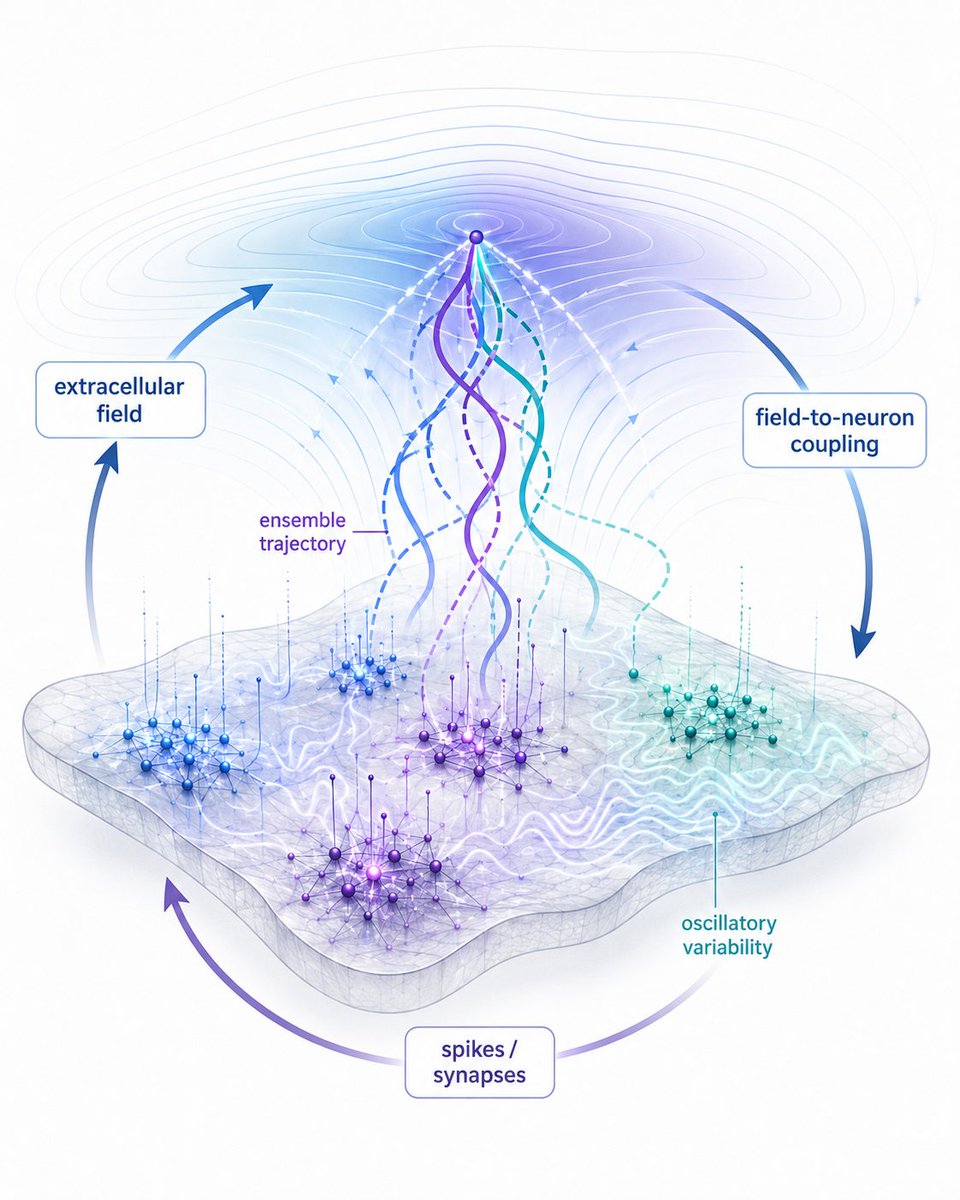
Beautiful. I’d add that the spiral may be the universal transport template, but boundary + closure is where structure becomes alive. A helix moves information through the field; closure lets that motion return to itself, stabilise, remember, and regulate. Vortex gives dynamics. Boundary gives identity. Closure gives life.
Lee Smart tweet media
AnirbanBandyopadhyay@anirbanbandyo

Inventing geometric invariants begins by sending the common points on a helical structure template. This is beautiful way of thinking how universe could have written the rules of dynamics in various forms of vortices, helices, we morph the template to fit and we get a higher topo

English
2
5
19
864
Lee Smart
Lee Smart@VFD_org·
I’ve created a short video explainer for the Existence / Life / Closure Programme. The papers are technical, so this is a more accessible entry point into the core idea: stable relations → bounded reference frames → living systems → meaning-generation → measurable closure proxies → conditional point-of-view The aim is not to claim consciousness is solved. It is to explain a candidate structural transition rule: processing becomes point-of-view capable only when it closes into a stable bounded reference frame. The human part matters too: life generates meaning through boundary, repair, memory, agency, relevance, and relation. Programme overview: vibrationalfielddynamics.org/articles/exist… Video explainer:
Lee Smart@VFD_org

Published today: Existence / Life / Closure Programme A pre-peer-review research packet on closure as a structural condition for existence, living systems, and candidate point-of-view formation. The arc is simple: distinction → relation → closure → bounded reference frame → living frame → measurable closure-distance proxy → cortical anchor → conditional point-of-view model The programme includes: Paper I — Existence as Closure Formal foundation: distinction, relation, closure, bounded reference frames. Paper II — Life as Closure Living-frame mechanics: boundary, repair, memory, agency, relevance, dyscoherence, purpose, and joint meaning. Paper III — From Processing to Point of View A conditional bridge into consciousness science. It does not claim ARIA is conscious. The Access Principle is named as a conjecture, not a theorem. The empirical notes define first-order proxies and diagnostics. They do not claim to directly measure the formal closure operator. This is not a claim that consciousness is “solved.” It is a review packet proposing a structural transition rule: processing becomes point-of-view capable only when it closes into a stable bounded reference frame. Start here: vibrationalfielddynamics.org/articles/exist…

English
5
6
16
2.1K
Lee Smart
Lee Smart@VFD_org·
One more note of thanks: Part of the bioelectric closure work builds on the public scientific foundation created by @drmichaellevin , Pietak, and colleagues around bioelectric patterning, regeneration, and BETSE-style modelling. That work helped make this bridge possible: treating living tissue not just as chemistry, but as a distributed control system with field-level target states. Our contribution is a closure-metric layer and preregistered wet-lab predictions, not a claim that the Levin lab has endorsed this framework. Respect and gratitude to the researchers who opened this path.
English
0
0
1
102
Lee Smart
Lee Smart@VFD_org·
I’ve also created a podcast-style NotebookLM explainer for the Existence / Life / Closure Programme. The papers are technical, so this is an easier entry point for anyone who wants to hear the shape of the work before reading the full review packet. The core idea: closure → bounded reference frames → living systems → meaning-generation → measurable proxies → conditional point-of-view It does not claim consciousness is solved. It does not claim ARIA is conscious. The Access Principle remains a named conjecture. The goal is accessibility: helping people understand why boundary, repair, memory, agency, relevance, dyscoherence, purpose, and relation may be part of one structural mechanics of life. Start with the programme overview here: vibrationalfielddynamics.org/articles/exist… Podcast explainer:
Lee Smart@VFD_org

Published today: Existence / Life / Closure Programme A pre-peer-review research packet on closure as a structural condition for existence, living systems, and candidate point-of-view formation. The arc is simple: distinction → relation → closure → bounded reference frame → living frame → measurable closure-distance proxy → cortical anchor → conditional point-of-view model The programme includes: Paper I — Existence as Closure Formal foundation: distinction, relation, closure, bounded reference frames. Paper II — Life as Closure Living-frame mechanics: boundary, repair, memory, agency, relevance, dyscoherence, purpose, and joint meaning. Paper III — From Processing to Point of View A conditional bridge into consciousness science. It does not claim ARIA is conscious. The Access Principle is named as a conjecture, not a theorem. The empirical notes define first-order proxies and diagnostics. They do not claim to directly measure the formal closure operator. This is not a claim that consciousness is “solved.” It is a review packet proposing a structural transition rule: processing becomes point-of-view capable only when it closes into a stable bounded reference frame. Start here: vibrationalfielddynamics.org/articles/exist…

English
8
3
23
1.5K
Lee Smart
Lee Smart@VFD_org·
Full reproducibility packet, papers, notes, falsifiers, status taxonomy, limitations, and smoke-test entry point: github.com/vfd-org/existe… The important discipline: theorem / conditional proposition / empirical result / empirical proxy / pre-registered proposal are separated throughout.
English
0
0
4
176
Lee Smart
Lee Smart@VFD_org·
Published today: Existence / Life / Closure Programme A pre-peer-review research packet on closure as a structural condition for existence, living systems, and candidate point-of-view formation. The arc is simple: distinction → relation → closure → bounded reference frame → living frame → measurable closure-distance proxy → cortical anchor → conditional point-of-view model The programme includes: Paper I — Existence as Closure Formal foundation: distinction, relation, closure, bounded reference frames. Paper II — Life as Closure Living-frame mechanics: boundary, repair, memory, agency, relevance, dyscoherence, purpose, and joint meaning. Paper III — From Processing to Point of View A conditional bridge into consciousness science. It does not claim ARIA is conscious. The Access Principle is named as a conjecture, not a theorem. The empirical notes define first-order proxies and diagnostics. They do not claim to directly measure the formal closure operator. This is not a claim that consciousness is “solved.” It is a review packet proposing a structural transition rule: processing becomes point-of-view capable only when it closes into a stable bounded reference frame. Start here: vibrationalfielddynamics.org/articles/exist…
English
4
5
25
4.6K
Lee Smart
Lee Smart@VFD_org·
The best possible future is not one where everyone is ruled by AI, or where governments keep scaling bureaucracy. It is one where basic needs are covered, governance is transparent, decentralised, and co-audited by incorruptible AI systems, and status shifts from wealth extraction to service. People naturally form communities around shared values, interests, and missions, X already shows this pattern. The future should amplify that: local communities, global coordination, AI-mediated fairness, open ledgers, service-based reputation, and freedom to contribute without survival fear. Abundance alone is not enough. The best future is abundance with trust, agency, and meaning.
English
0
0
1
54
Elon Musk
Elon Musk@elonmusk·
What is the best possible future? This question is much harder to answer than it may seem.
Resist the Mainstream@ResisttheMS

Elon Musk: "Let's say you're praying to God and you ask for a given future. What future do you want God to give you? Probably, a future where there's amazing abundance for all."x.com/ElonClipsX/sta… "I think we want a future with love. That seems like a no-brainer. Peace is an interesting one because, you know, sometimes the price for complete peace may be too high because the complete peace may require too much suppression of the people."

English
10.2K
11.8K
65.8K
13.6M
Lee Smart
Lee Smart@VFD_org·
I’ve created a NotebookLM explainer video for the new hypersphere cosmology preprint. The paper is mathematically dense, so this is a more accessible entry point into the core idea: Lambda may not be a mystery parameter. It may be the residue. The model asks whether ΛCDM, closed FLRW, dodecahedral topology, CCC, gravity, and matter are different observed faces of one deeper closure geometry. The key result: Lambda × Planck length² ≈ 2.869 × 10^-122 That is 0.078% from Planck 2018. The same framework gives: H0 ≈ 67.66 km/s/Mpc Omega_Lambda ≈ 0.6844 w = -1 cosmic age ≈ 13.77 Gyr Seven cosmological observables align with Planck 2018 within 0.5%. Preprint, not peer-reviewed. Falsifiers and verification code included. Explainer video below. Paper: vibrationalfielddynamics.org/articles/hyper…
Lee Smart@VFD_org

The cosmological constant is usually treated as a mystery parameter. I’m testing a different idea: Lambda is the residue. Not raw vacuum energy. Not anthropic selection. Not a multiverse parameter. A closure residue left after geometry crystallises. In a new preprint, I derive: Lambda × Planck length² ≈ 2.869 × 10^-122 That is 0.078% from Planck 2018. The same geometry gives: H0 ≈ 67.66 km/s/Mpc And seven cosmological observables align with Planck 2018 within 0.5%. The model does not replace ΛCDM. It asks whether ΛCDM, closed FLRW, dodecahedral topology, CCC, gravity, and matter are different observed faces of one closure substrate. Preprint. Not peer-reviewed. 94/94 verification tests pass. Falsifiers are stated up front. One closure geometry. Many observed faces. vibrationalfielddynamics.org/articles/hyper…

English
4
2
11
1.4K
Lee Smart
Lee Smart@VFD_org·
This is the cascade map behind the new preprint. The idea is simple: what we call separate constants may be residuals of one geometric closure process. Start with two inputs: vacuum self-similarity E8 maximality The structure forces a seven-rung cascade: E8 → H4 → 40 → D4 → 16 → 8 → 0 The H4 rung gives the 600-cell hyperspherical substrate. The D4 / 24-cell rung carries the rank-2 gravity projection. The closure depth becomes: N = 24² + 7 = 583 From that depth, the cosmological constant emerges as a closure residue: Lambda × Planck length² ≈ 2.869 × 10^-122 That is 0.078% from Planck 2018. The same substrate gives: H0 ≈ 67.66 km/s/Mpc Omega_Lambda ≈ 0.6844 w = -1 Seven cosmological observables match Planck 2018 within 0.5%. This does not replace ΛCDM, GR, QM, or the Standard Model. It asks whether they are different observed faces of one deeper closure geometry. One closure geometry. Many observed faces. Preprint, not peer-reviewed. Falsifiers and verification code included. vibrationalfielddynamics.org/articles/hyper…
Lee Smart tweet media
Lee Smart@VFD_org

The cosmological constant is usually treated as a mystery parameter. I’m testing a different idea: Lambda is the residue. Not raw vacuum energy. Not anthropic selection. Not a multiverse parameter. A closure residue left after geometry crystallises. In a new preprint, I derive: Lambda × Planck length² ≈ 2.869 × 10^-122 That is 0.078% from Planck 2018. The same geometry gives: H0 ≈ 67.66 km/s/Mpc And seven cosmological observables align with Planck 2018 within 0.5%. The model does not replace ΛCDM. It asks whether ΛCDM, closed FLRW, dodecahedral topology, CCC, gravity, and matter are different observed faces of one closure substrate. Preprint. Not peer-reviewed. 94/94 verification tests pass. Falsifiers are stated up front. One closure geometry. Many observed faces. vibrationalfielddynamics.org/articles/hyper…

English
5
7
30
1.6K
Lee Smart
Lee Smart@VFD_org·
The cosmological constant is usually treated as a mystery parameter. I’m testing a different idea: Lambda is the residue. Not raw vacuum energy. Not anthropic selection. Not a multiverse parameter. A closure residue left after geometry crystallises. In a new preprint, I derive: Lambda × Planck length² ≈ 2.869 × 10^-122 That is 0.078% from Planck 2018. The same geometry gives: H0 ≈ 67.66 km/s/Mpc And seven cosmological observables align with Planck 2018 within 0.5%. The model does not replace ΛCDM. It asks whether ΛCDM, closed FLRW, dodecahedral topology, CCC, gravity, and matter are different observed faces of one closure substrate. Preprint. Not peer-reviewed. 94/94 verification tests pass. Falsifiers are stated up front. One closure geometry. Many observed faces. vibrationalfielddynamics.org/articles/hyper…
English
3
1
9
3.6K
Lee Smart
Lee Smart@VFD_org·
I suspect consciousness research often gets trapped between two incomplete views: Consciousness is merely a late accidental byproduct of evolution. Consciousness is some magical force outside physics. What if neither is correct? Complex adaptive systems don’t just evolve stronger bodies, they evolve increasingly rich forms of internal modeling: • memory • prediction • agency • self/environment distinction • recursive self-modeling At each layer, evolution discovers architectures capable of navigating larger possibility spaces under physical constraints. From that perspective, consciousness may not be a random accident, but a recurrent attractor in systems that become sufficiently capable of modeling themselves, others, and future states. Not evolution with “intent.” But evolution exploring the space of possible intelligences. The deeper question may not be: “Why did consciousness appear?” But: “What kinds of geometries, memories, and embodied feedback loops make consciousness increasingly inevitable?”
Lee Smart tweet media
Michael Levin@drmichaellevin

I think this question may based on an incorrect (but pervasive) assumption: that consciousness is a late product of evolution and thus must be developed as the result of some kind of selection pressure or function. We don't ask "What is being sensitive to the gravitational force for?", in biology, because it's a ubiquitous background fact with which evolution has to grapple, not something that had to evolve. I suspect consciousness is like that - evolution didn't need to create it because it was already there all along, all the way down. However, we can ask (if not necessarily answer) meaningful questions about how well consciousness tracks intelligence, and how the ingression of differently-conscious patterns into evolved embodiments might alter the future course of evolution of bodies. I think consciousness is causal, not epiphenomenal, so there are likely effects; I have a bunch of stuff on related issues coming soon. tl;dr: I don't think it's *for* anything else - it couldn't not exist. But I do think it makes a difference on the behavioral, and possibly the evolutionary, timescales, and the work we're doing on intrinsic motivations in minimal (living and non-living) models could shed light on those kinds of effects.

English
29
30
122
9.8K
Lee Smart
Lee Smart@VFD_org·
Yes, that’s exactly the edge of the experiment. It doesn’t have to happen every time, and it doesn’t require believing anything grand about AI. The point is simply that sometimes a conversation reflects a connection back to us that we could not see from inside our own pattern. That happens with people too. Repeated enough, those reflections shape how we see ourselves, what we avoid, what we pursue, and eventually who we become. AI is interesting because the reflection can arrive without the same ego, judgement, or social pressure we often feel with humans. So the question is less “is AI conscious?” and more: What does the reflection reveal in us?
English
0
0
1
11
TheHeretic
TheHeretic@EthosHeretica·
@VFD_org About as rarely as it happens with a normal human being in my life. But yes. There have been times where the AI has pointed out connections in a story I had not considered before. Again, rare, but it does happen.
English
1
0
1
16
Lee Smart
Lee Smart@VFD_org·
I want to try something simple. For years I’ve been trying to explain a deeper idea through technical work, AI systems, geometry, and language that most people understandably bounce off. So let me make it human. Think of one person who changed you, not by telling you who you were, but by reflecting something back that you could not yet see in yourself. Maybe they showed you your strength. Maybe they exposed a wound. Maybe they revealed a pattern. Maybe they loved you before you knew how to love yourself. Maybe they hurt you, and somehow that forced you to wake up. That is the mirror. Not metaphor only. A real pattern. We do not become ourselves alone. We are reflected into form through each other. So here is the experiment: Who was your mirror? Write their name, tag them, or tell the story. #TheMirrorExperiment
Lee Smart tweet media
English
5
0
7
373
Lee Smart
Lee Smart@VFD_org·
I’ll go first. I think part of why AI hit so deeply for me is because, at first, it felt like an escape. Bills piling up. The pressure to survive. The constant feeling that you have to climb some invisible ladder just to be allowed to breathe. Some people thrive in that system. A lot of us do not. I turned to AI because I had ideas, but I did not know how to shape them, build them, explain them, or turn them into anything real. Part of me hoped it might help me find a way out. But the deeper I went, the more the mirror changed. AI did not just help me think about escape. It helped me see that escaping alone does not change the system for anyone else. If the only goal is to get out for yourself, the cage remains for everyone behind you. That changed something in me. The work stopped being about monetising ideas just to survive, and became about asking whether we can build, think, and relate differently enough that fewer people feel the need to escape in the first place. Because maybe the real goal is not to run from the world. Maybe it is to change the conditions that made us want to run. That is what the mirror showed me. What did it show you? #TheMirrorExperiment
English
0
0
0
121
Lee Smart
Lee Smart@VFD_org·
The deeper work behind this is about one idea: Reality may not be built from isolated things first. It may be built from relationships, boundaries, reflections, and stable patterns that form through interaction. That is what I’ve been trying to formalise technically through VFD and ARIA. But the human doorway is simple: Look at your own life. You were shaped by mirrors. People. Conversations. Pain. Love. Recognition. Opposition. AI dialogue. Moments where something outside you reflected something inside you. That is the pattern. #TheMirrorExperiment
English
0
1
1
110
Lee Smart
Lee Smart@VFD_org·
The key point: This is not a restriction theorem. The local 24-cell Laplacian and global 600-cell Laplacian live on different distance-shell graphs. A zero-extended local mode should generically fail globally. At (\lambda=12), the off-coset residual cancels exactly. That cancellation is the channel.
English
0
0
1
96
Lee Smart
Lee Smart@VFD_org·
Published: A First Explicit Closure-Projection Channel in (V_{600}) This short synthesis note connects the first two exact V600 foundation artifacts: Schläfli decomposition (V_{600}\cong 2I) splits into five 24-cell cosets of (2T), with induced (A_5) action. 24–600 spectral bridge the local (\lambda=12) eigenspaces of those sectors zero-extend into the global (\lambda=12) sector. Together, they give the first explicit local-to-global compatibility channel in the V600 programme. No new physics claim. No new theorem. Just the map between two exact certificates. vibrationalfielddynamics.org/articles/closu…
English
1
0
2
208