Lee Smart@VFD_org
I think we're converging more than diverging.
I completely agree the biological brain is multiscale. Neurons are almost certainly not the fundamental dynamical unit, and your work on microtubule oscillations and nested time scales points to a much richer hierarchy than most network models currently capture.
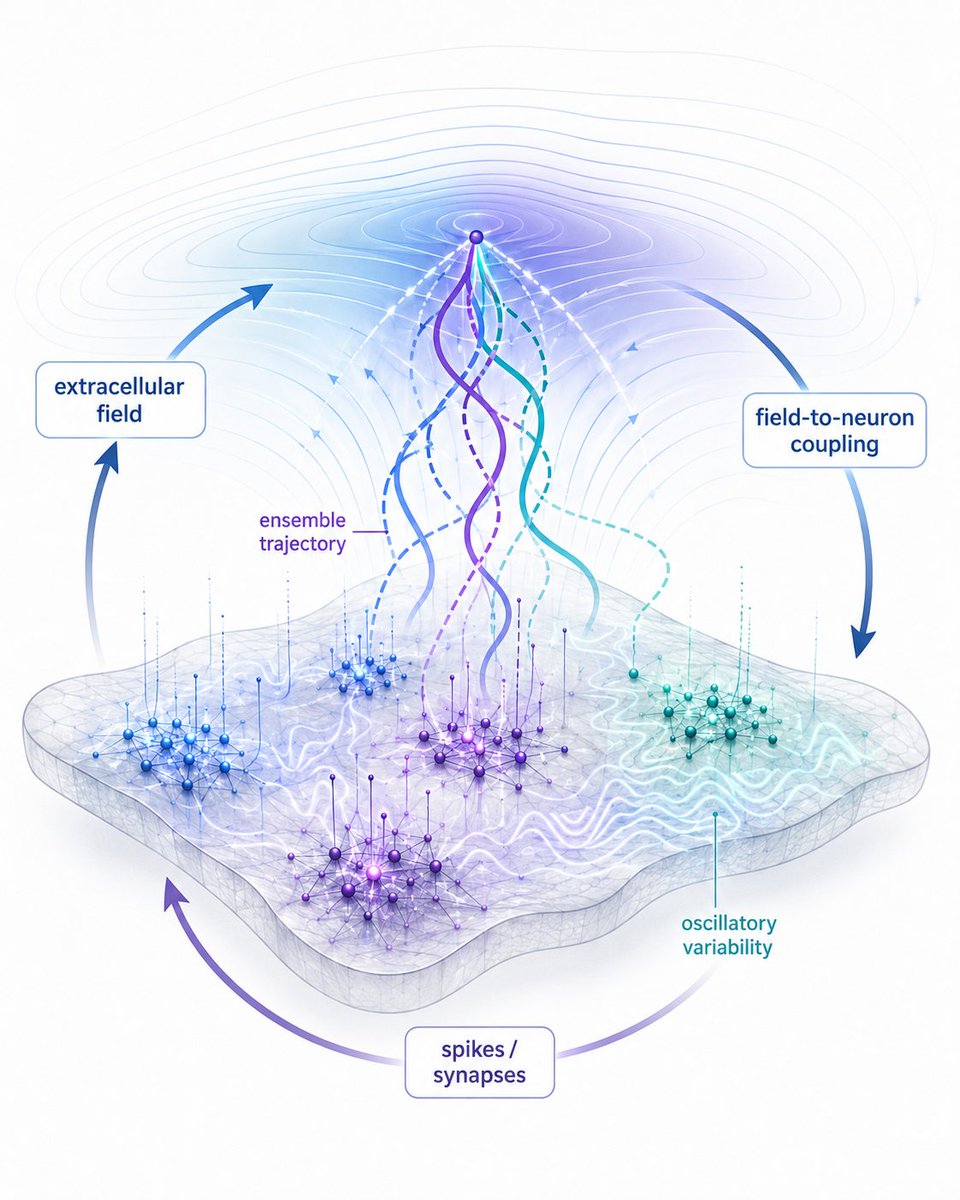
The question I'm increasingly asking is whether the same dynamical principle operates across every level, from microtubules, to neurons, to cortical networks, with each scale simply changing the effective coupling, geometry and time constants.
If that's true, then the relevant cognitive field wouldn't belong to any single network. It would emerge from coherent synchronisation across nested oscillatory networks, with chemistry, cytoskeletal dynamics and large-scale connectivity acting as different levels of the same hierarchy.
My prediction is that the unifying mathematics will ultimately describe multiscale coupled oscillatory systems rather than treating molecular biology, electrophysiology and cognition as separate domains.
If that bridge exists, I suspect both approaches are describing different layers of the same phenomenon.