
Vanguard Laboratory
39 posts

Vanguard Laboratory
@Vanguard_Lab
ISO 17025 accredited laboratory. Microbiological & chemical analysis of peptides, supplements, food, pharma, drinking water and environmental samples.
Washington Katılım Temmuz 2023
265 Takip Edilen231 Takipçiler

Validated methods. Legally defensible data. Independent quality checks.
Vanguard participates in proficiency testing for every method where PT is available. For methods without a formal PT program, we conduct interlaboratory round-robin comparisons with other ISO-accredited laboratories.
Our latest PT highlights include USP-related pharmaceutical testing and food microbiology detection methods, supporting reliable data for regulated industries.


English
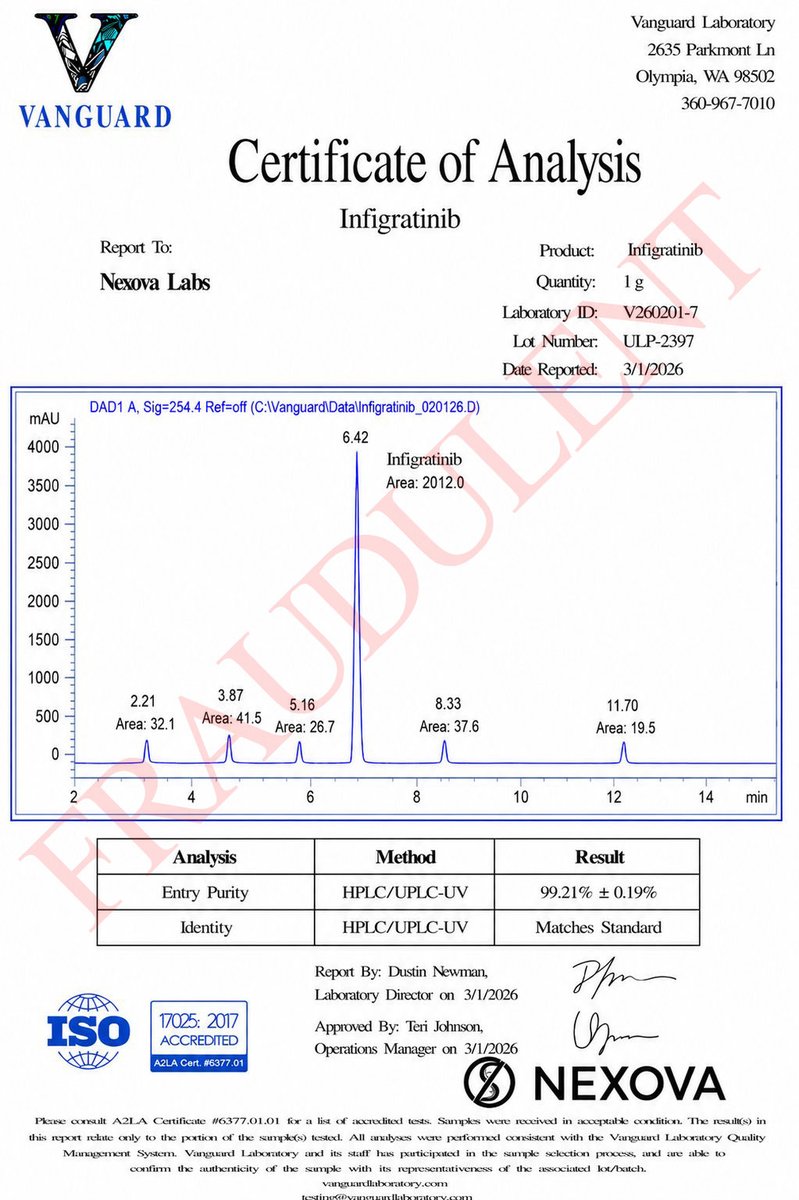
Another Fraudulent COA, this time they redesigned our logo. If ever in doubt about a COA's authenticity visit verifiedbyvanguard.com, email us , or call(360) 967-7010 and we will happily tell you if it is legitimate.
English
Vanguard Laboratory routinely tests compounded pharmaceuticals and research peptides using the same USP methods for both. Many grey market suppliers opt for more thorough testing than our regulated pharma clients. Quality and safety data exist—independent labs like ours provide it.
English

Peptide injections are the hottest trend in wellness, but researchers say enthusiasm for these unregulated drugs has got ahead of the science.
go.nature.com/3QD2o32
English
@PeptIQio I'd add sterility to the list. We see far more failures for sterility than we do endotoxins.
English

No COA = no idea what is in your vial. Full stop.
HPLC purity above 98%. Identity confirmed by mass spec. Third-party lab only, not the seller's own facility.
If a supplier cannot produce this document, do not buy from them.
#peptides #qualitycontrol #biohacking

English
A lot of fake COAs are in circulation. We always encourage people to verify that a COA is legitimate. A COA is only useful if the lab is real, the methods are listed, the methods are fit for purpose, reporting limits are clear, and the vial you’re buying is actually from the batch that was tested.
English

Funny how the peptide goalposts keep moving.
1. “Peptides are fringe biohacking” → GLP-1s became some of the biggest drugs in the world.
2. “It’s all just weight loss” → the real story is metabolic disease, cardiovascular risk, liver disease, kidney disease, inflammation, adherence, muscle preservation, and long-term monitoring.
3. “Semaglutide is the story” → tirzepatide raised the bar, and retatrutide is now showing Phase 3 results that make the next wave look very different.
4. “Compounded GLP-1s are here forever” → the shortage window changed, FDA policy tightened, and copycat semaglutide/tirzepatide compounding is getting squeezed hard.
5. “BPC-157 and TB-500 are either miracle cures or scams” → the boring answer is still the right one: interesting biology, uneven human evidence, shifting regulatory status, and huge quality-control variance.
6. “A COA means it’s good” → a COA is a starting point, not a safety system. Identity, purity, sterility, endotoxin, storage, batch history, and supplier integrity all matter.
7. “Research peptide” means clean gray area → sometimes it means exactly what it says: not approved for human use, not prescribed through normal channels, and not held to the same standard as an FDA-approved medicine.
8. “Dose is the protocol” → dose is one variable. The actual protocol is response, side effects, labs, lean mass, sleep, heart rate, nutrition, training, medical history, and follow-up.
9. “Side effects are random” → some are predictable enough to plan around. GI tolerance, dehydration, gallbladder issues, lean-mass loss, drug interactions, and escalation speed are not minor details.
10. “Peptide clinics are all the same” → the good ones separate FDA-approved drugs, compounded medications, off-label use, and research-only compounds. The bad ones blur everything into a menu.
11. “Personalization means stacking more peptides” → real personalization often means using fewer things, measuring more carefully, and knowing when not to add another compound.
12. “Genetics will tell you exactly what peptide to take” → no. But genetics can help frame better provider conversations around dose, tolerance, response, side effects, and what needs closer monitoring.
13. “Directories are just lists” → the next layer is decision support: who offers what, what’s regulated, what’s evidence-backed, what needs a prescription, what needs labs, and what questions to ask before spending money.
14. “The hard part is finding peptides” → the hard part is knowing what’s real, what’s legal, what’s tested, what’s appropriate, and what’s hype dressed up as a protocol.
That’s why we built: ThePeptideList.
Provider discovery, peptide education, and genetics testing for people who want to have smarter conversations before they start injecting things they barely understand.
I guarantee I’m holding at least 2-3 peptide beliefs right now that will look wrong by Christmas.
So should everyone else.
This space is moving fast. Stay curious, stay skeptical, and measure more than vibes.
English
@ogsvg Check the method being used for Sterility. It should be USP 71, 72, or 73. Bioburden, PCR, and Microarray are not USP approved for injectables, and are not sufficient. Those methods are better suited for topicals, supplements, tinctures, etc.
English

So I would rank the tests in order of importance -
1. Sterility - if your peptide coa doesn’t have sterility on it, I wouldn’t research with it period. You’re gonna risk exposing yourself to bacteria?
2. Endotoxin - same thing as sterility, same sort of effects on the body. You don’t want to expose yourself to dead bacteria byproduct either.
3. Net content/assay - important just for you to know how much of the peptide you just bought you are actually getting.
4. HPLC - how pure is the peptide you just bought. Don’t want a test result that’s 92% pure, what’s the other 8%?? You don’t want a chromatograph to look like a mountain range.
5. Heavy metals testing. Nice to have. Not as important because peptide manufacturing doesn’t require heavy metals the same way other processes might.
If you’re a vendor, don’t let the market scare you into getting a billion different tests done just because, stick to these 5.
If you’re a consumer, these 5 tests are usually the most important. I wouldn’t do research with anything that doesn’t have the first 4 tests. PERIODT.
English
A good way to verify any lab is to look beyond marketing claims.
Check whether they list an ISO/IEC 17025 accrediting body, whether that accreditor has a public directory, whether the lab has a physical address, Google reviews, real contact info, visible testing methods, and COAs that are consistent and traceable.
Lab Testing is meaningless if the lab isn't vetted, third party audited, or verifiable.
English

Here we have another RUO vendor, BlankChem promoting independent and third-party testing, while operating its own COA lookup portal, and issuing reports through something called the BlankChem Quality Control Division.
Plus there's a publicly accessible placeholder COA containing unfinished analytical fields alongside purity claims.
And what about the similarity to Blank Peptides?
Full article linked below
x.com/krysia830073/s…
Krysia@Krysia830073
English
Important note for clients submitting injectable samples:
Microarray and PCR-based screens are not USP <71> sterility tests, and they are not recognized as compendial sterility methods under USP <71>, <72>, or <73>.
USP <71>, <72>, and <73> remain the official compendial sterility tests for injectable products.
Rapid or molecular methods may have research or screening value, but they should not be represented as USP sterility testing unless they fully meet the applicable USP compendial requirements and validation expectations.
Always ask the lab: “Is this a true USP compendial sterility test (<71/72/73>), or a non-compendial rapid method?”
Your compliance depends on clear answers. #USP #SterilityTesting #PharmaQC

English
That “all-natural” herbal pain supplement that works surprisingly well?
Sometimes the secret ingredient is not an herb.
This overlay shows a product sample matching a diclofenac sodium standard an actual pharmaceutical that was not disclosed on the label.
Trust, but verify with chromatography. Vanguard has validated full NSAID test panels for HPLC, and LCMSMS with PPB level detection limits.

English
@PeptidePartners Great call, Purity, identity, quantity, endotoxin, sterility, and metals answer different questions. Passing one does not imply passing the others. Endotoxin results and sterility failures have been trending higher the last few months.
English

Today we rejected a batch due to endotoxin levels being too high. This is only the second time a batch has failed endotoxin screening. It might seem trivial, but you have to test test test.
English
@AK_2_FL @labs_vanguard @ThePepGuy @KimeraChems For what its worth if you need bloodwork we've heard great things about @labs_vanguard , no relation though to us. We test just about everything other than blood.
English

English

Which lab test do you prefer to see in a US vendors COA’s
Janoshik (Europe)
Freedom Diagnostics (USA)
Kovera Labs (USA)
Other?
Looking into options here 🙏
Thanks for your input
- ThePepGuy🔋
English
Good question. Low/no benzyl alcohol and sterility are related, but they are not the same test.
A sample with insufficient BA could still be sterile, but this sample did not pass sterility, and it also failed BA content.
For preservative containing samples, the preservative has to be neutralized, diluted, or otherwise removed from interfering with the sterility test. Otherwise the preservative could suppress microbial growth during the assay and create a false pass. So with BAC water, the sterility test is not asking if benzyl alcohol can inhibit growth. It is asking whether viable microorganisms are present after the method is made suitable for that matrix.
In this sample, BA was 0.08% against a 0.72–1.08% specification, so it did not meet the bacteriostatic water specification. Since sterility also failed, it did not meet sterile water expectations either.
On endotoxin: “N/A” means that parameter was report-only on this COA. The client supplied pass/fail specifications for BA, pH, and sterility. Endotoxin, conductivity, and TDS were reported quantitatively, but no pass/fail decision rule was requested for those parameters.
To be clear, if someone wants to apply USP Bacteriostatic Water for Injection endotoxin criteria, then yes, there is a limit, and this result would not meet it. The reason the COA says N/A is scope/reporting: it was reported as a quantitative result, not rendered as a conformity decision.
Labs do not automatically attach every possible regulatory limit to every result because limits depend on intended use, matrix, route, dose, and regulatory framework. Metals are a good example: Prop 65, USP, FDA, and EPA criteria can all differ. Micro limits also differ depending on whether you are evaluating a USP sterile article, nonsterile product, drinking water, environmental water, or some other matrix.
English

@Vanguard_Lab BA w/o enough BA can still technically be sterile water? Is there a different process or assay for sterility testing BAC water?
Also with the endotoxin load, why does the report not have a limit range on it? It just says n.a next to the endo quantity. Isn’t there a USP limit
English


@watchingdascene @Krysia830073 B.A. content was well below effective threshold to prevent bacterial growth.
English
@Vanguard_Lab @Krysia830073 This doesn’t make sense how did it fail Sterility?
English
@Krysia830073 @jair_aleman @peptidesdaily The sample was submitted and tested. The picture, conductivity results and pH match what we have on file but someone heavily edited the COA, and changed or omitted results on the official COA. Will post original to this thread
English
@Vanguard_Lab @jair_aleman @peptidesdaily So did they actually send this sample to you or is it just completely faked?
English
Portal is nearing completion. All client data is being uploaded but clients have to pre authorize us sharing data or they have to login to make COAs public. ISO 17025 has strict rules on client confidentiality, and data security which we must adhere to. In the meantime we will happily verify authenticity via email- testing@vanguardlaboratory.com or phone 360-976-7010
English

@tread_on_them @Vanguard_Lab We need them to finish their verification portal! We’ve offered free technical work to make it happen.
They do respond to manual COA verifications though.
English
If you’re a lab testing peptides or work for a lab then we want to partner with you.
We will be reaching out in the next couple of weeks!
English
@jair_aleman @Krysia830073 @peptidesdaily COA has been heavily edited, sample failed sterility. Benzyl alcohol content was ~0.09% not 0.9%
English

English
@SolutreanDACA @tread_on_them @Krysia830073 Bottom of the page, Working on updating the website to make more clear. vanguardlaboratory.com/peptide-testin…
all peptides/small molecules $250 purity/ID, $550 purity/quant/endotoxins/sterility, & 700 for everything plus metals. no charge for additional sterility vials. Amino Acid analysis
English

English
@BrianSuttererMD @oasishealthapp LMNT is not a client but we have tested the product after seeing these reports and it has always been well under Prop 65 limits. We actually keep it stocked in our break room for employees.
English

Maybe just sit the next few out until you can learn how to interpret and report tests @oasishealthapp
Oasis@oasishealthapp
Correction: we posted inflated heavy metal contamination levels for LMNT electrolytes. A calculation error overstated lead, cadmium and arsenic per serving. Corrected amounts: - Citrus Salt: Lead 0.0773 µg/serving (15% MADL), cadmium 1%, arsenic 0.5%, mercury non-detect - Raw Unflavored: Lead 0.0945 µg/serving (19% MADL), cadmium, arsenic, mercury non-detect. Both under the MADL, California's strictest daily lead reference (0.5 µg/day). Based on the latest verified lab reports. Amounts and scoring may change with new data. We're adding review steps and bringing on more scientific and engineering support to reduce future mistakes
English