
Victor Vallejo Garcia

1.4K posts

Victor Vallejo Garcia banner
Victor Vallejo Garcia

Victor Vallejo Garcia

@VictorEVG

MD. MSc. Clinical Cardiology & Cardiac Imaging at @IMEDHospitales Valencia🫀 Profesor Cardiología at @uchceu. Tutor Cardiologia at @UCV_svm. Runner🏃🏻‍♂️

Valencia, Spain Katılım Ağustos 2009
241 Takip Edilen166 Takipçiler
Victor Vallejo Garcia
Victor Vallejo Garcia@VictorEVG·
Una barbaridad!!! Los que hemos hecho maratones sabemos lo que cuesta, y es que bajar de 2 horas es ir a 2:50 min/km por 42 km🤯🤯 Como corredor y como cardiólogo que hace reconocimientos a deportistas: INCREIBLE🏃🏻‍♂️🏃🏻‍♂️🏃🏻‍♂️ Y ojo, que el número 2 ha bajado de 2h también
Tiempo de Juego@tjcope

🏃🏽‍♂️ ¡HISTORIA DEL DEPORTE! 🇰🇪 El keniano Sawe se convierte en el primer atleta en bajar de las dos horas en un Maratón 😳 Ha hecho 1h 59 min 30 seg en #LondonMarathon

Español
0
0
0
95
Victor Vallejo Garcia retweetledi
Tiempo de Juego
Tiempo de Juego@tjcope·
🏃🏽‍♂️ ¡HISTORIA DEL DEPORTE! 🇰🇪 El keniano Sawe se convierte en el primer atleta en bajar de las dos horas en un Maratón 😳 Ha hecho 1h 59 min 30 seg en #LondonMarathon
Español
66
817
9.2K
3.2M
Victor Vallejo Garcia retweetledi
Samuel Hume
Samuel Hume@DrSamuelBHume·
These are really really nice data that've gone largely under the radar In people already taking a statin, Enlicitide (an oral PCSK9 inhibitor) was tested head-to-head against other cholesterol medicines — Bempedoic Acid, Ezetimibe, or the combination Enlicitide lowered LDL more than even the combination (and was the only agent to lower lipoprotein(a) too, by ~25%)
Samuel Hume tweet media
Subodh Verma@SubodhVermaMD

Honor to work with this team on the oral PCSK9i - Enlicitide. Now in JACC.

English
11
42
290
145.9K
Victor Vallejo Garcia retweetledi
American Heart Association
American Heart Association@American_Heart·
The American Heart Association mourns the passing of the legendary cardiologist Eugene Braunwald, M.D., widely recognized as one of the most influential figures in the history of cardiovascular medicine. Over seven decades, his work reshaped the understanding and treatment of heart disease, leading many to call him the father of modern cardiology. Braunwald was a lifelong contributor to the American Heart Association, helping advance its research and scientific mission, and was honored with some of the Association’s highest honors for his lasting influence on cardiovascular care and research. His influence extended well beyond his own discoveries, as generations of Association‑supported investigators, clinicians and academic leaders were trained by Braunwald or guided by the clinical trial standards and mentorship models he helped establish. newsroom.heart.org/news/american-…
English
68
895
2.2K
436.8K
Victor Vallejo Garcia
Victor Vallejo Garcia@VictorEVG·
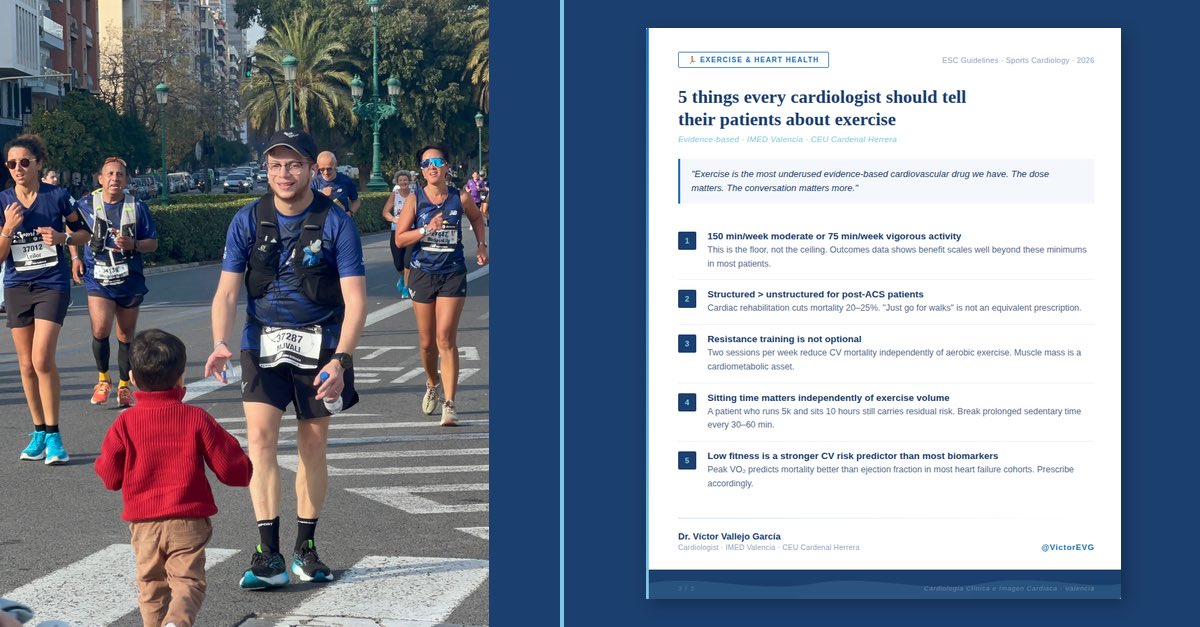
5/ El sedentarismo es un factor de riesgo independiente. Un paciente que corre y luego pasa 10h sentado tiene riesgo residual. Rompe el sedentarismo cada 30-60 min. Especialmente aplicable para nosotros los médicos!🚶🏻‍♂️
Español
0
0
0
10
Victor Vallejo Garcia
Victor Vallejo Garcia@VictorEVG·
4/ El entrenamiento de fuerza reduce mortalidad CV independientemente del volumen aeróbico. 2 sesiones/semana. La masa muscular es un activo cardiometabólico que no prescribimos🏋🏻‍♀️
Español
0
0
0
12
Victor Vallejo Garcia
Victor Vallejo Garcia@VictorEVG·
3/ Rehabilitación cardiaca estructurada ≠ “salga a caminar”. Un programa supervisado reduce mortalidad post-SCA un 20-25%. Es una intervención farmacológica sin fármaco. 👟🚴🏻‍♂️
Español
0
0
0
10
Victor Vallejo Garcia
Victor Vallejo Garcia@VictorEVG·
2/ 👟150 min/semana es el suelo, no el techo. Los datos muestran beneficio incremental muy por encima del umbral mínimo de guías. Y la mayoría de nuestros pacientes no llegan ni a eso.🥲
Español
0
0
0
10
Victor Vallejo Garcia
Victor Vallejo Garcia@VictorEVG·
1/ El VO₂ pico predice mortalidad mejor que la FEVI en IC. Si tomásemos la forma física tan en serio como el LDL, tendríamos mejores resultados. #cardiotwitter #CardiologíaDeportiva 🏃🏻‍♂️🚴🏻‍♂️
Español
0
0
0
12
Victor Vallejo Garcia retweetledi
NEJM
NEJM@NEJM·
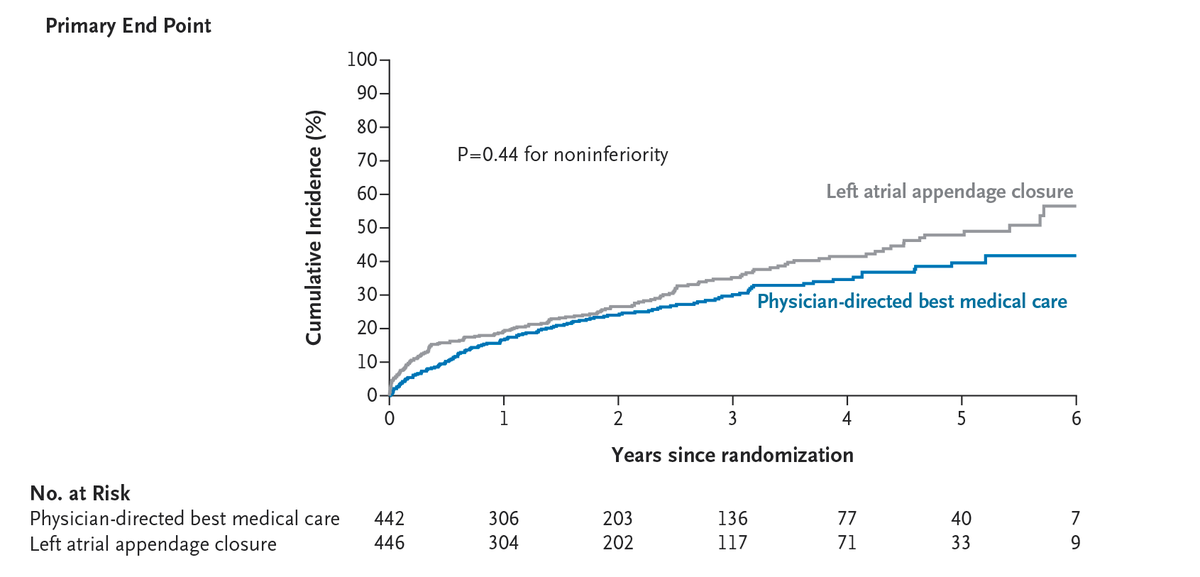
Among patients with atrial fibrillation at high risk for stroke and bleeding, left atrial appendage closure was not noninferior to medical therapy in reducing the risk of stroke, embolism, major bleeding, or death at 3 years. Full CLOSURE-AF trial results: nejm.org/doi/full/10.10… Editorial: Left Atrial Appendage Closure — Another Overused Method in Cardiology? nejm.org/doi/full/10.10…
NEJM tweet media
English
16
312
721
467.6K
Victor Vallejo Garcia
Victor Vallejo Garcia@VictorEVG·
@DrCamRx 😂😂😂 really good!!! Also the takers of metformin and 30 supplements but who won’t drink coffee because it de-regulates them (Sinclair). Exercise, eat real food, sleep, avoid stress and enjoy life.
English
0
0
0
24
Dr. Cameron Maximus🤴🏻 🥷🏻 🧙🏻‍♂️ 🤵‍♂️
Of course that's your contention. You're a first-time biohacker. You just got finished listening to some podcast, Huberman on Rogan, probably. Now you think it’s the end of chronic disease and seed oils are the devil. You're gonna be convinced of that til tomorrow when you get to “The Glucose Goddess Method”. Then you’ll strap on an Oura Ring, track your HRV on a Whoop app, and say we’re all just a couple sauna sessions away from living to 120. That’s gonna last until next week when you discover NAD boosters, and then you're gonna be talking about how mitochondria are the key to everything and reposting Levels marketing graphics. “Well, as a matter of fact, I won't, because ultimately the health tech stack is just ….” The health tech stack is just quantified self on top of a fitness tracker. You got that from Peter Attia’s episode on Tim Ferriss, March 2025, right? Yeah, I heard that too. Were you gonna plagiarize the whole thing for us? Do you have any thoughts of your own on this matter? Or...is that your thing? You get into the replies of anyone posting a longevity ticker. You listen to some podcast and then pawn it off as your own idea just to impress some VCs and embarrass some anon who’s long on biotech? See the sad thing about a guy like you is in a couple years you're gonna start doing some thinking on your own and you're gonna come up with the fact that there are two certainties in life. One: don't do that. And two: you dropped thirty grand on peptides and supplement stacks to come to the same conclusion you could’ve got for free by reading primary sources on PubMed.
Dr. Cameron Maximus🤴🏻 🥷🏻 🧙🏻‍♂️ 🤵‍♂️ tweet media
English
91
136
1.6K
202.4K
Victor Vallejo Garcia
Victor Vallejo Garcia@VictorEVG·
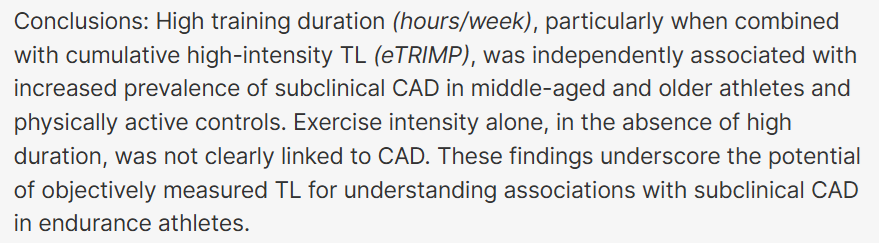
@Alan_Couzens No evidence of hard end points. Coronary plaque in athletes tends to be calcified and more stable, it does not rupture/have erosions with the same frequency as in non athletes
English
1
0
1
598
Alan Couzens
Alan Couzens@Alan_Couzens·
A good reminder of the perils of too much zone 2 "chronic cardio"... Increased training load (especially at high eTRIMP/hr) = increased coronary plaque🫀 My thoughts on the paper in the #MADcrew forum thread below 👇
Alan Couzens tweet media
English
10
4
93
17.8K
Victor Vallejo Garcia retweetledi
Dr. Filippo Cademartiri
Dr. Filippo Cademartiri@FCademartiri·
🫀⚡ Extreme CAC doesn’t mean extreme stenosis: photon-counting CCTA changes the narrative This 2026 JACC: Advances brief report asks a clinically uncomfortable question: what do we actually find when asymptomatic patients with very high CAC (>1,000) undergo coronary imaging with modern technology? With photon-counting CT (PCCT), the answer is surprisingly reassuring . 📊 Who was studied 19 asymptomatic patients Mean age 64.5 years, 32% women Mean CAC 1,510 AU High burden of risk factors, but no prior CAD or symptoms All underwent ultra–high-resolution PCCT CCTA (0.2 mm slices). 🔍 The key finding 👉 All scans were diagnostic — even with extreme calcification. And more importantly: 74% had no severe coronary stenosis CAD severity: CAD-RADS 2–3: 74% CAD-RADS 4: 21% CAD-RADS 5: 5% (1 patient) 🧠 Physiology confirmed anatomy FFR-CT performed in 7 patients → all negative (0.80–0.93) 4 patients underwent invasive angiography Only one had truly severe multivessel disease → CABG No PCI performed 🖥️ Why PCCT matters here Extreme CAC traditionally discourages CCTA due to blooming artifacts. PCCT flips this: Higher spatial resolution Reduced calcium blooming Reliable lumen assessment Preserved confidence in FFR-CT ⚠️ Important nuance This is a small, retrospective, real-world series—not an outcomes trial. But it highlights a critical concept: 👉 Extreme CAC ≠ flow-limiting disease in most asymptomatic patients 🔮 Bottom line In selected asymptomatic patients with very high CAC, PCCT CCTA can safely rule out high-risk anatomy and avoid unnecessary downstream testing. 📌 CAC still defines risk. 🧭 PCCT helps define reality. Sometimes, even a four-digit calcium score doesn’t mean what we think it means.
Dr. Filippo Cademartiri tweet media
English
6
37
93
6.8K
P. Juan Manuel Góngora
P. Juan Manuel Góngora@patergongora·
@MonsArguello Monseñor, el problema está en que deberían tener posadas en sus países de origen, no reclamarlas aquí mientras nuestros jóvenes no se pueden permitir ni un pesebre a 40 años de tipo fijo.
Español
99
698
4.5K
64.8K
Mons. Luis Argüello
Mons. Luis Argüello@MonsArguello·
Jesús nació en un pesebre porque no había sitio en la posada. Hoy inmigrantes no son regularizados, pero si son desalojados en España y en USA con luces y sonidos navideños de fondo; familias viven en una habitación “con derecho a cocina”… Tampoco hoy “hay sitio en la posada”.
Español
1.7K
170
513
366K
Sama Hoole
Sama Hoole@SamaHoole·
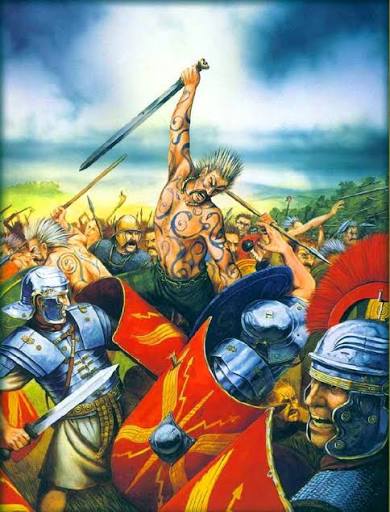
Ancient Rome had a specific insult for Celtic and Germanic tribes: "Butter-eaters." Not warriors. Not fighters. Not even barbarians. Butter-eaters. Why was this insulting? Because Romans considered butter uncivilized. Olive oil was the mark of sophistication. Butter was what savages smeared on their bread. The historical irony: Roman soldiers: 5'5" average height, grain-based diet, weak bone structure, required constant reinforcement Celtic warriors: 5'10" average height, meat and dairy diet, robust skeletal structure, fought naked because they were confident Germanic tribes: 6'0" average height, meat-heavy diet, terrified the Roman legions The Romans called them "butter-eaters" while simultaneously being terrified of fighting them because the butter-eaters kept winning. It wasn't military tactics. It was nutrition. Roman grain-fed soldiers versus Celtic dairy-fed warriors was a biological mismatch. The Romans knew it. That's why the insult existed. They needed to denigrate the diet that produced men physically superior to them. "Butter-eater" was cope for "we can't match them physically so we'll mock their food." The tribe eating butter conquered Rome in 410 AD. The insult aged poorly.
Sama Hoole tweet media
English
501
501
4.1K
350.7K