
The Crypto Contrarian 🐬 retweetledi
The Crypto Contrarian 🐬
25.2K posts
The Crypto Contrarian 🐬
@Voidvamp
Divyajitsinh Vaghela | 30 | Gen AI | Dual dating 9 to 5 and start up | Analyst | Geek | Naturalist | Metalhead | 神風 | H^0
Himalaya Katılım Ağustos 2013
18K Takip Edilen17.2K Takipçiler

The Crypto Contrarian 🐬 retweetledi

🚨 OpenAI 's own engineers just showed how to actually use OpenAI Codex properly.
60 minutes. free. built by the people who contribute to made it.
watch the masterclass. bookmark it.
worth more than every $900 coding course you almost bought.
you’ve been using Codex like a simple coding tool…
while it’s actually a full software engineering system.
watch this, it could the best 62 minutes of your life:
English
The Crypto Contrarian 🐬 retweetledi

Instead of watching Netflix for 2 hours, watch this guy explain why some people become successful while others stay average.
English
The Crypto Contrarian 🐬 retweetledi

The Crypto Contrarian 🐬 retweetledi
The Crypto Contrarian 🐬 retweetledi

يا اخي هذا الشخص فناااان 🔥
كورس 5 ساعات مجانا عن بناء وكلاء الذكاء الاصطناعي.
صدقني اذا فهمت كل شيء في هدا الفيديو تصير انت من افضل 1% من الناس في العالم باستخدام الذكاء الاصطناعي.
العربية
The Crypto Contrarian 🐬 retweetledi

10 things billionaires don't want you to know are free.
The richest people on Earth use these every day. You can use them right now. Bookmark this.
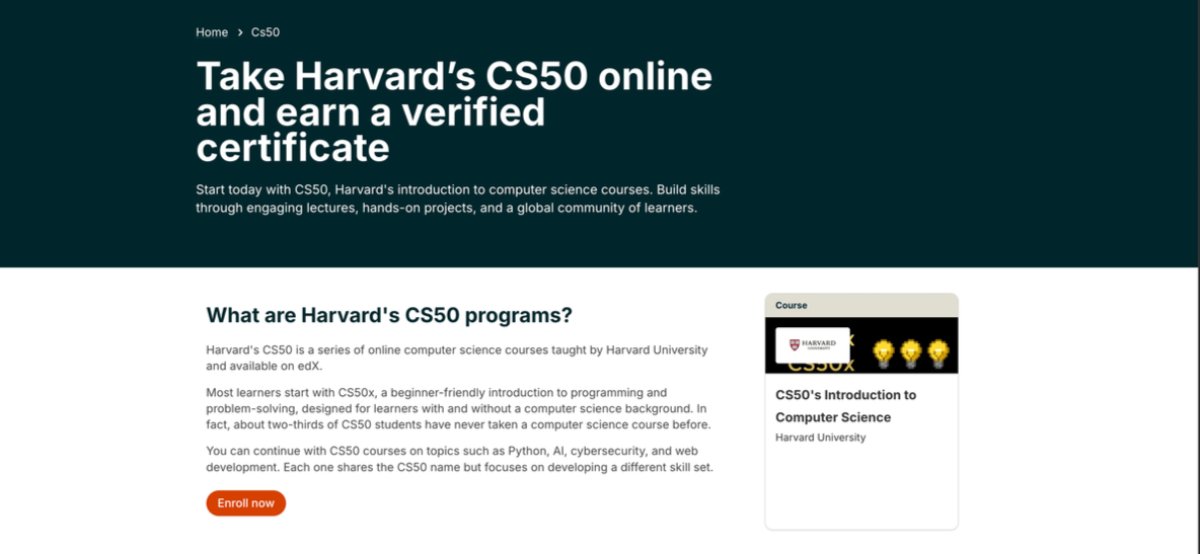
1. Harvard CS50
The exact computer science course Harvard freshmen take. Includes a real certificate signed by the professor.
Site → cs50.harvard.edu
2. MIT OpenCourseWare
2,500+ MIT courses online. The same lectures their $80K-a-year students sit in.
Site → ocw.mit.edu
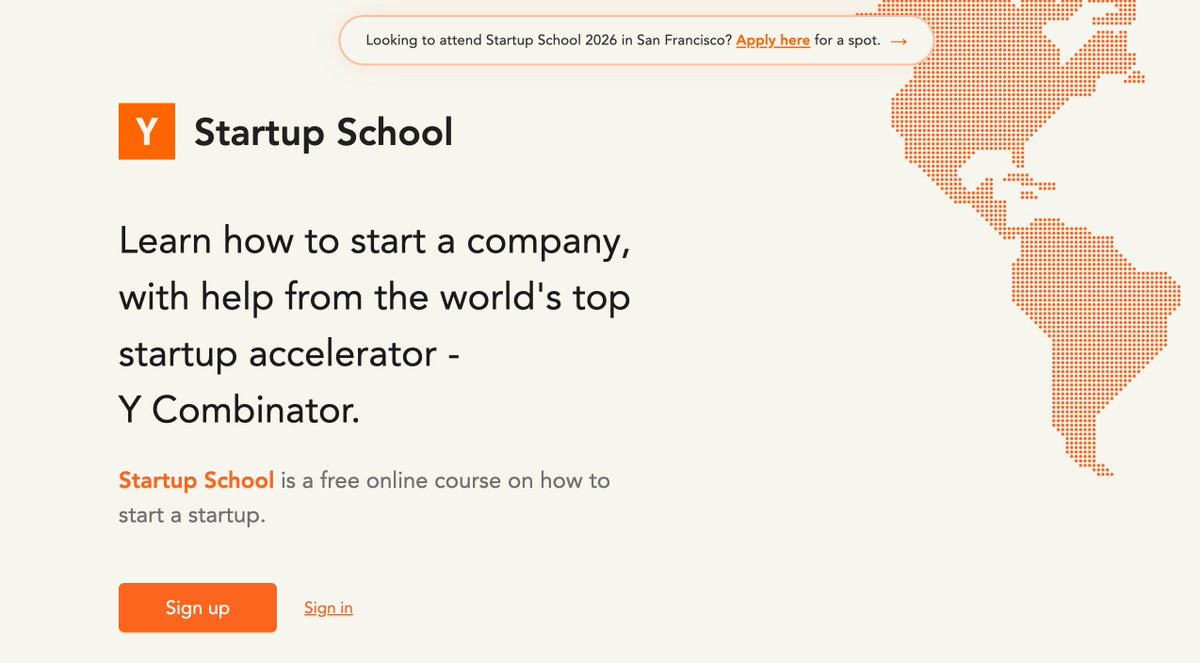
3. Y Combinator Startup School
The exact playbook YC uses to train the founders of Airbnb, Stripe, and Coinbase.
Site → startupschool.org
4. Berkshire Hathaway Letters
Warren Buffett's annual investing letters since 1977. Hedge fund managers re-read these every year.
Site → berkshirehathaway.com/letters/letter…
5. SEC EDGAR
The real-time filing system Wall Street uses. Watch what every billionaire is buying the moment they file.
Site → sec.gov/edgar
6. Stanford Online
Stanford's CS, engineering, and machine learning lectures. The exact courses Andrew Ng once taught.
Site → online.stanford.edu
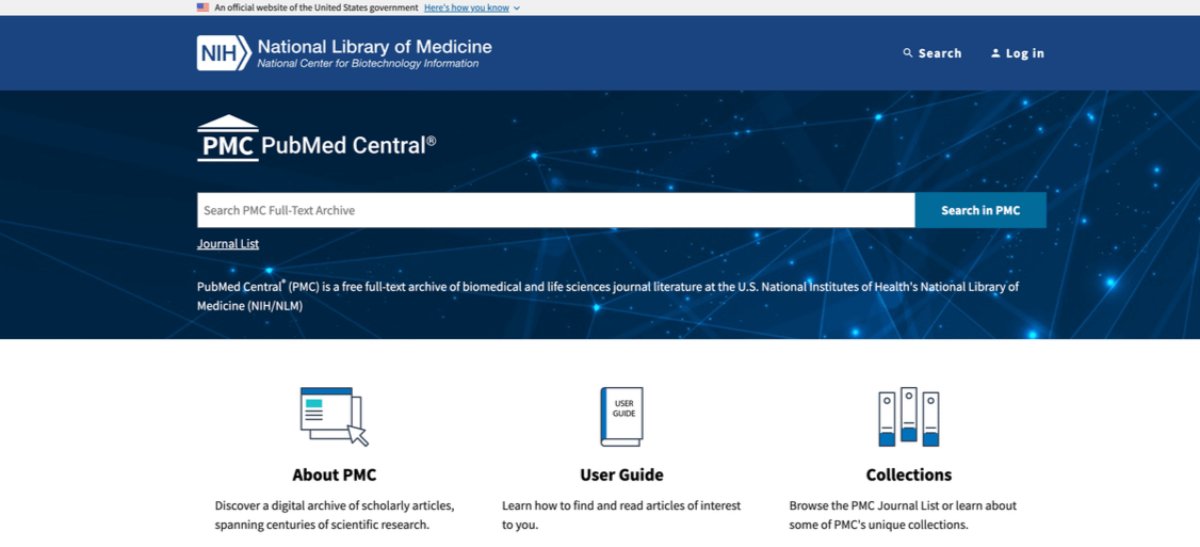
7. PubMed Central
The NIH's full archive of medical research. Studies that journals charge $40 each to read. Millions of them.
Site → ncbi.nlm.nih.gov/pmc
8. World Bank Open Data
Every economic dataset the World Bank tracks. The same data Goldman Sachs analysts pay for.
Site → data.worldbank.org
9. OpenLibrary
The Internet Archive's free book lending service. Millions of books, no library card needed.
Site → openlibrary.org
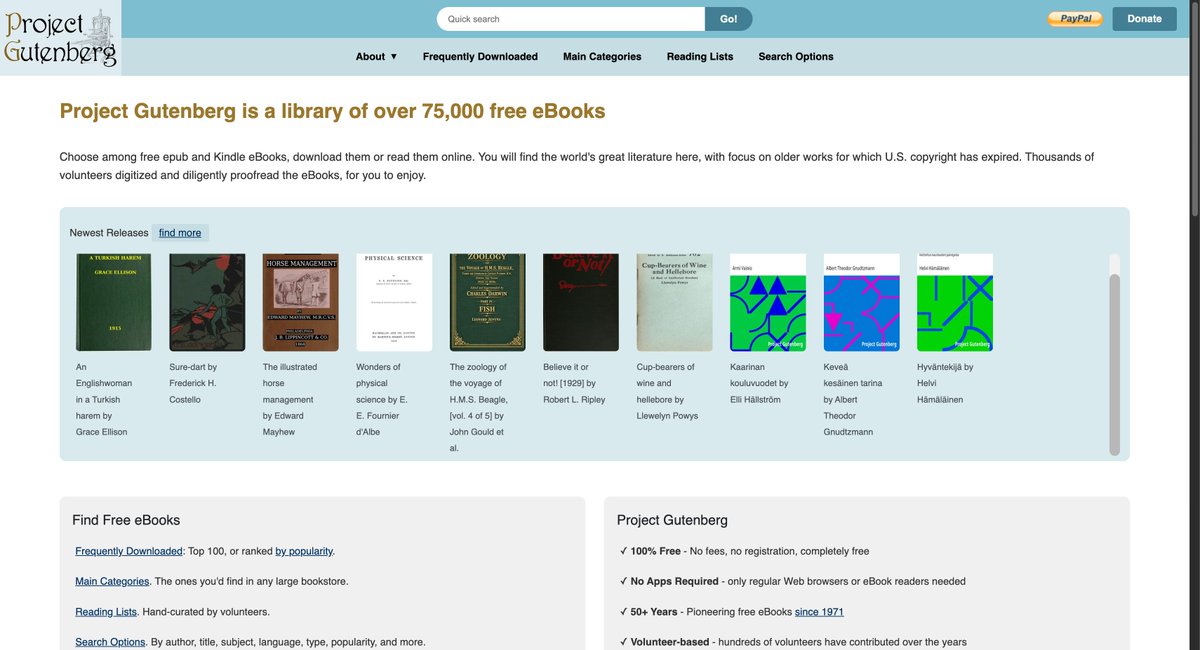
10. Project Gutenberg
70,000+ classic books, completely free. From Plato to Tolstoy.
Site → gutenberg.org
Here's the wildest part:
A Harvard education costs $250K. An MBA costs $200K. A Bloomberg Terminal costs $25K a year. A YC seat costs you 7% of your company.
You just got all of it. For free.
The most expensive things in the world are usually free. You just have to know where the door is.
Most people never look.
Save this before you forget.
100% free. Forever.
English

CLAUDE SCANNED GITHUB FOR 24 HOURS AND CAME BACK WITH A POLYMARKET BOT WALLET UP $143,379.
He reverse engineered it overnight, threw $90 at the strategy, and woke up to instant proof it was real.
You only need Claude+ laptop + 1 hour/day.
Giving This Free for 24 hours. To get it:
1. Comment the word 'Anthropic'
2. Like and Retweet this post
3. Follow me @marryevan999
English
The Crypto Contrarian 🐬 retweetledi

Andrej Karpathy just sat down and built GPT from scratch, line by line, in 2 hours.
For Free. From the man who co-founded OpenAI.
This video is enough to become an AI engineer.
Bookmark it. Watch it tonight. Build your own GPT this week.
$5,000. $15,000. $40,000.
That's what bootcamps charge to teach less than what's in this 2-hour video.
This video fixes that this week.
Follow @codewithimanshu for more high-signal AI content that actually moves your engineering career forward.
↓
Karpathy doesn't explain GPT. He builds it.
Live. From "Attention is All You Need" the original paper. To the same architecture powering GPT-5.
Founding member of OpenAI in 2015. Senior Director of AI at Tesla. Now running Eureka Labs.
He's not teaching you how to use GPT. He's teaching you how it actually works at the source code level.
Most engineers will never understand transformers this deeply. The ones who do build the next generation of AI products.
Follow @codewithimanshu for breakdowns of every must-watch AI lecture worth your time.
↓
Here's what gets built in 2 hours. No fluff.
Tokenization and data loading.
The foundation of every modern LLM. Train/val splits done right. Batch loaders that don't break in production.
Most tutorials skip this. You can't ship anything serious without it.
The bigram baseline.
The simplest possible language model. Karpathy builds it first because it teaches you what every fancier model is actually trying to improve.
Once you understand bigrams, transformers become obvious. Skip this and the rest never clicks.
Follow @codewithimanshu for daily breakdowns of what AI engineers actually need to know.
↓
Self-attention. From scratch. Live.
This is the section that should have its own course.
Karpathy builds self-attention in 4 versions:
> Version 1: averaging past context with for loops
> Version 2: matrix multiply as weighted aggregation
> Version 3: adding softmax
> Version 4: full self-attention
Each version teaches you why the next one exists. Why attention works. Why matrix math replaces explicit loops. Why scaling matters.
You'll never look at "attention is all you need" the same way again.
Follow @codewithimanshu for production transformer breakdowns weekly.
↓
The 6 attention notes that change everything.
Karpathy drops 6 insights most engineers never hear:
> Attention as communication between tokens
> Attention has no notion of space, operates over sets
> No communication across batch dimension
> Encoder blocks vs decoder blocks
> Attention vs self-attention vs cross-attention
> Why we divide by sqrt(head_size)
Each one of these explains a different failure mode in production AI systems.
Most "AI engineers" can't answer these. The ones who can charge $300K.
Follow @codewithimanshu for the engineering insights that turn into job offers.
↓
Building the full transformer block.
Single self-attention head. Then multi-headed self-attention.
Feedforward layers. Residual connections. LayerNorm.
Each piece added with the reason it exists. Why residuals stop the model from collapsing. Why LayerNorm replaced BatchNorm. Why dropout matters at scale.
This is the architectural understanding that lets you debug any modern AI system.
Once you've built one transformer by hand, every paper you read becomes 10x clearer.
Follow @codewithimanshu for transformer architecture content every week.
↓
Scaling up to a real model.
Karpathy goes from baseline to a working GPT.
Hyperparameters. Dropout. Model dimensions. The exact tradeoffs every production model makes.
By the end you have a Shakespeare-generating language model running on your machine. From scratch. Built by you. Understood by you.
That's not a tutorial. That's an architectural unlock.
Follow @codewithimanshu for production model scaling breakdowns.
↓
Encoder vs decoder vs both.
The architecture choice that defines every modern AI product.
Why GPT is decoder-only. Why BERT is encoder-only. Why translation models use both.
Once you understand this, you can read any AI paper and immediately know what kind of system you're looking at.
This is the difference between someone who follows AI hype and someone who builds it.
Follow @codewithimanshu for AI architecture deep dives weekly.
↓
NanoGPT walkthrough.
Karpathy ends with a quick walk through nanoGPT. The repo every serious AI engineer has cloned at least once.
Batched multi-headed self-attention. Production-grade code. The clean version of everything you just built.
This is the bridge from "I built a toy GPT" to "I can read and modify production AI code."
Follow @codewithimanshu for repos every AI engineer should know.
↓
ChatGPT, pretraining, finetuning, RLHF.
The video closes with the full lineage. From your toy GPT to ChatGPT.
What changes when you scale up. Why RLHF matters. The exact path from research model to product.
You finish the video understanding the entire stack from raw paper to deployed product.
Most "AI experts" can't draw this map. After 2 hours, you can.
↓
What you'll be able to do after this.
Read "Attention is All You Need" and understand every line.
Debug attention layers when they break in production.
Build a custom language model on your own dataset.
Modify transformer architectures for specific use cases.
Have technical conversations with AI engineers without faking it.
Train a GPT on any data you want. Shakespeare. Code. Your own writing.
That's not "AI literacy." That's the foundation of an AI engineering career.
The kind of foundation that turns into senior roles and consulting contracts most people will never access.
↓
2 hours. Free. From the engineer who built it.
You'll spend longer in meetings this week and learn nothing.
This compounds for the rest of your career.
People who watch it can build GPT from scratch by Friday.
People who skip it stay confused about why their prompts fail in production.
Save the video. Watch it this week. Build something with the knowledge by the weekend.
Follow @codewithimanshu for more high-signal AI content from the people actually building the future.
English
The Crypto Contrarian 🐬 retweetledi

This guy in 16 minutes teaches you how to monetize a YouTube channel in just 9 days.
Save it; It’ll be incredibly useful for you.
English
The Crypto Contrarian 🐬 retweetledi

The Crypto Contrarian 🐬 retweetledi

Claude Code cannot read 300 files at once.
So someone built a system that lets it control NotebookLM from the terminal instead. The results are wild.
Here is the full workflow nobody is talking about:
The Setup
→ Claude Code connects to NotebookLM via a command line interface
→ Claude searches YouTube, finds relevant videos, uploads them as sources automatically
→ NotebookLM processes up to 300 sources simultaneously and returns cited, grounded answers
→ Everything syncs back into your Obsidian vault with passage-level citations you can click to verify
Why This Changes Research Forever
→ No more 20 browser tabs you never close
→ No more copy-pasting outputs into random notes
→ No more hallucinated answers with no sources to back them up
→ 60% of citations verified as strong matches in accuracy audits - answers are grounded in real data
What Claude Can Do From the Terminal
→ Search YouTube for relevant videos on any topic and rank by relevance
→ Create a new NotebookLM notebook and add 20 sources in parallel automatically
→ Ask questions and export cited answers directly into Obsidian with wikilinks
→ Set custom personas per notebook - concise, no filler, no preamble
→ Generate audio overviews and save them as MP3 files into your vault
→ Build mind maps, flashcard decks, and research dashboards from your sources
→ Search arXiv for academic papers and feed them directly into NotebookLM
→ Upload competitor blog posts, podcast episodes, PDFs, and your own vault notes
The Obsidian Output
→ Every answer arrives with clickable citations that link to the exact passage in the source video or article
→ Graph view shows connections between all 20 sources and the topics they share
→ Q&A log tracks every question asked and the grounded response received
→ Source dashboard shows citation frequency, topics extracted, and which questions each source answered
Use Cases Worth Building Today
→ Academic research with arXiv papers, full citation traceability
→ Competitor analysis from their YouTube channels and blog posts
→ Company knowledge base for onboarding, new employees ask NotebookLM instead of interrupting teammates
→ Podcast research, feed 4-hour Lex Fridman episodes and ask what's new in AI this week
→ Personal second brain, 300 daily notes uploaded and queryable in one notebook
Before this system existed you needed 20 tabs, hours of manual reading, and no guarantee the answers were real.
Now you type one prompt in the terminal and Claude does all of it for you.
The research stack of 2026 is not a browser. It is a terminal connected to everything
English
The Crypto Contrarian 🐬 retweetledi

This tool can download literally anything from link 🤯
100% free. open source. no ads.
English
The Crypto Contrarian 🐬 retweetledi

A man spends 50 years teaching at MIT.
He knows his time is running out.
So he records one last lecture — everything he knows, distilled into a single hour.
He died 5 months later.
This is that lecture.
The most important hour you'll watch this week. 👇
Bookmark it for later
English
The Crypto Contrarian 🐬 retweetledi

Dropped a 1 hour masterclass on how to go from Gambler to Profitable Trader:
• Why you keep blowing accounts
• How to stop revenge trading
• Why overtrading is killing you
• When to stay in cash
• The system I use to stay profitable
Hope this helps.
English
The Crypto Contrarian 🐬 retweetledi

this 16-min video course teaches you how to set up your own agent-dev team.
it’s free. zero coding. just watch, copy the prompts and deploy.
and just like that, you’ll have:
• a frontend dev
• a backend dev
• a QA agent
all working for you, ready to build anything.
Khairallah AL-Awady@eng_khairallah1
English
The Crypto Contrarian 🐬 retweetledi

Jane Street pays $650,000+ a year for quants who understand this math of systematic trading.
UC Berkeley just put the exact same knowledge for free in 1 hour.
Bookmark & watch it today, no matter what. Then read the complete blueprint below.
Roan@RohOnChain
English
The Crypto Contrarian 🐬 retweetledi

Two Anthropic engineers, who built Claude just explained why you use less than 10% of actual Claude abilities.
This 24-minute talk will change how you use Claude Code forever.
Watch it, then read the breakdown below👇
darkzodchi@zodchiii
English
The Crypto Contrarian 🐬 retweetledi

This guy literally explains how to build an algorithmic trading hedge fund from scratch in under 6 minutes.
This is crazy:
English