Nicolás E. Quintana Ashwell

749 posts

Nicolás E. Quintana Ashwell banner
Nicolás E. Quintana Ashwell

Nicolás E. Quintana Ashwell

@WaterEcon_Delta

Water economist - National Center for Alluvial Aquifer Research (NCAAR) - Mississippi State University

Katılım Ocak 2019
710 Takip Edilen192 Takipçiler
Nicolás E. Quintana Ashwell retweetledi
Dwarkesh Patel
Dwarkesh Patel@dwarkesh_sp·
When Copernicus proposed heliocentrism in 1543, it was actually less accurate than Ptolemy's geocentric model - a system refined over 1,400 years with epicycles precisely tuned to match observed planetary positions. It took another 70 years before Kepler, working from Tycho Brahe's unprecedentedly precise observations, replaced Copernicus’s circles with ellipses - finally making heliocentrism empirically superior. Terence Tao's point is that science needs a high temperature setting. If we only fund and follow what's most state of the art today, we kill the ideas that might need decades of work to surpass some overall plateau.
English
122
583
4.8K
533.8K
Nicolás E. Quintana Ashwell retweetledi
Michael Baym
Michael Baym@baym·
Annual reminder: if you’ve been accepted to multiple graduate programs and are still deciding, please let the ones you’re definitely not going to know as soon as possible! -Someone who got into his PhD off the waitlist the day after the deadline
English
1
25
224
14.6K
Nicolás E. Quintana Ashwell retweetledi
Justin Wolfers
Justin Wolfers@JustinWolfers·
Key issue to bear in mind as you watch today's political response to the Supreme Court tariff decision: The Court didn't say that the US can't issue tariffs, simply that the President has to convince (the Republican-controlled) Congress first. If tariffs are a great idea, that should be an easy argument to win. (Spoiler: They're not.)
English
112
972
4.7K
192.2K
Nicolás E. Quintana Ashwell retweetledi
Sam Knowlton
Sam Knowlton@samdknowlton·
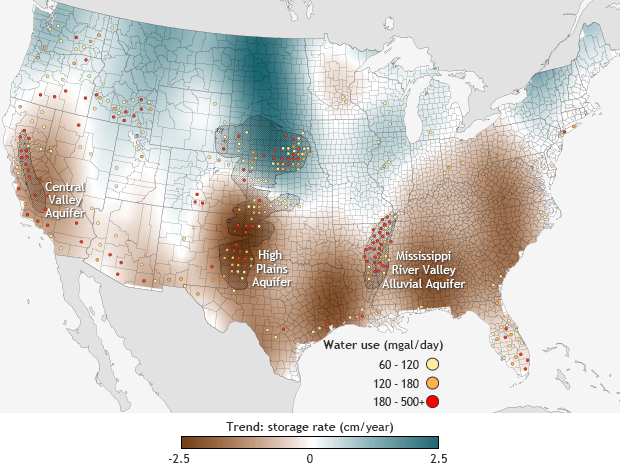
One of the most pressing issue facing agriculture in the US is the rapid and continued depletion of ground water in our most important food producing regions. But even more concerning is the degradation of farmland's ability to capture, store and cycle rainwater. The Ogallala Aquifer supports 30% of US irrigation and has lost 286 million acre-feet, or 93.2 trillion gallons, since agricultural development. Portions of Kansas and Texas are on pace for complete depletion in 20-50 years. Natural recharge occurs at less than one inch annually and full replenishment would take 6,000 years. California's Central Valley, producing 25% of national food supply, pumps groundwater 5x faster than its rate of recharge. The land has subsided up to 28 feet, permanently destroying aquifer storage capacity. As alarming as this may be, the long-term – and in some cases permanent – damage caused to aquifers pales in comparison to the disruption of the small water cycle. The small water cycle depends on vegetation recycling moisture through evapotranspiration, which generates over 50% of precipitation in most river basins. This "green water" accounts for 4-5x more agricultural water use than the "blue water" drawn from aquifers and rivers. When soil is disturbed and left bare, this pump fails. Further disrupting this cycle, bare agricultural soil reaches surface temperatures up to 24°C higher than vegetated areas, creating heat islands that repel rainfall while eliminating evaporative cooling entirely. US agricultural soils have lost 50% of original organic matter over that last century. Each 1% increase in organic matter allows soil to hold 20,000 additional gallons of water per acre. The widespread loss of 3-4 percentage points of organic matter means farmland now stores tens of thousands fewer gallons per acre than it once did, reducing natural drought resilience and increasing runoff. Conventional agriculture compounds this by collapsing soil aggregates through excessive tillage, leaving fields bare, applying synthetic fertilizers that accelerate organic matter decomposition, disrupting soil microbiology with pesticide applications and compacting soil with heavy machinery. The good news is, unlike aquifer depletion, the small water cycle can be repaired rapidly and in ways that offer a cascade of positive benefits to farms. Continuous living roots maintain the pore structure for infiltration. Growing roots open channels, decaying roots leave voids, and root exudates feed aggregate-building microorganisms. A functional and diverse soil microbiome produces biological glues that create water-stable aggregates. These networks increase hydraulic conductivity while enhancing water storage. Permanent soil cover reduces evaporation, prevents raindrop impact from sealing surfaces, and maintains biological activity. Five years of cover cropping can improve infiltration up to 200%. Integrated biological diversity drives the feedback loops between soil carbon, water retention, and climate regulation. Diverse rotations, livestock integration, and perennial crops restore landscape-scale water cycling. Aquifer depletion, in large part, cannot be undone. But restoring the small water cycle offers an immediate opportunity to rebuild and maintain agricultural water security.
Sam Knowlton tweet media
English
100
680
2.5K
219K
Nicolás E. Quintana Ashwell retweetledi
Steven N. Durlauf
Steven N. Durlauf@sndurlauf·
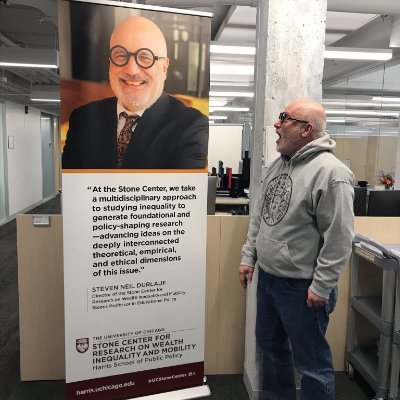
Exceptionally impressive study of the marginal effects of public university attendance by the wonderful Jack Mountjoy. Perhaps the most important finding involves the value of college to students admitted on the margin. ...despite the fact that marginally admitted students tend to arrive on campus with substantially weaker academic preparation and end up with below-average degree attainment and earnings relative to their university peers, the analysis in this paper shows that these outcomes are significant improvements over the typical trajectories these marginal students would have experienced had they been rejected instead. Moreover, since the benefits of enrolling marginal students surpass the costs, the results in this paper also suggest that marginally expanding admissions slots at public universities would tend to generate positive net returns, both for the newly admitted students themselves and for the taxpayers subsidizing the investment
QJE@QJEHarvard

Recently accepted by #QJE, “Marginal Returns to Public Universities,” by Jack Mountjoy: doi.org/10.1093/qje/qj…

English
5
56
289
73.9K
Nicolás E. Quintana Ashwell retweetledi
𝙎𝙇𝙀 𝘼𝙂𝙍𝙊🇧🇷
As margens operacionais da soja previstas em 2026: Brasil🇧🇷: 24% Argentina 🇦🇷: 8% EUA🇺🇸: 13% As margens operacionais são as sobras da receita do agricultor depois de pagar os custos variáveis de produção, mas antes de considerar itens como depreciação, custos financeiros, impostos ou remuneração do capital e da terra. Agro never stops. O Agro Não Para. Fonte: Rabobank
𝙎𝙇𝙀 𝘼𝙂𝙍𝙊🇧🇷 tweet media
Português
6
19
97
22.5K
Laura Nicolae
Laura Nicolae@lauramnicolae·
Spanish words rarely start with the letter f. Even when a word starts with f in all the other Romance languages, it usually starts with a silent h in Spanish. Ex: The verb “to do” is hacer in Spanish, vs. fazer (Port.), faire (Fr.), and fare (It.). Why? lauranicolae.substack.com/p/on-the-econo…
Laura Nicolae tweet media
English
4
11
62
35.3K
Nicolás E. Quintana Ashwell retweetledi
MSU CALS/MAFES
MSU CALS/MAFES@MSU_AG·
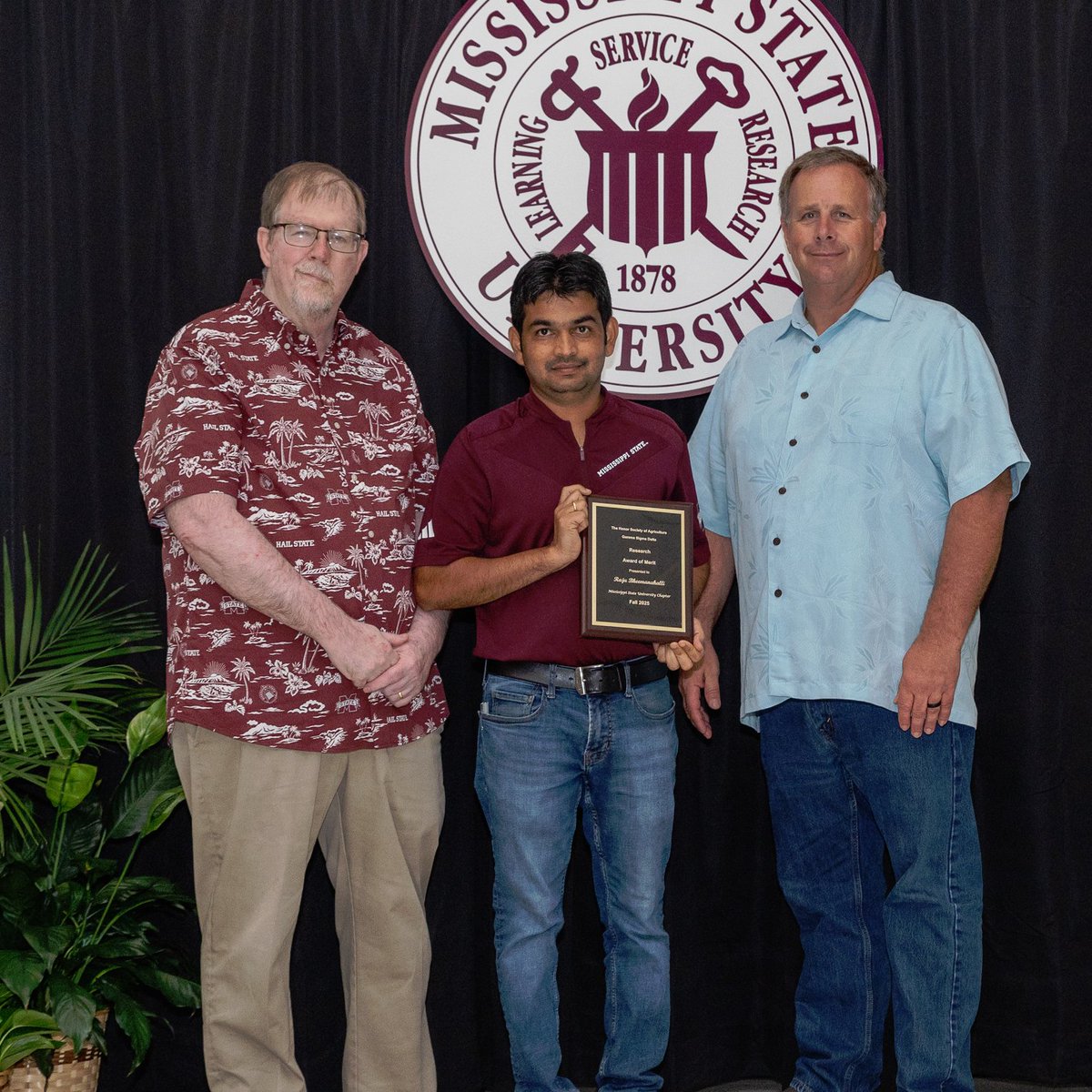
Congratulations to our #MSUAg Gamma Sigma Delta merit award winners! Teaching- Will Davis, associate professor, @MSStateAgEcon; Research- Raju Bheemanahalli, associate research professor, Plant and Soil Sciences; Extension- Elizabeth Canales, associate professor, Ag Econ.
MSU CALS/MAFES tweet mediaMSU CALS/MAFES tweet mediaMSU CALS/MAFES tweet media
English
0
2
4
338
Nicolás E. Quintana Ashwell retweetledi
Tom Allen
Tom Allen@baldpathologist·
The best southern rust management advice I can ever give you is to implore you to NOT spray corn at dent with a fungicide. We (unbiased entities) do not see a positive ROI with a fungicide made that late regardless of product @MStateCorn #mscrops
Tom Allen tweet media
English
4
20
62
5.6K
Nicolás E. Quintana Ashwell retweetledi
Erick Larson
Erick Larson@MStateCorn·
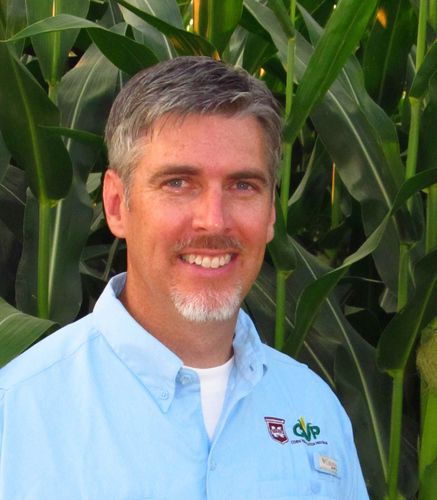
After a few sunny days, #corn is wilting. If we check the #soil, it is clear moisture is not short. Accordingly, leaf wilt is a very unreliable indicator of #irrigation needs. More sunshine and aeration are the best cure for this matter. 🌽#mscorn #MSUext #plant25 #mscrops
Erick Larson tweet media
English
2
17
40
3.6K
Nicolás E. Quintana Ashwell retweetledi
Tom Allen
Tom Allen@baldpathologist·
Galling from the southern root-knot nematode is oftentimes difficult to observe on young soybean plants. Look at the roots of “healthy” plants on the margins of areas where dead plants occur as a result of RKN @MSSOY #mscrops @MSUextPlantLab #Extension @changliunema
Tom Allen tweet mediaTom Allen tweet media
English
1
10
28
3.4K
Nicolás E. Quintana Ashwell retweetledi
farmdoc daily
farmdoc daily@farmdocDaily·
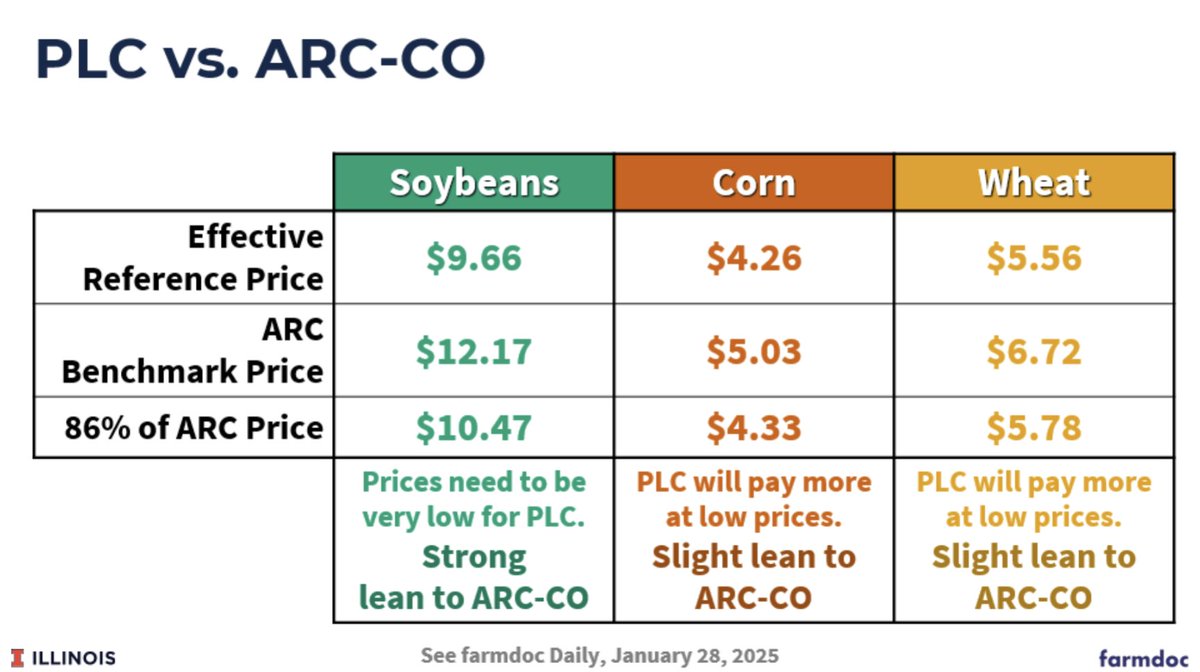
3/3 For #wheat in 2025, there is also a slight lean toward ARC-CO, though PLC will again likely pay more at low prices. From today's 'ARC/PLC Choice' webinar
farmdoc daily tweet media
English
0
3
6
960
Nicolás E. Quintana Ashwell
Nicolás E. Quintana Ashwell@WaterEcon_Delta·
This system has been tried by some farmers in the Delta (focused on yields) and there's a trial at @NCAAR_MSU looking into this (focused on profitability)+other alternatives being evaluated. Key is economic moisture level of corn at harvest+plant soybean behind combine.
MSU Extension@MSUExtService

At the Row Crop Short Course hosted in December by the Mississippi State University Extension Service, those in attendance heard about a double-cropping system not yet tried in Mississippi. Read more here: ow.ly/ATzc50V2fB6 #mscrops #MSUext

English
0
0
0
84
Nicolás E. Quintana Ashwell retweetledi
FarmPolicy
FarmPolicy@FarmPolicy·
UPDATE 2: White House Press Secretary Karoline Leavitt says earlier reporting about March 1 #tariff date is inaccurate and she confirms that "the president will be implementing tomorrow 25% tariffs on Mexico, 25% tariffs on Canada and a 10% tariff on China":
FarmPolicy@FarmPolicy

1/ Today's @FarmPolicy News Summary covers how "President Trump on Thursday said he plans to follow through on Saturday on his threat to impose 25 percent #tariffs on goods from #Mexico and #Canada." farmpolicynews.illinois.edu/2025/01/trump-…

English
0
2
2
1.6K
Nicolás E. Quintana Ashwell
Nicolás E. Quintana Ashwell@WaterEcon_Delta·
@LATAM_CO Yes we made the nearly hour long trip to the airport and the counter folks helped us. Glad to know this is a legit account.
English
0
0
0
10
LATAM Colombia
LATAM Colombia@LATAM_CO·
@WaterEcon_Delta Nicolás, we noted that now both are confirmed on the flights at 11:10 a.m and arriving at 6:34 p.m. Regarding the seats, we can use the paid seat as credit for the new seats and you pay the difference. Also, we can refund of this amount. Looking forward for your decision via DM
English
1
0
0
54