Chris Kelly
66.1K posts

Sabitlenmiş Tweet

A big TY @RyanTubridyShow @RTERadio1 for thanking the donor family who gave me a new lease of life with a kidney transplant @Beaumont_Dublin @IrishKidneyAs @Jarlath @JoeBrolly1993 @soniaagrith @paulreiddublin #WorldKidneyDay Please carry a donor card
English
Chris Kelly retweetledi

Chris Kelly retweetledi

"With close to 30 billion euros in corporate tax revenues, Ireland is now getting a decent chunk of revenue out of some of the world’s most profitable global companies," writes expert @Brad_Setser. cfr.org/articles/the-l…
English
Chris Kelly retweetledi

“This has nothing to do with me. It’s like the Cultural Revolution or the ’90s mass layoff of the state-owned enterprises. It’s a historical cycle. It's just our turn. When the Titanic is sinking, all you can do is try to go down with some dignity.” nytimes.com/2026/03/21/bus…
English
Chris Kelly retweetledi

This is WILD.
Peter Thiel just bet $2 billion on a collar that wraps around a cow’s neck.
The company is called Halter and it has a proprietary algorithm that runs the entire operation.
They actually trademarked the name for it and called it the Cowgorithm and here's how it works.
A farmer opens an app, taps a button, and 600,000 cows across three countries start walking toward the milking station on their own.
No farm dogs, fences or physical labor, it's just a solar-powered GPS collar sending sound and vibration cues to each animal.
The collar does more than move cows around.
It monitors digestion, fertility cycles, and health patterns in real time, 24 hours a day, using machine learning trained on the behavior of hundreds of thousands of animals.
Halter was founded by a rocket engineer who built spacecraft at Rocket Lab before deciding that farming was the bigger unsolved problem.
US ranchers alone have already used the technology to build over 11,000 miles of virtual fencing, roughly the full perimeter of the continental United States, saving an estimated $220 million in physical fencing costs.
Halter's previous funding round valued the company at $1 billion.
This new round, led by Thiel's Founders Fund, doubles that valuation to $2 billion before the new money even hits the account.
And they charge farmers between $5 and $8 per animal per month on a subscription model, meaning the more cows they collar, the more locked-in the revenue becomes.
The most powerful venture capitalist on earth just decided that the future of food and farming runs through an algorithm named after a cow.
He might be right.
Bloomberg@business
Peter Thiel’s Founders Fund is backing a company bringing AI to cow herding at a $2 billion valuation bloomberg.com/news/articles/…
English
Chris Kelly retweetledi

Irish in World Indoors Sunday ☘️
09:12 - Kate O’Connor (60m Hurdles)
09:43 - Kate O’Connor (High Jump)
11:55 - Sarah Lavin (60m Hurdles Heat 1)
12:21 - Kate O’Connor (Shot Put)
16:40 - Kate O’Connor (Long Jump)
17:51 - Sarah Lavin (60m Hurdles SF)*
19:03 - Kate O’Connor (800m)
19:13 - Sarah Lavin (60m Hurdles Final)*
Live on Virgin Media / BBC 🎥
*If qualified
English
Chris Kelly retweetledi

⚡️⚡️⚡️BREAKING: Ukrainian long-range drones struck Russian targets overnight in Saratov, Engels, and Tolyatti (Samara Oblast), with reports of explosions, a major fire at an oil refinery (likely in Tolyatti or near Saratov), power outages in parts of Saratov, and damage to the massive TolyattiAzot plant—one of the world's top ammonia producers critical for Russian fertilizers and industry.
Refinery fires often lead to weeks or months of halted production (potentially millions of barrels of refining capacity offline), while damage to ammonia facilities like TolyattiAzot risks supply chain disruptions worth hundreds of millions in lost output and repairs.
English
Chris Kelly retweetledi

For Mark English, this one hurt more than most.
Morning report from Torun:
independent.ie/sport/other-sp…
English
Chris Kelly retweetledi

Did you know a handful of raspberries can blunt dangerous post-meal blood sugar spikes — a key driver of diabetes complications?
In a study of adults with type 2 diabetes, adding raspberries to meals significantly lowered glucose AND inflammation markers right after eating.
Even better: After 4 weeks, chronic inflammation dropped — without changing fasting glucose!
Raspberries are low-calorie, delicious, and surprisingly powerful for metabolic health. Are you adding more berries to their meals?
#AntiInflammatoryDiet
#BetterBloodSugar
Source:
Edwards, C. G., et al. (2019). Raspberries Improve Postprandial Glucose and Acute and Chronic Inflammation in Adults with Type 2 Diabetes. Annals of Nutrition & Metabolism. DOI: 10.1159/000497226
English
Chris Kelly retweetledi

A long-ish post about China and energy security buffers and strategic reserves, building on @IsabellaMWeber's very sensible comments:
Energy security has been a feature in Chinese economic planning for decades, of course, but up until the early 2010s, it was mostly framed in FYPs and other high-level documents as a question of adequacy (i.e. "we must secure enough energy supplies to ensure no barriers or drags on industrialization").
The early Xi-era was the inflection point, in my view. Beginning around 2014, Chinese leaders began reframing energy security as a multidimensional strategic concept that included supply, sufficiency technology advancement, geopolitics, and energy transition risk. For example, check out Xi's June 2014 speech to the Central Financial Work Leading Group on China's energy security strategy (linked at the end). This was a relatively fresh (for China at the time) way of discussing Chinese energy strategy.
In the next FYP (13th FYP from 2016-2020), energy security starts to be framed more as a system reliability issue, not just a industrial capacity issue. It starts talking about diversification of supply and climate and efficiency goals, and power market reform is partially presented as a energy security tool. This may have also been a politically expedient way to promote unpopular reforms (at least for the SOEs) but it was also useful and good.
This all got super explicit in the next FYP (14th FYP from 2021 to 2025, linked at the end). Chapter 53 "Strengthening Safeguards for Our Nation's Economic Security" had a Section 2 called "Energy and Resource Security Strategy" with mentions of ensuring secure supply, oil and gas self-reliance, enhancing strategic reserves, using "coal as the foundation" and framing power system reliability as a political priority. This was of course further underlined by the power shortages in 2021, followed by the global energy crisis in 2022 with the Russia-Ukraine war. The China energy system that exists at this moment in 2026 is the product of this 14th FYP. If 2021 and 2022 didn't happen the way they did, China probably would still be in decent shape today, but they DID happen, and lessons were learned, and the overall system is that much more robust for it.
And then we have the newest FYP (15th FYP from 2026 to 2030) which we are still analyzing and awaiting more details on, but within which I'd say energy security continues to be a defining theme of the energy strategy sections. The broad story I'm reading now from the 15th FYP is: electricity is the primary instrument of energy security, with renewables, nuclear, storage, grids, and electrification seen as tools to offset imports, absorb shocks, and preserve industrial competitiveness. Coal is explicitly retained as the strategic energy reserve and flexibility source of choice (not gas or petroleum). Energy security, industrial policy, and geopolitical risk management are fully merged into one unified political and economic paradigm.
So yeah, China didn't just stumble into a position of resilience for the current Iran war/Hormuz energy shock - it's been building up to it (and sharing its strategy quite publicly, mind you) for the last 12+ years, essentially all of Xi's tenure...!
Xi's 2014 speech:
ncuscr.org/wp-content/upl…
13th FYP official translation
en.ndrc.gov.cn/policies/20210…
14th FYP officialtranslation:
en.ndrc.gov.cn/policies/20230…
15th FYP (no official translation yet, only machine-translation English available):
files.bengxie.cc/15th-five-year…
Isabella M Weber@IsabellaMWeber
I have studied China for years and have been banging the drum for buffer stocks in essentials like food and energy with Western policy makers. The response was always some version of market fundamentalism: it’s not efficient, it distorts prices etc. Well, here we are.
English
Chris Kelly retweetledi

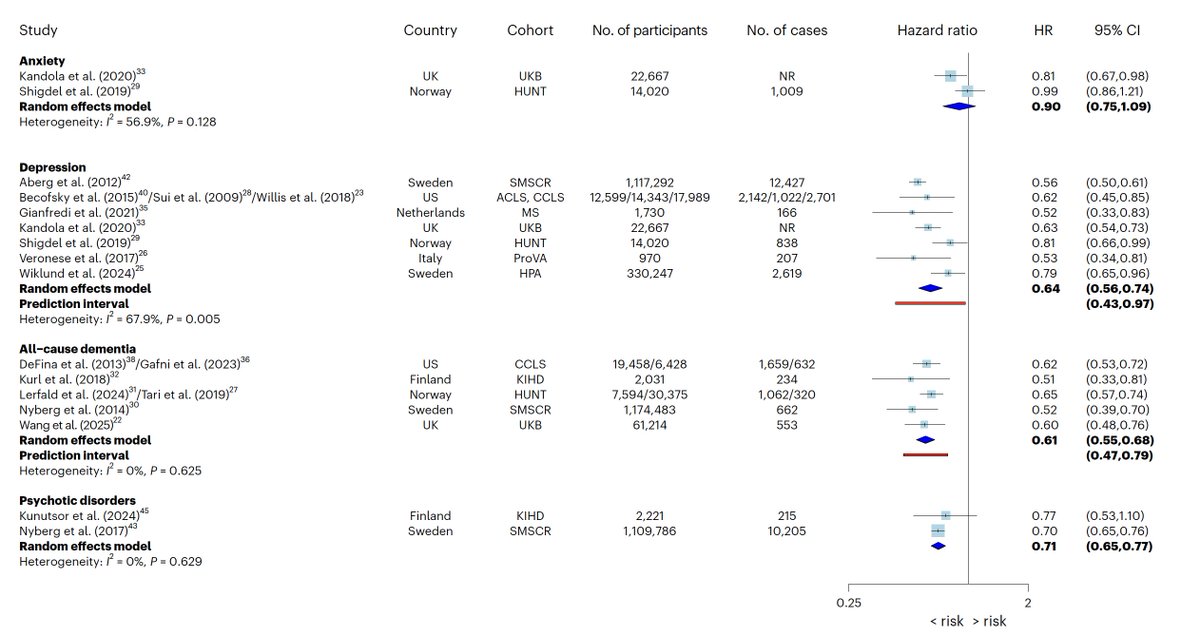
The relationship between increased cardiorespiratory fitness (METS) and reduced risk of all-cause dementia, depression, and psychotic disorders. From over 4 million individuals in 27 studies @NatMentHealth
[association, not cause and effect evidence]
nature.com/articles/s4422…

English
Chris Kelly retweetledi

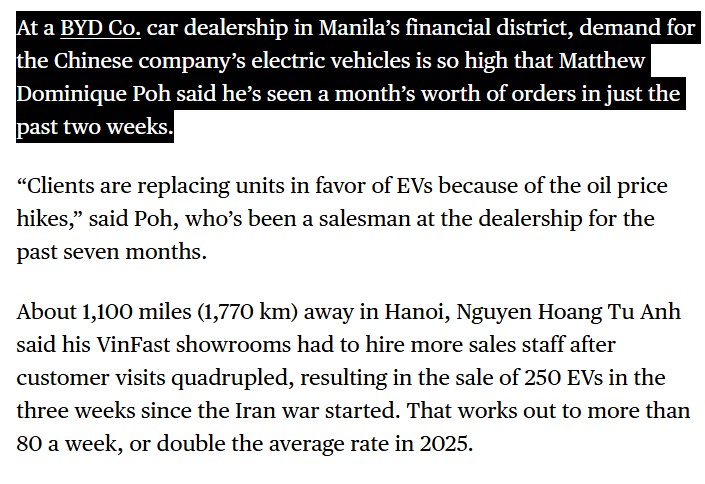
WOW. Just in the last two weeks, BYD showrooms around the world are seeing a surge in customer demand from people who are deciding that now is the time to switch to EVS, with oil prices so high. bloomberg.com/news/articles/…

English
Chris Kelly retweetledi

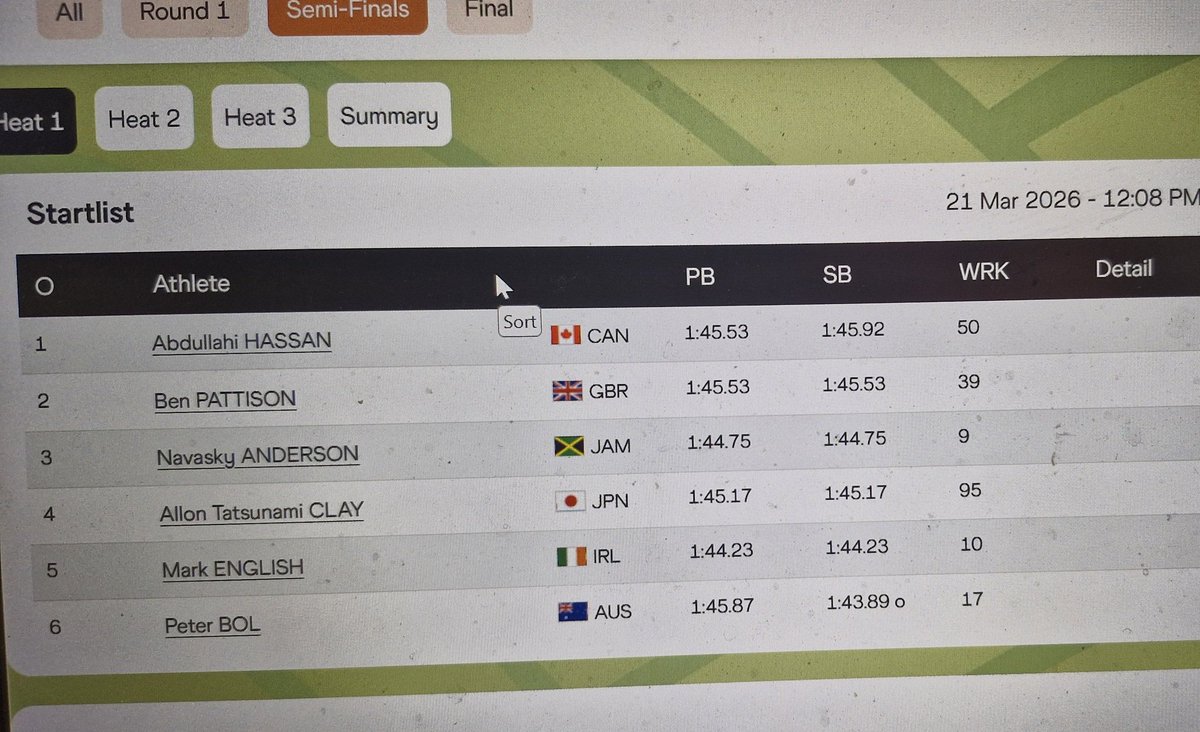
Draw is out for Mark English's 800m semi-final tomorrow and it's as good as he could hope for.
Top two to go through. Huge, huge chance to make his first global final.

Cathal Dennehy@Cathal_Dennehy
Smooth as it gets, Mark English marches on to the world indoor semi-final after winning his heat in 1:46.42. He has yet to make a global final, but it's very much within reach.
English
Chris Kelly retweetledi

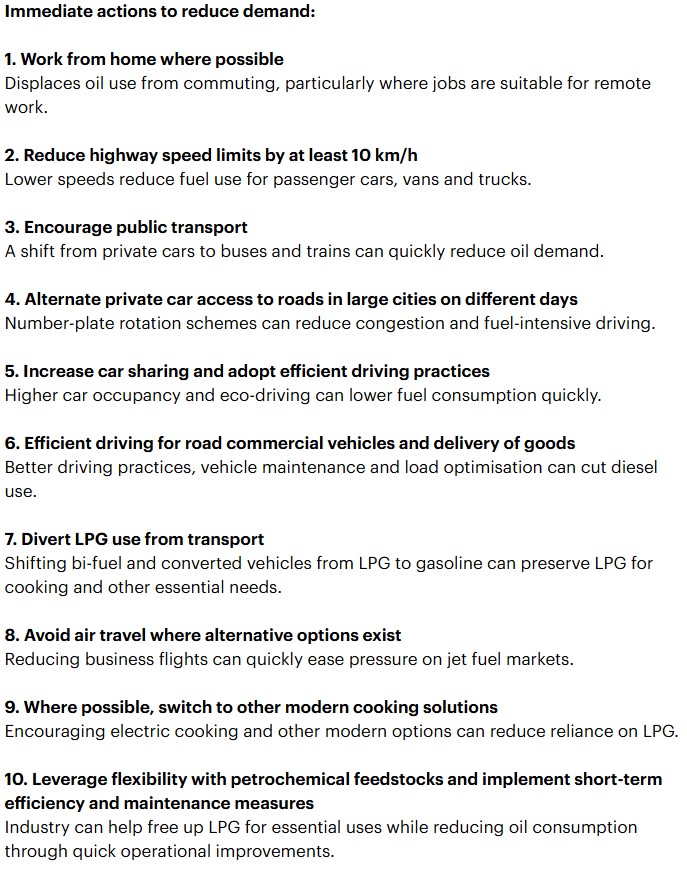
The International Energy Agency is this morning suggesting people should work from home, avoid air travel and drive at lower speeds to help tackle impending oil shortages
The International Energy Agency (IEA) has issued a list of “demand side measures” that governments, businesses and households could take to alleviate the impact of soaring oil prices and disruption to supplies
It has also recommended that ministers could reduce road speed limits, reduce car access to designated zones in large cities and give vehicles with odd-numbered plates access on different weekdays to those with even-numbered plates.
Fatih Birol, the IEA executive director, said: “The war in the Middle East is creating a major energy crisis, including the largest supply disruption in the history of the global oil market. In the absence of a swift resolution, the impacts on energy markets and economies are set to become more and more severe.”
The report also recommended that travellers “avoid air travel where alternative options exist” and switch from private cars to public transport

English