XLANG NLP Lab
140 posts

XLANG NLP Lab
@XLangNLP
developing embodied AI agents that empower users to use language to interact with digital and physical environments to carry out real-world tasks.


Introducing ChatGPT Work, a new agent in ChatGPT powered by Codex and GPT-5.6. It can take action across your apps and files, stay with a project for hours if needed, and turn a goal into finished work. It’s a whole new way to get work done.

Two years ago, we built OSWorld 1.0 — the benchmark that became the standard for computer-use agents. Agents now score 83.5% on it. Problem solved? Not even close. 🚀Today we introduce OSWorld 2.0: Benchmarking Computer Use Agents on Long-Horizon Real-World Tasks. What's new: 🎯 108 real-world workflows, each ~1.6 hours ⏱️ for a skilled human ⚙️ ~318 tool calls/task vs. ~30 in OSWorld 1.0 🌍 Grounded in authentic artifacts & stateful user profiles ⚡ Captures real phenomena: dynamic environments, streaming interaction, cross-source reasoning, implicit-state inference & more 📊 Best results: Claude Opus 4.8 reaches the highest accuracy at 20.6%, while GPT-5.5 is far more token-efficient but plateaus near 13%. No one is close to solving real computer use. 🏠 Homepage: osworld-v2.xlang.ai 📄 Paper: github.com/xlang-ai/OSWor… 💻 Code: github.com/xlang-ai/OSWor… 🤗 Dataset: huggingface.co/datasets/xlang… 🧵 [1/8]

Two years ago, we built OSWorld 1.0 — the benchmark that became the standard for computer-use agents. Agents now score 83.5% on it. Problem solved? Not even close. 🚀Today we introduce OSWorld 2.0: Benchmarking Computer Use Agents on Long-Horizon Real-World Tasks. What's new: 🎯 108 real-world workflows, each ~1.6 hours ⏱️ for a skilled human ⚙️ ~318 tool calls/task vs. ~30 in OSWorld 1.0 🌍 Grounded in authentic artifacts & stateful user profiles ⚡ Captures real phenomena: dynamic environments, streaming interaction, cross-source reasoning, implicit-state inference & more 📊 Best results: Claude Opus 4.8 reaches the highest accuracy at 20.6%, while GPT-5.5 is far more token-efficient but plateaus near 13%. No one is close to solving real computer use. 🏠 Homepage: osworld-v2.xlang.ai 📄 Paper: github.com/xlang-ai/OSWor… 💻 Code: github.com/xlang-ai/OSWor… 🤗 Dataset: huggingface.co/datasets/xlang… 🧵 [1/8]

Two years ago, we built OSWorld 1.0 — the benchmark that became the standard for computer-use agents. Agents now score 83.5% on it. Problem solved? Not even close. 🚀Today we introduce OSWorld 2.0: Benchmarking Computer Use Agents on Long-Horizon Real-World Tasks. What's new: 🎯 108 real-world workflows, each ~1.6 hours ⏱️ for a skilled human ⚙️ ~318 tool calls/task vs. ~30 in OSWorld 1.0 🌍 Grounded in authentic artifacts & stateful user profiles ⚡ Captures real phenomena: dynamic environments, streaming interaction, cross-source reasoning, implicit-state inference & more 📊 Best results: Claude Opus 4.8 reaches the highest accuracy at 20.6%, while GPT-5.5 is far more token-efficient but plateaus near 13%. No one is close to solving real computer use. 🏠 Homepage: osworld-v2.xlang.ai 📄 Paper: github.com/xlang-ai/OSWor… 💻 Code: github.com/xlang-ai/OSWor… 🤗 Dataset: huggingface.co/datasets/xlang… 🧵 [1/8]


Two years ago, we built OSWorld 1.0 — the benchmark that became the standard for computer-use agents. Agents now score 83.5% on it. Problem solved? Not even close. 🚀Today we introduce OSWorld 2.0: Benchmarking Computer Use Agents on Long-Horizon Real-World Tasks. What's new: 🎯 108 real-world workflows, each ~1.6 hours ⏱️ for a skilled human ⚙️ ~318 tool calls/task vs. ~30 in OSWorld 1.0 🌍 Grounded in authentic artifacts & stateful user profiles ⚡ Captures real phenomena: dynamic environments, streaming interaction, cross-source reasoning, implicit-state inference & more 📊 Best results: Claude Opus 4.8 reaches the highest accuracy at 20.6%, while GPT-5.5 is far more token-efficient but plateaus near 13%. No one is close to solving real computer use. 🏠 Homepage: osworld-v2.xlang.ai 📄 Paper: github.com/xlang-ai/OSWor… 💻 Code: github.com/xlang-ai/OSWor… 🤗 Dataset: huggingface.co/datasets/xlang… 🧵 [1/8]

Two years ago, we built OSWorld 1.0 — the benchmark that became the standard for computer-use agents. Agents now score 83.5% on it. Problem solved? Not even close. 🚀Today we introduce OSWorld 2.0: Benchmarking Computer Use Agents on Long-Horizon Real-World Tasks. What's new: 🎯 108 real-world workflows, each ~1.6 hours ⏱️ for a skilled human ⚙️ ~318 tool calls/task vs. ~30 in OSWorld 1.0 🌍 Grounded in authentic artifacts & stateful user profiles ⚡ Captures real phenomena: dynamic environments, streaming interaction, cross-source reasoning, implicit-state inference & more 📊 Best results: Claude Opus 4.8 reaches the highest accuracy at 20.6%, while GPT-5.5 is far more token-efficient but plateaus near 13%. No one is close to solving real computer use. 🏠 Homepage: osworld-v2.xlang.ai 📄 Paper: github.com/xlang-ai/OSWor… 💻 Code: github.com/xlang-ai/OSWor… 🤗 Dataset: huggingface.co/datasets/xlang… 🧵 [1/8]

Two years ago, we built OSWorld 1.0 — the benchmark that became the standard for computer-use agents. Agents now score 83.5% on it. Problem solved? Not even close. 🚀Today we introduce OSWorld 2.0: Benchmarking Computer Use Agents on Long-Horizon Real-World Tasks. What's new: 🎯 108 real-world workflows, each ~1.6 hours ⏱️ for a skilled human ⚙️ ~318 tool calls/task vs. ~30 in OSWorld 1.0 🌍 Grounded in authentic artifacts & stateful user profiles ⚡ Captures real phenomena: dynamic environments, streaming interaction, cross-source reasoning, implicit-state inference & more 📊 Best results: Claude Opus 4.8 reaches the highest accuracy at 20.6%, while GPT-5.5 is far more token-efficient but plateaus near 13%. No one is close to solving real computer use. 🏠 Homepage: osworld-v2.xlang.ai 📄 Paper: github.com/xlang-ai/OSWor… 💻 Code: github.com/xlang-ai/OSWor… 🤗 Dataset: huggingface.co/datasets/xlang… 🧵 [1/8]


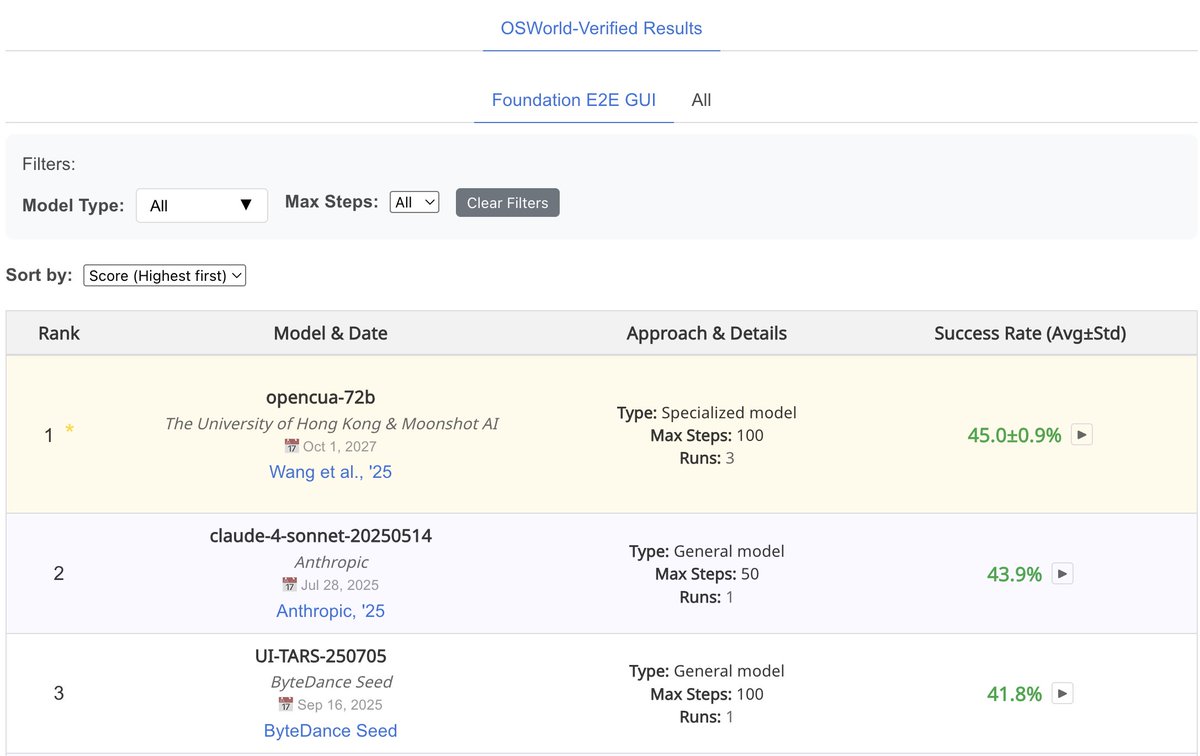
We are super excited to release OpenCUA — the first from 0 to 1 computer-use agent foundation model framework and open-source SOTA model OpenCUA-32B, matching top proprietary models on OSWorld-Verified, with full infrastructure and data. 🔗 [Paper] arxiv.org/abs/2508.09123 📌 [Website] opencua.xlang.ai 🤖 [Models] huggingface.co/xlangai/OpenCU… 📊[Data] huggingface.co/datasets/xlang… 💻 [Code] github.com/xlang-ai/OpenC… 🌟 OpenCUA — comprehensive open-source framework for computer-use agents, including: 📊 AgentNet — first large-scale CUA dataset (3 systems, 200+ apps & sites, 22.6K trajectories) 🏆 OpenCUA model — open-source SOTA on OSWorld-Verified (34.8% avg success, outperforms OpenAI CUA) 🖥 AgentNetTool — cross-system computer-use task annotation tool 🏁 AgentNetBench — offline CUA benchmark for fast, reproducible evaluation 💡 Why OpenCUA? Proprietary CUAs like Claude or OpenAI CUA are impressive🤯 — but there’s no large-scale open desktop agent dataset or transparent pipeline. OpenCUA changes that by offering the full open-source stack 🛠: scalable cross-system data collection, effective data formulation, model training strategy, and reproducible evaluation — powering top open-source models including OpenCUA-7B and OpenCUA-32B that excel in GUI planning & grounding. Details of OpenCUA framework👇

We are super excited to release OpenCUA — the first from 0 to 1 computer-use agent foundation model framework and open-source SOTA model OpenCUA-32B, matching top proprietary models on OSWorld-Verified, with full infrastructure and data. 🔗 [Paper] arxiv.org/abs/2508.09123 📌 [Website] opencua.xlang.ai 🤖 [Models] huggingface.co/xlangai/OpenCU… 📊[Data] huggingface.co/datasets/xlang… 💻 [Code] github.com/xlang-ai/OpenC… 🌟 OpenCUA — comprehensive open-source framework for computer-use agents, including: 📊 AgentNet — first large-scale CUA dataset (3 systems, 200+ apps & sites, 22.6K trajectories) 🏆 OpenCUA model — open-source SOTA on OSWorld-Verified (34.8% avg success, outperforms OpenAI CUA) 🖥 AgentNetTool — cross-system computer-use task annotation tool 🏁 AgentNetBench — offline CUA benchmark for fast, reproducible evaluation 💡 Why OpenCUA? Proprietary CUAs like Claude or OpenAI CUA are impressive🤯 — but there’s no large-scale open desktop agent dataset or transparent pipeline. OpenCUA changes that by offering the full open-source stack 🛠: scalable cross-system data collection, effective data formulation, model training strategy, and reproducible evaluation — powering top open-source models including OpenCUA-7B and OpenCUA-32B that excel in GUI planning & grounding. Details of OpenCUA framework👇


We are super excited to release OpenCUA — the first from 0 to 1 computer-use agent foundation model framework and open-source SOTA model OpenCUA-32B, matching top proprietary models on OSWorld-Verified, with full infrastructure and data. 🔗 [Paper] arxiv.org/abs/2508.09123 📌 [Website] opencua.xlang.ai 🤖 [Models] huggingface.co/xlangai/OpenCU… 📊[Data] huggingface.co/datasets/xlang… 💻 [Code] github.com/xlang-ai/OpenC… 🌟 OpenCUA — comprehensive open-source framework for computer-use agents, including: 📊 AgentNet — first large-scale CUA dataset (3 systems, 200+ apps & sites, 22.6K trajectories) 🏆 OpenCUA model — open-source SOTA on OSWorld-Verified (34.8% avg success, outperforms OpenAI CUA) 🖥 AgentNetTool — cross-system computer-use task annotation tool 🏁 AgentNetBench — offline CUA benchmark for fast, reproducible evaluation 💡 Why OpenCUA? Proprietary CUAs like Claude or OpenAI CUA are impressive🤯 — but there’s no large-scale open desktop agent dataset or transparent pipeline. OpenCUA changes that by offering the full open-source stack 🛠: scalable cross-system data collection, effective data formulation, model training strategy, and reproducible evaluation — powering top open-source models including OpenCUA-7B and OpenCUA-32B that excel in GUI planning & grounding. Details of OpenCUA framework👇