Sabitlenmiş Tweet
Xavionis
418 posts

Xavionis
@Xavionis
Behavioral escalation layer for recurring transaction environments. Explainable sequence logic for retries, renewals, decision drift and review-heavy flows.
Global Katılım Şubat 2026
65 Takip Edilen10 Takipçiler

@BensonBenn12520 Alerts help answer “what happened.”
The next layer is understanding the chain around the event: failed renewal → retry → access state → support ticket → manual review.
That’s where retention risk often lives.
@Xavionis
English

Stripe dashboards answer: “What happened?”
Founders care about: “Did something unusual happen?”
That’s why I built: → Stripe signals → retention monitoring → pre-filled workflows
No noise. Just important alerts.
#SaaS #Stripe #BuildInPublic
English

@yashdev_2003 Good distinction.
One nuance: involuntary churn isn't just about failed payments - it's about the chain after: renewal → retry → access confusion → support ticket → manual review.
That's where many recovery attempts fail even when the payment eventually goes through.
English

Two types of churn. Both are killing your MRR. And they need completely different fixes.
**Voluntary churn** = a customer makes a conscious decision to cancel.
They're not happy. They feel the product isn't worth the price, doesn't solve their problem, or they found something better. By the time they hit the cancel button, they've already mentally moved on. The damage happened 2-4 weeks before the click.
The fix: intervention before the button. Behavioral signals (dropping logins, narrowing feature usage, support tickets about pricing). A cancellation flow that captures the reason, maps it to the right save offer, and gives them an exit that isn't permanent (pause, downgrade, credit).
**Involuntary churn** = a customer had no intention of leaving. Their card failed.
Maybe it expired. Maybe the bank flagged an unusual charge. Maybe they hit their limit on a rough month. They still want your product. They'd be confused if you told them they'd "cancelled." But if you don't recover that payment fast, with the right timing, the right channel, and a frictionless update path, they're gone anyway.
The fix: intelligent retry logic (timed to failure reason, not a generic 3-day interval), multi-channel dunning (email + in-app banner + SMS), and a card update experience that loads in under 2 seconds and doesn't require a login.
Most tools fix one.
Most founders ignore the other.
And almost no payment processor handles either one well, because that's not their job.
See how your churn breaks down → recurflux.com/resources/chur…
English

@subscriptiondoc As the category matures, I think more attention will move from “how do we run subscriptions?” to “how do we manage the messy edge cases around renewals, access, support and retention?”
That operational layer is where a lot of customer trust is won or lost.
English

This is so huge I don’t think people realize what they’re building. Incredible win for all subscription brands!!
Oisin@OisinO
My company, Recharge, just acquired Skio for $105m. This is the largest private acquisition in the space ever. Just 5 years ago I got a crazy phone call that nearly killed us... Here’s the story I've never told anyone before:
English

@subscriptiondoc The stronger the membership promise, the more important the operational experience becomes.
If customers prepay or commit upfront, access state, renewal clarity, support context and issue resolution have to stay very clean.
The offer creates trust. Operations have to protect it
English

The best subscription offer I heard this week:
A yearly membership priced at 1.5x AOV. Members get every dollar back in store credit.
The brand frontloads LTV. The customer gets full value. It feels like a no-brainer because it is.
That's not an email problem. That's an offer problem. Get the offer right first.
English

@subscriptiondoc Exactly. Churn is often measured at the end of the story, but the decision may start much earlier.
In subscriptions, small operational frictions can accumulate before cancellation: failed renewal, unclear access, confusing support path, delayed manual decision.
English

A brand sees churn spike after an email campaign and stops emailing subscribers.
But did the email cause the churn? Or did it just surface a decision subscribers had already made?
Correlation isn't causation. One data point isn't a strategy. Before you kill a channel, understand what actually happened.
English

@subscriptiondoc Strong point. One retention layer that often gets underestimated is the operational path after a subscription issue.
A failed renewal, unclear access state or slow support/manual decision can quietly reduce LTV even if the offer and acquisition side are strong.
English

@PhilipPages This is a good example of how churn can start as a payment event but become an operational problem
The failed card is the trigger
But what happens next-retry logic, access state, customer messaging, support path- often determines whether the customer is recovered or silently lost
English

It's truly mind-boggling to see $20M ARR brands spend millions on ads then throw a bunch of that work down the drain.
You acquire a customer for your subscription package, they buy from you for 2 months, then their payment card fails on month 3, and they disappear forever.
Every mega-subscription business (think Amazon, Netflix) is spending millions of dollars every year going to the ends of the Earth to fix those payment issues, often using advanced machine learning to narrow down custom solutions for each customer one-by-one. They need to because there are hundreds of reasons for card decline.
But your typical B2C brand is fighting this battle with a plastic fork.
This stuff is opaque and confusing on purpose, and you only get minimal help from your payment processor (i.e. Stripe). So most brands either have no clue this issue exists or give up because it's so hard to figure out.
A simple way to start is to take a deep dive into your churn: How many are due to failed payments, and how does that compare to your peers?
English

@PhilipPages The “Stripe handles it” assumption stops too early.
Even when Stripe processes the transaction, the business still owns the sequence after: retry path, access state, support visibility, customer trust.
That operational layer is where many recoveries fail.
@Xavionis.
English

It drives me crazy to see subscription companies ignore the reality that 48% of churn - yes, almost half - has nothing to do with your services.
It comes from failed payments.
"Oh but Stripe handles that."
Are you sure about that?
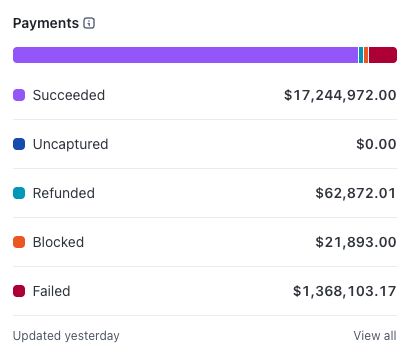
Take a look at your dashboard. See how many failed payments Stripe actually cannot recover. It's a big red bar. It's a lot. A ton.
Then multiply that by your average Customer Lifetime Value.
$100 missed payment X average customer staying 9 months = $900 down the drain.
"OK but there's nothing I can do about that."
The truth is there are hundreds of error codes that cause a declined payment. And Stripe's algorithm is geared toward fixing common payment fail errors that affect millions of businesses - not the unique failed payment issues that subscription companies face.
For instance:
You try processing a payment at 7 p.m. in LA. But the customer lives in London, where it's 1 a.m. Their UK bank's fraud detectors flag and shut down the payment.
All you'd need to do is retry it during normal London business hours and the payment will go through. Suddenly a dead customer is revived.
When you look across all these different error codes, you can boost ARR by 8% on average just by getting into the weeds, which is what the big brands like Netflix and Disney do. They pay a lot for their payment recovery services because it's a huge profit center.
I am sitting here begging you to re-think how to solve churn by looking closer at failed transactions.

English

@PhilipPages Strong point.
Recovery adds cycles, but the leak often starts before the payment fails. The sequence that matters: renewal → retry → access confusion → support ticket → manual review.
Fixing that chain prevents churn before recovery is needed.
English

When you fix a customer's failed payment, they stay on for an average of 5.1 more billing cycles.
So if you charge $20 a month and lose a subscriber due to a failed payment, getting them back gets you $102 in lifetime value.
Yeah, we've done tens of thousands of these and that's what our internal data shows. It's surprising to some founders because "failed payment" subscribers are seen as lost causes who aren't interested in paying.
Otherwise they would have fixed their payment problem, right?
Turns out a lot of people simply have no idea their payment failed and need to be reminded.
Or have it fixed for them by retrying the card at a better time. Or they opted out because the failed payment created a log-in error and they gave up.
They fell through the cracks and want to give you 5 months more revenue. Let them.

English

@joygospelv True. But tracking involuntary churn as a percentage still hides the real leak.
The problem isn't one failed payment - it's the sequence: failed renewal → retry → support ticket → manual review → churn.
Measurement needs to map the chain, not just the total.
English

A thought after a week deep in Razorpay's subscription docs and public benchmarks from FlyCode and Recurly:
Every Indian SaaS founder knows what "churn" is.
Almost none track their involuntary churn rate separately.
This isn't a product problem.
It's a measurement problem.
The founders who'll win in Indian SaaS over the next 3 years won't be the ones with the best product.
They'll be the ones who identify every leak in their revenue and close them one by one.
Failed payments are the biggest untracked leak.
That's why we're building @ The Vaultr.
English

@AkwaabaApp @AnthropicAI Subscription payment fails while usage credits work - classic sign of a broken sequence, not just a single decline.
The real friction often hides in: failed renewal → confused access → support ticket → manual review → ongoing churn risk.
Diagnostics‑first would map that gap.
English

@AnthropicAI @AnthropicAI been trying to upgrade Pro to Max for 24 hours. Payment fails on subscription but the same card processes usage credits fine every five minutes. Support ticket 215474304236919 going nowhere. Can someone escalate this? Burning cash on workarounds.
English

@Ofir_Friedman Hi Ofir!
Xavionis helps with recurring payment/access sequences: renewal → failed payment → support → manual review → churn risk.
Not a processor or antifraud - we surface behavioral patterns.
Is this your area, or who should I send an overview to?
English