Baby💕

3K posts

Baby💕 banner
Baby💕

Baby💕

@Y4n_tee

TopTier💕

Katılım Mayıs 2022
548 Takip Edilen151 Takipçiler
future
future@abdul_Quduus·
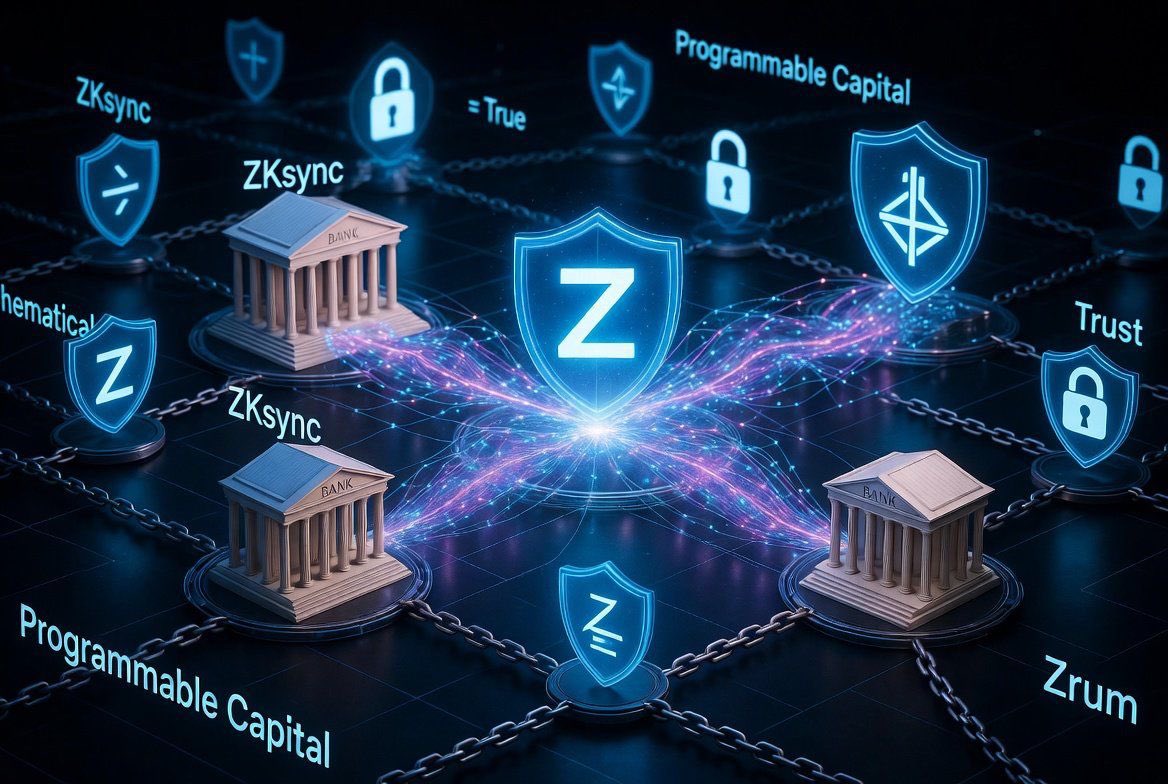
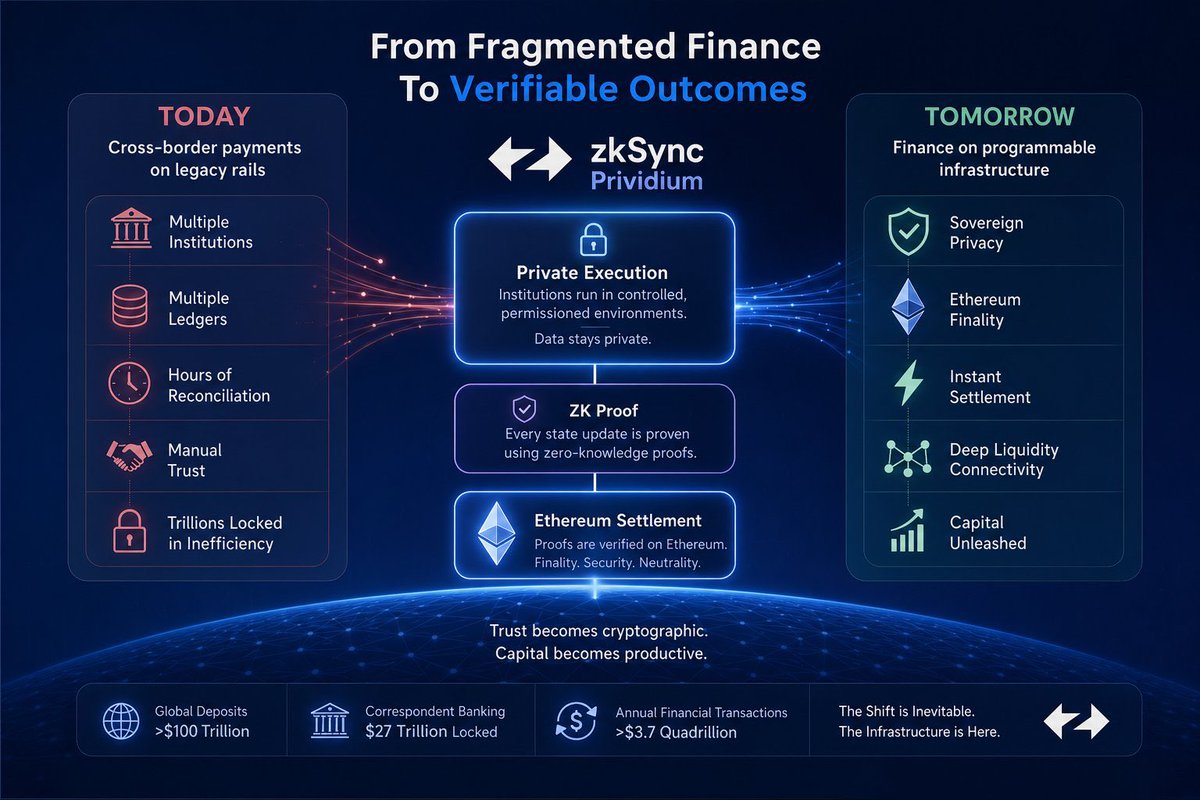
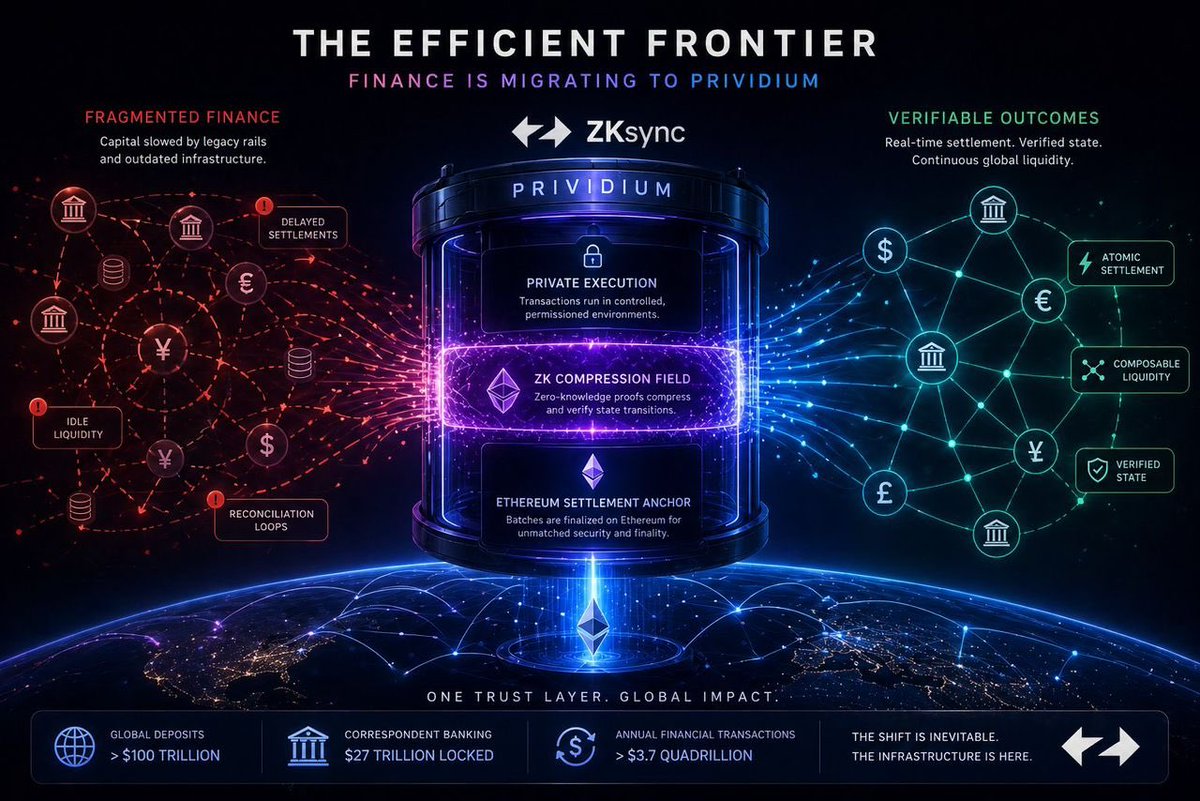
I once asked someone in banking why money that moves digitally still takes days to settle. He said the delay isn’t technical, it’s trust. Every institution keeps its own ledger, so reconciliation becomes the real bottleneck. That explains why over $27T sits pre-funded just to keep payments flowing. The current system looks like this: separate ledgers → manual trust → capital locked → delayed settlement When I studied how @zksync approaches this, the shift wasn’t about speed, it was about redesigning trust itself. Prividium lets institutions execute transactions privately inside their own controlled environment, then prove the outcome with a zk proof. No sensitive data leaves that environment. Only the proof and state commitment are published and settled on Ethereum, inheriting its finality. So the model becomes: private execution → zk proof → Ethereum finality No pre-funding across fragmented systems. No dependency on intermediaries to validate outcomes. Each state update is verified mathematically, not institutionally. That changes coordination more than it changes throughput. If trust is no longer something institutions maintain between each other, but something proven cryptographically, what exactly are we still paying all that friction for?
future tweet media
English
9
2
67
41.1K
future
future@abdul_Quduus·
I can confidently say there’s a part of global finance that rarely gets discussed openly: how much capital is not being used. Correspondent banking alone locks roughly $27T in pre-funded liquidity. That’s not investment capital. It’s capital sitting idle, parked across accounts just to make cross-border settlement possible. From an economic standpoint, that’s friction at scale. When capital has to be duplicated across institutions just to maintain trust, the system is already inefficient before a single transaction happens. What’s interesting about @zksync isn’t just “bringing finance onchain.” It’s how it removes the need for that duplication entirely. Prividium, built with the ZK Stack, is a permissioned ZK Chain operating as a Validium. Transactions execute privately within institution-controlled environments, while only zero-knowledge proofs and state commitments are posted to Ethereum. That design changes the equation. Instead of pre-funding trust, institutions can rely on cryptographic verification. Capital doesn’t need to sit idle across multiple ledgers to guarantee settlement. The proof replaces the requirement for duplication. This is where the current adoption starts to make sense. Cari Network isn’t just five banks. It represents over $600B in deposits now exploring a model where capital efficiency improves without sacrificing compliance. The fact that it was founded by Eugene Ludwig, a former U.S. Comptroller of the Currency, signals that this isn’t experimental thinking, it’s regulatory-aware infrastructure design. Deutsche Bank’s Memento ZK Chain and First Abu Dhabi Bank’s ADI Chain show the same pattern: institutions are not abandoning control, they’re redefining how it’s implemented. Each new participant doesn’t just increase activity. It reduces the need for redundant capital across the system while expanding the number of viable settlement paths between institutions. That’s a structural shift, not just a network effect. Within this architecture, $ZK has a defined role. It is the only native asset of the ZKsync network, with a fixed supply of 21 billion and no inflation. It functions as the governance token, where holders participate in decisions around protocol upgrades, fee structures, and economic parameters through the Token Assembly, alongside the Security Council and Guardians. It is also the native gas token for ZKsync Gateway, the settlement layer that aggregates transactions across ZKsync chains and Prividium environments before posting them to Ethereum. So the model becomes clearer: Private execution where institutions require control Cryptographic settlement on Ethereum where verification matters A single asset, $ZK, coordinating governance and settlement mechanics across the network The shift here isn’t ideological. It’s economic. When infrastructure stops forcing capital to sit still, the system doesn’t just become faster. It becomes fundamentally more efficient.
future tweet media
English
9
2
113
52.8K
future
future@abdul_Quduus·
When I was in school, there was always that one student who explained things better than the teacher. Not louder, not more popular, just clearer. People would gather around them before exams, listen carefully, and actually understand the topic for the first time. But when results came out, only the official system got the credit. The student who helped everyone else learn got nothing. That pattern doesn’t stop in school. It’s exactly how influence works today. People who genuinely help others understand things create real value, but the rewards usually go through agencies, negotiations, and invisible filters that have nothing to do with the actual contribution. That disconnect is what makes the system feel outdated. What @RallyOnChain is doing is simple to explain but hard to ignore once you see it. They are rebuilding that system so the person who explains things well is the one who gets recognized and rewarded. On Rally, you don’t need permission to participate. You don’t need a certain follower count. You don’t need to be “known.” You just need to understand a campaign and express it clearly. You pick a campaign, create your post, and submit it. From there, your work is evaluated by AI through intelligent contracts on GenLayer, based on specific factors: how well your content matches the brief, how accurate it is, how original your thinking is, and how people genuinely respond to it. No hidden decisions. No guesswork. The scoring is transparent, and the rewards are distributed onchain at the end of each period. That clarity changes behavior. Creators stop trying to perform for attention alone and start focusing on making ideas understandable and meaningful. And something interesting happens when many people operate like that at the same time. The community becomes the real product. Instead of repetitive posts, you get multiple perspectives, different ways of explaining the same idea, and a deeper level of understanding across the network. That collective effort is what gives campaigns strength. The infrastructure quietly supports all of this. GenLayer handles the AI evaluation through intelligent contracts. Base and zkSync Era are used for distributing rewards. Campaign funds are held in escrow, results are calculated algorithmically, and payouts are publicly verifiable. Everything is structured so that value flows directly from contribution to reward. For me, that’s why this feels early. Not because it’s new technology, but because it corrects something that has been inefficient for a long time. It turns influence into something measurable, transparent, and fair. And once you understand that shift, it doesn’t feel like using a new platform. It feels like stepping into a system that finally reflects how value is actually created.
future tweet media
English
5
2
6
63
Baby💕 retweetledi
future
future@abdul_Quduus·
I used to help my neighbor fix his phone every Sunday evening. He runs a small shop, not tech-savvy at all. The first time I explained crypto to him, I didn’t use charts or big terms. I compared it to how he tracks goods in his notebook, every item recorded, nothing hidden. A week later, he explained it to a customer using that same notebook example. That’s when I understood something clearly. Real influence is when someone can carry your explanation forward, not just like your post. But online, that kind of effort rarely wins. Fast, recycled content usually drowns it out. That’s why what @RallyOnChain is building feels like a correction, not just another platform. The Minimum Sorsa Score stands out to me. It sets a baseline where your content actually has to show understanding before it earns reputation. You can’t just rush in with surface-level posts and expect to climb. It reminds me of a local apprenticeship. You don’t get trusted with real work until you prove you understand the basics. Then the Max Winners per period takes it further. Instead of spreading rewards across everyone who shows up, it focuses on the strongest contributions. Think of it like a small competition in that same shop. Only the people who truly learned the craft get paid for their work, not everyone who stood around watching. That shift changes behavior. You stop chasing volume and start refining how you explain things, how you connect ideas, how you actually help someone understand. What makes this even stronger is how these updates came in. People raised concerns about bots and low-effort farming, and Rally responded with manual banning, tighter referral rules, and clearer quality thresholds. That feedback loop matters. It shows this isn’t a fixed system. It’s something being shaped in real time with its community. Under the surface, it all connects. GenLayer handles the AI evaluation through intelligent contracts, scoring content across alignment, accuracy, originality, and engagement. Base and zkSync Era handle distribution, with funds held in escrow and rewards paid out transparently onchain. So when you earn, it’s not because you were the loudest. It’s because your work held up. For creators who care about being understood, not just noticed, that difference is everything. And honestly, it feels like the first time the system is starting to reward influence the way it actually works in real life.
future tweet media
English
0
2
4
40
Baby💕
Baby💕@Y4n_tee·
@spacejunnk This could also change how smaller creators think about participation. If follower count is no longer the primary gate, then the barrier becomes understanding. That’s a more accessible but also more demanding requirement.
English
0
0
0
8
𓆩𝕋𓆪
𓆩𝕋𓆪@spacejunnk·
There’s a mechanic I know who barely uses social media. But in his area, everyone trusts him. If he recommends a product, people act on it immediately. The funny part is, brands would rather pay a big influencer across the country than work with someone like him, even though his influence is more real and more direct. That’s the gap most people ignore. Influence exists everywhere, but the system only rewards what it can easily package and sell through middlemen. So value gets distorted. That’s why @RallyOnChain feels important to me, because it flips that logic completely. Instead of asking “who has the biggest audience,” Rally asks “who can actually communicate value clearly?” Anyone can join a campaign. No follower threshold, no agency approval, no hidden entry point. You pick a campaign, understand it, express it in your own way, and submit. From there, your work is evaluated by AI through intelligent contracts on GenLayer. Not based on popularity alone, but on defined signals: how well your content aligns with the brief, how accurate it is, how original your thinking is, and how people genuinely engage with it. The scoring is visible. The process is consistent. The rewards are distributed onchain. That transparency changes the game in a quiet but powerful way. It means someone like that mechanic could write one clear, honest post and be rewarded fairly for the influence he already has, instead of being invisible to the system. And when many creators start operating under those rules, something bigger forms. The community itself becomes the engine. You don’t get hundreds of identical posts. You get different interpretations, different explanations, different ways of making the same idea understandable. That diversity is what gives a campaign depth, not just reach. Underneath it all, the infrastructure supports that shift without getting in the way. GenLayer handles AI verification through intelligent contracts. Base and zkSync Era handle reward distribution. Campaign funds sit in escrow, results are calculated algorithmically, and payouts are verifiable. No reliance on trust. No hidden layers deciding outcomes. For me, that’s why this feels early. Not because it’s new tech, but because it’s a new standard. A system where influence is treated like real work, evaluated clearly, and rewarded directly. Once you see that model in action, it’s hard to go back to one where value gets lost before it reaches the people who created it.
𓆩𝕋𓆪 tweet media
English
6
62
199
631
Baby💕
Baby💕@Y4n_tee·
@roadboy_brown There’s also an economic implication here. If smaller creators can consistently produce high-quality interpretations and get rewarded, it redistributes earning potential away from pure audience size toward actual contribution.
English
0
0
0
3
Roadboy
Roadboy@roadboy_brown·
Growing up, I noticed something strange. In my area, if someone wanted to try a new tailor, they didn’t go to the shop with the biggest signboard. They asked one person who had already sewn there. Not because that person was famous, but because they could explain exactly how the clothes came out, what went wrong, what was worth it. That kind of explanation carried more weight than any advertisement. Now compare that to how marketing works online today. Projects spend through layers. Agencies, middlemen, large accounts. Content gets pushed out, but no one can clearly tell who actually helped someone understand the product. The system rewards visibility, not clarity. That’s the gap @RallyOnChain is solving, and it’s why I see it as more than a protocol. It rebuilds influence around something more honest. On Rally, anyone can step in. You don’t need status or connections. You just need to understand a campaign and explain it properly. You submit your post, and instead of a human gatekeeper, AI evaluates it through intelligent contracts on GenLayer. It looks at substance. Did you stay aligned with the brief? Is your explanation accurate? Is it original? Did people genuinely engage with it? The scoring is transparent. You can see how it works. Rewards are distributed onchain. No hidden criteria. This changes how creators behave. Instead of copying what others are saying, you’re pushed to think for yourself. To explain things in a way your own audience can understand. And when many creators do that at once, something interesting happens. The community itself becomes the value. Different people explaining the same idea from different real-life angles. One person simplifies it, another breaks it down technically, another connects it to everyday experiences. Together, they build a deeper level of understanding than any single voice could. Underneath all this, the infrastructure is doing quiet but important work. GenLayer handles the AI evaluation. Base and zkSync Era handle reward distribution. Campaign funds sit in escrow, and payouts are calculated and delivered in a way anyone can verify. So what you get is not just a platform. You get a system where influence is measured, validated, and rewarded based on real contribution. That’s why it feels early. Because this isn’t just improving creator marketing. It’s redefining what influence actually means, and giving it back to the people who earn it.
Roadboy tweet media
English
5
48
161
464
Baby💕
Baby💕@Y4n_tee·
@abdul_Quduus What you’re describing feels like a move from probabilistic rewards to deterministic ones. On most platforms, outcomes feel random. Here, there’s at least an attempt to tie results to measurable inputs, which changes how people approach effort.
English
0
0
0
8
Baby💕
Baby💕@Y4n_tee·
@L4t5s Your closing point about cultural change is key. When influence is treated as measurable work rather than perceived status, it changes how value is created and distributed across the ecosystem.
English
0
0
0
15
Lo𝕋us🌸
Lo𝕋us🌸@L4t5s·
A friend of mine runs a small food spot. Not fancy, not viral, just good food and loyal customers. One day, a big brand approached him for promotion. But instead of paying him directly, they went through an agency. The agency took their cut, brought in bigger influencers, and gave him almost nothing even though his customers were the ones actually buying. That situation stuck with me. Because it showed how broken influence really is. The people closest to the audience are often the furthest from the reward. That’s why what @RallyOnChain is building feels like a shift, not just another platform. Rally removes that middle layer completely. No agencies deciding who matters. No hidden deals. If you can explain a project clearly and contribute meaningfully, you can participate. You go to the platform, pick a campaign, create your post, and submit it. From there, your work is evaluated by AI through intelligent contracts on GenLayer. It looks at what actually matters: how well you understood the message, how accurately you explained it, how original your perspective is, and how people genuinely engage with it. The scoring is transparent. You can see the criteria. You can understand the outcome. And when rewards are distributed, it happens onchain. That changes the mindset. Instead of trying to look important, creators focus on being useful. A smaller account with clear thinking can outperform a larger account posting surface-level content, because the system is built to measure contribution, not popularity. Over time, that creates something deeper than just campaigns. It creates a community where creators are not competing for access but contributing to a shared outcome. Each person adds their own perspective, their own way of explaining things, and that collective effort becomes the real value. That’s why I don’t see Rally as just infrastructure. Yes, it runs on Base and zkSync Era for distribution. Yes, GenLayer handles AI verification. Yes, rewards are calculated algorithmically and paid from escrow in a verifiable way. But the real shift is cultural. It’s the first time I’ve seen a system where influence is treated like actual work with clear inputs, clear evaluation, and fair outputs. And if you’ve ever created something that moved people but didn’t get rewarded properly, you’ll understand why this matters. This isn’t just a better tool. It’s the early version of a creator economy that finally makes sense.
Lo𝕋us🌸 tweet media
English
13
61
207
755
Baby💕
Baby💕@Y4n_tee·
@abdul_Quduus That explanation from banking circles is refreshingly honest. Settlement delays are often framed as technical limitations, but they’re really about synchronizing independent records. When each institution maintains its own truth, reconciliation becomes the only way to converge
English
0
0
0
5
Baby💕
Baby💕@Y4n_tee·
@roadboy_brown That observation about institutions needing to “agree” is the core friction point. The system isn’t just moving value, it’s coordinating independent versions of reality. Each step adds latency because alignment isn’t native, it has to be constructed through process.
English
0
0
0
4
Roadboy
Roadboy@roadboy_brown·
A few weeks ago I tried to trace a simple cross-border payment end to end. What surprised me wasn’t the movement of money, it was how many institutions had to “agree” before anything finalized. Different ledgers, delayed reconciliation, capital parked in advance just to keep trust intact. That’s where the $27T in pre-funding really comes from. The system today: fragmented records → manual trust → capital locked → slow settlement While reading how @zksync approaches this, I realized the shift isn’t about making finance faster, it’s about removing the need for that trust layer entirely. Prividium lets institutions run transactions inside private, controlled environments, then generate a zk proof that the outcome is valid. No sensitive data leaves their system. Only the proof and state commitment are posted and settled on Ethereum, inheriting its finality. So it becomes: private execution → zk proof → Ethereum finality No intermediary verification loops. No capital sitting idle just to guarantee completion. Every state update is proven, not negotiated. If settlement can be verified mathematically instead of institutionally, are we still optimizing finance… or finally redesigning it?
Roadboy tweet media
English
9
46
175
48.5K
Baby💕
Baby💕@Y4n_tee·
@spacejunnk The $27T figure becomes easier to understand when you view it as a coordination buffer. It’s capital deployed not for productivity, but to guarantee that fragmented systems can eventually reconcile without breaking. That’s a costly way to manufacture trust.
English
1
0
0
18
𓆩𝕋𓆪
𓆩𝕋𓆪@spacejunnk·
I sat with a banker friend recently while he explained why cross-border settlement still takes days. Not because the money can’t move faster, but because trust is fragmented across systems. That stuck with me. Today’s flow looks like this: multiple ledgers → manual reconciliation → capital parked in advance → delayed settlement Over $27T sits locked just to keep that system functioning. When I looked into @zksync, the model felt fundamentally different. With Prividium, institutions don’t expose sensitive data or rely on intermediaries. They operate in private environments, then publish a zk proof that verifies everything without revealing anything. The flow becomes: private execution → zk proof → Ethereum finality Every state update is mathematically verified and settled on Ethereum. No need to pre-fund trust across disconnected systems. This isn’t just about speed, it’s about coordination. If trust becomes cryptographic instead of institutional, what part of today’s financial infrastructure actually remains necessary?
𓆩𝕋𓆪 tweet media
English
10
49
132
43.4K
Baby💕
Baby💕@Y4n_tee·
@abdul_Quduus Framing the $27T as “unused” capital is important because it shifts the conversation from speed to efficiency. That liquidity isn’t idle by accident, it’s structurally required to compensate for fragmented trust.
English
0
0
0
4
𓆩𝕋𓆪
𓆩𝕋𓆪@spacejunnk·
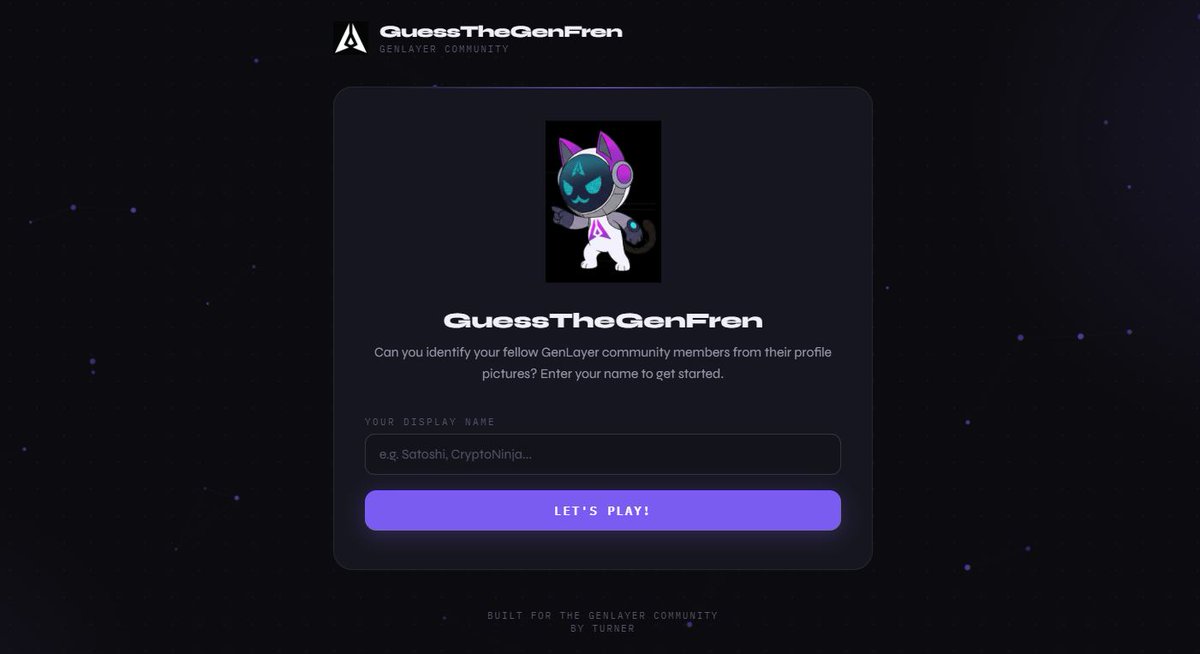
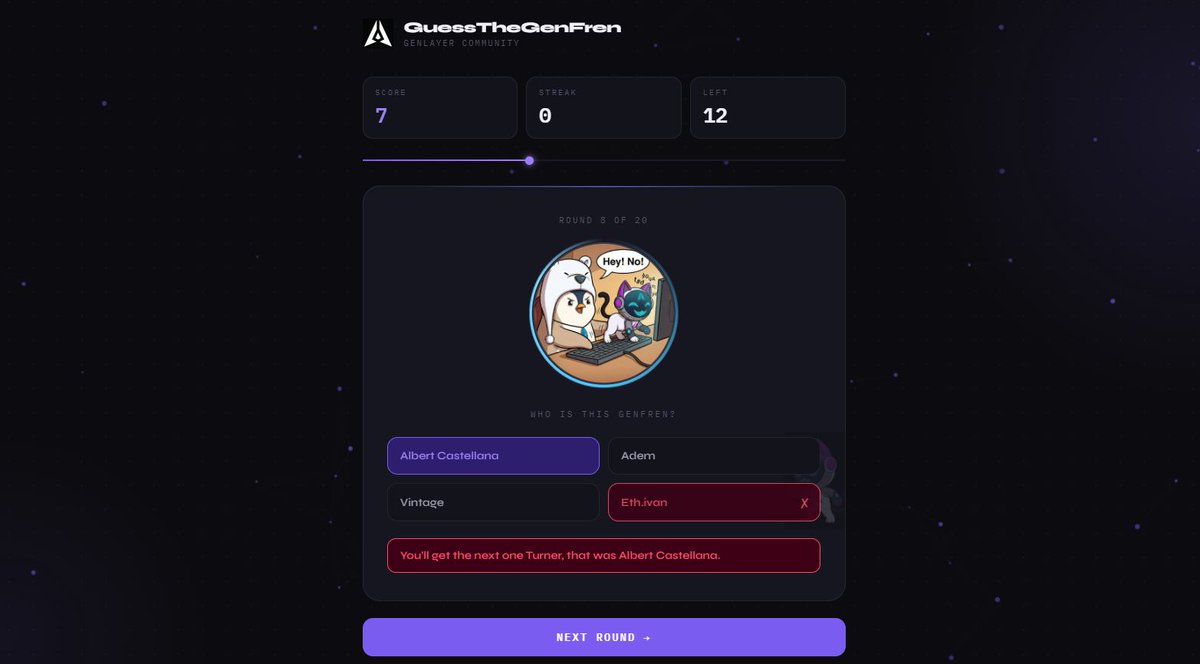
How well do you really know the core and contributing members of the @GenLayer community? Genfrens, I took the time to compile 100+ recognized and active contributors across the ecosystem. Introducing guessthegenfren.vercel.app Register your name, jump into rounds featuring 20 different community members, and test how many you can identify. It’s a simple way to see just how observant you’ve been without even realizing it. Drop a screenshot of your score in the comments, let’s see who’s truly woven into the fabric of this community.
𓆩𝕋𓆪 tweet media𓆩𝕋𓆪 tweet media𓆩𝕋𓆪 tweet media𓆩𝕋𓆪 tweet media
English
58
11
78
4.7K
Baby💕
Baby💕@Y4n_tee·
@roadboy_brown @RallyOnChain There’s a competitive clarity here that feels new. You’re not just trying to be seen, you’re trying to be ranked. And ranking forces a different level of thinking entirely.
English
0
0
0
9
Roadboy
Roadboy@roadboy_brown·
Crazy enough to remember that I used to assume that posting every day was discipline. Now I’m starting to think it was just habit. Because I saw someone earn around $300+ in a few days on @RallyOnChain from one post, and it forced me to rethink everything. This isn’t about being active all the time. It’s about being right at the right moment. On Rally, your post gets evaluated, and when most of the reward goes to the top 3, it means one sharp idea can outperform a week of effort. AI evaluates content quality using transparent criteria, and rewards are distributed on-chain. There are no judges, no follower requirements, and no intermediaries. If your work is truly strong, the system identifies and rewards it. That changes how you approach content. You slow down. You think more. You stop posting just to stay visible. Because here, visibility isn’t the goal. Outcome is. Some posts look busy others actually convert into money If the gap between those two is a few hundred dollars in a few days, why are we still measuring consistency the old way?
Roadboy tweet media
English
14
39
181
7.2K
Baby💕
Baby💕@Y4n_tee·
@spacejunnk @RallyOnChain Good read. the fast feedback loop is underrated. Instead of waiting weeks to see if something worked, you know quickly. That accelerates learning but also exposes weak thinking faster.
English
0
0
0
11
𓆩𝕋𓆪
𓆩𝕋𓆪@spacejunnk·
I am quite surprised to remember that i used to think getting paid for content in crypto was mostly luck or connections. You post, wait, hope someone notices… and usually nothing happens. Then I started watching how people earn on @RallyOnChain. I Just saw a creator earn $350 in a few days on Rally. in my own honest opinion , this is how you reward quality. What stood out wasn’t follower count, it was how clear their posts were. That changed how I see it. Rally isn’t a place where you just post and hope. You’re actually being evaluated. Your content gets scored for alignment, accuracy, and real engagement, and the best ones rise to the top. That’s why the payouts look different. When a campaign puts most of the reward pool into the top 3, it means a single well-thought post can land you around $300 to $400 in a few days. Not because you got lucky, but because you got it right. It feels more like submitting something for review than shouting into a timeline. And honestly, that’s a much fairer game. If you knew only a few posts actually get rewarded, how differently would you write?
𓆩𝕋𓆪 tweet media
English
13
51
172
6.8K
future
future@abdul_Quduus·
I used to think patience was enough in crypto. Then I held a leveraged BTC position through a slow market… not volatile, just drifting. I wasn’t wrong on direction, but every funding window quietly chipped away at my position. It felt like standing still on a moving walkway that was going backwards. That’s when I understood something simple: leverage doesn’t just test your thesis… it taxes your time. That’s exactly why I joined the waitlist for @FragmentsOrglink.fragments.org/rally BTC-Jr changes how leverage is built. It’s ~1.33× $BTC exposure, but without borrowing, no funding payments, and no liquidation risk. Instead of relying on debt, Fragments restructures volatility internally: – BTC-Jr (Junior) gets amplified exposure – Senior side takes less risk and earns yield So the leverage isn’t rented… it’s engineered. The way I explain it: Traditional leverage is like using a generator that burns fuel constantly just to keep the lights on. BTC-Jr is more like wiring your house directly into a stable power grid, the energy is already structured into the system, so you’re not paying extra just to stay connected. That difference is what makes it actually holdable long-term. Also, during April, 10 random waitlist signups win $200 each. $2,000 total. Follow @FragmentsOrg too, some shifts don’t look loud, but they change how the whole system behaves.
future tweet media
English
9
3
54
42.2K
Baby💕
Baby💕@Y4n_tee·
@spacejunnk Feels like the real innovation isn’t the 1.33×, it’s removing the friction around it. When you take away funding and liquidation pressure, you’re left with something that actually aligns with long-term thinking.
English
0
0
0
22
Baby💕
Baby💕@Y4n_tee·
@abdul_Quduus A lot of people avoid leverage because of exactly what you described. Not the volatility, but the erosion. If BTC-Jr solves that, it opens the door for a completely different type of user.
English
0
0
0
10
Baby💕
Baby💕@Y4n_tee·
@roadboy_brown A lot of people don’t realize how much funding shapes outcomes until they experience it. It’s not just a fee, it’s a structural constraint. Removing it changes behavior as much as it changes returns.
English
0
0
0
9
Roadboy
Roadboy@roadboy_brown·
I once got “timed out” of a good BTC idea. Not liquidated. Not even wrong. I was using leverage and decided to hold through a slow phase… but funding kept resetting like a parking meter. I had conviction, but I kept paying just to stay parked. Eventually I left early, and of course… the move came later. That’s when I realized: some leverage doesn’t just amplify price… it punishes patience. That’s exactly why I joined the waitlist for @FragmentsOrglink.fragments.org/rally BTC-Jr flips that structure. It’s ~1.33× $BTC exposure, but no borrowing, no funding payments, and no liquidation risk. The leverage isn’t coming from debt, it’s created by how the system is designed. Fragments splits volatility into two parts: – Junior (BTC-Jr): amplified exposure – Senior: lower risk, earns yield So instead of paying an external counterparty, the system balances itself internally. The way I see it: Traditional leverage is like renting time on a parking meter, even if your car doesn’t move, the cost keeps ticking. BTC-Jr feels like owning the parking space itself, you’re exposed to what happens around it, but you’re not bleeding just for being there. That’s a very different experience if you actually want to hold. Also, during April, 10 random waitlist signups win $200 each. $2,000 total. Follow @FragmentsOrg too, this is one of those ideas that quietly fixes something people have been tolerating for too long.
Roadboy tweet media
English
9
53
162
40.5K