
Yannis Siglidis

300 posts

Yannis Siglidis banner
Yannis Siglidis

Yannis Siglidis

@YSiglidis

Postdoc in Narrative Modeling @ Pioneer Institute for AI, in Copenhagen; PhD in Computer Vision; conceptual artist; tortured-philosopher; ex-poet

Copenhagen Katılım Kasım 2021
143 Takip Edilen130 Takipçiler
Sabitlenmiş Tweet
Yannis Siglidis
Yannis Siglidis@YSiglidis·
@elluba and me are super excited to organize the first AI art gallery in a European conference #ECCV2026! I've met lots of AI artists over the years in Europe who couldn't travel to show their work. We are excited to see you in Malmö (Sweden) early September. Submit by 14th June!
Luba Elliott@elluba

There will be an Art Gallery at #ECCV2026 😍 Submit to our open call for artworks made with or about computer vision by 14th June More details: eccv.ecva.net/Conferences/20… Co-organising with @YSiglidis 🖼️@annaridler @mattierialgirl @zzznah from #ECCV2018 gallery with @wxswxs

English
0
3
13
1.4K
Yannis Siglidis
Yannis Siglidis@YSiglidis·
The amount of times I've heard someone mention this hypothesis this year is remarkable and it doesn't require a lot of <thinking> to understand that something doesn't add up - either methodologically or conceptually. Thanks @ASophiaKoepke for debunking!
A. Sophia Koepke@ASophiaKoepke

New paper: Back into Plato’s Cave Are vision and language models converging to the same representation of reality? The Platonic Representation Hypothesis says yes. BUT we find the evidence for this is more fragile than it looks. Project page: akoepke.github.io/cave_umwelten/ 1/9

English
0
0
2
119
Yannis Siglidis retweetledi
Grace Luo
Grace Luo@graceluo_·
We trained diffusion models on a billion LLM activations, and we want you to use them! New preprint: Learning a Generative Meta-Model of LLM Activations Joint work with @feng_jiahai, @trevordarrell, @AlecRad, @JacobSteinhardt. More in thread 🧵
English
31
190
1.4K
217.5K
Yannis Siglidis retweetledi
Haozhe Jiang
Haozhe Jiang@erichzjiang·
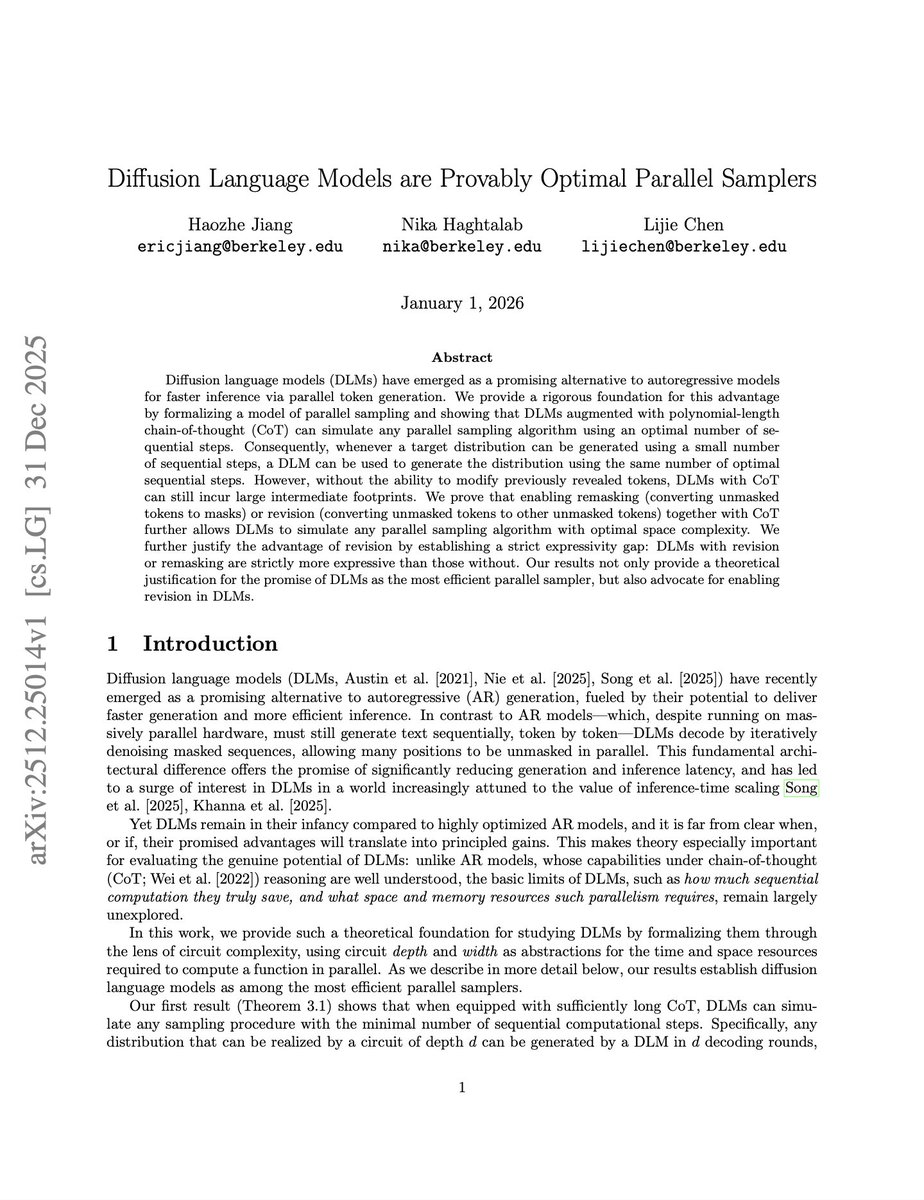
Diffusion language models (DLMs) are provably optimal parallel samplers! In my new paper with @nhaghtal and @wjmzbmr1 we show that DLMs can sample distributions with the fewest possible steps, and further with the fewest possible memory with revision/remasking.
Haozhe Jiang tweet media
English
15
67
432
34.4K
Yannis Siglidis
Yannis Siglidis@YSiglidis·
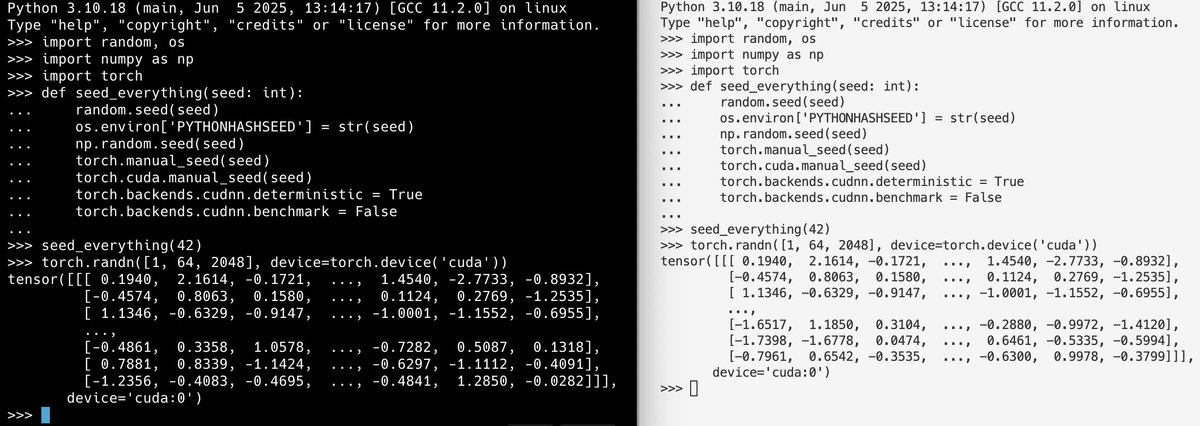
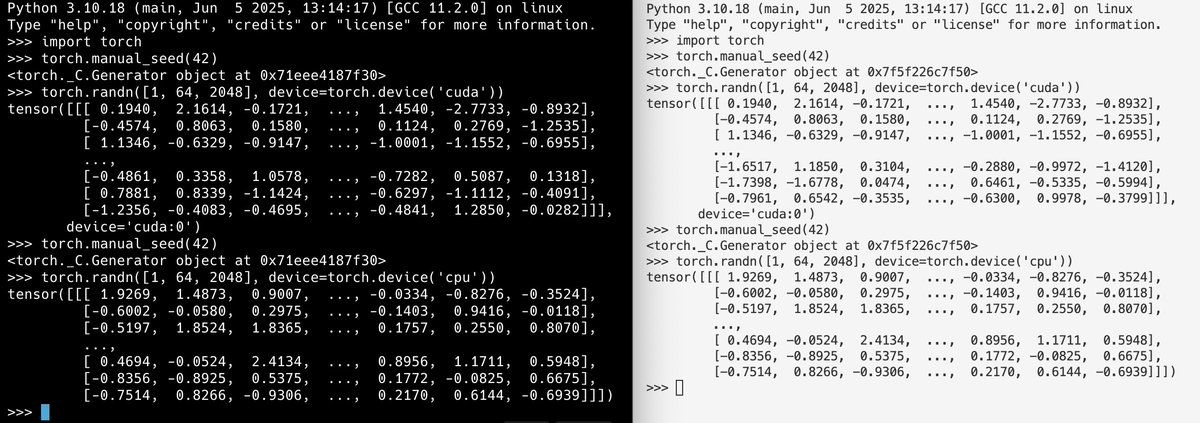
Note that this may not be an issue if the gpu is also identical across machines but I can't test it at the moment. It may also be correlated with cuda 12.6-hope it gets clarified. Also note that the samples seem id. in the beginning which hints to gpu thread structure parallelism
English
0
0
0
65
Yannis Siglidis
Yannis Siglidis@YSiglidis·
In @PyTorch randn(s, device) w/ fixed seed has different output across machines if device='cuda' (both for generator and manual_seed) - w/ this any diffusion gen. pipeline won't reproduce across machines (even for id. env). Fix: randn(s, device='cpu').to('cuda') @PyTorchPractice
Yannis Siglidis tweet media
English
1
0
1
104
Yannis Siglidis retweetledi
Antikythera
Antikythera@antikythera_xyz·
As AI becomes both more general and more foundational, it shouldn’t be seen as a disembodied virtual brain. It is a real, material force. AI is increasingly embedded into the active, decision-making systems of real-world systems. As AI becomes infrastructural, infrastructures become intelligent, and as societal infrastructures become more cognitive, the relation between AI theory and practice needs realignment. This composite article combining 10 separate papers collectively gathers the work of the 2024 Antikythera Cognitive Infrastructures Studio—the concept of AI as a real, material force embedded within physical systems, not just a disembodied virtual brain. Studio Researchers Alasdair Milne @aldmilne — researcher at Serpentine Creative AI Lab Cezar Mocan @DrawingMoving — artist & programmer Chloe Loewith — MPhil graduate at Leverhulme Centre for the Future of Intelligence Daniele Cavalli — PhD researcher at École normale supérieure Gary Zhexi Zhang — writer, filmmaker & researche Iulia Ionescu — programme director, Creative Computing & Robotics at University of the Arts London Ivar Frisch @FrischIvar — MSc student at Utrecht University & TNO research intern Jackie Kay @jackayline — research engineer at Google DeepMind Jenn Leung @jennnital — lecturer & technical artist at University of the Arts London Michelle Chang — researcher in robotics & HCI Philip Moreira Tomei @synchroaphasia — AI/ML researcher Sonia Bernaciak — researcher in artificial & distributed intelligence at RCA & Hong Kong Polytechnic University Tyler Farghly @tylerfarghly — PhD student in theoretical ML at University of Oxford Winnie Street @winniestreet — senior AI researcher at Google Paradigms of Intelligence Team & fellow at the Institute of Philosophy, University of London Yannis Siglidis @YSiglidis — computer vision researcher at Ecole Des Ponts ParisTech Read Cognitive Infrastructures article in Antikythera Journal at coginfra.antikythera.org
Antikythera tweet media
English
0
12
43
3K
Yannis Siglidis
Yannis Siglidis@YSiglidis·
“One can pet a dream like a house cat. But one cannot pet reality because reality is like a wild cat.” Jean Baudrillard
Yannis Siglidis tweet media
English
0
0
2
69
Yannis Siglidis
Yannis Siglidis@YSiglidis·
Speaking of cats, thumbs up also to the cutest CV paper of last year that is a learnable point and click navigation simulator of a custom cat, which being disenchanted by X forgot to repost: x.com/gengshanY/stat… (though in reality you can never tell a cat where to go ^^)
Gengshan Yang@gengshanY

Sharing my recent project, agent-to-sim: From monocular videos taken over a long time horizon (e.g., 1 month), we learn an interactive behavior model of an agent (e.g., a 🐱) grounded in 3D. gengshan-y.github.io/agent2sim-www/

English
1
0
1
154
Yannis Siglidis
Yannis Siglidis@YSiglidis·
EGO-World Model from my BAIR friends Yutong & Amir. Hopefully EGOPET-World Model on the way; the real hard problem is to figure out where the cat wants to go!
Yutong Bai@YutongBAI1002

What would a World Model look like if we start from a real embodied agent acting in the real world? It has to have: 1) A real, physically grounded and complex action space—not just abstract control signals. 2) Diverse, real-life scenarios and activities. Or in short: It has to be annoyingly complex—in both the action and vision space—to even get close to real life. We did an initial attempt: Whole-Body Conditioned Egocentric Video Prediction. In collaboration with @dans_t123 , @_amirbar, @ylecun , @trevordarrell and @JitendraMalikCV. (For more details, check: arxiv.org/abs/2506.21552) What we did is very simple: Predict Egocentric Video from human Actions (PEVA) - Given the past video and a future action represented by relative 3D body pose, PEVA predicts how the world looks next—from the first-person view. By conditioning on kinematic pose trajectories, structured by the joint hierarchy of the body, it learns how physical actions shape perception.

English
1
0
2
213
Yannis Siglidis retweetledi
Boyang Deng
Boyang Deng@boyang_deng·
Curious about how cities have changed in the past decade? We use MLLMs to analyse 40 million Street View images to answer this. Do you know that "juice shops became a thing in NYC" and "miles of overpasses were painted BLUE in SF"? More at→boyangdeng.com/visual-chronic… (vid ↓ w/ 🔊)
English
1
15
94
21.3K
Yannis Siglidis retweetledi
Zhou Xian
Zhou Xian@zhou_xian_·
Everything you love about generative models — now powered by real physics! Announcing the Genesis project — after a 24-month large-scale research collaboration involving over 20 research labs — a generative physics engine able to generate 4D dynamical worlds powered by a physics simulation platform designed for general-purpose robotics and physical AI applications. Genesis's physics engine is developed in pure Python, while being 10-80x faster than existing GPU-accelerated stacks like Isaac Gym and MJX. It delivers a simulation speed ~430,000 faster than in real-time, and takes only 26 seconds to train a robotic locomotion policy transferrable to the real world on a single RTX4090 (see tutorial: genesis-world.readthedocs.io/en/latest/user…). The Genesis physics engine and simulation platform is fully open source at github.com/Genesis-Embodi…. We'll gradually roll out access to our generative framework in the near future. Genesis implements a unified simulation framework all from scratch, integrating a wide spectrum of state-of-the-art physics solvers, allowing simulation of the whole physical world in a virtual realm with the highest realism. We aim to build a universal data engine that leverages an upper-level generative framework to autonomously create physical worlds, together with various modes of data, including environments, camera motions, robotic task proposals, reward functions, robot policies, character motions, fully interactive 3D scenes, open-world articulated assets, and more, aiming towards fully automated data generation for robotics, physical AI and other applications. Open Source Code: github.com/Genesis-Embodi… Project webpage: genesis-embodied-ai.github.io Documentation: genesis-world.readthedocs.io 1/n
English
561
3K
16K
3.8M
Yannis Siglidis
Yannis Siglidis@YSiglidis·
“Chapeau!” - as the french say - to how the Chinese science community got together and responded with such dignity to that offensive @NeurIPSConf racist slide. Solidarity is the real candle~\cite{Nostalghia_Tarkovsky} we have to protect!
English
0
0
2
125