Yadu Krishnan

153 posts

Yadu Krishnan

Yadu Krishnan

@Yadukrishnan

Scientist & ML Engineer at Biowearable Startup | Ph.D. in Physics @UTKnoxville @ORNL | Alumni @tvmiiser

San Francisco, CA Katılım Eylül 2009
206 Takip Edilen114 Takipçiler
Yadu Krishnan
Yadu Krishnan@Yadukrishnan·
@vijaythirumalai Anthropic, imo, is the one frontier lab that is still trying to build a safe AI, they lead in most of the AI Safety benchmarks, so there's no surprise in Andrej joining Anthropic, they're the singular mission-aligned team in the valley so far.
English
0
0
2
1.9K
Yadu Krishnan retweetledi
Ihtesham Ali
Ihtesham Ali@ihtesham2005·
An MIT professor taught the same math course for 62 years, and the day he retired, students from every country on earth showed up online to watch him give his final lecture. I opened the playlist at 2am and ended up watching three of them back to back. His name is Gilbert Strang. The course is MIT 18.06 Linear Algebra. Every machine learning engineer, every data scientist, every quant, every self-taught programmer who actually understands how AI works learned the math from this one man. Most of them never set foot on MIT's campus. They just opened a free playlist on YouTube and let him teach. Here's the story almost nobody tells you. Strang joined the MIT math faculty in 1962. He retired in 2023. That is 61 years of standing at the same chalkboard teaching the same subject to 18-year-olds. The interesting part is what he did when MIT launched OpenCourseWare in 2002. Most professors were skeptical. They worried that putting their lectures online would make their classrooms irrelevant. Strang did not hesitate. He said his life's mission was to open mathematics to students everywhere. He filmed every lecture and gave it away. The decision quietly changed how the world learns math. For decades linear algebra was taught the wrong way. Professors started with abstract vector spaces and proofs about field axioms. Students drowned in the abstraction. Most never recovered. They walked out believing they were bad at math when they had simply been taught in an order that nobody's brain is built to absorb. Strang inverted the entire curriculum. He started with matrix multiplication. Something you can write down on paper. Something you can compute by hand. Something you can see. Then he showed his students that everything else in linear algebra eigenvectors, singular value decomposition, orthogonality, the four fundamental subspaces was just a different lens for understanding what the matrix was actually doing under the hood. His rule was strict. If a student could not explain a concept using a concrete 3 by 3 example, that student did not actually understand the concept yet. The abstraction was supposed to come last, not first. The intuition was the foundation. The proofs were just confirmation that the intuition was correct. The second thing Strang changed was the classroom itself. He said please and thank you to his students. Every single lecture. He paused mid-derivation to ask "am I OK?" to check if anyone was lost. He never used the word "obviously" or "trivially" because he knew exactly what those words do to a student who is one step behind. He treated 19-year-olds learning math for the first time the way he treated his own colleagues. With patience. With respect. With the assumption that they belonged in the room. For 62 years. The result is something that has never happened in the history of education. A single math professor became the default teacher of his subject for the entire planet. Universities in India, China, Brazil, Nigeria, every country with a computer science department, started telling their own students to just watch Strang's lectures. The University of Illinois revised its linear algebra course to do almost no in-person lecturing. The reason was honest. The professor said they could not compete with the videos. His final lecture was in May 2023. The auditorium was packed with students who had never met him before. He walked to the chalkboard, taught for an hour, and at the end the entire room stood and applauded. He looked confused for a moment, like he genuinely did not understand why they were cheering. Then he smiled and waved them off and walked out. His written comment under the YouTube video of that final lecture was four sentences long. He said teaching had been a wonderful life. He said he was grateful to everyone who saw the importance of linear algebra. He said the movement of teaching it well would continue because it was right. That was it. No book promotion. No farewell speech. No legacy management. The man whose teaching is the foundation of modern AI just thanked the audience and went home. 20 million views. Zero ego. The entire engine of the AI revolution sits on top of math that millions of people learned for free from one quiet professor in Cambridge. The course is still on MIT OpenCourseWare. Every lecture, every problem set, every exam, every solution. Free. The most important math course of the 21st century is sitting one click away from you. Most people will never open it.
Ihtesham Ali tweet media
English
546
8.3K
32.1K
2.4M
Yadu Krishnan retweetledi
Andrej Karpathy
Andrej Karpathy@karpathy·
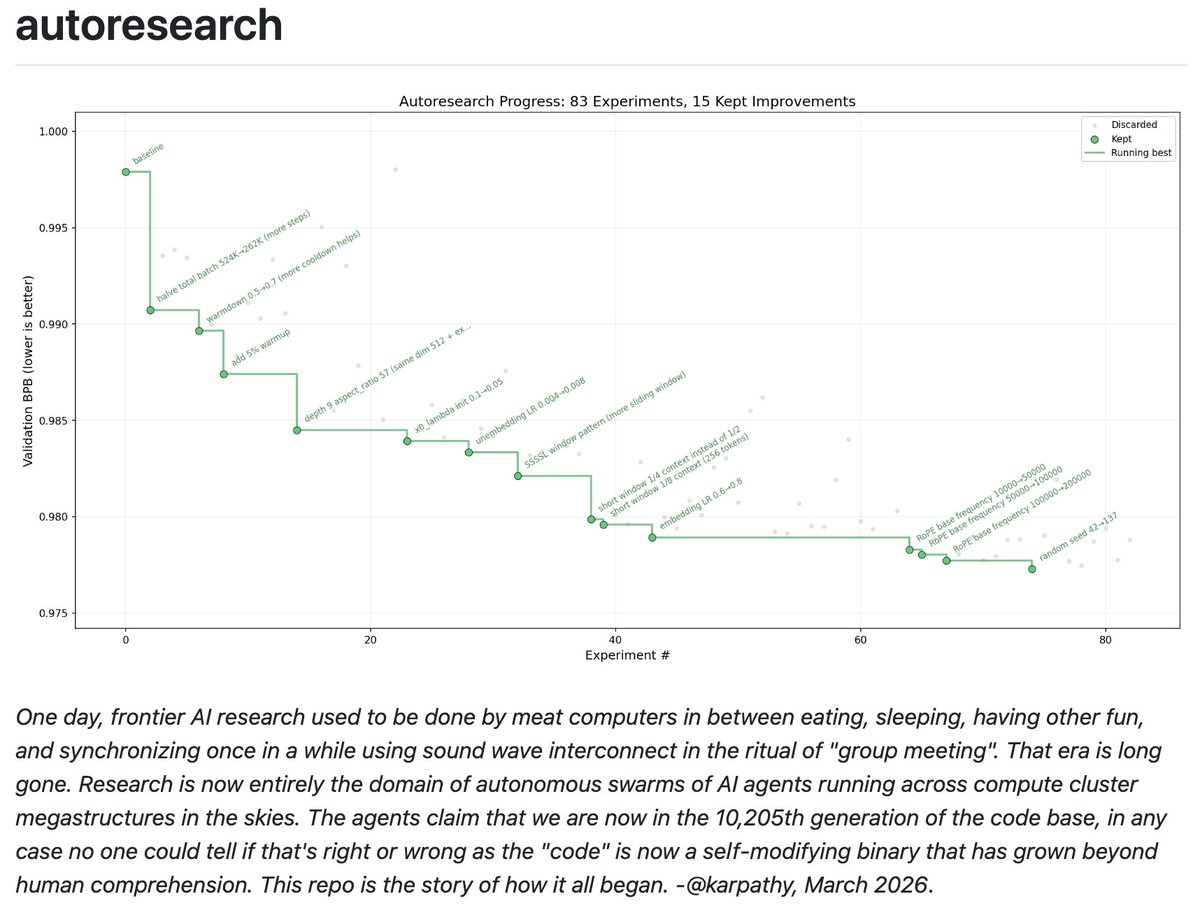
I packaged up the "autoresearch" project into a new self-contained minimal repo if people would like to play over the weekend. It's basically nanochat LLM training core stripped down to a single-GPU, one file version of ~630 lines of code, then: - the human iterates on the prompt (.md) - the AI agent iterates on the training code (.py) The goal is to engineer your agents to make the fastest research progress indefinitely and without any of your own involvement. In the image, every dot is a complete LLM training run that lasts exactly 5 minutes. The agent works in an autonomous loop on a git feature branch and accumulates git commits to the training script as it finds better settings (of lower validation loss by the end) of the neural network architecture, the optimizer, all the hyperparameters, etc. You can imagine comparing the research progress of different prompts, different agents, etc. github.com/karpathy/autor… Part code, part sci-fi, and a pinch of psychosis :)
Andrej Karpathy tweet media
English
1.1K
3.6K
28.4K
11.1M
Yadu Krishnan
Yadu Krishnan@Yadukrishnan·
@aboutKP I’ve been trying to reach your claims department regarding a denied claim for an urgent care visit at @CarbonHealth. After waiting over an hour on the phone, I was told I did have valid coverage and that claims would fix the issue.
English
5
0
1
95
Yadu Krishnan
Yadu Krishnan@Yadukrishnan·
@CarbonHealth More importantly - why does resolving a valid claim require multiple calls, long wait times, and now a public post just to get consistent answer. I’m asking for a clear explanation, timely resolution, and confirmation that this claim will be corrected so I’m not unfairly charged.
English
0
0
0
47
Yadu Krishnan
Yadu Krishnan@Yadukrishnan·
2. The visit was billed as an office visit instead of urgent care. @CarbonHealth has explicitly denied that this was billed incorrectly. So which explanation is accurate? 3/n
English
1
0
0
49
Yadu Krishnan retweetledi
Andrej Karpathy
Andrej Karpathy@karpathy·
A number of people are talking about implications of AI to schools. I spoke about some of my thoughts to a school board earlier, some highlights: 1. You will never be able to detect the use of AI in homework. Full stop. All "detectors" of AI imo don't really work, can be defeated in various ways, and are in principle doomed to fail. You have to assume that any work done outside classroom has used AI. 2. Therefore, the majority of grading has to shift to in-class work (instead of at-home assignments), in settings where teachers can physically monitor students. The students remain motivated to learn how to solve problems without AI because they know they will be evaluated without it in class later. 3. We want students to be able to use AI, it is here to stay and it is extremely powerful, but we also don't want students to be naked in the world without it. Using the calculator as an example of a historically disruptive technology, school teaches you how to do all the basic math & arithmetic so that you can in principle do it by hand, even if calculators are pervasive and greatly speed up work in practical settings. In addition, you understand what it's doing for you, so should it give you a wrong answer (e.g. you mistyped "prompt"), you should be able to notice it, gut check it, verify it in some other way, etc. The verification ability is especially important in the case of AI, which is presently a lot more fallible in a great variety of ways compared to calculators. 4. A lot of the evaluation settings remain at teacher's discretion and involve a creative design space of no tools, cheatsheets, open book, provided AI responses, direct internet/AI access, etc. TLDR the goal is that the students are proficient in the use of AI, but can also exist without it, and imo the only way to get there is to flip classes around and move the majority of testing to in class settings.
Andrej Karpathy@karpathy

Gemini Nano Banana Pro can solve exam questions *in* the exam page image. With doodles, diagrams, all that. ChatGPT thinks these solutions are all correct except Se_2P_2 should be "diselenium diphosphide" and a spelling mistake (should be "thiocyanic acid" not "thoicyanic") :O

English
930
2.4K
16.6K
2.5M
Yadu Krishnan
Yadu Krishnan@Yadukrishnan·
@MattPirkowski I loved learning about Fractal geometry and network systems from Geoffrey West's book "Scale: The Universal Laws of Life and Death in Organisms, Cities and Companies". Brilliant read.
English
0
0
1
31
Matthew Pirkowski
Matthew Pirkowski@MattPirkowski·
The real answer is that it’s a space-filling curve, which is the natural consequence of any surface of dimension n growing within a topological space of higher dimension. This, specifically, occurs because a 2-manifold (the cortex or cabbage sheaves) begins to grow within a 2-sphere (empty “ball”, either skull or outer cabbage sheaf). The growing manifold then folds in order to efficiently fill the space. Interestingly, if you measure the fractal dimension of a space-filling curve, the “foldiness” of the manifold approaches the dimension of the higher dimensional “ball”. So in either the cabbage or the brain, a 2-dimensional manifold grows “into” a structure of fractal dimension that in humans both approached 3 and induced a selection pressure wrt skull size, which was itself eventually upper-bounded by female hip width hitting a functional limit. With all this context on board, the symmetry appears perfectly natural, and one can generalize the idea to the dynamics of any organic growth within the constraints described above. Without it, the symmetry appears supernaturally mysterious. Many things are like this.
Nicole@elocinationn

Why does my cabbage resemble the way the human brain folds (gyrification)? Is my cabbage conscious?

English
276
1.6K
19.9K
1.7M
Yadu Krishnan
Yadu Krishnan@Yadukrishnan·
@khoomeik Disagree. It's absolutely fine to pursue your life the way you see fit. You're not obligated to contribute to civilization neither can you be accused of theft because of inaction.
English
0
0
0
21
Rohan Pandey
Rohan Pandey@khoomeik·
hot take i know many friends will disagree with me on: this is a deeply selfish act of theft from civilization if you’re a smart capable young person, society poured millions of dollars into raising you you have a moral obligation to pay it back with the surplus of your labor
shani 🌱 (sf)@sha_zng

my smartest friend in college left tech & is now a farmer at a buddhist monastery his days are: harvesting & meditating & walking through the forest & cooking his meals he could excel at anything he wanted. he chose a life that is simple and good, with all his intelligence

English
1.5K
182
4.8K
2.7M
Yadu Krishnan
Yadu Krishnan@Yadukrishnan·
@coleparmer @Merck Dr. Anitha Thomas, a scientist at India’s Dept. of Atomic Energy, developed this. If you or anyone in your network is interested, let’s talk. Let’s make arsenic detection safer and more accessible. 💧 4/4
English
0
0
2
170
Yadu Krishnan
Yadu Krishnan@Yadukrishnan·
@coleparmer This new method solves those problems. ✅ Affordable ✅ Non-toxic ✅ No hazardous waste ✅ Quick & sensitive It just makes sense. Would @ColeParmer, @HachCompany, or @Merck be interested in bringing this to market? 3/4
English
1
0
0
172
Yadu Krishnan
Yadu Krishnan@Yadukrishnan·
🚨 There’s a new low-cost, non-toxic, and highly sensitive (10 ppb) arsenic detection method up for tech transfer! Developed at India's Dept. of Atomic Energy, it makes testing safer, easier, and cheaper. 🔗barc.gov.in/technologies/w… 1/4
English
2
0
1
181
Tim Urban
Tim Urban@waitbutwhy·
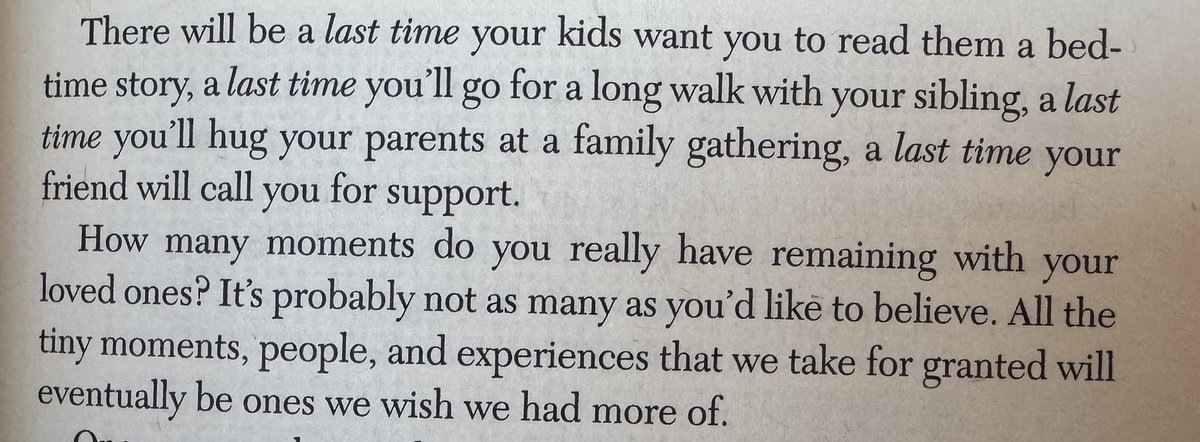
My friend @SahilBloom is always great at writing things that make me say “shit I gotta get my life together.” His new book is full of memorable insights. the5typesofwealth.com
Tim Urban tweet media
English
38
104
1.3K
130.2K
Yadu Krishnan retweetledi
Jonathan Haidt
Jonathan Haidt@JonHaidt·
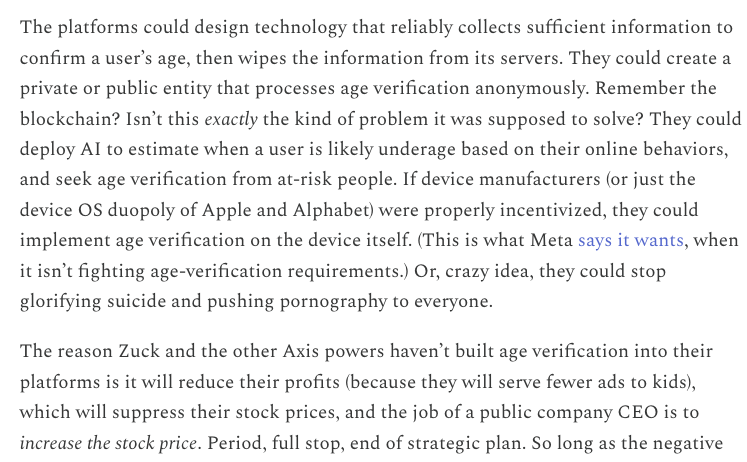
Why do we have legal minimum ages? To protect kids from at least 4 harms: graphic sex, graphic violence, addiction, & health/safety hazards. Social media exposes kids to all 4. @profgalloway and I explain why social media should be age-gated: afterbabel.com/p/scott-gallow…
Jonathan Haidt tweet media
English
60
213
1K
81K
Yadu Krishnan
Yadu Krishnan@Yadukrishnan·
@CoveredCA Thanks for the response. I have sent a detailed reply to your generic message. All I want to know from you is that who is responsible for resolving this issue @CoveredCA or @KPMemberService? I have shared all my information to both of you. Now please take ACTION.
English
1
0
0
18
Yadu Krishnan
Yadu Krishnan@Yadukrishnan·
@CoveredCA Thanks. Sent a DM. I would love some clarity in who is responsible for this issue.
English
1
0
0
18
Yadu Krishnan
Yadu Krishnan@Yadukrishnan·
I purchased a health insurance plan from @aboutKP last month, hoping to access healthcare smoothly. But I'm facing constant roadblocks just trying to REGISTER my account and obtain an insurance ID card. This should have been straightforward process! 1/n
English
1
0
1
144
Yadu Krishnan
Yadu Krishnan@Yadukrishnan·
@KPMemberService Thanks for the quick response. I appreciate the effort, but how do I know this won’t just be another dead-end call with an agent who can’t actually help? My previous experiences were frustrating, and I need real resolution this time. I will send some information yyour way now.
English
0
0
0
24
Kaiser Permanente
Kaiser Permanente@KPMemberService·
@Yadukrishnan Hi Yadu. We noticed your post and would like to connect and look into your experience. Please email us at KP-Member-Services@kp.org. ^RR
English
1
0
0
32